Author: Dinah Dye

psalm

Rooted to Rule: The Pattern of Psalm 1

Psalm 1 does not necessarily begin with advice or spiritual reflection—it begins with a claim about reality itself. There is a way of life that produces order, stability, and flourishing, and it begins with a king who is rightly planted in the wisdom of God.

We are accustomed to reading Psalm 1 as a word about ourselves—guidance for personal growth, a description of the righteous life. But that is not where the book of Psalms begins. Psalm 1 lays down the architecture for the entire Psalter. Its message is the necessity of the right king on the throne. When the right king rules, the world is ordered. When the right king is rooted in the wisdom of God, his rule brings flourishing to his realm and to the inner world of those who come under his authority.

The psalm begins with the Hebrew word ashrei. It is generally translated “blessed” or “happy,” but neither quite captures the true meaning. It is a recognition of a state that is publicly visible and undeniable. It carries the sense of flourishing, alignment, and rightness that can be seen and acknowledged within a community. In an honor-shame culture, it is the language of status.

Oh the honor of the one…

This is public recognition of a life rightly ordered.

Psalm 1 is not merely describing a man who feels blessed. It is identifying the one who stands in the place of honor because he has aligned himself with the order of creation as defined by the Torah—the oracles of God, the wisdom that governs the world. The psalm should be read in tandem with Psalm 2. The first introduces the honored man; the second reveals him as the anointed king who stands in the midst of rebellious nations. These two chapters frame the book and establish the kingship that governs everything that follows.

The honored one is defined first by what he refuses. He does not walk in the counsel of the rasha, the wicked. He does not stand in their path. He does not sit in the seat of mockers. These are descriptions of competing systems of order. The rasha represents a world structured apart from God’s wisdom, a world untethered from the wisdom that sustains creation. To walk, stand, and sit in that world is to come under its influence, to be shaped by its assumptions, to align oneself with its vision of reality.

Instead, his delight—his chefetz, his deep longing—is in the Torah of Yahweh because it is the wisdom of God. He meditates on it day and night, not as ritual but as covenantal alignment. The king orders his inner world according to divine wisdom. In doing so, he becomes the site where ordered creation is reestablished.

He will be like a tree.

In the ancient world, kings were often depicted as trees—strong, stable, life-giving. The tree connects heaven and earth, drawing life from deep waters and extending its canopy outward in fruit and shade. The trunk represents stability and endurance, the central structure upon which everything else depends.

This tree is planted—more precisely, transplanted—by streams of water. The language evokes irrigation channels, carefully directed flows of life that sustain the tree in every season. This is Eden language. The rivers of the garden that watered the earth now appear here as the source of the king’s stability—divine wisdom itself. He is intentionally placed within the life system of creation, rooted in the very waters that once flowed from the garden and later from the temple.

His fruit comes in its season. His leaf does not wither.

The Hebrew concept of withering carries the sense of collapse into folly, the unraveling of ordered life. To wither is not merely to dry up; it is to fall into confusion and a lack of discernment. In contrast, the righteous king remains green, enduring, productive. His life is sustained because it is aligned with wisdom. His fruit nourishes others. His leaves, in the language echoed later in Ezekiel and Revelation, become instruments of healing for the nations.

This is kingship as it was meant to be. Not domination, but sustenance. Not instability, but enduring life that radiates outward.

The contrast with Genesis 3 deepens the imagery.

There, the woman sees that the tree is good (tov), pleasing to the eyes, and desirable to make one wise. The language is drawn directly from creation itself. But she evaluates the tree apart from God’s word. She sees, desires, takes, and eats. Wisdom is seized rather than received. What was meant to be given is snatched, and in that moment, God’s wisdom is replaced with human judgment. Eating the fruit of the tree becomes a realignment away from the source of life.

Psalm 1 reverses that movement.

The righteous king does not seize wisdom. He meditates. He does not take; he receives. He does not eat from the tree in rebellion; he becomes the tree through covenantal obedience. His roots go down into the living waters, and from those waters life flows. Psalm 1 produces order through rootedness.

Yahweh knows the way of the righteous.

This is covenantal language. It is relational. The way of the righteous king is upheld because it is perfectly in sync with God’s design. But the way of the rasha is not so. They are like chaff driven by the wind. They are not anchored in the waters of wisdom. They cannot sustain life. They do not endure. Their way perishes, dissolving back into chaos.

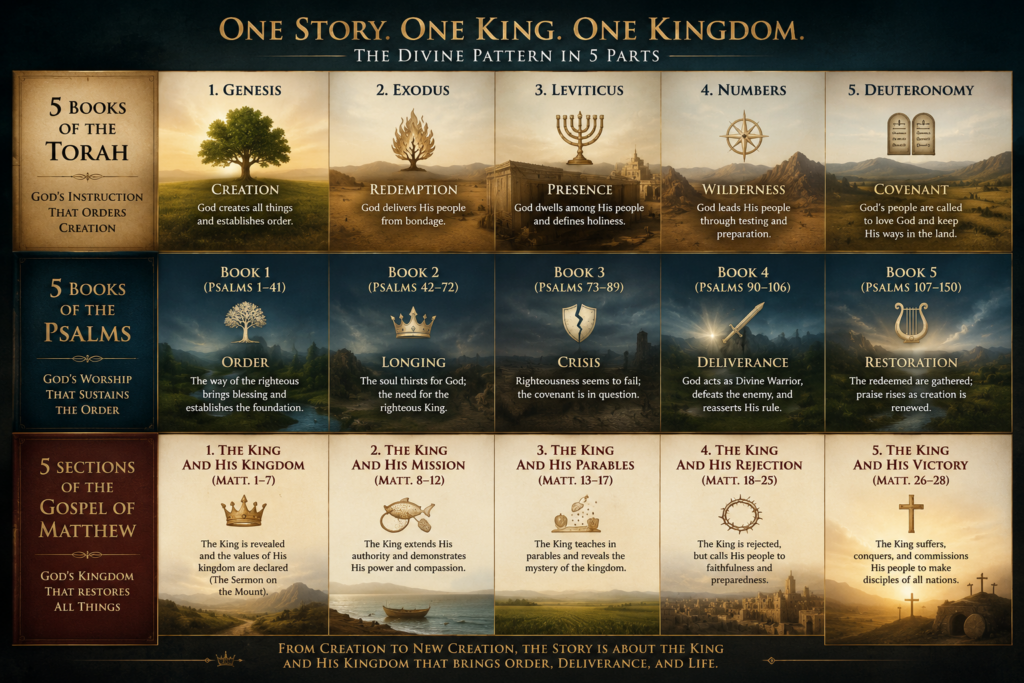
Psalm 1, then, is not an isolated meditation. It is the opening movement of a much larger composition. The book of Psalms is arranged in five books, mirroring the five books of the Torah. Just as the Torah provides the instruction that orders creation, the Psalms provide the liturgical response that sustains that order through worship.

The structure of the five sections of the Psalms traces a kingship narrative.

It unfolds as a movement from order to chaos and back to restoration. It begins with creation grounded in divine rule, where the king—like a tree planted by living waters—embodies the stability of Yahweh’s reign. But that order is contested. Pressure builds, distance from God’s presence is felt, and the need for righteous rule intensifies. The crisis comes when kingship appears to fail, the covenant fractures, and creation itself seems to unravel in exile and disorder.

The turning point is the reassertion of Yahweh’s kingship. He rises as the Divine Warrior (Psalm 104), subdues chaos, and establishes His rule once more. From there, the movement shifts toward restoration. The scattered are gathered, hope is renewed, and the Psalter closes in a rising chorus of praise as creation itself is drawn back into ordered worship under its rightful King.

This is the pattern of Scripture itself. Creation. Exile. Conflict. Divine intervention. Restoration. It is the pattern of Genesis. It is the pattern of the Exodus. And it is the pattern taken up again in the Gospel of Matthew, also structured in five major sections, presenting Jesus as the new Moses, the new Israel, the true King, the Messiah.

Matthew opens with the language of ashrei—the Beatitudes—rendered in Greek as makarios.

Oh the honor of the poor in spirit.
Oh the honor of the meek.
Oh the honor of those who mourn.

In the Roman world, honor belonged to power, wealth, and dominance. In Matthew, honor is reassigned to those whom the empire considers insignificant but publicly identified by God as part of His kingdom. The Beatitudes redefine kingship. They declare that true status belongs to those ordered according to God’s wisdom.

And this is where Psalm 1 finds its fulfillment. It anticipates a person.

The true Ashrei man.
Rooted in living waters.
Embodying wisdom.
The one whose life bears fruit in every season.
The one whose leaves bring healing to the nations.

Yeshua lives the pattern of Psalm 1. He is the tree planted by living waters. He is the wisdom of God made flesh. He is the king who stands unmoved by the counsel of the wicked, who refuses the kingdoms offered through compromise, who remains rooted in the will of the Father even unto death. And in His resurrection, the tree that could not wither, becomes the source of life for the world.

Psalm 1 is an invitation. Not first to self-improvement, but to recognize the sovereignty of the King.
psalm
earth

When Earth Is Pushed Beyond Its Limits

What happens when the earth is forced to produce without rest—and why Scripture warns us this always leads to collapse.

The earth that was created to sustain life is now being forced into relentless production, driven for yield at any cost. This is poor stewardship and it is a violation of the created order. Scripture never envisioned a world where the land would be worked without rest or treated as a machine for profit. The land is not failing us. It is exposing what happens when we refuse to live within the order that was designed to sustain life.

The biblical story unfolds through the language of land, cultivation, and kingship. From the beginning, the earth is ordered, tended, and brought under the rule of a rightful King. In the ancient world, a king subdued a threat, defeated an enemy, secured the land, and by doing so established order. Only then did he take his seat on the throne—his rest—within a house prepared for his presence.

The Land as Sacred Space

Adonai speaks to Moses on Mount Sinai and introduces the command that the land itself must observe a Sabbath. In Leviticus 25, the instruction is clear. For six years the land is to be cultivated—planted, tended, and harvested—but in the seventh year it is to rest completely. There is to be no sowing, no pruning, no fertilizing, and no harvesting. Instead, whatever the land produces on its own is to be shared by all: the landowner, the servant, the hired worker, the outsider, and even the animals.

The land’s yield in that year is not the result of human control, but of divine provision.

This command reveals something fundamental about how Scripture understands the earth. The earth is not neutral ground. It is not simply a resource to be managed or exploited. It is sacred space. It belongs to God and functions within His larger cosmic order. Its purpose is to provide food, sustenance, beauty, and stability so that life can flourish.

In that sense, the land participates in the larger structure of creation, which Scripture presents as a kind of cosmic house—heaven, earth, and sea ordered together as a dwelling place. At the center of that structure is the garden, and at the center of the garden are the trees. This layered design reflects a temple pattern, where sacred space is concentrated and life radiates outward from it.

The rhythm of seven is woven throughout this structure, reinforcing the idea of completion and rest. Ancient Jewish tradition observed that “all sevens are beloved,” and Scripture itself is saturated with this pattern—seven days of creation, seven-day festivals, cycles of seven years, and recurring sevens in offerings, rituals, and prophetic imagery.

Rest, Kingship, and the Order of Creation

Shabbat is about the transition from one state of being to another. During the six years of cultivation, human beings engage in the work of ordering the earth through sowing, planting, pruning, and harvesting. In the seventh year they cease from that activity because the cycle is designed to reveal something greater. They do not cease from all activity; rather, they enter a different mode of living in which God’s provision becomes central.

Rest signifies that the rightful King is on the throne, that order has been established, and that the land can now produce under His sovereign rule. When a king rested, it meant that his enemies had been subdued and that peace governed the earth.

This understanding places agriculture within a much larger framework. In the ancient Near East, kings were closely associated with gardens, and royal gardens were often attached to temples. These gardens symbolized a well-ordered world under the king’s authority. In Ecclesiastes, Solomon describes his building projects, vineyards, and gardens in language that reflects this royal role.

Cultivating the land was not only an economic activity but a participation in maintaining cosmic order. Adam’s task in the garden reflects this same pattern. To tend and keep the garden is temple language, closely related to priestly service. In this framework, cultivation becomes an act of worship, and even eating becomes a form of participation in the life God provides.

When the Land Bears the Weight of Disorder

Scripture also makes clear that this relationship between humanity and the land is fragile. When humanity steps outside of God’s order through injustice, idolatry, and corruption, even the land itself begins to suffer.

The prophets describe this in vivid terms. In Jeremiah 12, the land mourns and the grass withers because of the evil of those who dwell in it. In Isaiah 24, the earth is described as polluted under its inhabitants, consumed by a curse. These passages present the land almost as if it were a participant in human suffering, burdened by disorder and exposed to its consequences.

This helps explain why exile was necessary in Israel’s history. When the people failed to observe the rhythms of rest and obedience, the land itself required relief. Exile allowed the land to rest from the contamination caused by human disobedience. The sabbatical years were built into the structure of creation as a means of preserving both the land and the people.

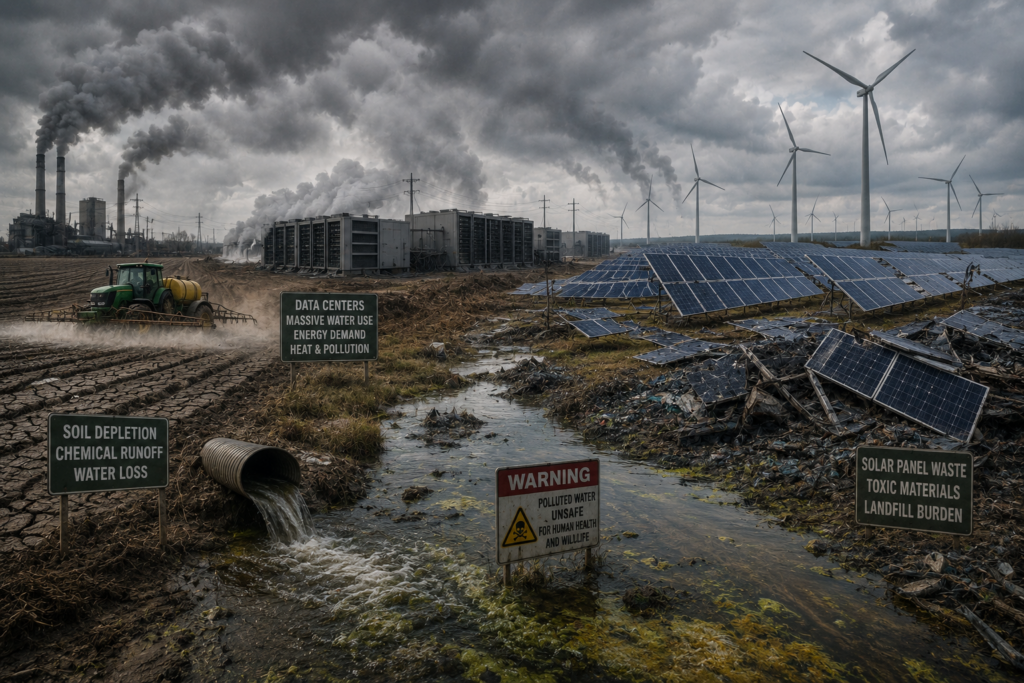
In our modern context, this pattern has been deeply disrupted. The earth is no longer simply neglected; in many cases, it is forced into relentless production. Large agricultural systems prioritize efficiency and profit, leading to soil depletion, chemical contamination, and declining food quality. The land is treated less like sacred space and more like a mechanism for extraction.

We are now seeing the land further strained by massive data centers and sprawling solar and wind installations that consume enormous amounts of water and resources, while creating long-term environmental problems through waste and storage once these systems fail.

earth

The language of Scripture—of the land being burdened or oppressed—feels increasingly relevant as the earth is pushed beyond its natural limits.

At the same time, an opposing response from modern environmental movements elevate nature to the ultimate authority. Humanity is viewed as the primary problem, something that must be restricted or removed in order for the earth to recover. These approaches reject the biblical vision in which humanity plays a necessary and restorative role. Scripture does not present humanity as an intrusion into creation but as its caretaker, called to cultivate and guard the earth in alignment with God’s purposes.

This leaves us in a place of tension. On one hand, we see the consequences of exploitation in degraded land and compromised food systems—the growing dominance of “big agri.” On the other, we encounter solutions that remove humanity from its intended role. The biblical answer calls for a return to the original pattern, where humanity participates in God’s order through responsible cultivation and trust in His provision.

This return begins with a shift in perspective. The sabbatical command in Leviticus ultimately asks whether we trust God enough to release control. It challenges the assumption that constant, forced production is necessary for survival and invites us to consider a different model, one in which provision is not solely dependent on human effort.

While few today can practice a literal sabbatical year, the principle remains deeply relevant. It calls us to reconsider how we relate to food, the land, and the systems that sustain us.

Practically, this means supporting local farmers who practice responsible cultivation, choosing food sources that prioritize quality over convenience, and recognizing that farming is not merely an economic activity but a participation in creation. Technology has its place, but it cannot replace the human role in tending the land. Agriculture is not simply about output; it is about relationship—between people, the soil, and their Creator.

Ultimately, the biblical vision is not one of despair but of restoration. The same God who brought order out of the waters continues to sustain and renew creation.

The land was never meant to be treated like a slave, and humanity was never meant to abandon its responsibility to it. When we return to God’s order, the land responds—provision stabilizes, life recovers, and what has been pushed to its limits begins to flourish again. The question is whether we will trust that pattern and the God who still sustains it.

Restoration begins the moment we step back into the pattern God has already established.

earth
OLYMPUS DIGITAL CAMERA

temple

Where Chaos Ends, Presence Begins (in God’s Temple)

There is a pattern that runs like a deep current shaping Scripture from beginning to end. In the ancient world, a temple was never built in the absence of conflict. A temple always followed victory. A king subdued a threat, defeated an enemy, secured the land, and by doing so established order. Only then did he take his seat on the throne—his rest—within a house prepared for his presence. The story of the Bible is the story of a God who confronts an enemy, establishes order, and then dwells among His people.

From Chaos to Sacred Space

The opening chapter of Genesis begins with a world that is unformed, unpredictable, and untamed—waters that represent something unstructured and without boundary. The Spirit of God hovers like a mother bird over her nest, preparing a world waiting to be shaped into something that can sustain life. This hovering is a sign of divine intention—the quickening presence of God.

God speaks, and the world takes shape. Light is separated from darkness. Waters are gathered and restrained. Dry land appears, providing a fixed point for new life. Life begins to flourish within the boundaries that have been set. This is the first great act of victory—not through violence, but through sovereign authority. Chaos is brought under control and placed under the rule of God. What follows is sacred space for His divine presence—a garden established on a mountain, a place where heaven and earth meet.

Eden is the first temple where God’s presence dwells, where He walks, and where life flows outward. Within this space, humanity is placed as image bearers. Adam and Eve are installed within the garden temple as representatives of God’s rule, called to extend the order of this sacred space outward into the world.

The story of Noah returns to this pattern in a dramatic fashion. The world once again descends into disorder, where human corruption and violence mirror the chaos of untamed waters. Creation begins to unravel, and the waters return as instruments of judgment and cleansing. Yet even here, the story is one of preservation and renewal. Noah is instructed to build a house, a vessel that will carry life through the flood—a kind of floating temple carrying the presence of God through the chaos.

As the waters rise, the ark is lifted above them, echoing a new beginning. The world is once again covered in water, and once again there is a sign of life returning—a dove sent out over the waters. The dove signals that the waters are receding. The ark comes to rest on a mountain, the place of stability where heaven and earth meet. When Noah emerges, he builds an altar. The re-entry into the world is marked by worship and the recognition that life continues because God’s presence has carried it through judgment.

Victory Leads to Dwelling

With Abraham, the pattern becomes more personal. When he confronts the coalition of kings, he steps into a conflict that mirrors the larger struggle between order and disorder. After his victory, he does not choose the fertile plains. Instead, he moves toward the mountains, toward Hebron. There he dwells in tents, establishing a household that carries the presence forward. The structure may be temporary, but the pattern remains: after victory, a dwelling is established, and the presence of God is carried into the world.

This pattern comes into even greater clarity in the book of Exodus. Chaos is embodied in a system that oppresses, enslaves, and destroys life. Egypt becomes a representation of anti-creation. Yahweh enters as the Divine Warrior, confronting the powers that hold His people in bondage. The plagues dismantle that system, revealing that the gods of Egypt have no real power or authority.

The climax comes at the sea, the ultimate symbol of chaos. The waters are divided at the command of God, and Israel passes through on dry ground, echoing creation itself. The same waters collapse upon the Egyptian army, bringing a decisive end to their power.

The story, however, does not end at the sea. Israel is led into the wilderness and brought to the mountain, where covenant is established and order is defined. Instructions are given for the Tabernacle, a mobile temple reflecting the cosmos, the mountain, and the garden. The presence of God fills this space and becomes the center of Israel’s life. Once again, chaos is defeated, order is established, and a dwelling place for God is created.

The story continues through the conquest and monarchy. Under Joshua, the people cross the Jordan into a new phase of life, with the Tabernacle ensuring the presence of God remains central. David defeats Israel’s enemies and secures Jerusalem. Solomon builds the temple on Mount Moriah—a permanent house for the presence of God. After victory, a house is built, and God dwells among His people.

The Temple Becomes a Person—and Then a People

In the Gospels, this pattern reaches its fullest expression in Jesus. He enters the waters, confronts the adversary in the wilderness, and demonstrates authority over the sea and the demonic realm that manifests in human brokenness. Each act confronts chaos. Each act sets captives free. His greatest victory comes through entering the realm of death itself. The cross becomes the battlefield, and the resurrection the victory over death that results in a new creation temple.

Yeshua embodies that temple. He becomes the place where heaven and earth meet. The temple is no longer confined to a stone building; it is present in a person, and through Him extends into His people.

Revelation brings the story to its conclusion. Chaos rises once more, depicted as beasts and empires, but is ultimately defeated. A city descends—a dwelling place that is also a mountain, a temple, and a garden. The entire city is filled with the presence of God. Heaven and earth are united, and the pattern reaches fulfillment.

If the pattern has always moved from victory to dwelling, where does that leave us now? We do not stand in Eden or gather at a temple in Jerusalem.

The dwelling place of God is now found within His people. The presence that once filled the garden, the ark, the Tabernacle, and the temple now resides within those who have been renewed. With the resurrection, humanity is being restored as the image-bearing temple of God. The Spirit that hovered over the waters now dwells within, bringing life, order, and transformation.

Through regenerated humanity, that presence is carried into every place and every act of faithful living. We become a living temple, bearing the presence of God into a world that still struggles with chaos and very real evil.

The Temple in a World That Still Feels Broken

temple

When we look at the world, it does not feel like chaos has been defeated. Disorder, suffering, and death remain very real. It can appear as though evil is winning and God is absent. But Scripture never presents victory as instant completion. There is always a space between decisive victory and final restoration.

In the Gospels, Jesus defeats death, yet the world is not immediately transformed.

To say we are the temple is not to deny the darkness around us, but to recognize that God has chosen to dwell within humanity and move through it. Like the Tabernacle in the wilderness, the presence now travels into places still marked by chaos.

To those looking toward a future temple in Jerusalem, we are still called not to stand idle, but to live now as the dwelling place of God—carrying His presence into the world even as we watch for what is yet to come.

We carry the presence not because the world is finished, but because God is still restoring it—through us.

Delphi

The Voice At Delphi and The God Who Speaks

Giants, Oracles, and the Battle Over Truth

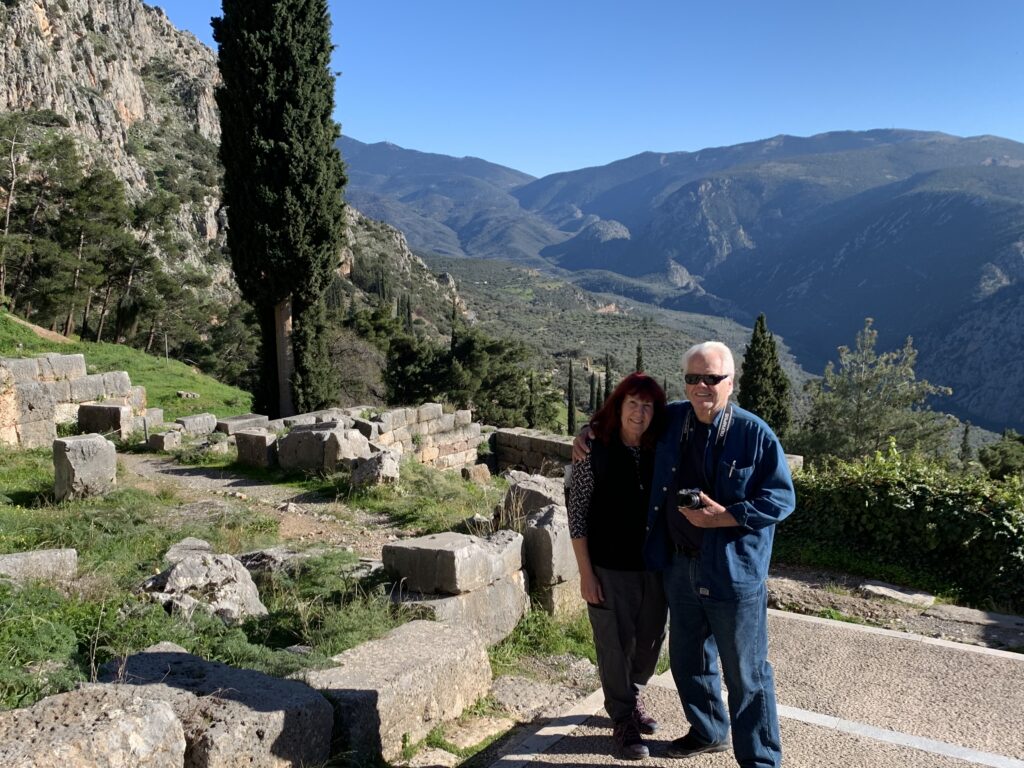
I had wanted to visit the oracle at Delphi (pronounced Delphee) for decades. I spent time in Greece in the 1970s but never made it there. In December 2025, I finally stood on that ancient, revered ground—after navigating a narrow, overcrowded road with impossible parking. It felt oddly appropriate for a site that once drew pilgrims from across the ancient world, including kings, generals, and rulers.

Some places are remembered. Others are felt. Delphi was both for me.

I could barely contain my excitement that day. The sky was a perfect blue, the air crisp, and the landscape itself truly otherworldly. This was not just a scenic location—it was a place chosen, layered with meaning, memory, and power. Delphi’s museum became an important key that unlocked the entire experience for me. Walking through it, I began to understand just how central the oracle was to Greek and Roman life.

This was the place where the gods spoke—and the world responded.

The Oracle and the Economy of Divine Speech

People came for direction—when to wage war, when to retreat, how to rule, how to live. The answers were believed to come from Apollo himself, delivered through a priestess known as the Pythia. For modern readers, the Pythia was a woman who served as the mouthpiece of the god. She would sit on a tripod in the innermost chamber—the adyton—and enter into an altered, frenzied state. Her speech, often fragmented or ecstatic, would then be interpreted by priests and shaped into responses. Not surprisingly, those interpretations could be—and often were—manipulated to suit the hearer.

The responses were famously ambiguous by design. At Delphi, they could guide, but they could also justify. A king might hear it was time to go to war. A general might interpret the words in a way that affirmed his plans for invasion. And all of this took place within a system that was not only religious, but economic. Delphi was a center of wealth, influence, and power. The more you brought, the more weight your question carried—and the more favorable the response.

As I moved through the museum, however, it was not only the oracle that captured my attention. It was the imagery that surrounded it.

Again and again, the same scenes appeared: gods in battle, giants rising in defiance, bodies falling in defeat. On the north side of the temple, the reliefs depict the Gigantomachy—the battle between the Olympian gods and the giants, the children of Gaia. The giants are not abstractions. They are armed, aggressive, and determined. They come with spears, stones, and shields, fighting against the gods. The gods, in turn, fight back with equal force. Apollo and Artemis stand against them. Zeus reigns above them. The outcome is not in doubt, but the struggle is intense.

This was one of the most important ideas in the ancient world: order is established through conflict and violence. Civilization survives because the gods defeat chaos. Power is maintained through victory. The world, in this telling, is held together by the triumph of the strong over the weaker.

Standing there at Delphi, surrounded by these scenes, I was struck by how familiar this narrative still is. It is not only ancient. It is human. We still believe, in many ways, that order can only be secured through force, and that power must be asserted in order to crush chaos.

A World Spoken Into Being

And yet, this is precisely where the biblical story takes a radically subversive path.

The Bible does not deny the existence of chaos or conflict. Genesis 6:1–4, with its reference to the “sons of God” and the Nephilim would not have seemed strange to an ancient audience. They lived in a world where the boundaries between the divine and human were not neatly separated, where rulers could be described in divine terms, and where stories of powerful, hybrid figures were part of the cultural imagination.

What the Bible does differently is refuse to ground creation in violence.

In the Greek and broader ancient Near Eastern imagination, the world emerges through conflict. The gods battle, and from that battle comes order. But in Genesis, God creates by speaking. There is no rival, no cosmic struggle, no war that produces the world. The world is ordered, named, and established by the Word and the Spirit of God.

This is a fundamental redefinition of reality.

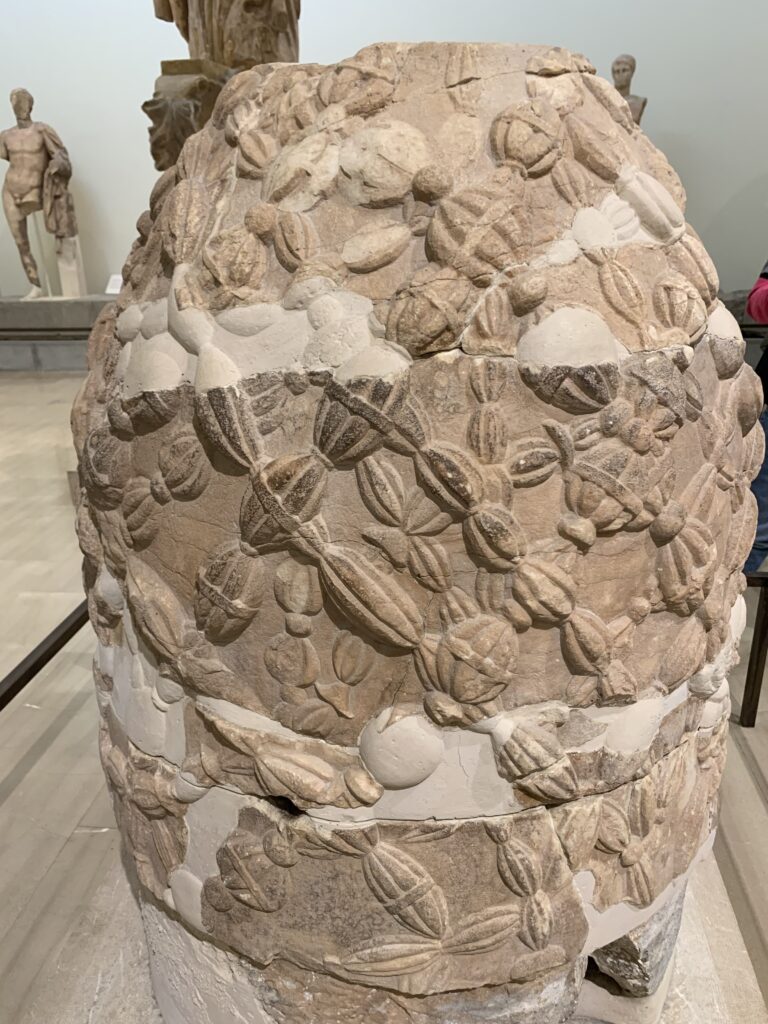
Delphi, with its sacred omphalos—meaning the “navel” of the world was believed to mark the very center of the earth, the place from which divine knowledge flowed. According to myth, Zeus released two eagles from opposite ends of the world, and where they met, he marked the center with a stone. That stone stood in the temple, symbolizing the connection between the divine and human realms.

Delphi

The Bible has its own center.

The Garden, with its tree of life, serves as a place of divine presence and instruction. Later, the Temple in Jerusalem builds upon this, with its inner chamber marking the place where God’s presence dwells. Rabbinic tradition even speaks of a foundation stone in the Holy of Holies as the true “navel” of the world, with the world’s waters lying beneath it.

This brings us to an unexpected but important connection in the New Testament.

The True Voice and the Liberation of Truth

In Acts 16, Paul encounters a slave girl in Philippi who is described as having a “spirit of divination”—in the Greek, a python spirit. This language directly connects her to the world of Delphi.

In Greek tradition, the Python was the serpent or dragon that dwelled at Pytho, near Delphi, guarding the oracle. Apollo was said to have slain this creature and established his prophetic center there. The term python became associated with prophetic spirits, particularly those connected to ecstatic, oracular speech.

In other words, this girl is functioning within that same tradition as the Pythia. She is, effectively, a portable oracle.

She follows Paul and his companions, declaring, “These men are servants of the Most High God, who are telling you the way to be saved.” Her words are accurate. But Paul does not affirm her.

Why? Because in the biblical framework, truth is not defined by accuracy alone—but by source.

This girl is embedded in a system of exploitation. Her owners profit from her condition. Her ability to speak is not a gift freely exercised—it is controlled, monetized, and used for gain. Like Delphi, this is a system where spiritual insight is entangled with power, economics, and manipulation.

Paul does not debate her. He does not reinterpret her message. He does something far more disruptive.

He casts the spirit out.

In doing so, he is dismantling the system. He is liberating a human being. He is restoring what has been distorted—giving her a new-creation life, her human nature delivered from what had enslaved it.

This raises a question. What does any of this have to do with us?

It is easy to relegate Delphi, giants, and oracles to the past. They seem distant, like artifacts from a world we no longer inhabit. But that is not entirely true. We have not outgrown Delphi—we have simply renamed it.

We still seek voices to guide us. We still look for authority—spiritual, political, technological—to tell us what is true, what is good, and what will lead to life. We still navigate a world of competing claims, loud and persuasive voices, and systems that deliver confusion.

The ancient world externalized these tensions through stories of gods and giants. The deeper question, then, is whether we understand the nature of the voice we are listening to. Delphi offered answers—but those answers were often shaped by human desire open to manipulation.

The biblical story moves in a different direction.

It presents a God who speaks clearly. A God who creates without violence. A God who does not manipulate but restores.

In Yeshua, this becomes visible in a way that confronts both ancient and modern assumptions. His works are not displays of power for their own sake. They are acts of deliverance—healing, freeing, and reordering lives that have been shaped by forces beyond their control.

The encounter in Acts 16 reminds us that not every spiritual voice is aligned with truth—even when it sounds convincing. It also reminds us that the work of God is not to exploit, but to liberate.

Standing in Delphi, surrounded by images of gods battling giants, I found myself reflecting on that contrast. The biblical story offers something altogether different.

A God who speaks.
A creation ordered without violence.
A voice that does not manipulate—but calls.

And that leaves us with a question.

Whose voice are we trusting to shape our understanding of truth, power, and the life we are building?

Delphi
supernatural

When Heaven and Earth Overlap: Rethinking the “Supernatural” in the Ancient World

The ancient world did not divide reality into natural and supernatural categories. That distinction belongs to a later way of thinking—one shaped by modern assumptions about a closed universe governed by impersonal forces. For Israel and its Ancient Near Eastern (ANE) neighbors, the visible and invisible were not competing realities. They were intertwined dimensions of the same world.

Modern readers struggle with this. We elevate the physical, material world as the default. Nature, in our imagination, operates on its own. God, if He acts at all, must “intervene.” We place those interventions into a special category and call them miracles. But this framework would have been foreign to an ancient world. It is not simply a different vocabulary—it is a completely different way of seeing.

Distinguishing Between Seen and Unseen not Between Natural and Supernatural

The ANE distinguished between the seen and the unseen, while assuming both were always operating together. The world was not a closed system occasionally interrupted by divine action. It was an open system, sustained continuously by divine presence.

Rain was not simply a weather pattern. Clouds could gather, winds could shift, and rain could fall—but it was also understood as the action of the divine. Not either/or. Both at once.

This is precisely the kind of world described in Scripture.

When the sea parts, when nations rise and fall, when the sun darkens or the stars fall from heaven, the biblical text does not signal a break in normal reality. It assumes divine agency is always present. These moments are not anomalies—they are revelations. They are points where the unseen dimension is visible—we refer to it as a supernatural event.

So, what we call miracles were not understood as interruptions of nature. They were expressions of divine rule—moments when order pushed back against chaos.

This framework explains the overlap of language in the biblical and ANE world. The phrase “sons of God” can refer to divine beings, members of the heavenly council, but also to earthly rulers and kings. This is not meant to be confusing. It’s that Heaven and Earth are mirroring one another.

Scholars such as Michael S. Heiser have drawn attention to this divine council worldview, where the rule of God in heaven is reflected in the governance of rulers on earth. Similarly, John H. Walton emphasizes that the ancient world understood creation not as a self-sustaining mechanism, but as a system functionally ordered by divine presence. The world works because God is actively sustaining it.

Kingship Aligned the Earth

This is why kingship mattered so deeply. Earthly rulers were not merely political figures; they were mediators. Their role was to maintain order—to align the earthly realm with the divine order above. This is also why the failure of a king was so catastrophic.

The plagues of Egypt illustrate this dramatically. Pharaoh was not simply a ruler; he was the guarantor of order. His role was to maintain the balance between heaven and earth. When the God of Israel confronted Egypt, the plagues did more than disrupt the environment—they dismantled Egypt’s entire worldview. The Nile turned to blood. Darkness covered the land. The system collapsed. Pharaoh was exposed as weak and powerless. Another King had entered the arena.

In the ANE imagination, heaven and earth were not separated realms but overlapping domains. N. T. Wright describes this as the intersection of heaven and earth—two spheres meant to overlap and ultimately unite. The supernatural realm. The connection between realms was anchored in concrete realities: mountains, temples, standing stones, monuments, altars, pillars etc.—places where heaven and earth were understood to meet.

The cosmos itself was seen as a temple. L. Michael Morales has shown how deeply temple theology is woven into Scripture. The temple was not merely a building. It was the point where divine presence filled creation. Humans were to be participants and mediators—called to serve as a kingdom of priests, maintaining the connection between realms.

There was no secular world. No so-called neutral space. Every place was sacred space because every place existed under the sovereignty of God within His Presence.

This is the world into which Jesus steps.

When He calms the sea, we generally read it as a comforting miracle—a display of power over nature. But in the ancient imagination, the sea represents chaos, the untamed forces that once covered the earth before God’s ordering word in Genesis. When He rebukes the wind and the waves, He is not suspending natural law. This is what we call supernatural. He is confronting chaos. He is acting as the Divine Warrior King, restoring order within creation.

The same is true when He casts out demons. This is not merely mental and physical relief. It is the expulsion of forces that distort a human’s image. When He heals the lame, gives sight to the blind, or raises the dead, these are not random acts detached from a larger framework.

They are new creation events.

These are moments when the original design of humankind—created in the image of God—is restored. The Kingdom is taking shape in real time, within the world.

We have placed these acts into a category called “miracle” because we do not know how else to describe them. But the category itself obscures what is really happening. It isolates these events from the ongoing reality of divine presence.

In the ancient world, they would not have asked, “Is this natural or supernatural?” That question would not make sense. Instead, they would recognize that the King is present, and where the King is present, order is restored.

Heaven and earth are aligning.

Kingdom and empire exist at the same time, just as the visible and invisible operate together. The Kingdom of God is not separate from the world; it is an overlay upon it. It is the reassertion of divine rule within creation. As Yeshua moves through Galilee and Judea, He is not stepping outside reality. He is revealing its true nature.

This is why His works are signs because they point to something deeper—the renewal of all things.

To rightly read Scripture, we should make the effort to recover this worldview. We should try to see as the ancient world saw: a reality that is not divided but layered.

When we do, the so-called supernatural question dissolves altogether. Miracles are not interruptions of reality, but revelations of it—moments when the true order of creation breaks through into the visible world. And for a brief moment, the veil is pulled back, and reality is seen as it truly is—held together, sustained, and ruled by the living God.

supernatural
two birds

Two Birds, Two Goats, One Cross: The Biblical Pattern of True Cleansing

Purification in Scripture is never about managing impurity—it is about removing it entirely. The ritual for the metzora (one with a skin disease) and the service of Yom Kippur operate on the same underlying pattern. In Leviticus 14, the death and release of two birds restores the individual. In Leviticus 16, the death and release of two goats restores the sanctuary and the people.

The Pattern of Cleansing: Death and Release

Leviticus 14 begins outside the camp, where the metzora, cut off from the life of Israel, waits for restoration. The priest goes out to him, not the other way around. Two birds are brought. One bird is slaughtered over living water in a clay vessel. The other, still alive, is dipped—along with the wood, scarlet, and hyssop—into the blood of the slain bird. The blood and water are then sprinkled seven times upon the one being cleansed. Only after this does the living bird go free, released into the open field.

Blood applied and impurity removed. The metzora is washed, shaved, and gradually restored. He reenters the camp but remains outside his tent for seven days, undergoing a second cycle of washing and shaving before final reintegration on the eighth day. Cleansing is a process of reordering life back into alignment within sacred space.

Leviticus 16, the Day of Atonement, mirrors this structure on a corporate scale. Here the concern is not a single body but the body of Israel and the sanctuary itself. Over time, impurity accumulates through sin, disorder, and the reality of life in a fractured world. The tabernacle, as the meeting place of heaven and earth, must be cleansed.

Again, two animals stand at the center. One goat is designated “for Yahweh” and is slain. Its blood is carried into the Holy of Holies and sprinkled—again seven times—upon the kapporet (covering for the seat) and on the veil, the parokhet. The inner sanctum, the place of divine presence, is purified through blood. The second goat remains alive. The high priest lays his hands upon it, confessing the sins of the people, and it is sent away into the wilderness, carrying those sins into a place of desolation, never to return.

The blood purifies. Removal completes the act. One animal addresses defilement within sacred space; the other removes impurity from the community. In later Jewish tradition, the imagery expands. A scarlet thread is tied to the goat designated for the wilderness and, according to tradition, also to the Temple gate—possibly the Nicanor Gate, the main eastern entrance into the inner court.

When the thread turned white, it signaled that sins had been forgiven. Scarlet becomes white, the sign of cleansing that echoes the elements in the metzora ritual: cedar, hyssop, and scarlet bound together in purification.

The Temple, the Body, and the Removal of Impurity

What emerges from these two chapters is a unified vision of cleansing. The human body and the tabernacle function as parallel sacred spaces. The metzora is a defiled micro-temple, cut off from the community. The sanctuary is the macro-temple, bearing accumulated impurity. Both require cleansing. Both are restored through the same pattern: blood applied, impurity removed, life reestablished.

The pattern moves beyond Leviticus and into the Gospel narratives.

Yeshua is the slain one. Like the bird killed over living water, like the goat offered to Yahweh, His death is a purifying act. His blood is central. But He is also the one sent away. Like the living bird released into the open field and the goat driven into the wilderness, Yeshua is led outside the city. He is crucified beyond the walls of Jerusalem, in the place of exile away from the camp. He dies outside the camp, bearing reproach, carrying the weight of impurity beyond the boundary of sacred space.

In Leviticus 14, the bird is slain over living water, and the cleansing involves blood and water. In John’s Gospel, when Jesus’ side is pierced, blood and water flow out. The elements of purification are present at the moment of His death. Hyssop appears again at the crucifixion, used to lift sour wine to His lips. The threads of Leviticus are brought together in Him.

Even the movement of the ritual is preserved. The metzora waits outside the camp until the priest comes to him. On Yom Kippur, the high priest moves between spaces, carrying blood into the presence of God and sending impurity away. In the Gospel narrative, Yeshua embodies both priest and offering. He offers Himself. He goes outside. He returns in resurrection, not simply restored, but inaugurating access.

Fulfilled in Yeshua: Cleansing and Removal United

The pattern converges in one place. Yeshua is the priest who goes out, the sacrifice that is given, the one sent away, and the one who returns to restore. He embodies Israel, the temple, and the individual in need of cleansing. Through Him, impurity is both cleansed and removed, and the way back into the presence of God is opened fully.

two birds

This reframes the modern question: how do we purify ourselves?

We begin with the recognition that something must be dealt with—something that disrupts life, fractures relationships, and distances us from the presence of God. Scripture names this as impurity, sin, uncleanness, disorder. In modern life, it often appears as shame, anxiety, hidden habits, fractured identity, or the quiet sense that something is not as it should be.

Something must be addressed, and something must be removed.

In Leviticus, this takes the form of death and release. One bird is slain; another is sent away. One goat is sacrificed; another carries impurity into the wilderness. Impurity is dealt with and removed.

This is where the connection to Yeshua becomes practical. If He embodies this pattern, then purification today is not a ritual we perform but a reality we enter into. His removal outside the camp carries away what we cannot carry ourselves. But that work is ours to receive and to live within.

But receiving does not mean passivity. The metzora, once declared clean, still participates in a process. He washes. He shaves. He reenters the camp gradually. He is restored step by step into a new way of living.

To live as one who has been cleansed is to refuse to carry what has already been removed. The goat does not return to the camp. The living bird does not fly back. What has been sent away is meant to remain gone.

Yet, this is where many still struggle. We continue to carry what has already been released. We rehearse failures, revisit wounds, and allow past realities to define present identity. In doing so, we reject the second half of the pattern—the removal.

The call is not to achieve purity through effort, but to live as those who have been purified.

Confession is the act of stepping out of isolation and into the possibility of restoration. It also means allowing patterns of thought and behavior that produce disorder to be released. Just as the goat carries impurity away, there are habits, narratives, and attachments that must be relinquished. We let go because it has already been carried away.

This is where community becomes essential. The metzora is restored to the camp, not to isolation. The goal is not individual purity in abstraction, but reintegration into a people shaped by the presence of God. Healing is lived out in relationships where truth, accountability, and grace are present.

What God has removed is not meant to be carried again—true cleansing is learning to live as though it is completely gone.

empire

How Empire Distorts the Image of God—and How Yeshua Restores It

empire
Splitting

Splitting, Tearing, and the Threshold of a New World

There is a pattern in Scripture that appears again and again in moments of transition, deliverance, and new creation. It is the language of splitting or bursting open, and it tells us that we are standing at a threshold—the collapse of one order and the rise of another.

The Hebrew word is bakah, and it means to split, cleave, break open, divide, or burst forth. In Scripture it is used for splitting wood, dividing waters, breaking open rocks, and the earth splitting. It is a forceful, often sudden, and at times violent action. It appears in moments of divine intervention, crisis, or transition. Bakah marks the boundary between what is passing away and what is coming into being.

In the ancient Near Eastern world, this language would have been understood. Splitting was something a victorious warrior did to a defeated enemy. To split was to bring an end to one reality so that another could take its place. Chaos is confronted. Order is restored. In this context, splitting is the act that establishes a new reality. The gods split the seas. Warriors split their enemies and ordered their world.

Creation Begins with a Splitting

The pattern begins at creation itself. In Genesis, God separates the waters, dividing chaos and bringing order into existence. The firmament—the raqia—is stretched out, establishing a boundary between waters above and waters below. Creation is portrayed as the structuring of a world out of the deep.

Later, in Genesis 7:11, the flood is described using similar language: “on that day” the fountains of the deep burst forth. The waters are split—bakah. The imagery echoes birth. The waters break open like a womb. What once brought forth life now threatens to undo it. From the beginning, splitting stands at the boundary between chaos and life.

Exodus: The Splitting that Creates a People

In Exodus 14, God commands Moses to stretch out his hand over the sea and split it. This is not merely a miracle of escape. It is a decisive act of recreation, deliverance, and judgment. Israel passes through the waters of chaos and emerges on dry ground.

It is the collapse of Egypt’s power and the birth of a new people. The sea that once symbolized disorder becomes the very pathway into freedom. It splits for Israel’s deliverance and then returns to drown Pharaoh and his army. The fall of one kingdom and the rise of another—Israel moves through the space in between.

The wilderness further showcases this theme. The rock is split, and water bursts forth (Psalm 78:15; Isaiah 48:21). Life emerges from rupture. Provision comes from what is split open. The rock, a symbol of stability, brings forth life-giving water. A new order emerges from what has been broken.

The Language of Splitting in Sacrifice

In Genesis 22, Abraham rises early and splits the wood for the offering. The act seems ordinary, but shares in this deeper pattern. The wood that will carry the sacrifice is itself divided. The language of splitting moves through the narrative, pointing toward the potential sacrifice of Isaac and then the substitute ram. The pattern continues to build.

Prophets and the Collapse of Kingdoms

The prophets take this imagery and expand it to a cosmic level.

Micah describes mountains melting and valleys splitting. Zechariah speaks of the Mount of Olives splitting in two as God confronts the nations. These are not just descriptions of natural events. They are declarations of divine intervention in history.

Mountains represent power, stability, and permanence—the places where kingdoms establish themselves. When they split, it signals that what appeared immovable is being overturned. God is dismantling kingdoms that stand in opposition to His own. This is the language of political and cosmic collapse.

The Heavens Are Torn Open

When Yeshua rises from the waters of the Jordan, the heavens are torn open (schizo), a word often used in the New Testament connected to the Hebrew bakah. This echoes Isaiah’s cry: “Oh that You would rend the heavens and come down.”

The tearing of the heavens signals the arrival of God’s kingdom. A boundary is broken. Access is opened. The barrier between realms is removed. Once again, something is split so that something new can begin.

The Cross: The Collapse of an Order

All of these moments lead to the cross.

At the crucifixion, the language of splitting reaches its fullest expression. The Gospel of Matthew records that the veil of the temple was torn in two from top to bottom, the earth quaked, and the rocks were split.

It is the language of cosmic upheaval. The temple veil represents the boundary between heaven and earth. The earth represents the created order. The rocks represent stability and permanence. Everything is breaking.

This is the moment where the old order begins to collapse—religious systems, political power, and even death itself are exposed. What looks like defeat is, in reality, the unmasking of every power that has shaped the world through control and violence.

The cross is not simply where Yeshua dies. It is where the world as it has been known begins to come apart.

Resurrection: The Rise of a New Kingdom

But the story does not end with rupture. The resurrection reveals what that rupture was for.

What was torn open at the cross becomes the passageway into new life. The same power that split the sea, the rock, and the earth now brings forth life from the grave. The kingdom of God does not emerge alongside the old order—it rises out of its collapse.

This is the decisive moment. The fall of one kingdom gives way to the rise of another.

As G. K. Beale observes, whenever an earthquake (or splitting) is mentioned, it “denotes the chaos between [the fall of] one kingdom and [the rise of] another.” The shaking of the earth marks the unstable space between worlds. It is the moment when an existing order is being dismantled but the new has not yet fully emerged. This is the tension point of history, where chaos is exposed and the structures that once appeared secure begin to give way, making room for the establishment of God’s kingdom.

At the resurrection, that transition is complete.

What appears to be the moment of death is, in fact, the beginning of a new creation. Access is restored. Life is renewed. A new humanity begins.

splitting
Psalm 136

The Song Before the Garden: Jesus Sang Psalm 136 on the Way to Gethsemane!

Matthew records a small detail with enormous implications: “And when they had sung a hymn, they went out to the Mount of Olives” (Matt. 26:30). These were not later Christian hymns. This was not “the old rugged cross” or “I’ll fly away.” They were the Hallel Psalms, and very likely included Psalm 136—the Great Hallel. Psalm 136 is not simply a praise psalm; it is a structured retelling of the biblical story, moving deliberately from creation to Exodus to covenant inheritance, all anchored by the repeated refrain: “For His Chesed (mercy) endures forever.”

This is Israel’s faith acted out in liturgical form through Psalm 136

The psalm begins with creation: “To Him who made the heavens with wisdom… who spread out the earth above the waters… who made the great lights…” (vv. 5–7). Creation is presented as ordered, sustained, and governed by the word of God. It then moves directly to Exodus: “To Him who struck down the firstborn of Egypt… and brought Israel out… who divided the Red Sea…” (vv. 10–15). Creation and Exodus are not separate acts. Exodus is new creation. The God who ordered the waters in Genesis parts them again to bring forth a people. The psalm concludes with wilderness, inheritance, and provision: “who led His people through the wilderness… gave their land as a heritage… remembered us in our low estate… and gives food to all flesh” (vv. 16–25). The goal is not escape. It is a world rightly ordered under God’s presence.

The biblical pattern is creation, deliverance, indwelling, and ongoing provision.

The language of “spreading out the earth upon the waters” echoes Genesis 1, where the waters are gathered and boundaries are established so that dry land can appear. The Hebrew verb used in Psalm 136:6 (רָקַע — rāqaʿ, “to spread out” or “to hammer out”) is closely related conceptually—though not identical in form—to רָקִיעַ — rāqîaʿ (“firmament”) in Genesis 1. Both share the same root and describe the act of spreading, stretching, or forming a boundary that orders creation. The firmament separates the waters above from the waters below; the earth is spread out over the gathered waters. In both cases, God is establishing order over chaos.

It is on the third day of creation that the waters are gathered and the dry land appears (Gen. 1:9–13). It is the first moment where stable, inhabitable ground emerges from the deep. It is also the day when life begins to sprout—seed-bearing plants and fruit-bearing trees. The third day is not simply about land; it is about life emerging from the restraint of chaotic waters.

That pattern is foundational.

Psalm 136 then moves directly to Exodus: “to Him who divided the Red Sea in two… and made Israel pass through the midst of it…” (vv. 10–15). The connection is deliberate. The same God who gathered the waters in Genesis gathers them again in Exodus. The Reed Sea is a replay of creation itself.

Exodus is new creation.

The waters are divided. A path appears. Israel walks through on what is, in effect, newly revealed “dry land.” The enemy—the embodiment of chaos and oppression—is swallowed as the waters return. What Genesis establishes, Exodus then reenacts. The world is being ordered again through the formation of a people.

This is what Yeshua is singing.

On the night of Passover, He is stepping into this pattern fully aware that He is about to embody it. The movement from the table to the Mount of Olives is the continuation of the story He has just sung. He is singing of the God who creates, the God who restrains chaos, and the God who brings His people through the waters and into His presence—because He is about to enact that reality at its deepest level.

The next movement is the garden—Gethsemane, where He will be arrested.

This is not Eden restored yet. It is Eden in exile. It is a place of pressure, sorrow, and the approach of death. Adam was driven out of the garden and could not return. Humanity remained in exile, east of Eden, cut off from the Presence. Yeshua enters Gethsemane not as a restored Adam, but as representative humanity in exile. He steps into the place where the story has been held since Genesis 3.

From the garden, the movement continues toward the grave.

The grave becomes the greater sea. Psalm 136 declares that God divides the waters, defeats the enemy, and brings His people through. In the Gospel account, that pattern reaches its fullest expression. Darkness falls over the land (Matt. 27:45). The earth shakes. The tomb is sealed. Like the sea, it appears final. Death has closed over Him.

But the third-day pattern holds.

Just as in creation the waters are gathered and dry land appears, just as in Exodus the sea is divided and a people emerges, so now, on the third day, the grave is opened. The stone is rolled away (Matt. 28:2). What seemed to be the final boundary is undone. The place that held Him cannot contain Him.

The third day is the day of emergence.

What the Reed Sea was to Pharaoh, the tomb is to death itself. The enemy enters, but does not return. Death is not avoided. It is defeated.

And then, the garden appears again.

In John’s account, Yeshua is encountered in a garden and is even mistaken for a gardener (John 20:15). This is an important detail. In the ancient world, kings were gardeners—horticulturalists who took great pride in their gardens. The story has now come full circle. The One who entered the garden of exile now returns in resurrection life. What was lost in Eden is not merely recovered; it is reestablished on the other side of death itself.

This is new creation.

So, when Yeshua and His disciples sing Psalm 136, He is not recalling Israel’s past. He is declaring what is about to take place. The God who spread out the earth over the waters is about to bring forth life from the grave. The God who split the sea is about to divide life from death. The God who led His people through the wilderness is about to open the way to His Divine Presence.

Creation, Exodus, and resurrection are not separate acts. They are one continuous pattern. And all of it is grounded in the same refrain: “For His steadfast love endures forever.”

Psalm 136
fulfillment

Why fulfillment, not replacement, tells the true story of Israel and the Church

At a time when debates about Israel, the Church, and biblical prophecy are shaping Evangelical conversations — often in the shadow of rising antisemitism and global unrest — we would do well to ask: How does the New Testament actually relate to the story of Israel and her fulfillment?

Since the early days of Christian history, the relationship between Israel and the Church has often been framed as old versus new, with the Church viewed as Israel’s replacement. This mindset assumes that God’s covenantal purposes depended on Israel’s faithfulness and that the generational covenant promised to Abraham could be reassigned to another people. Over time, that assumption has shaped theology in ways that detach the New Testament from its foundations in the Hebrew Scriptures.

The New Testament does not present Israel as discarded but as fulfilled. Israel’s calling is embodied in one faithful representative. Jesus (Yeshua), the Jewish Messiah, does not stand outside Israel to replace her; He stands within her story as its climax. In Him, Israel’s mission reaches the goal of God’s promise to Abraham, extending outward to bless the nations.

Fulfillment Within Israel’s Story

The early disciples did not see themselves as founders of a new religion. They understood themselves as participants in Israel’s long-awaited renewal. The Jerusalem community was not a breakaway movement; it was the Sinai assembly raised into a New Creation reality. Israel’s vocation, to be a kingdom of priests and a light to the nations, was not revoked but expanded.

The New Testament writers assume the Hebrew Scriptures, festivals, temple structure, and covenant narrative as their interpretive framework. Matthew organizes his Gospel around five major discourses, echoing the five books of Moses. John presents Jesus as the embodiment of divine presence — the glory that once rested in the Tabernacle: “The Word became flesh and tabernacled among us.” Luke situates Pentecost at Shavuot, the festival of covenant renewal and first fruits. Revelation is saturated with temple imagery, Exodus patterns, and prophetic vision. These are not Gentile innovations; they are Jewish proclamations about Israel’s Messiah, firmly rooted in the Old Testament.

When we read the New Testament, we do not find a story of substitution but the unbroken tracing of promise. From the beginning, humanity — Adam — was created as God’s image bearer, commissioned to steward sacred space in the garden and commanded to “be fruitful and multiply, fill the earth and subdue it.” This creational charge established humanity’s vocation to extend God’s ordered presence throughout the world. After exile from Eden and the cleansing of the flood, that vocation narrows through Abraham, Isaac, and Jacob, renamed Israel. The promise extends to the twelve tribes, to a covenant nation, to the Davidic kings, and ultimately to the Servant who fulfills Israel’s calling. The trajectory has always pointed toward the renewal of that original garden mandate: faithful stewardship and the extension of God’s reign over the whole earth.

In Jesus (Yeshua) the Messiah, that calling does not end; it expands — first to the Jew and also to the Gentile. What began in one man extends to a renewed community as Gentiles join Israel’s story rather than replacing it. Together, Jew and Gentile are sent to the four corners of the earth to extend the Kingdom of Heaven. The movement is restorative, not substitutive.

Representation, Not Substitution

This pattern of representation is deeply embedded in the Scriptures. Ezekiel became a living sign, bearing symbolically the iniquity of Israel and Judah. Isaiah speaks of a Servant who both embodies Israel and becomes a light to the nations. Even Caiaphas, in John 11, articulates the idea of representation: it is better for one man to die for the people than for the nation to perish. John interprets this as gathering into one the scattered children of God. One stands for the many. This is representation, not replacement.

Throughout Scripture, God works through chosen representatives — not because they are superior, but because they are entrusted with the weight of covenant vocation. Israel was not chosen for righteousness but because God’s promises to Abraham are irrevocable. With election comes accountability, which includes serious consequences for violating the covenant.

One Covenant, One Unfolding Story

Paul makes this explicit in Romans 11. Gentiles are grafted into Israel’s olive tree; they do not become a new tree. The root remains the patriarchal promise. Paul’s warning is unambiguous: Gentiles must not boast over the branches as though they have supplanted what came before. The metaphor assumes continuity within one unfolding covenant story.

The Gospel writers frame Jesus’ life as a deliberate retracing of Israel’s path. Israel passes through the sea; Jesus passes through the Jordan. Israel wandered for 40 years; Jesus fasted for 40 days. Israel is called God’s son; at His baptism, Jesus is declared the beloved Son. Israel receives Torah on a mountain; Jesus ascends a mountain and teaches with authority. He does not position Himself against Israel but within her story as her faithful embodiment. Fulfillment does not mean replacement.

As a Jewish believer in Jesus, shaped by Torah, temple, and Exodus patterns, I cannot read the New Testament as a Gentile takeover. I read it as Israel’s story reaching its climactic moment. Jesus embodies Abraham’s promise, Moses’ mediation, David’s kingship, and the Servant’s obedience. His death is framed in Passover language. His resurrection unfolds in garden imagery.

When Jesus says, “I will build my ekklesia (church),” He is not inventing something new; He is speaking of rebuilding the covenant assembly. The earliest believers understood this. They worshiped in the Temple, observed the feasts, and saw themselves as participants in Israel’s restoration.

On the final mountain in Matthew’s Gospel, the risen Messiah issues a “go” into all the world that echoes the first “go” spoken to Abraham in Genesis 12. Abraham was sent so that all nations would be blessed through him. Now the promised Seed sends His followers to disciple the nations. What began with one man called outward to bless the earth culminates in the risen King commissioning a renewed community to extend that blessing globally.

If Israel can be replaced, then covenant promises are ultimately conditional and transferable. But if the New Testament presents fulfillment rather than replacement, then the integrity of God’s word stands firm. The God who called Abraham, formed Israel at Sinai, and spoke through the prophets is the same God who raised the Messiah from the dead. His promises are brought to completion.

This is not replacement. It is Israel’s calling brought to its fullness — and extended to the world through her Jewish Messiah.

fulfillment
Skip to content