Author: Dinah Dye

Leviticus

Leviticus: The Protocol of Holy Access

The book of Leviticus continues where Exodus leaves off.

Exodus 40 ends with the Tabernacle fully constructed, erected, anointed, and filled. The cloud descends, and the glory of Adonai fills the Mishkan. The same glory that once covered Mount Sinai now fills this portable sanctuary in the midst of Israel’s camp. The text makes an intentional point: Moses was unable to enter the Tent of Meeting because the cloud rested upon it and the glory filled the Tabernacle. Access was denied—even to God’s mediator. The one who once entered the mountain cloud cannot enter this newly constructed sanctuary.

Leviticus: When Glory Descends but Access Is Denied

The final verses of Exodus form a hinge to Leviticus. The cloud remains over the Tabernacle by day and fire by night throughout Israel’s journeys. Immediately Leviticus opens: “Now Adonai called to Moses and spoke to him from the Tent of Meeting.” The voice comes from inside the sanctuary. God speaks outward from within His dwelling.

Just as in Genesis God spoke creation into ordered existence, here He speaks from within the Mishkan. Leviticus answers the question raised at the end of Exodus: If the glory has descended and even Moses cannot enter, who can approach? Who may ascend? Psalm 24 asks the same question and answers it: the one with clean hands and a pure heart.

Leviticus provides the protocol for approaching a holy God.

Genesis describes how God filled creation. Exodus describes how God filled the Tabernacle. Leviticus explains how humanity may approach that filling. It introduces mediation through a set-apart priesthood and establishes boundaries that regulate access.

Sacred Space, Boundaries, and the Danger of Approach

In Genesis 1–2, God speaks and order emerges. Humanity is placed within sacred space and given a vocation “to serve” (avad) and “to guard” (shamar). These same verbs later describe priestly responsibilities in Numbers. Adam’s placement in the garden included structured access. There was abundance, but there were also limits. Access to the tree of the knowledge of good and evil was restricted. Adam transgressed that boundary, and the result was exile. Sacred space was then guarded by cherubim.

Exodus mirrors this pattern. The Tabernacle becomes concentrated holy space in Israel’s midst. Holiness implies restriction. Moses cannot enter. It is deadly if approached incorrectly. Leviticus 10 confirms this when Nadab and Abihu offer unauthorized fire and die before Adonai. The issue seems to be the violation of divine boundaries.

Leviticus is fundamentally about boundaries. These boundaries are protective, not punitive. Greater proximity to holiness requires greater accountability. The central question becomes clear: How does one approach divine glory without dying?

The answer unfolds through sacrifice, blood, priesthood, and graduated holy space. Access is mediated.

Blood, Mediation, and the Restoration of Access

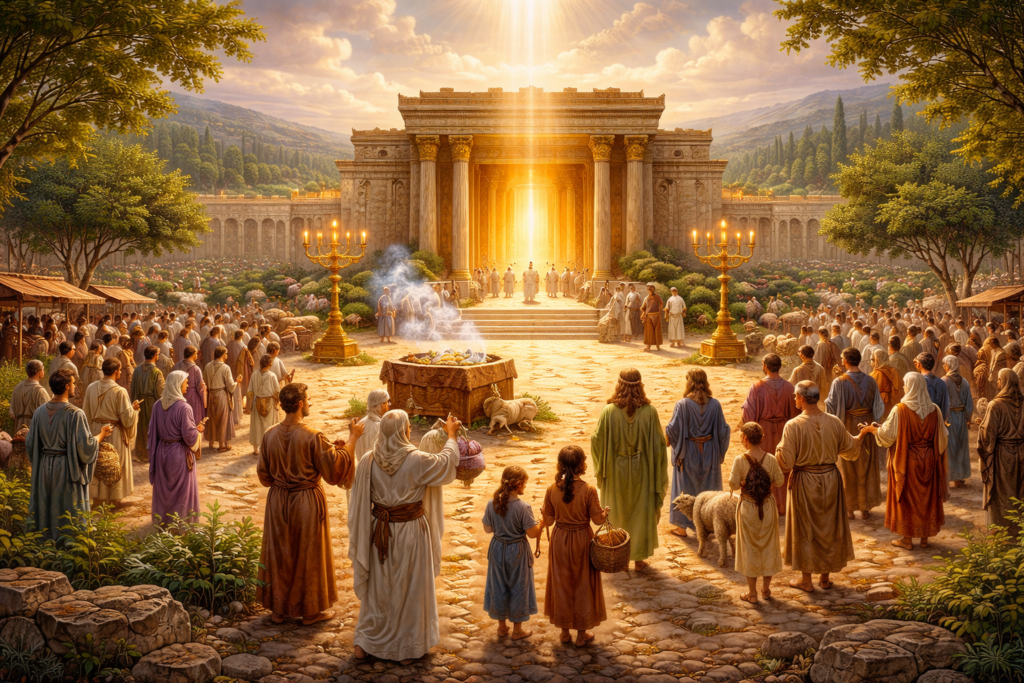
Leviticus 1 introduces the elevation offering, the korban olah. The term korban derives from karav, meaning “to draw near.” The offering is brought to “the entrance of the Tent of Meeting.” The altar stands at the boundary between common space and holy space. The animal is slaughtered before Adonai, and the priests apply the blood to the altar.

This must be understood in contrast to the broader Ancient Near Eastern world. In Mesopotamian religion, sacrifices were offered to feed the gods. In Israel, blood functions to cleanse sacred space. Leviticus 17 explains, “The life is in the blood… I have given it to you upon the altar to make atonement.” The Hebrew root kaphar means to purge or cleanse. Blood represents life given in place of life and serves as a ritual means of removing contamination from the sanctuary.

Since Genesis 3, death entered the human condition. A life had been forfeited. Blood symbolized life offered to restore covenant order so that the divine presence could remain among the people.

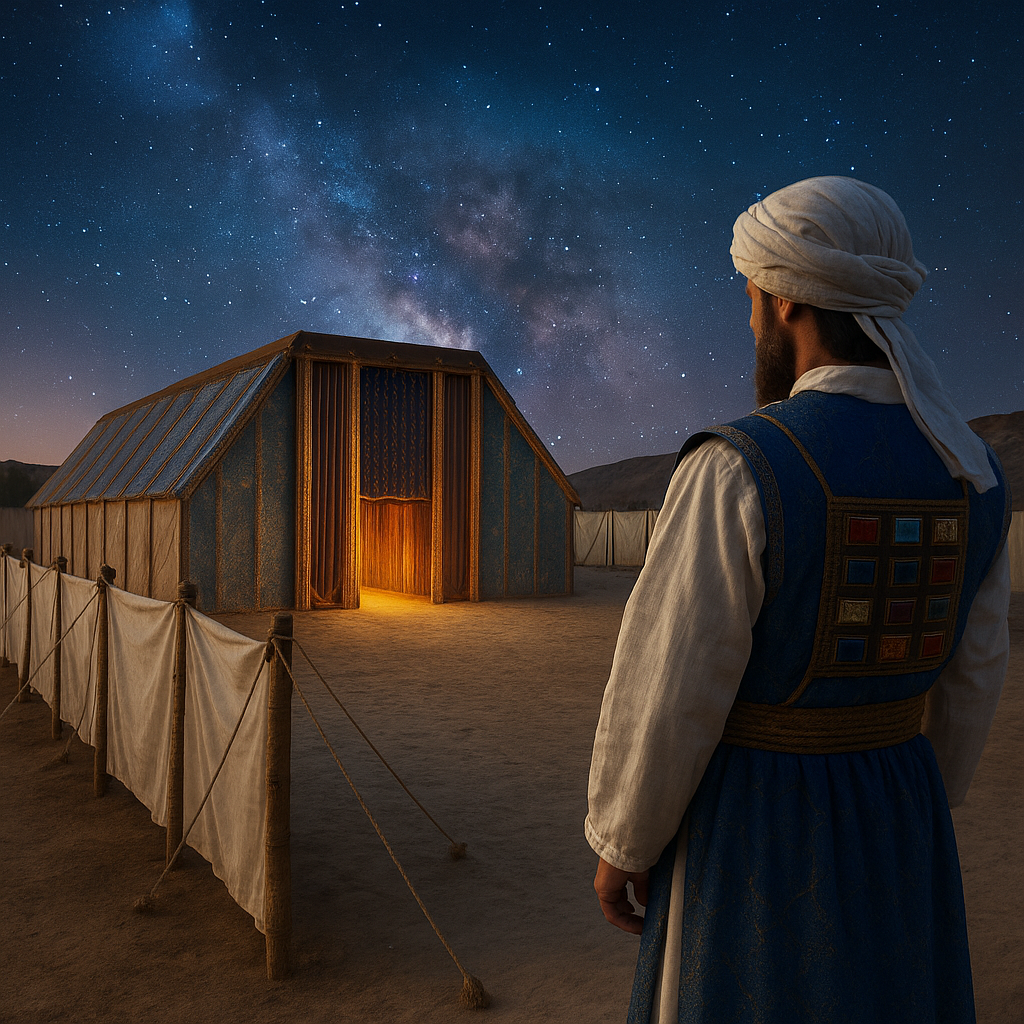
Leviticus is not about arbitrary restriction; it is about structured access. In Exodus 33, during the golden calf incident, Moses met God in a provisional tent outside the camp. By Exodus 40, reconciliation had occurred, and the permanent sanctuary replaced the provisional one. The Tent of Meeting and the Tabernacle are treated as one unified structure, but access is now carefully regulated.

Leviticus 10 demonstrates the danger of unauthorized approach. Leviticus 16 establishes the Day of Atonement, structuring the only annual entry into the Holy of Holies. The pattern remains consistent: unregulated access leads to death; ordered approach leads to life.

Every sacrifice represents regulated nearness. Israel does not return fully to Eden, but it moves toward the presence under defined conditions. Worship—the telos of creation—requires ordered access. Holiness requires limits. Sacred space is not common space.

Leviticus makes clear that life in the presence of a holy God depends upon approaching Him in the way He has prescribed.

The sacrificial system, however, also pointed beyond itself. The blood of bulls and goats cleansed sacred space ritually yet temporarily. In the fullness of time, Yeshua entered the story as the true mediator. His blood was offered once for all. His death addressed the root problem introduced in Genesis 3.

Through His shed blood, sacred space is cleansed at its deepest level. The barrier of restricted access is lifted. What Leviticus regulated through priesthood and sacrifice, Messiah fulfills through His own life given. He becomes both the offering and the High Priest. His work enables humanity to approach a holy God. The restrictions were never discarded; now they are satisfied. His blood opens the way.

He is the door of access.
Leviticus
carpenter

From the Son of a Carpenter to Master Builder of New Creation

The Son of a Carpenter— and the Son of the Master Craftsman

We read that Yeshua was a carpenter, the son of a carpenter, and we move on. The Greek word tekton refers to a builder, a craftsman, a construction artisan someone trained to shape raw materials into a structure. His father, Joseph was such a man. But in the larger biblical narrative, Jesus is not only the son of Joseph the craftsman. He is the Son of the Master Craftsman, Yahweh.

Genesis presents God as the One who orders, separates, shapes, and forms creation. The world does not emerge chaotically but through structured building. Six days of intentional work, melachah, culminate in Sabbath rest. The Hebrew Scriptures use the same term to describe skilled construction — purposeful labor that produces structure. Creation itself is the first great act of divine melachah.

Spirit-Filled Craftsmanship in Exodus

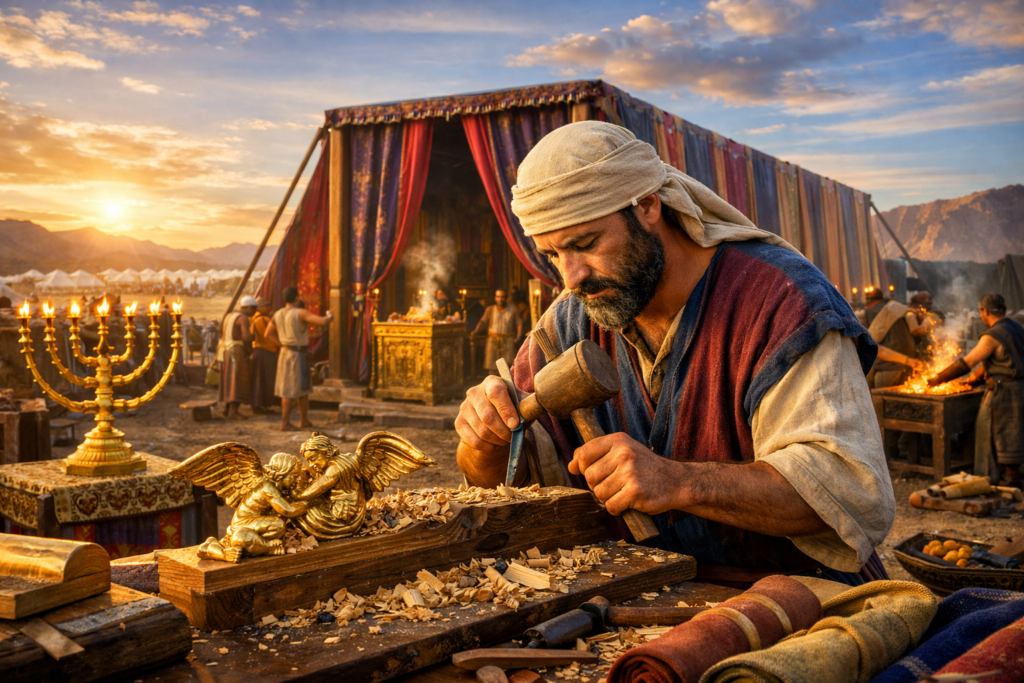
When Exodus introduces Bezalel and Oholiav, the language deliberately echoes Genesis. Bezalel, whose name means “in the shadow (or image) of El,” and Oholiav, “father’s tent,” are filled with the Spirit of God with wisdom (chokmah), understanding (tevunah), and knowledge (da’at) to perform melachah and build the Tabernacle. This is Spirit-empowered craftsmanship. They are master carpenters entrusted with a dwelling place where heaven and earth meet once again.

The placement of the Sabbath command in Exodus 35–40 reinforces the creation pattern. In both Genesis and Exodus, six days of construction precede rest. Completion precedes Yahweh’s indwelling glory.

The parshah Pekudei concludes the book of Exodus. Pekudei means “accounts” or “oversight” and refers to the administrative reckoning of the Tabernacle. The materials are numbered, inspected, and reviewed. The Hebrew root pāqad carries covenantal weight: to visit, to oversee, to reckon. The same word also describes God “visiting” Sarah to bring life and “visiting” Israel to bring deliverance. Divine visitation advances covenant purpose.

Yeshua the Tekton and the True Temple

In the New Testament, Yeshua is called a tekton — a builder, a craftsman, the son of a builder,  and the Son of God, the One who ordered creation itself. Within the broader temple framework this identification is significant. Jesus presents Himself as the true Temple, the locus of divine presence. The Father is the Architect of creation, and the Son embodies that dwelling place.

Greater Works Than This…

Yet the story does not end with Messiah alone. In John 14:12, Jesus, the carpenter states, “He who believes in Me, the works that I do he will do also; and greater works than these he will do, because I go to My Father.” The Greek word for works, ergon, corresponds conceptually to the Hebrew idea of melachah — work accomplished, work that produces structure and result, work that includes worship and sacred action. Yeshua, as carpenter is speaking of the continuing work of New Creation. The ordering, restoring, building work continues.

Paul reinforces this in Ephesians 2:10: “For we are His workmanship, created in Christ Jesus for good works, which God prepared beforehand that we should walk in them.” We are His workmanship, crafted, intentionally formed in order to participate in His crafting work. The language recalls Genesis and Exodus. We were created to create.

Shavuot and the Expansion of Sacred Construction

The Spirit who hovered over the waters in Genesis, who filled Bezalel and Oholiav with wisdom, understanding, and knowledge, and who descended upon Messiah, is poured out at Shavuot upon a gathered people. In the Torah portion V’yakhel, Moses gathers the congregation and declares that work is to be done for six days and rest observed on the seventh. Sacred construction is communal. The skill set for building sacred space does not disappear; it expands.

Wisdom, understanding, and knowledge are the tools of the trade. They are the equipment necessary for sacred craftsmanship. Bezalel worked according to divine pattern. He measured, designed, calculated, and executed with skill. Scripture makes clear that he was Spirit-filled — but he was also disciplined and trained. Gifting requires development. Sacred craftsmanship demands apprenticeship.

Builders of the Greater Tabernacle

We often assume that such building belongs to a spiritual elite — leaders, clergy, scholars. Yet the Tabernacle was constructed in the midst of a gathered congregation. Sacred construction is communal. In the garden, humanity cultivated soil and tended life. In Messiah, that vocation expands. We cultivate communities, restore fractured relationships, construct ordered families, and build just systems. We are builders of the greater Tabernacle — the universal body of Messiah.

This body is structured and ordered. It requires wisdom, understanding, and knowledge. Yeshua’s promise of “greater works” signals expansion because He goes to the Father and the Spirit is poured out universally. The Temple becomes global.

The Ongoing Movement of the Greatest Exodus

Our faith is not passive belief or private spirituality. It is participation in divine melachah. The Father builds. The Son completes. The Spirit equips. The people construct. This is the biblical pattern from Genesis to Exodus to Messiah: God restores His dwelling place by restoring His image in humanity, and that restoration involves skilled, intentional work.

Sabbath marks order. Creation rested because it was complete. The Tabernacle rested because it was finished. Messiah rested in the tomb because His work was fulfilled. Now the work continues through a Spirit-filled people.

The question is not whether renewal is happening. Scripture affirms that it is. The question is whether we recognize ourselves as apprentices in the workshop of the Master Craftsman.

We were created to create. We were formed to build. The tools given to Bezalel and Oholiav — wisdom, understanding, and knowledge remain the equipment of the covenant community. The greater Tabernacle is being assembled. The task before us is faithful construction according to the pattern already given.

This is the ongoing movement of The Greatest Exodus, the rebuilding of humanity into a dwelling place for the presence of God.

carpenter
creation tabernacle

Creation, Tabernacle, and Messiah: The Pattern of Work (Melachah) and Sabbath Fulfilled

From the opening lines of Genesis, Scripture presents God as a craftsman at work. He speaks, separates, shapes, and orders. The Spirit of God hovers over the waters as divine energy poised to create. The refrain repeats: “And God saw that it was good.” The work is good because it is ordered. The work, melachah, the labor of building, moves steadily toward completion. Building creation and tabernacle.

Then comes the seventh day. “Thus the heavens and the earth were finished… and He rested” (Gen. 2:1–2). Creation is an ordered working construction model. The cosmos has become sacred space, and the Sabbath is the sign that the work is complete. Rest is not inactivity. Rest is enthronement. Rest is God’s dwelling place. And he fills it with Himself and his human image bearer artisans who will be responsible to maintain the upkeep of their part of the cosmos – the earth.

Exodus 31: Melachah and the Pattern Repeated

When we turn to Exodus 31, the language is strikingly familiar. Bezalel is “filled with the Spirit of God, with wisdom, understanding, and knowledge” (Ex. 31:3). The same triad used to describe divine creative activity now describes a human artisan serving in a priestly capacity. He is commissioned to perform melachah, skilled work, constructing the tabernacle and its furnishings.

Immediately following this commission comes the command concerning Sabbath (Ex. 31:12–17). The pattern is unmistakable: sacred work followed by sacred rest.

In the narrative, another craftsman tradition stands in the background. The god Ptah was revered as a creator-deity and master artisan in Egypt. He fashioned the world through wisdom and speech, and his earthly manifestation was the Apis bull — a living symbol of strength, fertility, and divine presence. The Pharaoh of Moses’ generation would have known this cult well. It is therefore difficult to ignore the proximity between Israel’s construction of a golden calf and the Egyptian bull imagery that had shaped their former world. Several scholars have noted that the calf of Exodus 32 almost certainly reflects Egyptian iconography, likely drawing upon the Apis tradition. Israel does not invent a new symbol at Sinai; they revert to one they knew.

The juxtaposition is striking. In Exodus 31, Bezalel is filled with the Spirit of God, endowed with wisdom, understanding, and knowledge to construct sacred space according to a heavenly pattern. In Exodus 32, those same human capacities are redirected toward crafting an image — an attempt to localize divine presence through familiar form. One act of craftsmanship prepares a dwelling for the invisible God; the other reduces divine glory to visible representation. Sacred melachah can either order space for God’s indwelling or distort worship through imitation—what we would call idolatry. The question at Sinai is not whether Israel will build, but what kind of dwelling their work will produce.

It Is Finished: Creation, Tabernacle, and the Work of the Craftsman

Scholars such as Naftali Cohn observe that the tabernacle instructions are arranged in a seven-fold structure mirroring Genesis 1, culminating in the Sabbath command. He notes that the narrative of building the tabernacle “echoes the creation story in Genesis 1–2:4a,” suggesting that the tabernacle is portrayed as a new creation—a microcosm of ordered sacred space. The language of completion reinforces this connection. In Genesis, God “finished” (kalah) His work and rested. In Exodus 39–40, Moses inspects the work, sees that it is done, and the work is “finished.” The verbal parallels are deliberate and theological.

G. K. Beale goes further. In The Temple and the Church’s Mission, he argues that the tabernacle represents a symbolic cosmos. Eden was the first sanctuary; the tabernacle replicates that reality in portable form. The sacred structure embodies the ordered world in miniature. As Beale writes, “The tabernacle and temple were microcosmic models of the universe… symbolizing that God’s dwelling place was intended to encompass the whole creation.” If creation culminates in divine rest, then the tabernacle culminates in divine indwelling.

Exodus 31 places Sabbath immediately after the artisan’s commission for a reason. Sacred construction does not eclipse sacred rest. The work of building God’s dwelling culminates in Shabbat. The Sabbath is called a “sign” between God and Israel—a reminder that creation and covenant share the same rhythm. Work that orders space for divine presence is followed by rest that acknowledges completion. Melachah leads to kalah. Completion leads to filling. And filling requires the ongoing maintenance of sacred space through ritual re-enactment—what Scripture calls worship.

This pattern does not end in the wilderness at Sinai.

The Word Tabernacled Among Us

John’s Gospel opens with unmistakable Genesis language: “In the beginning.” But John 1:14 intensifies the pattern: “The Word became flesh and tabernacled among us.” The Greek verb eskēnōsen deliberately evokes tabernacle imagery. The dwelling of God in the wilderness now takes on human flesh. Jesus does not merely visit sacred space; He embodies it.

If the tabernacle was a microcosm, Jesus is the living temple. Beale states plainly, “Jesus is the true temple… the locus of God’s dwelling presence.” In Him, heaven and earth meet again. The creative Word through whom all things were made now stands within creation as the true sanctuary.

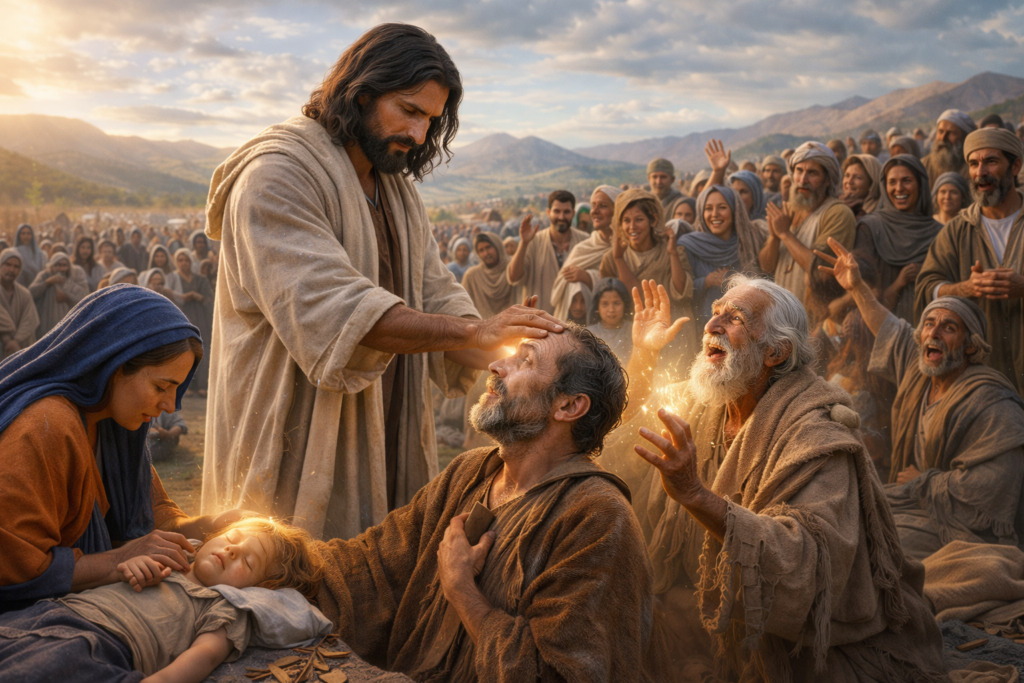
Notice the language of work in John’s Gospel. Yeshua repeatedly speaks of the “works” the Father has given Him to accomplish (John 5:36; 17:4). Though the Greek term differs from Hebrew melachah, the echo is unmistakable. The Son carries out the Father’s work of restoring and reordering creation. His miracles are acts of construction—rebuilding human beings into sacred space for the indwelling of the Holy Spirit. Sight is restored. Flesh is healed. Chaos is rebuked. Bread multiplies in the wilderness. The waters obey. Each sign reveals the Craftsman at work, shaping lives into places fit for divine presence and worship.

Bezalel was filled with the Spirit to construct sacred space. Jesus is anointed by the Spirit at His baptism and begins His ministry of holy work. Wisdom, understanding, and knowledge characterize the Spirit’s activity in Exodus 31. In the Gospels, the crowds marvel at Jesus’ wisdom, and the Spirit descends upon Him. The pattern continues—but now at a cosmic scale.

In Genesis, God finishes His work and rests. In Exodus, the tabernacle work is completed and the glory fills the tent. In John 19:30, Jesus declares, “It is finished.” The Greek tetelestai carries the weight of completion. The work entrusted to Him has reached its appointed end. The mortal body—the true tabernacle—is offered. The veil will soon be torn, opened for access.

If Sabbath in Genesis signified completion, and Sabbath in Exodus marked covenant fulfillment, then the death and resurrection of Jesus announce the completion of the greater pattern. Hebrews 4 speaks of a “rest that remains” for the people of God, tying that rest back to creation and forward to Christ. The new creation emerges from resurrection morning. The Craftsman has finished His work.

The Work of the Living Tabernacle is Finished

The pattern of work and rest does not end with crucifixion; it culminates in resurrection and ascension—divine enthronement once more. The rest of God becomes the rest of Messiah. The tabernacle of flesh gives way to the indwelling Spirit. The Gospels present Jesus as the living tabernacle who performs the Father’s work and declares its completion. Creation, tabernacle, and Messiah form a single theological arc.

Work, melachah, is the building of sacred space so that God may dwell. Rest—Shabbat is the sign that what was intended has been brought to fulfillment.

And when He says, “It is finished,” we are hearing the Craftsman announce that the true dwelling place of God among humanity has been established. The greater Bezalel has finished His work. God’s glory will fill the house.

creation tabernacle
Purim

How Purim Replays the Exodus Story

Though the book of Esther and the celebration of Purim is a captivating story about court intrigue and political reversal, it is also an Exodus story revisited. Different empire. Different tyrant. Different geography. Different circumstances. The message, however, is the same: the deliverance of God’s people in exile. The Exodus is the story through which Israel learns how God acts in history. And in Persia, once again under imperial shadow, that story unfolds.

How Esther Replays the Exodus Story

In the opening chapters of Exodus, Egypt is humming along with its building projects. Pharaoh’s power is consolidated. The machinery of his empire is functioning with precision. Then comes the threat: “The people of Israel are too many and too mighty for us.” Israel’s multiplication unsettles Pharaoh — this external challenge could create political instability for the empire.

In Esther, Persia stands equally secure under King Ahasuerus. The empire stretches across many provinces with bureaucratic efficiency. And again, a threat is perceived at Purim. Haman describes “a certain people scattered and dispersed… whose laws are different from those of every other people.” Their distinctiveness is intolerable, embodied most clearly in Esther’s Uncle, Mordecai. Their allegiance to another law exposes the limits of imperial control.

Pharaoh sees Israel as a resource to be exploited and restrained. Haman sees the Yehudi, those belonging to Judah, as politically subversive. In both narratives, the identity of the people of God collides with imperial fortunes. That collision ultimately provokes a genocidal decree. Empire cannot abide a people whose ultimate loyalty lies elsewhere.

The Decree of Death

So, the decrees are issued.

In Exodus, Pharaoh commands the death of Hebrew baby boys. In Esther, Haman seeks the annihilation of every Jew, men, women, and children, all across the empire. Both convert fear into public policy. Both attempt to legislate the erasure of God’s people.

Passover on the Calendar

Then the text of Esther and the story of Purim introduces a detail tied directly to Passover. “The king’s scribes were summoned on the thirteenth day of the first month” (Esther 3:12). The first month is Nisan. The thirteenth day is the eve of Passover. The decree of destruction goes out on the threshold of Israel’s feast of deliverance.

On Nisan 14, Israel remembers a night when earlier another genocidal decree hung over them in Egypt. A ruler had issued a death sentence. The covenant people were targeted. Deliverance came, and the turning point was Passover.

In Esther, the Persian ruler confirms a death sentence. Once again the covenant people are targeted. Deliverance will come — but through hidden providence at Purim And the threat begins at Passover time.

The author of Esther never names God. Never explicitly invokes Passover. Yet the narrative is framed against the calendar of redemption. It is as if another Pharaoh has arisen. The Exodus is being replayed, though without plagues or parted seas.

The connection deepens when we are told that Haman is an Agagite. Amalek was Israel’s first enemy after crossing the Reed Sea. The wilderness conflict in Exodus 17 reverberates through this genealogical detail. Amalek attacked the weary and the vulnerable. Now an Amalekite descendant rises again to threaten Israel’s existence. The ancient enemy has returned. The Exodus is not finished.

Even the deliverers mirror one another. Moses is raised in Pharaoh’s house, positioned inside the structure of empire. Esther — Hadassah — becomes queen in the Persian palace, embedded within imperial power. Both conceal their identities. Both are elevated not by political maneuvering but by providence. Both hesitate. Both must risk death for the sake of their people.

In Exodus, deliverance centers on redemption through the Passover lamb. Death passes over the homes marked by blood. Pharaoh’s army, pursuing Israel into the sea, is swallowed by the waters of the deep, waters that symbolized chaos. The Reed Sea turns back upon him, a reversal of a place that signified paradise in the Egyptian imagination. The empire’s instrument of control becomes its grave.

In Esther, reversal defines the climax. Haman constructs a towering wooden stake for Mordecai. That very structure becomes the site of his own execution. The weapon formed against God’s people collapses upon Haman. There is a pattern — chaos always turns back upon itself when Yahweh is in charge.

Passover on the Calendar

The story of Esther unfolds at a time when the Temple has already been rebuilt. In 515 BCE, under King Darius of the Achaemenid empire, the Second Temple stands in Jerusalem. Sacrifices have resumed. The presence of God dwells in the land in the Temple. And yet many of the Yehudi choose to remain in Persia. They are geographically separated from the central sanctuary.

If God’s presence is enthroned in Jerusalem, what does that mean for those still scattered in exile in Persia?

The book of Esther does not suggest relocating the Temple to Persia. Instead, it reveals something deeper about God’s dwelling. Though His name is absent from the book, His providence saturates His people wherever they settle. The hidden hand of divine presence is evident.

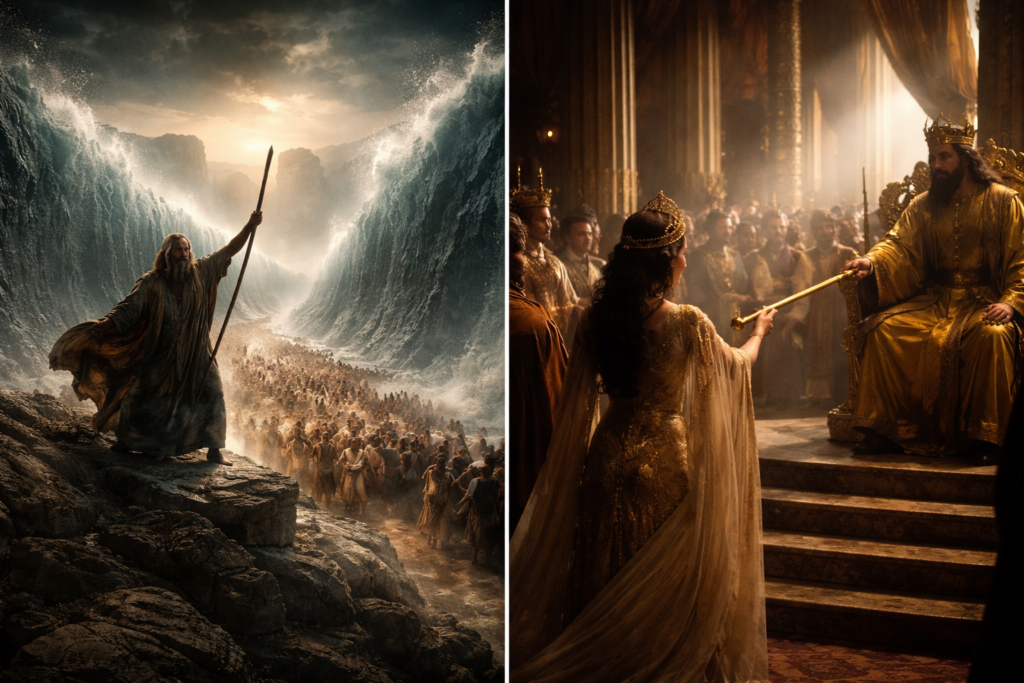
Temple imagery persists even in exile. Instead of sacrifice, there is fasting. Instead of priestly entry into the Holy of Holies, Esther approaches the king’s throne uninvited, risking death. The golden scepter is extended. Acceptance is granted. Like Moses, she stands as mediator between decree and people — a royal high priest in the Persian court.

And though the Temple stands in Jerusalem, God is not confined to Jerusalem.

Exodus culminates at Sinai in a covenant meal. The elders ascend, behold God, and eat in His presence. Deliverance leads to the indwelling presence of Yahweh. Salvation leads to communion. Esther, too, ends with a feast — Purim. Joy replaces mourning. Fear turns into celebration. The people institute an annual remembrance of a mighty reversal.

The date for Purim is set for destruction—Adar 13 becomes a day of Jewish triumph. In Exodus, destruction falls upon those without blood applied to their doorways. In Esther, destruction falls upon those who sought to erase God’s people. Reversal once again marks divine intervention.

The Pattern That Continues

Pharaoh or Haman. Egypt or Persia. Sea or gallows.

The question remains the same: Who has authority over life and death?

Purim answers the same way Passover answered. Certainly not empire.

The Exodus is not a closed chapter in Israel’s history. It is the interpretive lens through which history is understood. Esther and Purim continues the story. God delivers His people so He can dwell with them. In Egypt. At Sinai. In Jerusalem. In Persia.

And perhaps that is why the book of Esther feels so familiar. The names and locations have changed, but the story has not.

Purim
Tabernacle

𝗛eaven on Earth on the Move in the Tabernacle.

Exodus 24 reads like a deliberate replay of Genesis 1. In creation, the heavens and the earth are God’s sanctuary, structured in six days and crowned by Yahweh’s divine presence. At Sinai, the glory of the Lord settles upon the mountain, covering it for six days. Then it moves to the Tabernacle.

Genesis and Tabernacle

From Sinai flows the design of the Tabernacle—a portable creation. The Ark embodies the meeting of heaven and earth, the throne where the invisible King dwells among His people. The menorah, with its seven branches, mirrors the ordering of light in Genesis. The curtains, woven in blue and adorned with cherubim, evoke the firmament that once stretched across the primordial waters.

In Genesis 1, creation itself is God’s sanctuary. He establishes and fills His own cosmic dwelling. There is no “outside,” no rival territory beyond His rule. Heaven and earth together form a single, ordered realm saturated with divine sovereignty.

With the Tabernacle sacred space is concentrated at a center because the world beyond has become fractured, degraded and defiled. From the holy nucleus, God’s sovereignty must move outward. The Tabernacle is now carried by His people so that the Divine Presence can advance and the whole of creation will be filled once more with the glory of the Lord.

The message: His covenant people are participants and have a role to play in the restoration of creation. What are you doing today to see the sovereignty of God spread to earth’s four corners?

Tabernacle
Ephesus

Amazons, Artemis, and Ephesus: The World Paul Entered

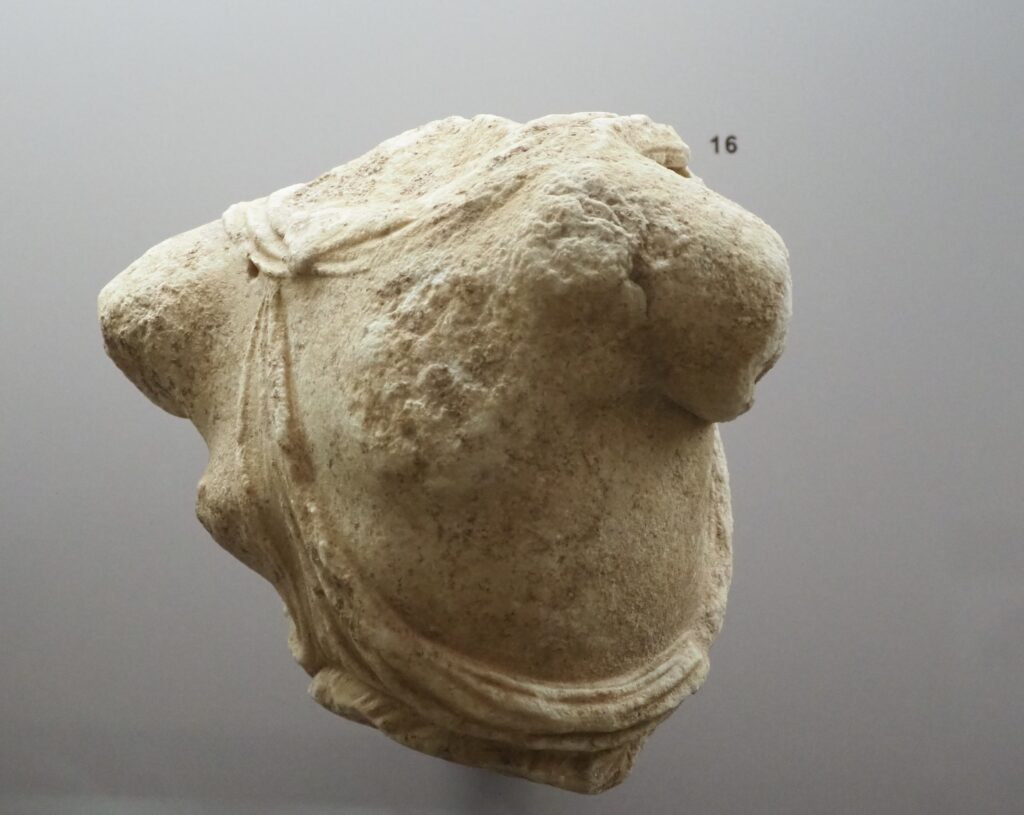
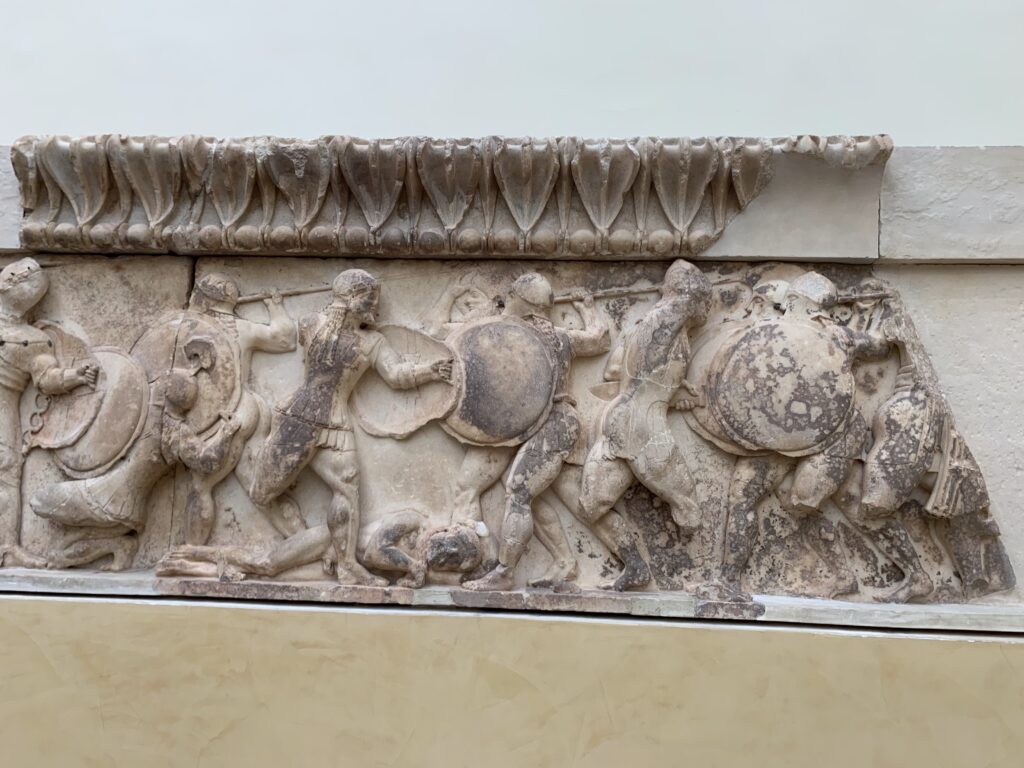
Walking through the museums of Greece was a journey into the ancient world. An ancient world of stone at every turn. Standing in the Acropolis Museum and seeing the remnants of Athena towering over the city. Marveling over the Parthenon friezes. And I noticed something else —carved into marble, painted onto pottery, frozen mid-combat, central to the imagination of the ancient Mediterranean world were the Amazons who settled in Ephesus at one point.

The Amazons were remembered as warrior women from the edges of the known world. Greek writers placed them in Anatolia, around the Black Sea, beyond the boundaries of the polis. Some traditions even said they migrated into parts of Asia Minor and were connected to early Ephesus.

Combat in Stone: How the Ancient World Secured Order

In Greek art, they usually appear in scenes called Amazonomachy — literally, “the battle against the Amazons.” You see it on temple friezes, especially in Athens. The story is consistent: Greek heroes defeat Amazon warriors. Civilization wins. Order pushes back. But the Amazons were only one part of a larger pattern. Everywhere in Greece you also find Gigantomachy — battles between the Olympian gods and the Giants. The Giants rise up from the earth in rebellion. Zeus crushes them. Divine order is secured.

What struck me walking through those museums was how pervasive this combat imagination was. It wasn’t just storytelling. It was a worldview. For most of us, religion often feels private, personal or moral — about beliefs or spirituality. For them, religion was about cosmic stability. It answered the question: why does the world hold together? The friezes were their theology in stone. They reminded citizens who had won and why their city was secure.

Ephesus: A City of Myth, Memory, and Civic Power

Paul writes to Timothy in Ephesus. Ephesus was one of the most symbolically charged cities in the ancient world. It was Roman, yes. But it was also Anatolian and Greek, layered with mythic memory and civic pride.

Ancient writers like Strabo preserved stories that Amazons once settled in parts of Anatolia and were connected to Ephesus. The Amazons were not just warriors; they were symbols of contested order — disciplined, powerful women from the east. Ephesus carried that mythic story.

At the center of the city stood the Temple of Artemis — one of the wonders of the ancient world. Artemis of Ephesus was not merely the bow-carrying huntress of Athens. She was a civic deity, guardian of prosperity and identity. Her image, likely adorned with ornamental pendants and jewels rather than literal breasts, symbolized abundance and divine protection. The temple was not only religious. It functioned as a financial center, a bank, a pilgrimage hub, and a major economic engine.

When Rome absorbed Greek culture, Artemis was identified with Diana. But the Ephesian cult retained its Anatolian character. Artemis shaped the city’s self-understanding.

Ephesus did have prominent women. Inscriptions show female benefactors, priestesses, and patrons. Wealthy women could wield influence within religious and social networks. The cult of Artemis gave women visible roles. But Ephesus was not a matriarchy. Civic authority still rested with male magistrates under Roman rule. The city was patriarchal in structure, even if symbolically centered on a goddess.

Paul in a Combat-Shaped Culture

Paul’s first letter to Timothy reads more like pastoral correction. False teaching was spreading. Speculative myths were circulating. Status and wealth were being displayed in ways that disrupted worship. Certain women appear to have been caught up in teaching error or asserting authority without grounding. Paul tells them to learn. He calls for modesty. He restricts certain forms of teaching authority.

So what was he pushing back against? All women for all time? Or something local?

Scholars debate this. Some argue that Artemis worship fostered an environment where women were accustomed to religious prominence, and Paul was correcting excess. What we can say with confidence is the Ephesus was shaped by the cult of Artemis, that women had visible religious roles, that wealthy female patrons likely influenced house churches. False teaching was present. Paul’s response was not a blanket criticism of women everywhere.  

Writers like S. M. Baugh argue that Artemis shaped the city’s culture in real ways. Paul’s instructions in 1 Timothy reflect local correction — especially regarding modesty, teaching, and authority — rather than universal condemnation.

Others, like Catherine Kroeger, argued more strongly that Artemis ideology promoted female supremacy and that Paul was countering that worldview directly. But that position remains debatable.

The real issue was never male versus female. It was order versus disorder within a very specific civic-religious environment.

Paul and the early Christians preached in a world saturated with the images of gigantomachy, and Amazonomachy. Temple friezes showed divine warfare. Sacred spaces commemorated mythic victory. Art depicted chaos subdued.

So when Christians proclaimed, “Jesus is Lord,” it was heard in a culture accustomed to enthronement through combat. But the Gospel didn’t reject the combat pattern; it reinterpreted it. The decisive victory is not Zeus hurling lightning. It is a crucified Messiah raised from the dead.

In Ephesus, Artemis towered over the skyline. Her temple defined civic identity. Yet Paul proclaimed that the true temple was not marble but people indwelt by the Holy Spirit. Authority would not be secured through mythic battle but through the cross and resurrection.

The Amazon memory in Ephesian tradition does not mean warrior women were running the city in Timothy’s day. But it does mean the city was shaped by stories in which female figures carried symbolic power within a larger combat worldview. Paul’s instructions must be heard against that layered background: Roman administration, Anatolian myth, Greek combat imagination, and a booming temple economy.

In a culture that secured order through stories of divine dominance, Paul quietly reshaped a community around a crucified King.

Ephesus
seventh

Six Days for Humanity, the Seventh for the King

The section of Exodus known as Mishpatim (Exodus 21–23) is often read as a collection of civil laws. The Hebrew word, however, carries more weight. Mishpatim refers to judgments and justice and the seventh. These are not just random case laws; they form a blueprint for how a covenant society is meant to function. They answer a foundational question: How do human beings live together in a way that protects the vulnerable, restrains power, and prevents the social decay that inevitably follows unchecked authority?

Mishpatim and the Architecture of Covenant Society

The answer is structured around a patter already established in creation itself: six and seven. The six-day seventh-day pattern, however, is not confined to Genesis 1. It becomes the organizing principle of Israel’s economic life, agricultural system, labor structure, and worship. It is civilizational.

For six days, humanity works. Work is not merely economic activity; it is cultivation. It includes sowing fields, managing households, adjudicating disputes, handling contracts, regulating servitude, and maintaining social order. The six-day principle is the arena of human responsibility toward one another.

Mishpatim makes this explicit. A Hebrew servant serves six years and goes free in the seventh without payment (Exodus 21:2). For six years the land is sown and harvested; in the seventh it rests so that the poor may eat (Exodus 23:10–11). Six days work is done, but on the seventh day even the ox, the donkey, the son of the handmaid, and the outsider must rest (Exodus 23:12). The verb used, naphash, carries the sense of catching one’s breath when weary. The Sabbath, the seventh, is not merely a ritual pause; it is an economic and social interruption.

Six days are oriented toward sustaining human life and building a just society. The seventh reorients that society toward its true sovereign. There is a distinction. The seventh day is not simply the absence of work; it is a different kind of work. It is the work of approach. It is ritual service, worship, priestly mediation, drawing near into the dwelling place of the divine ruler.

Creation itself establishes this movement. Six days of forming and filling culminate in divine rest. That rest is not inactivity; it is enthronement. God takes His seat within an ordered cosmos. The seventh day marks the establishment of divine kingship over creation.

The Seventh Day as Royal Encounter

The same structure appears at Sinai. Exodus 24 describes the glory of the Lord settling/tabernacling—shakan upon the mountain. The cloud covers it for six days. On the seventh day, God calls to Moses from within the cloud. Six days of concealment; on the seventh, access. The seventh is the day of face to face encounter.

Moses enters the thick darkness (Exodus 20:21) to receive Torah and further instruction. Later, he ascends again to intercede and renew covenant (Exodus 34), descending with his face shining from the reflected glory of God. Kingship is publicly declared: “I am the Lord your God.”

The Psalms preserve this liturgical memory. Psalm 47 announces, “God reigns over the nations.” Psalm 24 imagines gates lifting to receive the King of Glory. Psalm 93 declares, “The Lord reigns; He is robed in majesty.” Psalms 96–99 repeatedly affirm, “The Lord reigns.” These enthronement psalms were likely sung during festivals such as Sukkot, when Yahweh’s kingship was publicly celebrated.

The Six-Day Framework of Human Responsibility

The Sabbath functions as a weekly reenactment of that enthronement.

Each seventh day interrupts the six-day cycle of human cultivation to acknowledge that provision ultimately comes from the divine ruler. Without the seventh, the six becomes self-referential. Productivity becomes what’s most important. Wealth accumulates without restraint. The vulnerable are forgotten.

Mishpatim prevents that collapse by embedding justice within the six-day framework and grounding it in the seventh. The release of the Hebrew servant in the seventh year, the resting of the land for the sake of the poor, the command that even animals and outsiders must rest—these are structural safeguards. They prevent society from becoming purely exploitative.

This pattern reappears in the Gospels. On a high mountain, Yeshua is transfigured before Peter, James, and John (Matthew 17:1–9). His face shines, recalling Moses’ radiance after Sinai. Moses and Elijah, both associated with mountain theophanies, appear beside Him. A bright cloud overshadows them, and a voice declares, “This is My beloved Son.” The enthronement formula of Psalm 2 is invoked.

From creation to Sinai to Tabernacle to Transfiguration, the six/seven structure holds. Six days orient human beings toward sustaining society by ensuring justice, compassion, and economic stability. The seventh orients society toward the divine ruler whose kingship makes justice possible.

A society that ignores the seventh will eventually distort the six. A society that neglects the six while emphasizing the seventh becomes detached from concrete justice.

Six days are given for humanity’s work on behalf of humanity. The seventh is given for humanity’s work toward God. In that rhythm, covenant life remains balanced, and the world does not collapse under its own ambition. When the seventh is forgotten, the six inevitably turn inward and justice erodes. The rhythm of six and seven anchor society in both responsibility and reverence, ensuring that human labor remains accountable to the divine King.

seventh
Divine Warrior

Cosmic Combat at the Sea: Yahweh as Divine Warrior

The crossing of the Sea of Reeds in Exodus 14–15 is far more than a dramatic escape from Egypt. It is the climactic battle scene in Yahweh’s war against Egypt and its gods, revealing Him unmistakably as the Divine Warrior. In the ancient world, divine authority was often demonstrated through combat with chaos and frequently personified by the sea. The sea represented untamed disorder, unpredictability, and death. Israel’s stand at the water’s edge places them squarely within this ancient cosmic drama.

Chaos Confronted: The Divine Warrior Battles at the Threshold of Creation

Israel finds herself trapped between two chaos forces: Pharaoh’s military power pressing from behind and the impassable sea blocking the way forward. In this liminal space, fear exposes the grip of Egypt’s worldview on Israel’s heart. The people later cry out that it would have been better to serve Egypt than to die in the wilderness. Though physically freed, they still wrestle with doubt, still uncertain whether Yahweh as Divine Warrior is truly stronger than the forces that once ruled them. Idolatry has not yet been fully uprooted.

Yahweh’s response is a command that initiates cosmic action: “Raise your staff; stretch out your hand.” When Moses obeys, it is Yahweh Himself who engages the battle. The Hebrew verb bakah—to split, tear, or break open describes the parting of the sea. This same verb appears in later messianic contexts linking it to a broader biblical pattern of divine intervention through rupture. In ancient combat myths, victory over chaos often involved cutting or splitting the chaos monster in two. Yahweh’s act fits this while redefining it.

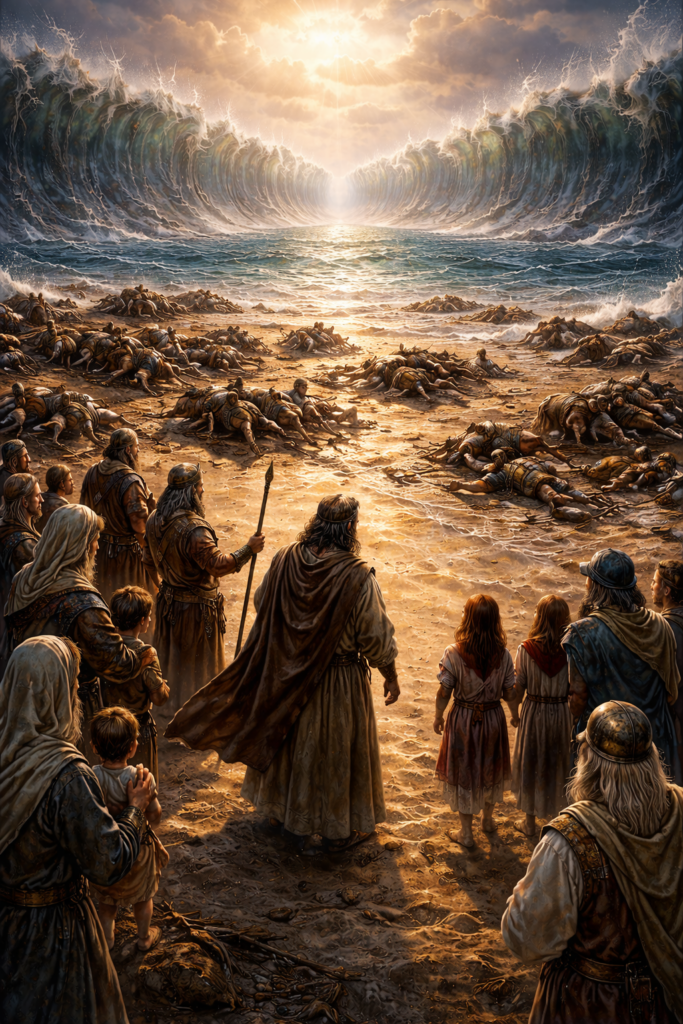
With a blast of His breath, the Divine Warrior piles the waters into walls on either side, an imposing structure. In Torah scrolls the text is written in a brick-like pattern, visually reinforcing the order now imposed on chaos. Dry land emerges—a deliberate echo of Genesis 1, where God gathers the waters so that life can appear. Yahweh is not only rescuing Israel; He is reenacting creation itself.

The crossing is a sacred threshold. Just as blood on the doorposts during Passover marked a boundary between death and life, the parted sea becomes a doorway through which Israel passes from bondage into freedom. The pillar of cloud and fire stands as a divine barrier, casting darkness toward Egypt and light toward Israel—another echo of the creation account’s separation of light from darkness.

When the Egyptians pursue Israel into the sea, the Divine Warrior turns the battlefield against them. Chariot wheels are jammed, the army is thrown into confusion, and the waters are released to return to their place. What unfolds resembles a River Ordeal—a common ancient test of innocence or guilt. Egypt is judged by water and found guilty. The very force meant to assert Pharaoh’s dominance becomes the instrument of his defeat.

As the waters recede, Israel sees their enemies lifeless on the shore. This marks a covenantal threshold. The people now belong to Yahweh, protected by Him and separated from Egypt’s power. At last, they fear Yahweh, the Divine Warrior and believe. The hold of idolatry begins to loosen. Egypt’s gods, manifest in its military, economy, and religious system, have been decisively shattered.

The location of the crossing carries some theological weight. In Egyptian mythology, the Field of Reeds was a realm associated with the afterlife, resurrection, and Osiris, the god of the dead. For Pharaoh and his army to perish there is deeply ironic. They pursued immortality and instead encountered judgment. Yahweh overturns Egypt’s mythology using its own symbols, demonstrating His supremacy over life, death, and the cosmos.

From Victory to Kingship: The Divine Warrior at the Sea

Exodus 15 responds to this victory with the Song of the Sea, a triumph hymn that blends history, theology, and worship. The song proclaims the great victory. It begins with Yahweh’s identity as Warrior and concludes with His eternal reign as King. It announces the restoration of cosmic order. Though rhreats arise and chaos confronts God’s people, Yahweh triumphs, and creation is renewed.

This liturgical moment bridges deliverance and testing. It grounds Israel’s identity in Yahweh’s victory. The Divine Warrior has defeated the sea, overthrown Pharaoh, and opened the way for covenant, worship, and new creation. Yahweh reigns forever and ever.

Divine Warrior
Worship

Worship as the Undoing of Chaos

The portion Bo (Exodus 10–13) brings the Exodus narrative to its climax. The final plagues—locusts, darkness, and death are carefully ordered acts within a larger combat narrative and which challenge Israel’s worship. These chapters reveal that the conflict between Yahweh and Pharaoh is not just political but is cosmic. At stake is the question of who rules the world and by what means order is sustained.

Worship as Liberation: From Forced Labor to Avodah

At the center of this struggle stands a repeated divine command: “Let my people go, so that they may serve me.” The Hebrew verb shalach (“send,” “send away,” “let go,” “release”) suggests a forceful removal. Pharaoh must release what he refuses to relinquish. Yet the purpose of this sending is equally important: “so that they may serve me.” The word avad means both labor and worship. Israel is being transferred from one form of service to another, from forced labor under Pharaoh to voluntary worship/service under Yahweh. The Exodus is a movement from oppressive service to restorative service. Worship is the means by which chaos is undone. It is the solution to world crisis.

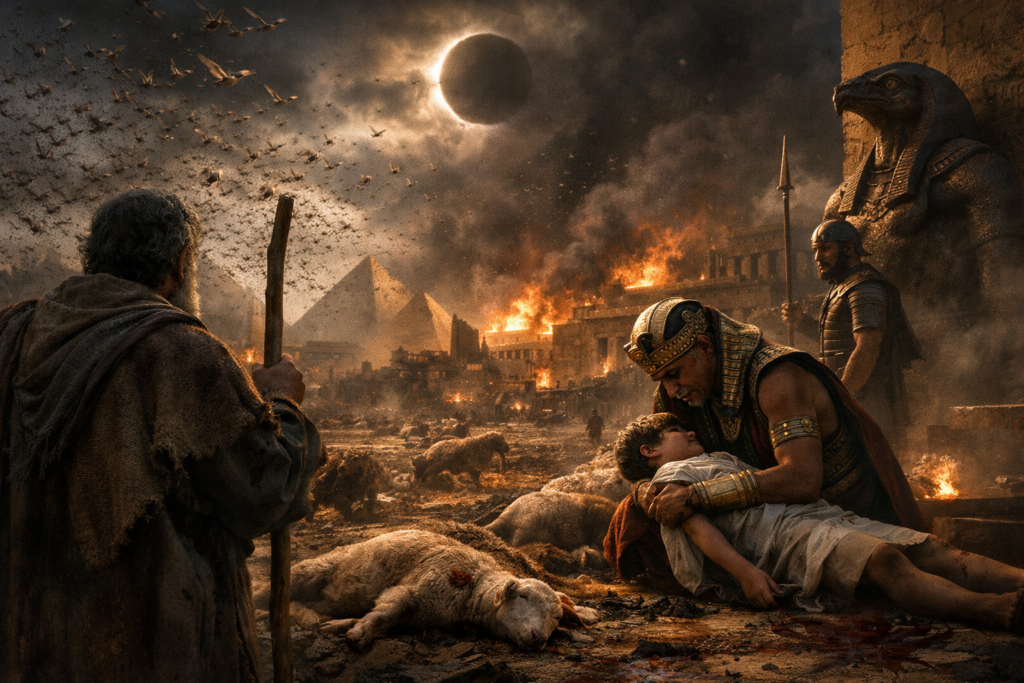
The plagues of Bo reveal how Yahweh dismantles Egypt’s theology of power. Locusts are announced as an invasion that will “cover the face of the earth” and consume what remains after the hail. This is language of de-creation. Egypt’s agricultural abundance, its control over land and food, is stripped away. The darkness that follows is described as thick and tangible, lasting three days. It is a direct challenge to Ra, the sun god. Egypt’s most revered deity is rendered powerless, while Israel remains in light. Creation itself appears to unravel under Yahweh’s command.

Pharaoh’s negotiations during these plagues expose the true nature of his resistance. He offers partial release: the people may go, but their flocks and herds must remain behind. Livestock represented wealth, stability, and future productivity. Pharaoh’s refusal is essentially economic. He will not let go of his “cash cow.” Egypt has relied on Israel’s labor and expertise, particularly in animal husbandry, and Pharaoh is unwilling to surrender his resources. Moses responds with theological clarity: the people must take sacrifices with them, and they will not know how they are to serve Yahweh until they arrive. Worship cannot be dictated by empire. It cannot be scheduled, minimized, or controlled by the very system it seeks to escape.

Divine Combat and the Dismantling of Egypt’s Gods

The final plague, the death of the firstborn, brings the conflict to its most severe point. Throughout ancient Near Eastern mythology, gods established their right to rule through cosmic combat. Creation and kingship were born of conquest. Egyptian religion reflected this worldview. Myths such as Set murdering Osiris or Sekhmet slaughtering humanity at Ra’s command portray a divine order sustained through violence. Pharaoh, viewed as a living god, maintained this order through domination, coercion, and even mass infanticide. His decree to drown Israel’s sons in the Nile was an act of state-sponsored de-creation.

Yahweh’s judgment responds measure for measure. The death of the firstborn is a direct confrontation with Egypt’s theology of power. Pharaoh’s own house is struck, revealing his impotence. In the ancient world, it was the king’s responsibility to preserve order. By failing to do so, Pharaoh is publicly exposed as a false chaos-tamer. The Egyptian people witness the humiliation of their god-king by the invisible God who acts through Moses.

The structure of the plagues reinforces this message. The first nine are arranged in three cycles of three, each building in intensity and followed by a pause. The final plague stands alone as the climax. This rhythmic progression heightens tension. These are strategic strikes. Yahweh uses nature itself as His weapon turning Egypt’s environment against its own gods. Each plague dismantles a specific aspect of Egypt’s pantheon and worldview in real time.

Yet Yahweh’s aim is not destruction for its own sake. Strike by strike, He is liberating Israel not only from physical bondage but from internal slavery—the mindset of empire that equates power with violence and order with domination. The plagues create space in Israel’s heart for true worship. Before they can be reshaped as a covenant people, the gods of Egypt must be slain.

The Exodus plagues, therefore, are a combat sequence. They are a war between justice and oppression, between creation and chaos. In Genesis, God subdues chaos by separating land from sea and filling the void with life. In Exodus, Yahweh again confronts chaos—this time embodied in empire, idolatry, and false worship. He defeats Pharaoh, judges the gods, liberates the oppressed, and begins the long process of restoring a people who have forgotten what it means to be free.

worship
Athena

Creation by Conflict: Athena, the Gods, the Giants, and the World They Made

One of the highlights of my trip to Athens was a visit to the Acropolis, literally the “high city” and to the Acropolis Museum—a must-see before visiting the Parthenon, the Erechtheion, and the remains of the old Temple of Athena. The museum provides essential context, allowing the visitor to understand how the Athenians envisioned order, power, and the divine.

Athena, the Acropolis, and the Architecture of Order

The Parthenon was dedicated primarily to Athena Parthenos, Athena the Virgin. It housed a massive gold-and-ivory statue of the goddess and emphasized civic order and protection, military readiness and victory, and imperial identity and power. The Erechtheion, by contrast, was dedicated to Athena Polias, Athena of the city. This was the older and more sacred cult, tied to the earliest history and identity of Athens.

According to tradition, the Erechtheion marked the site of the contest between Athena and Poseidon for patronage of the city. Poseidon struck the rock and produced salt water, a symbol of raw power and domination. Athena offered an olive tree. The Athenians judged her gift superior, and she became Athena Polias, guardian of the city. The olive tree mattered because it represented a different kind of order. It provided food, oil, light, medicine, wood, and long-term stability.

The Erechtheion was built around this sacred tree, preserving it within the architectural heart of the Acropolis. Even when the Persians destroyed Athens in 480 BCE, the olive tree was said to have resprouted immediately, reinforcing its symbolism that life cannot be extinguished.

Gigantomachy: When Creation Is Secured Through Violence

The museum also preserves the clearest visual expressions of how the ancient world understood creation, order, and power. Throughout its galleries, especially the Archaic Gallery and the Parthenon Gallery, Athena and the Olympian gods are repeatedly shown in violent conflict with the Giants. These scenes belong to a mythic cycle known as the Gigantomachy, a classic theme of divine struggle that shaped Greek religious imagination and civic identity.

The Gigantomachy depicts the battle between the Olympian gods and the Giants, a primordial race born from the earth itself. In Greek thought, the Giants were not merely large enemies; they embodied chaos, excess, and instability. They represented forces that threatened cosmic order and civic life. The defeat of the Giants was therefore necessary for the world to remain habitable.

Athena occupies a central role in these scenes. Marble reliefs in the Archaic Gallery, originating from the earlier Temple of Athena Polias, show Athena in the act of spearing a Giant. The east metopes (rectangular sculpted panels) of the Parthenon continue this theme in a more formalized and monumental style. Here, Athena appears in full battle gear alongside other gods, engaged in a long and violent struggle that culminates in the defeat of the Giants. One of the most striking examples is Athena’s combat with a Giant, one of the few clearly identifiable mythic combat scenes in which her warrior role is unmistakable.

These images communicated a worldview. In the ancient imagination, creation and stability emerged through violence. Order was born from conflict, and civilization endured only because the gods had crushed rival divine or semi-divine forces. The Gigantomachy captures this assumption with remarkable clarity. Chaos does not recede voluntarily; it must be subdued. The Giants are remnants of primordial disorder, and their destruction secures the cosmos.

Athena herself embodies a particular version of this logic. She is one of the most complex figures in Greek mythology, representing wisdom, strategic warfare, craft, and civic order. Unlike gods associated with uncontrolled violence, Athena represents measured power: intelligence applied to conflict, restraint guiding force. Her mythic birth reinforces this identity. According to Greek tradition, Athena is born fully armed from the head of Zeus, not from a womb. Order, in this account, emerges from divine intellect rather than generative process. She is Zeus’s ally, not his rival, and her authority reinforces the stability of the pantheon rather than threatening it.

As Athena Polias, guardian of Athens, she presides over law, political life, architecture, weaving, and education. The Parthenon stands as a civic and religious monument to her role as the one who secures the city’s order. When Athena battles Giants in temple sculpture, the message is clear: the city remains stable because chaos has been defeated. Divine violence underwrites civic peace.

This pattern reflects a widespread ancient assumption. Creation is not sustained through speech or covenant, but through the ongoing suppression of rival powers. Violence is not a tragic necessity; it is the engine of order. The world exists because someone stronger won.

God Speaks: The Bible’s Alternative Vision of Creation

Contrast this with the biblical worldview. Although the Bible speaks into this same symbolic world, it tells a strikingly different story. While it acknowledges chaos and opposition, often personified through sea monsters, hostile powers, and giants, it does not ground creation in divine warfare among equals. In Genesis, God does not fight other gods to create. He speaks. He separates. He orders. Light, land, and life emerge not from violence, imperial power, or bloodshed, but from divine command.

Even when biblical texts employ combat imagery, the emphasis differs sharply from the ancient mythic pattern. God’s authority is never in question. He will prevail. Chaos is real, but in the biblical story it is not ultimate. It does not rival God’s creative power; rather, it resists it.

This distinction becomes clear when considering giants in the biblical tradition. Like their ancient Near Eastern counterparts, biblical giants symbolize disorder, violence, and corruption. Yet they are never portrayed as cosmic equals to God. They threaten human faithfulness, not divine sovereignty. The struggle, then, is not between gods, but within human nature—between trust and fear, obedience and moral corruption.

The biblical battle is fundamentally moral rather than mythic. Where ancient myths portray creation as the outcome of divine rivalry, the Bible presents creation as sustained through wisdom and covenant fidelity. Violence does appear in certain biblical narratives, but it is never the foundation of order or divine will.

Seen in this light, the Gigantomachy panels in the Acropolis Museum provide a visual theology of the ancient world, a worldview in which stability depends on continual domination and creation emerges from conflict. Against this backdrop, the biblical creation account stands apart. It offers a vision of order grounded in the Word of God, moral restraint, and faithful governance. Scripture insists that the world endures because God speaks and what He speaks holds it together.

Athena
Skip to content