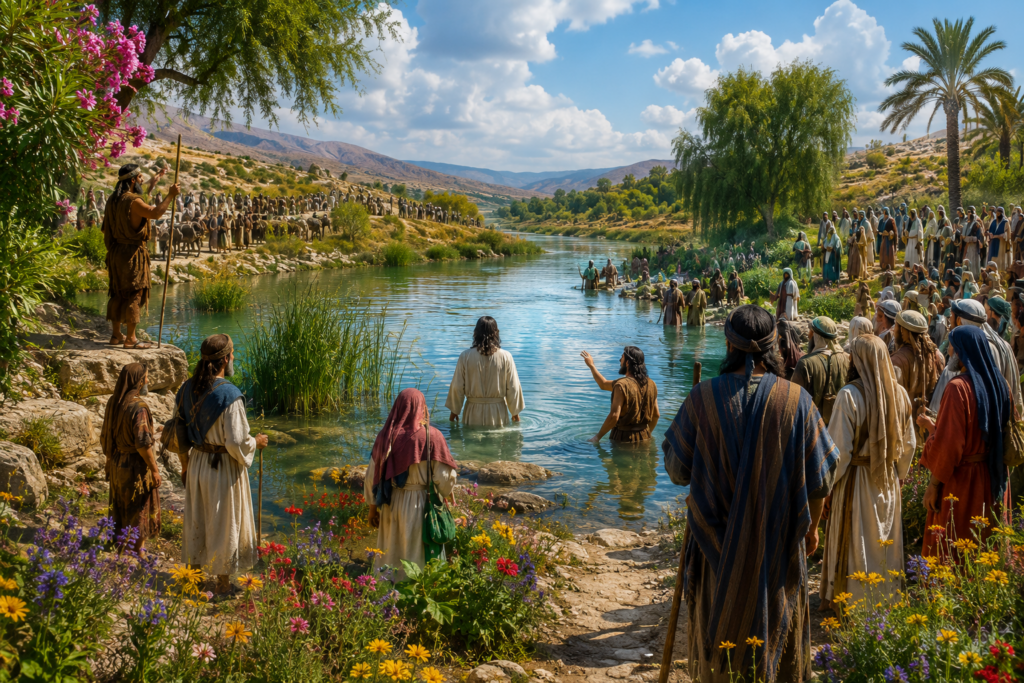
What does it mean to be redeemed? We often use the word as another way of saying that someone has been saved or rescued. Rescue is certainly part of redemption, but the biblical story goes much further. To be redeemed is to be reclaimed, possessed, brought back, restored to the One to whom we were always meant to belong. Redemption gives us a new identity because it changes our ownership and, with it, our allegiance.
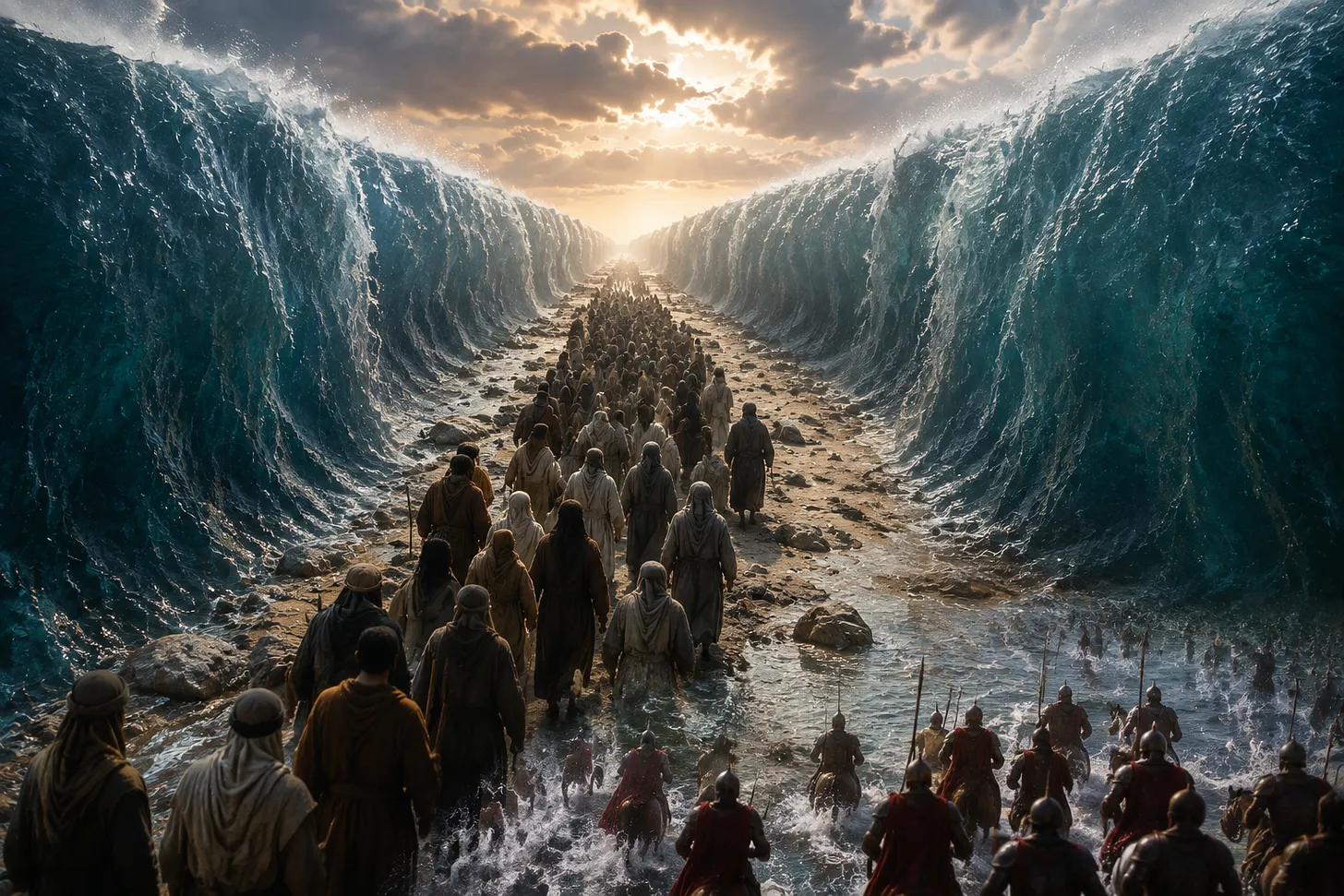
The Exodus gives us the architecture for understanding this larger story. Israel was enslaved in Egypt, serving Pharaoh and living under the shadow of Egypt’s gods. When Yahweh came to deliver them, He confronted not only a political ruler but the entire system of power that held His people captive. The plagues exposed the impotence of Egypt’s gods, while the Sea of Reeds brought the conflict to its decisive conclusion. Israel passed through the waters as Pharaoh’s army pressed close behind. The people emerged alive; the enemy disappeared beneath the deep.
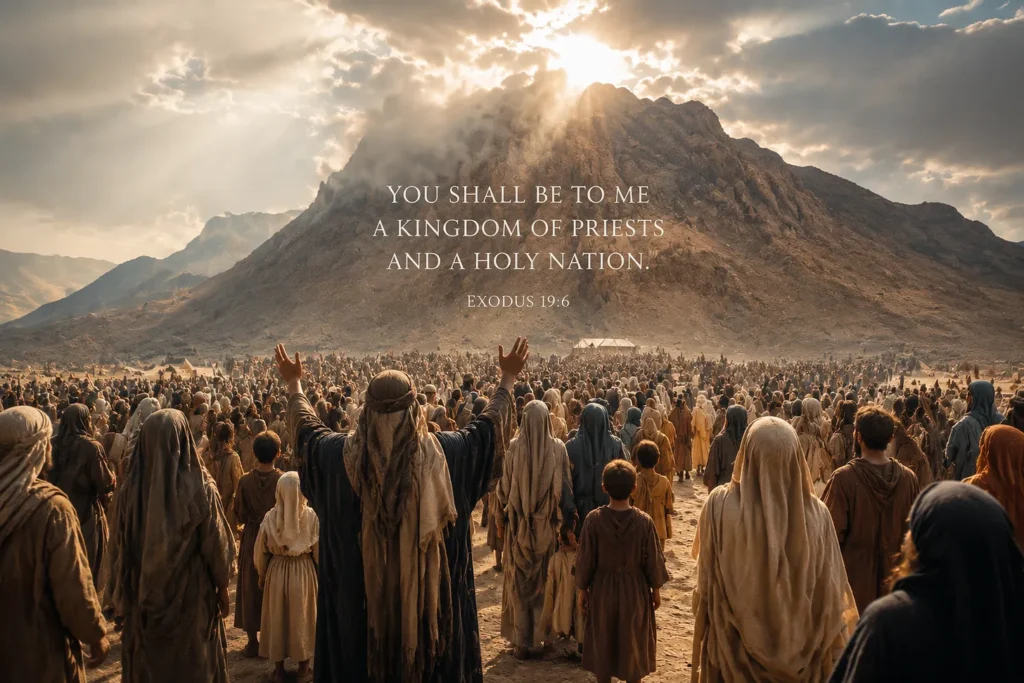
Getting Israel out of Egypt was only the beginning. Had rescue been the entire purpose, the story could have ended on the far side of the sea. Yahweh brought the people to Sinai and declared them His treasured possession, a kingdom of priests and a holy nation. Released from Pharaoh, they were now owned by Yahweh. Their service, allegiance, and identity had been transformed. Rescue brought them out. Redemption claimed them as His own.
Israel’s story, then, becomes a microcosm of the human story. What God began with Israel He intended to extend to humanity and ultimately to creation itself. Exodus was the blueprint for cosmic redemption, not its final fulfillment. Israel became the vehicle through which God would advance His purposes—carrying His presence and making Him known among the nations.
The wilderness became the proving ground for this calling, where God formed a people who could live with Him in their midst. In the barrenness of the desert, the Tabernacle stood as a sign of Eden being reclaimed. God was dwelling with humanity again. Israel was learning to live under His rule, depend upon His provision, and represent Him before the nations.
Yet the larger human captivity remained. Behind Pharaoh, Babylon, Rome, and every other empire stood an enemy no human ruler could defeat. Death held humanity in its grip.
We were created to bear God’s image and extend His life-giving rule throughout creation. Humanity rejected the God of life, distorted His image, and gave itself to other masters. Humans continually exploit, dehumanize, devour, and destroy one another. Violence becomes ordinary. Truth becomes expendable. And Creation bears the wounds of our rebellion. In trying to establish ourselves apart from God, we became slaves to the powers that destroy us.
We needed more than rescue. We needed to be reclaimed.
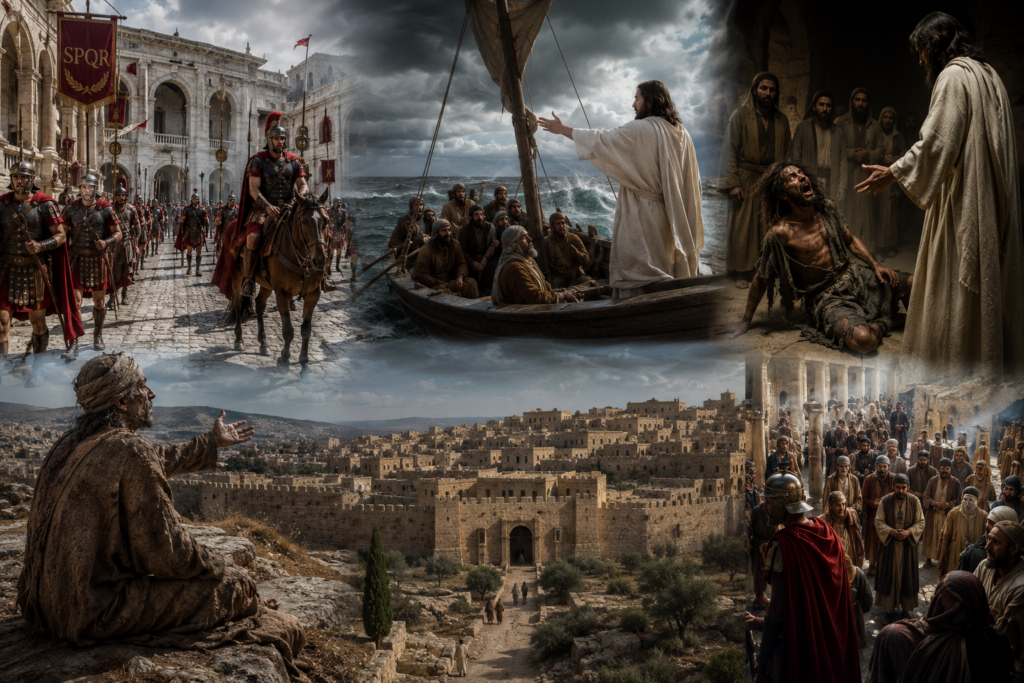
This is the world into which Yeshua came. Many longed for a deliverer who would free Israel from Rome, but Rome was not the greatest enemy. Yeshua came to confront the power behind every human empire and every grave. His mission was firmly covenantal, rooted in Israel’s longing for Yahweh to return and dwell among His people.
His gathering of twelve disciples was not incidental. The twelve mirrored Israel’s twelve tribes. Around Himself, Yeshua was forming a renewed Israel to carry God’s ancient mission forward. Israel had been called to be a kingdom of priests and a light to the nations. Yeshua was bringing that calling toward its intended fulfillment.
But first the greater Pharaoh had to be defeated.
Yeshua willingly entered the realm from which no human being returns. Death had swallowed every generation before Him and never released its captives. Yeshua entered that realm and broke its power from within. The resurrection is far more than a great miracle. It is the reality that the old master has lost his claim.
Paul describes redemption in precisely these terms: God “rescued us from the domain of darkness and transferred us to the kingdom of His beloved Son” (Col. 1:13). The dominion has changed. We have been repossessed by the living God.
The empty tomb announces a new Exodus. The redeemed belong to another King, bear another allegiance, and carry His presence into the world. The redeemed are His living tabernacle in motion, a kingdom of priests entering contested spaces and establishing signs of His life-giving rule.
The former master has been defeated. The King is alive, and the redeemed belong to Him.
One of the great biblical themes is “the place that the LORD your God will choose to put His Name.” Moses directs Israel to one location where sacrifices are offered and covenant life is centered. This is the sacred center—the place where heaven and earth meet because God Himself chooses to dwell.
In the ancient world, names carried far greater significance than they do today. A name represented identity, character, authority, and existence itself. God reveals Himself to Moses as the One “who was and is and is to come,” the eternal One whose very Name declares His unchanging existence. To place His Name somewhere is to establish His presence, His rule, and His covenant authority there.
The Hebrew word is makom, meaning “place.” In Jewish tradition, HaMakom, “The Place,” becomes one of God’s titles. God, in a very real sense, is the Place. He is the One in whom all creation exists and finds its stability. The sacred place is where His presence is established, where His covenant is confirmed, and where His people come to stand before Him.
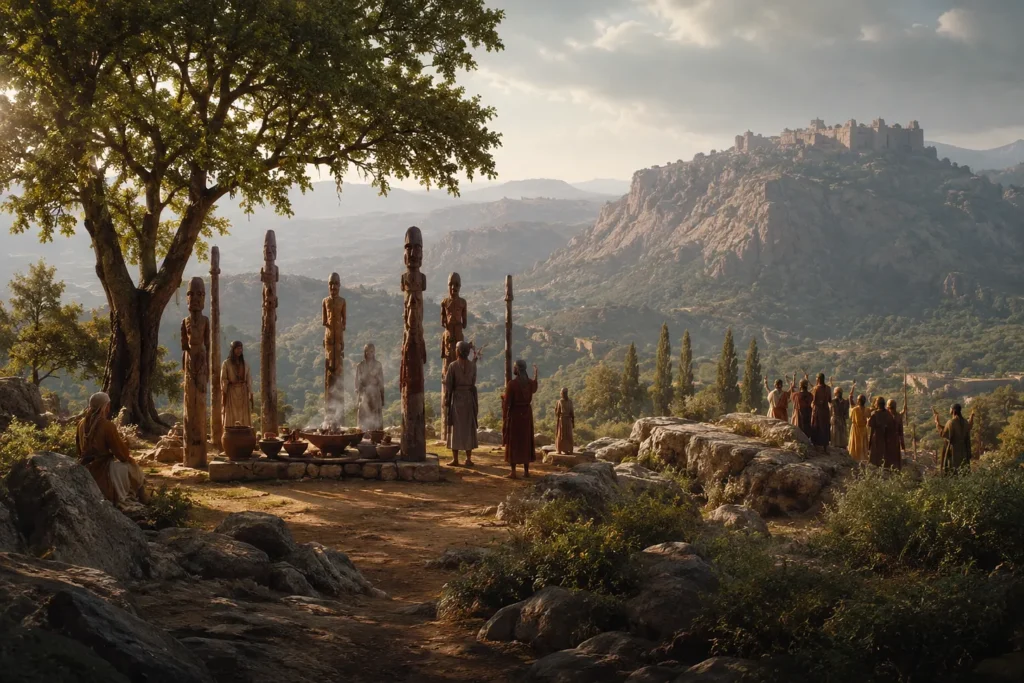
The nations saw sacred space differently. They believed their gods inhabited mountains, hills, and sacred groves. Elevated places became centers of worship. Every leafy green tree could become a place of fertility worship. Sacred poles and carved images marked locations where particular deities were believed to dwell. Every locality possessed its own sacred center. The nations themselves determined where their gods would reside.
Moses’ repeated reference to “the place where the LORD your God will choose to put His Name” only becomes clear when viewed against the ancient world’s understanding of sacred space. Every civilization believed there was a sacred center—the point where heaven and earth touched and where the divine realm intersected with human existence. It was considered the heart of reality itself, the place from which order flowed into the world and where creation was continually sustained.
Temples and sanctuaries were always built at this sacred center. But before a temple could be constructed, the sacred center first had to be identified. In the surrounding cultures this was often determined through oracles, omens, or divination. An image of the deity was then installed to validate the site’s sacred status, while the architecture of the sanctuary carefully reflected and protected its holiness.
Elevated mountains and hills naturally became favored locations because they symbolized the meeting point between heaven and earth. These sanctuaries functioned as miniature worlds, places where rituals and ceremonies renewed the relationship between the gods and humanity. In many ways they were understood as a microcosm of paradise—a center where the ordered world overcame the forces of chaos.
Israel also possesses a sacred center, but unlike the nations, it is never established by human initiative. The place is holy for one reason alone: the living God chooses it. From Eden onward, sacred space exists only because God establishes His presence there. It is where creation is restored and where His covenant people gather before Him.
The nations chose where their gods would live. Israel waited for God to choose the place of His dwelling. The sacred center did not originate from human imagination. It originated from divine initiative. God planted the garden. He placed Adam and Eve within it and walked among them. Eden became the first sacred center because God caused His presence to dwell there.
After humanity’s exile from Eden, God continually establishes places where His presence dwells. The patriarchs encounter Him in their tents and at divinely appointed locations. The Tabernacle in the wilderness becomes the center of Israel’s camp, where the glory of God dwells among His covenant people. Solomon’s Temple becomes the place where God causes His Name to dwell in Jerusalem.
Jerusalem certainly became that place within Israel’s history, yet it pointed beyond itself toward something greater.
The prophets looked beyond the earthly Temple toward a renewed creation where God’s presence would once again fill the entire world. The New Testament reveals that promise unfolding through the Messiah. John declares that “the Word became flesh and dwelt among us.” The language deliberately echoes the Tabernacle. God once again dwells among humanity, not in a building made with hands but in the person of Jesus Himself.
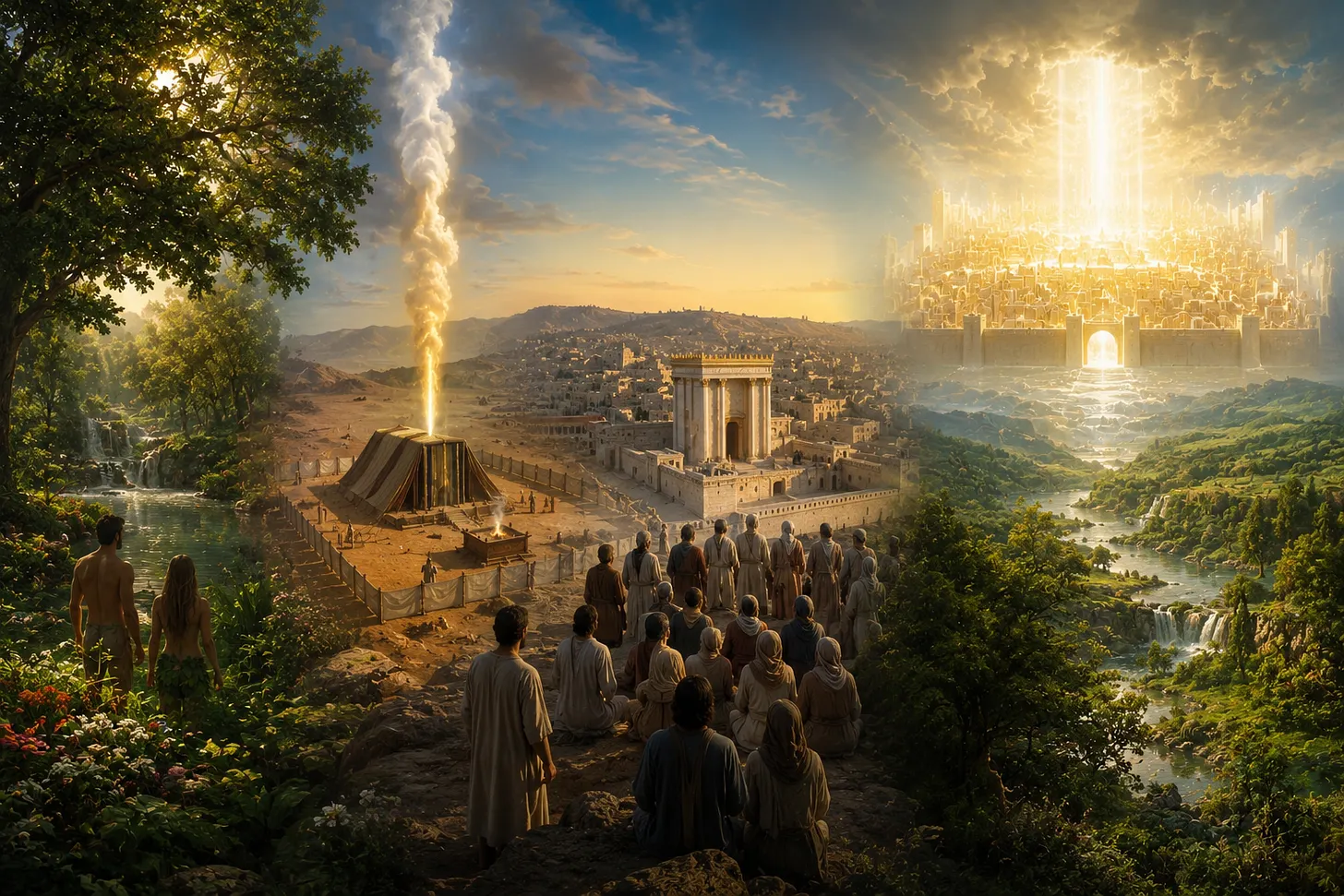
What began in a garden, moved through a tent and a temple, now lives within the covenant community. Revelation brings the entire movement to its glorious conclusion as the New Jerusalem descends from heaven. No temple stands within the city because God Himself dwells there. The whole renewed creation becomes the holy place. Heaven and earth are fully united once again.
God’s purpose has always been to restore His dwelling with humanity until His presence fills the whole earth. God meets His people everywhere through His Spirit. Yet humanity never determines where God dwells. We do not invite Him to bless our agendas, our kingdoms, or our ambitions. Instead, we are invited into His purposes.
God chooses.
We respond.
The place where God puts His Name is ultimately the place where His rule is welcomed. It is where His people willingly bend their will to His until His desires become their own. The sacred center is not defined by geography but by submission. It is the place where our plans yield to His purposes, where our desires are reshaped by His wisdom, and where our lives come into alignment with His covenant.
Throughout Deuteronomy, worship always gathers families, servants, strangers, and entire households before the Lord. They rejoice together in His presence because covenant life is lived in community. God’s dwelling is not simply about private spirituality; it creates a people who live under one King and one covenant.
While the nations scattered worship among countless sacred sites, Israel gathered around one sanctuary because there was one God, one covenant, and one King.
The same remains true today. The place where God chooses to put His Name is the place where His people willingly bend their will to His until His desires become their own. There chaos is overcome by God’s order, divided people become one covenant community, and self-rule is replaced by the reign of God’s Kingdom.
Every covenant community that lives under His rule bears witness to the day when all creation will become the place where He has chosen to put His Name.
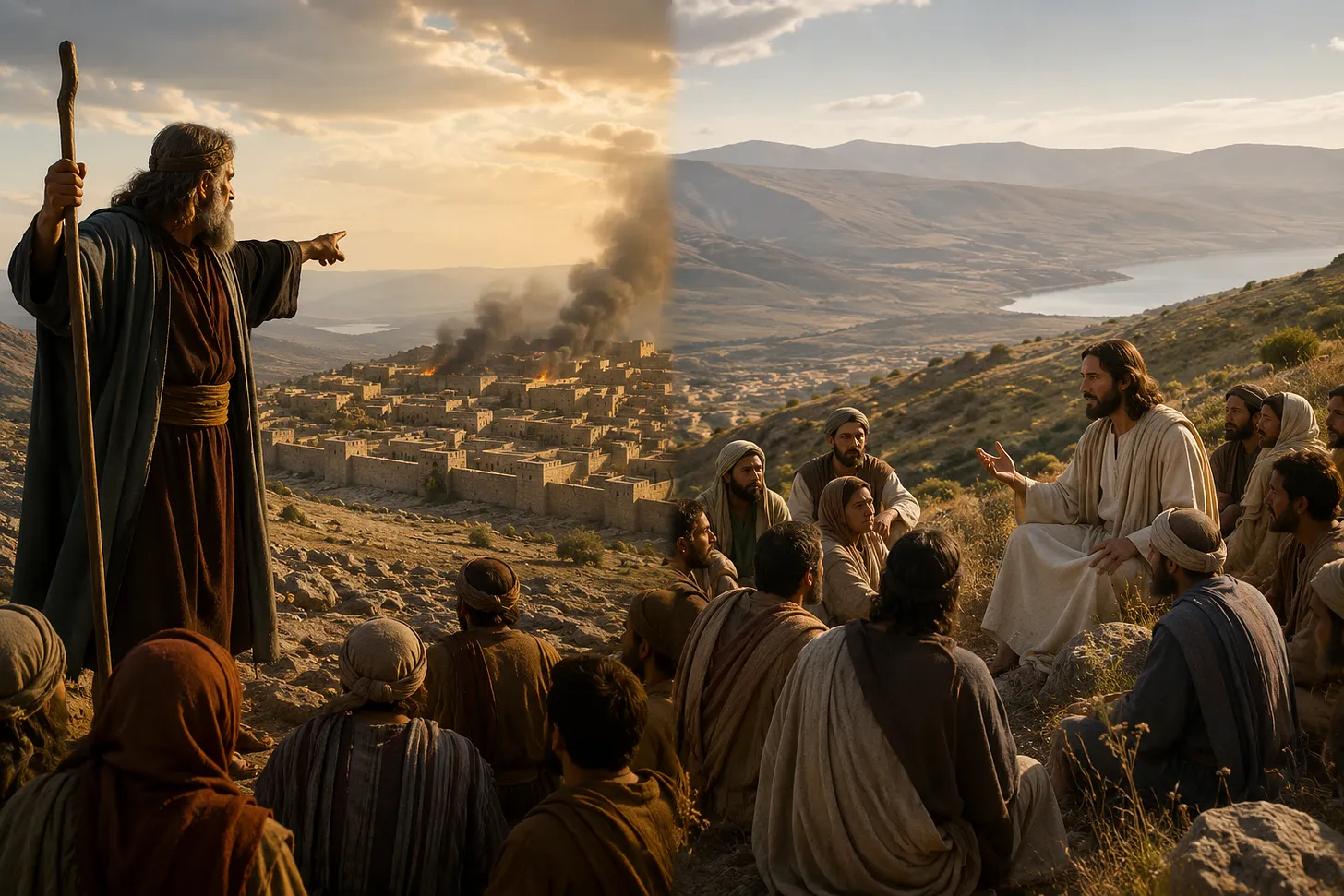
Some of the most difficult passages in Scripture are those that seem to contradict God’s ways. As Israel stands on the plains of Moab preparing to enter the Promised Land, God commands the people to drive out the nations before them, show them no pity, burn their carved images, and leave nothing that might entice them into compromise. Yet in the Sermon on the Mount, Jesus tells His disciples, “Love your enemy and pray for those who persecute you.” At first glance, these commands appear impossible to reconcile. How can the God who commanded Israel to destroy its enemies later command His disciples to love theirs?
The tension begins to disappear once we recognize that the real conflict has never been merely about Israel’s opponents. It has always been about humanity’s greatest enemy.
When Moses speaks about the nations inhabiting Canaan, he is not describing random foreign peoples who happened to occupy the land. They represent a rival kingdom whose worship, values, and way of life threaten everything Israel has been called to become. If Israel embraces their gods, she will inevitably embrace their character, no longer reflecting the God in whose image she was created. The greatest danger is not military defeat but the loss of Israel’s identity as God’s covenant people.
Again and again, Moses warns that these nations will become a snare to Israel. The danger is not simply that they occupy the land but that they will capture Israel’s heart. The people redeemed to bear God’s image will gradually begin to reflect the image of the nations instead. That is the threat Moses sees before them.
This is why Moses commands Israel not to covet the silver and gold that adorn their idols or bring those abominations into their homes. Idolatry rarely begins with outright rebellion. It begins with fascination, grows into compromise, and ends in allegiance. God knew that the greatest victory of the Canaanites would not be won on the battlefield but in the hearts of His own people. The conquest would fail long before Israel lost a battle if Israel became Canaanite in heart.
By the time we reach the Gospels, the political landscape has changed. Rome now occupies the land, and Israel lives under foreign rule. Yet Jesus never commands His disciples to overthrow Rome by force or wage war against Caesar.
Instead, He says something that surprises us. “Love your enemies.”
Has God changed His mind? Not at all. The enemy still represents everything that opposes the Kingdom of God. What changes is the place where the battle is fought.
Under Joshua, Israel entered a physical land that had to be cleansed of idolatry. Under Messiah, God’s people become His dwelling place, and the battlefield moves into the human heart. The greatest threat is not so much the army outside the gates. It is the corruption that enters through the gates we abandoned.
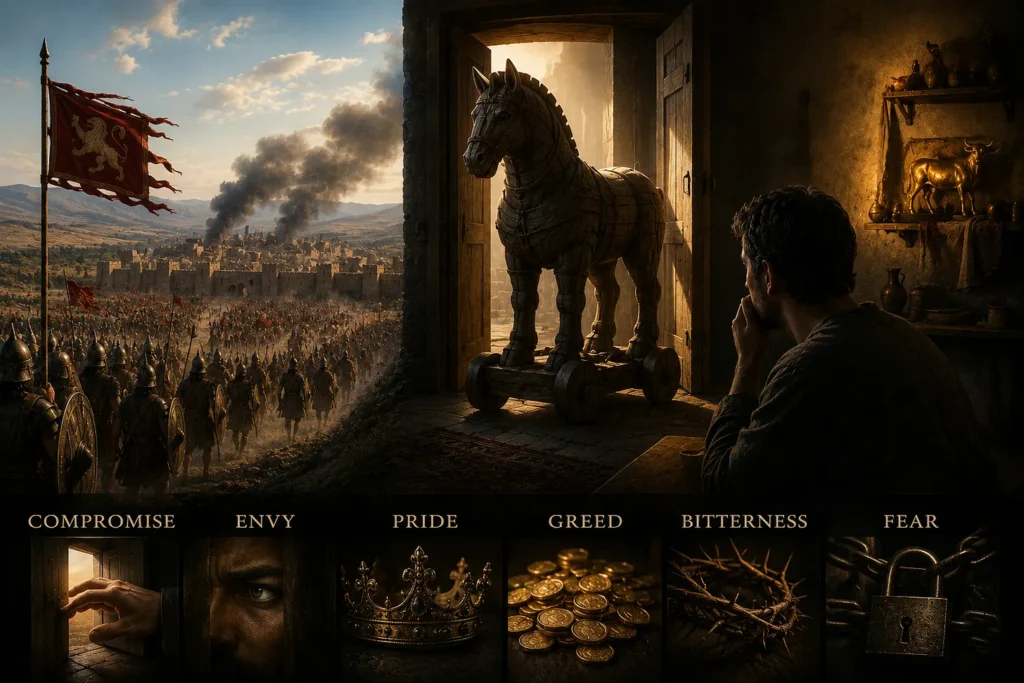
We imagine an external enemy arriving with banners flying and swords drawn.
More often, he enters like a Trojan horse.
He comes disguised as compromise, envy, pride, greed, bitterness, or fear. He hides in the small habits we overlook and the subtle beliefs that slowly reshape both our understanding of God and our understanding of ourselves. Every idol begins by asking for just a little room before demanding the whole house.
Our greatest enemy is not the person standing across from us but the desires that rise within us. James writes that temptation begins when each person is drawn away by his own desires. Long before evil becomes visible in our actions, it has already taken root in the heart. Too often, we open the gates ourselves.
Hatred has a way of reproducing itself. Violence forms violent people. Bitterness reshapes the soul. When we answer evil with evil, we allow the kingdom we oppose to take root within us. The Apostle Paul captures this truth in a single sentence: “Do not be overcome by evil, but overcome evil with good.” The real victory is refusing to mirror and become the enemy.
The command to destroy the enemy is a call to remove everything that seeks to destroy the covenant life of God’s people. Israel was commanded to tear down idols because idols deform human beings. They replace the worship of the Creator with the worship of created things. They rob men and women of the dignity for which they were created.
So who is your enemy? It is not your irritating neighbor. It is not your political opponent. It is not the person who insults you on social media.
Your enemy is every force that seeks to distort the image of God within you—every thought that leads you from the truth, every desire that pulls you toward selfishness, every idol that demands your loyalty, every habit that weakens your walk, every lie that challenges God’s voice, and every fear that causes you to distrust His promises. Anything that diminishes the dignity and calling of an image-bearer is working against the Kingdom of God.
That is the enemy.
This is why Moses repeatedly tells Israel not to fear the nations. The battle belongs to the Lord. Israel’s calling was never to secure victory by its own strength but to remain faithful while God fought on its behalf. Throughout Deuteronomy, Moses returns to the same exhortation: listen, keep, and do.
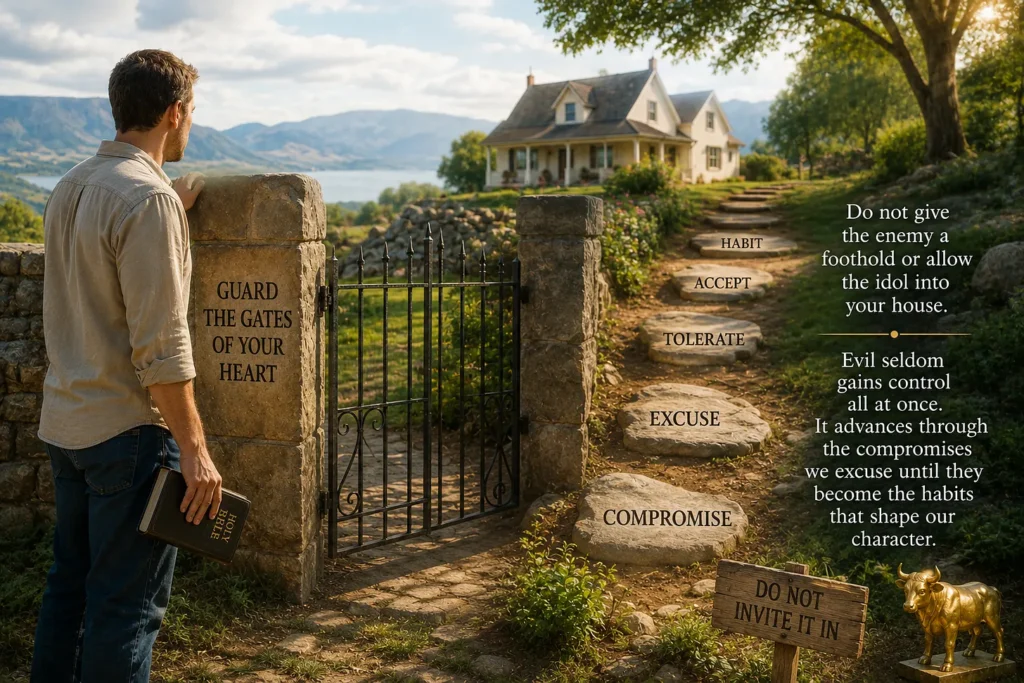
That same calling rests upon the disciple of Jesus. Guard the gates of your heart. Do not give the enemy a foothold or allow the idol into your house. Evil seldom gains control all at once. It advances through the compromises we excuse until they become the habits that shape our character.
The Lord who fought for Israel still fights for His people today. The enemy is whatever seeks to rob us of our calling as God’s image-bearers. Israel was commanded to remove whatever threatened the covenant community from within. Jesus calls His disciples to love those who oppose them while resisting the evil that seeks to deform God’s image in the human heart. Moses and Jesus are not speaking with different voices. They are calling God’s people to the same faithfulness against the same enemy—the one that would destroy God’s image in us.
It was a beautiful September afternoon in 1978 beneath the Sangre de Cristo Mountains of northern New Mexico. The sky was an impossible shade of blue, the kind that only high desert air can produce. Prayer flags fluttered gently in the breeze while the aroma of Indian food mingled with incense, sage, and patchouli oil. Everywhere I looked, people wore colorful shawls, beads, and sandals. Hand drums, tablas, and tambourines blended into a hypnotic rhythm as the voices chanted together, “Ram… Ram… Sita Ram… Jai Hanuman…”
The gathering had been organized by Ram Dass, formerly Richard Alpert, one of the leading voices introducing Hindu spirituality to America. Following the death of his guru, Neem Karoli Baba, he had commissioned a massive marble statue or murti of Hanuman, the Hindu monkey god celebrated for devotion and service to Rama. Carved in Jaipur, India, the statue had crossed the ocean to San Francisco before making its way to northern New Mexico. According to those who organized the event, this would be the first public unveiling of the image in America.
As the afternoon wore on, everyone’s attention shifted toward a large wooden crate resting on a construction trailer. One by one the heavy wooden slats were removed, each board heightening the anticipation of those gathered around it. Finally, the front of the crate came away.
Standing before us was a towering white marble Hanuman draped in brilliant saffron robes, holding a golden mace. Against the deep blue New Mexico sky, the image was visually stunning.
An unexpected hush settled over the crowd. The chanting ceased. All conversation stopped. Almost instinctively people began falling to their knees before the newly unveiled image.
I remained standing.
In that moment—the one and only time in my life—I heard the audible voice of God.
“Thou shalt have no other gods before Me.”
The words carried an authority that left no room for doubt. While everyone around me bowed before the image, I stood frozen in place. In an instant I knew with absolute certainty that the God of Israel alone is God, and there is no other.
At the time, however, I understood almost nothing of what I had witnessed. I knew very little about the ancient world, the purpose of sacred images, or the biblical theology that lay behind the commandment I had just heard spoken so clearly. It would take years of studying Scripture before that afternoon beneath Taos Mountain began to make sense.
Reading Moses’ final address to Israel in Deuteronomy this week, I recalled this event many years ago.
Moses reminded Israel that when God descended upon Mount Horeb, they heard His voice from the midst of the fire. “You heard the sound of words, but saw no form… Therefore watch yourselves very carefully, since you saw no form on the day Adonai spoke to you at Horeb from the midst of the fire, lest you act corruptly by making for yourselves a carved image…” (Deuteronomy 4:12, 15–16)
In years past, I had assumed this was simply another warning against idolatry. But Moses was saying something much deeper. Israel was not merely forbidden to worship other gods. She was forbidden to create any visible representation of the God who had revealed Himself without one.
Why was this so important? The answer lies in the world Moses was confronting.
Throughout Egypt, Mesopotamia, Canaan, and the surrounding nations, the climax of building a temple was not completing the building itself. It was installing the image of the god. A temple without an image was considered empty because the image represented the deity’s presence and authority among the people.
Modern readers often imagine that ancient people believed a block of wood or carved stone literally was their god. That was rarely the case. Rather, after elaborate ceremonies, the deity was believed to dwell within the image or manifest his presence through it. The statue became the visible representative through which the unseen god ruled.
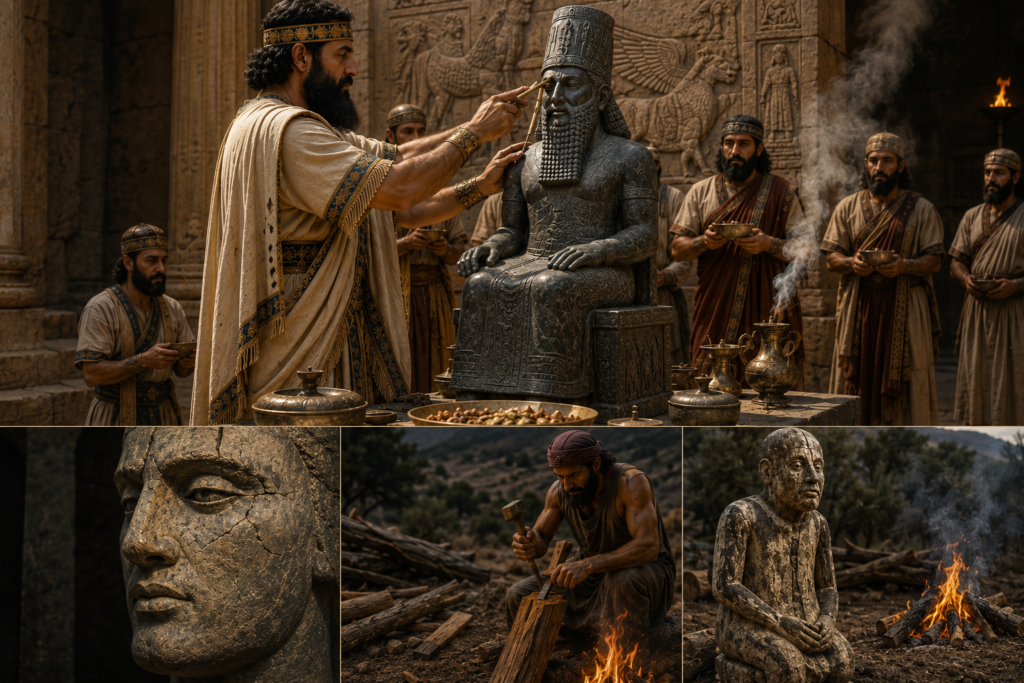
One of the most fascinating rituals was known in Mesopotamia as the Opening of the Mouth. After the image was carved, priests carefully washed it, clothed it, anointed it, and ceremonially touched its mouth, eyes, and ears. Only then was the image considered capable of seeing, hearing, receiving offerings, and serving as the earthly dwelling place of the deity.
Recall that Psalm 115 declares that idols have mouths but cannot speak, eyes but cannot see, ears but cannot hear. Isaiah mocks the craftsman who cuts down a tree, burns half of it for firewood, and fashions the other half into a god before which he bows.
These are direct attacks on the entire theology behind the mouth-opening ritual. Despite every ceremony performed by human hands, the images remained exactly what they had always been—lifeless stone and wood.
If God forbade Israel from making an image of Him, a question naturally follows.
Why? The usual answer is because idols are false. And that’s certainly true.
But Genesis suggests something deeper. God had already made His own image. God fashioned His own representative from the dust of the earth. Genesis tells us that He formed Adam and then breathed into his nostrils the breath of life. No priest stood beside Him. No ritual was required. No incantation was spoken.
God Himself breathed. The result was a living human being.
The contrast with the ancient world becomes obvious. Pagan priests attempted to prepare lifeless images for the indwelling of a deity. The Creator simply breathed, and His image opened its own eyes, heard His voice, spoke with Him, walked with Him, and received the commission to rule His world. The true image of God was never carved. It was created alive.
Genesis overturns the religious imagination of the ancient world. Every surrounding culture built temples, installed images, and invited the presence of the deity to dwell there. God followed a completely different pattern. He formed His cosmic temple, placed His own living image within it, and then walked with humanity in the Garden.
The prohibition against carved images is not merely a rejection of pagan religion. It is God’s declaration that His image already exists. He chose humanity.
Making another image implies that God’s own chosen representative is completely inadequate.
That is why idolatry is so serious. An idol is not simply a false object of worship. It is a counterfeit image. It replaces God’s living representative with something lifeless. It substitutes marble for flesh, wood for breath, stone for relationship.
Sin did not erase the image of God, but it distorted it. Humanity no longer reflected the Creator as it was intended to do. Instead of representing God, people began representing themselves. Eventually they manufactured gods fashioned after their own imagination.
Paul describes this exchange in Romans 1. Humanity traded the glory of the immortal God for images resembling mortal man, birds, animals, and creeping things. Those who had been created to be God’s living image began making images instead. Human beings who possessed eyes, ears, mouths, hands, and feet—the very capacities that enabled them to know and worship the Creator—began bowing before objects that possessed the same features but could neither speak nor hear nor see.
The counterfeit replaced the original.
This is why the New Testament presents Jesus as “the image of the invisible God.”
Jesus is not merely another image among many. He is the perfect Image—the One Adam was created to become but never fully was. In Him we finally see humanity reflecting the Father without distortion.
The first Adam received the breath of life but eventually returned to the dust from which he had been taken. Death marred the image God had created. The last Adam entered death willingly and emerged from the tomb alive forever. In His resurrection, the image of God is not merely restored. It becomes incorruptible.
Looking back after all these years, I understand that afternoon beneath Taos Mountain very differently. I do not question the sincerity of the people who knelt before the Hanuman murti. They were seeking the divine according to what they understood. But I now recognize that I was witnessing something that Moses had warned Israel about more than three thousand years earlier—a community gathered around a graven image believed to mediate the presence of the divine.
The God of Sinai chose another way. He revealed His voice, but no visible form. He entrusted His rule to living men and women, inviting them to reflect His character throughout creation.
The Bible begins with God placing His living image in His temple.
It ends with that image fully restored, dwelling forever in His presence.
Perhaps that is why the Second Commandment is much more than a prohibition against idols. It is a declaration of God’s confidence in His own creation. Every carved image says that God’s living representative is not enough. Every faithful life declares just the opposite.
Many people feel as though the very foundations of life are being shaken. They watch the world around them and wonder what comes next. What will remain if the economic, political, and institutional structures that have shaped modern society continue to crumble? Families who spent decades saving for retirement watch the purchasing power of their money steadily decline. Wars drag on with no clear end, enriching powerful interests while ordinary families bear the cost in lives and livelihoods. Fraud, corruption, and the concentration of wealth and power in the hands of a few leave many wondering whether our institutions still serve the people—or merely preserve themselves.
Thousands of acres of productive farmland are being transformed into data centers while drought grips one part of the country, floods devastate another, and wildfires consume millions of acres. Inflation is eating away at people’s savings. Many are in debt living paycheck to paycheck. Trust in governments, financial institutions, corporations, and even religious leaders continues to erode. Everywhere people look, the pillars that once held society together are weakening.
Throughout history, ancient people naturally looked to the heavens to make sense of what was happening on earth. They did not separate the natural world from the spiritual world as neatly as we do. For them, what happened in the heavens revealed the meaning of what was happening on earth. The lights in the heavens proclaimed God’s order, and when the prophets spoke of those lights being shaken, they were announcing that the established order of human rule was about to be overturned.
The signs did not create history.
They revealed its meaning.
This is the world in which Daniel lived. Babylon’s kings identified themselves with the stars. Their empires appeared as permanent as the heavens themselves. Yet Isaiah mocked the king of Babylon as the bright morning star cast down from heaven. Ezekiel described the King of Tyre in similar language before portraying his downfall. The prophets were not describing astronomical catastrophes. They were announcing that proud rulers who imagined themselves untouchable would be humbled before the God of Israel.
The heavenly lights represented earthly thrones.
Daniel watched Babylon destroy Jerusalem and carry away the vessels of the Temple. From every earthly perspective, Babylon’s gods had triumphed over Israel’s God. Yet Daniel’s visions told a different story. The kingdoms of men would rise and fall, but the Ancient of Days remained seated upon His throne. Every beastly empire would eventually lose its dominion because every human kingdom built upon pride ultimately collapses under the weight of its own corruption.
This is the language Jesus inherited.
When the disciples asked about the destruction of the Temple in Matthew 24, Jesus answered with the language of Israel’s prophets. “The sun will be darkened, the moon will not give its light, the stars will fall from heaven, and the powers of the heavens will be shaken.”
Modern readers instinctively look for future cosmic disasters.
First-century Jews would have recognized prophetic judgment. The Temple stood at the center of Israel’s covenant life. It was the place where heaven and earth met, where God’s presence dwelt among His people. Yet by the time of Jesus, the Temple leadership had aligned itself with political power, burdening the people while protecting its own position. Those entrusted with shepherding Israel had become rulers protecting their own kingdom.
When Jesus announced that the heavenly lights would be shaken, He was declaring that the entire order represented by that Temple system was coming to an end. The destruction of Jerusalem in A.D. 70 was far more than the fall of a city. It was the collapse of a corrupt religious order that had rejected its Messiah.
The cosmic imagery reflected what was happening on earth. Heaven interpreted history.
Daniel’s vision reaches its climax when One like the Son of Man comes with the clouds of heaven to the Ancient of Days. For many modern readers, the clouds immediately suggest the Second Coming. But in Daniel’s vision, the Son of Man is not descending to earth. He is approaching the throne of God to receive an everlasting kingdom. This is the moment of His enthronement.
The New Testament declares that this vision was fulfilled in Jesus’ resurrection and ascension. By His resurrection He conquered death, the final enemy. By His ascension He was enthroned at the Father’s right hand, receiving the kingdom that no earthly empire could ever possess.
This is why the shaking of the heavens is immediately followed by the appearance of the Son of Man. The old order is passing away because the true King has taken His throne.
From His throne the King sends out His heralds. Throughout the ancient world, a newly enthroned ruler announced his reign and summoned his subjects to swear their allegiance. The Gospel follows the same pattern. The King’s messengers go into every nation proclaiming that Jesus now reigns and calling men and women into His everlasting kingdom.
This does not mean Jesus’ words have nothing to say to our generation. They have everything to say.
We also live in a world where institutions lose their way and leaders pursue power instead of justice and people wonder whether the foundations of society are collapsing.
Matthew 24 is not a forecast of modern events.
It is God’s interpretation of one of the greatest covenant judgments in Israel’s history. The lights of heaven were shaken because the old order centered on the Temple was passing away, and the Son of Man had received the kingdom that would never pass away.
Jesus’s words remind us that history has always been marked by the rise and fall of kingdoms, the corruption of institutions, and the collapse of leaders who imagine themselves all powerful. None of those events overturn the reign of the Son of Man. The signs in the heavens do not tell us to fear the future. They remind us that every human kingdom is temporary, but the kingdom of God is eternal.
When the foundations of our world seem to shake, Scripture calls us to lift our eyes to the throne. The heavens still proclaim the same truth they declared in Daniel’s day: the Son of Man reigns. His kingdom alone will endure.
The book of Deuteronomy opens with Moses looking back over Israel’s forty years in the wilderness. Before he gives Israel new instruction, he reminds them where they’ve been.
Years ago, I had the privilege of following much of that same route through modern Jordan on a rugged jeep tour. Fortunately, it didn’t take me forty years, or I’d probably still be trying to cross back into Israel!
“It is eleven days’ journey from Horeb by way of Mount Seir to Kadesh-barnea… In the fortieth year… Moses began to explain this Torah.” (Deut. 1:2–5)
Most of us begin reading Deuteronomy and quickly stumble over an unfamiliar list of names. Horeb. Kadesh-Barnea. Mount Seir. The Arabah. Wadi Zered. The Arnon. Moab.
They seem like little more than ancient geography, the sort of details we skim on our way to the “important” parts of Moses’ final speech. But Moses wasn’t giving Israel a geography lesson. He was telling a story—a story of their history.
Our journey through Jordan traced much of Israel’s final wilderness route. We traveled through the Arabah, explored Petra, crossed the Zered Valley, descended into the magnificent Arnon Gorge, climbed Mount Nebo, and eventually stood overlooking the Jordan Valley. Suddenly those names in Deuteronomy were no longer dots on an ancient map. They were no longer just names on the pages of my Bible. They had become real places I had seen with my own eyes.
The first thing that struck me was the Arabah itself. It is difficult to describe just how barren this landscape is. Stretching south toward the Gulf of Aqaba, it is one of the driest regions in the Near East, receiving little more than half an inch of rain each year. I remember looking across miles and miles of desert and seeing almost nothing alive. A few scattered acacia trees struggled against the relentless heat. Rocks stretched to the horizon. The silence was almost overwhelming. It was a thirsty, parched land.
Yet it is precisely this landscape that Isaiah speaks of regarding God’s promises:
“The desert and the dry land shall be glad; the Arabah shall rejoice and blossom like the crocus… For waters shall break forth in the wilderness, and streams in the desert.” (Isaiah 35:1, 6)
The place of desolation will become the place of restoration.
Continuing north, we crossed Wadi Zered, the valley Moses mentions in Deuteronomy 2. In biblical times it formed the boundary between Edom and Moab. Moses reminds the people that by the time they crossed the Zered, the generation that had refused to trust God at Kadesh-Barnea had passed away. The crossing marked the end of one chapter in Israel’s history and the beginning of another.
Not long afterward we descended into the spectacular Arnon Gorge. The Arnon is far more than a river. It cuts through the plateau of Moab in a canyon nearly 1,700 feet deep in places. Standing there, the biblical description of a “rushing torrent” suddenly made perfect sense. A canopy of rock hovered above us. As our convoy of white jeeps slowly wound its way through the valley, I understood why this place remained etched in Israel’s memory. Beyond it lay new enemies, new victories, and the first steps toward the Promised Land.
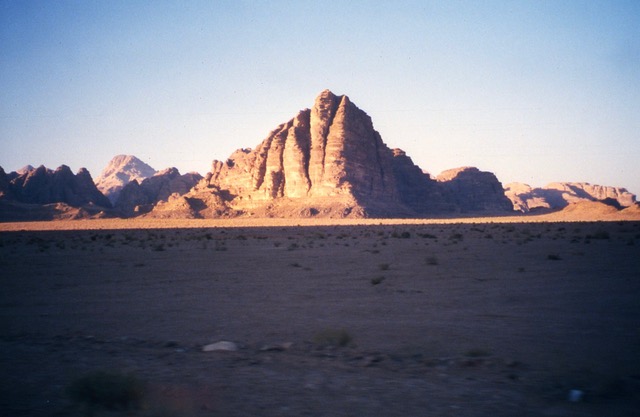
Not every location mentioned in Deuteronomy can be identified with certainty. Wadi Rum, for example, has been suggested by some scholars as a possible location for Kadesh-Barnea because of its immense size and natural water reservoirs hidden beneath its sandstone formations. It resembles a vast sand ocean. Whether that ultimately proves correct or not, standing in that vast wilderness helps one appreciate the scale of Israel’s encampment.
Wadi Rum is also forever linked with one of history’s most famous adventurers, T. E. Lawrence—better known as Lawrence of Arabia. During the Arab Revolt of 1917–1918, Lawrence crossed these deserts while helping lead Arab forces against the Ottoman Empire.
One of Wadi Rum’s towering sandstone formations now bears the name The Seven Pillars of Wisdom which inspired the title of Lawrence’s famous memoir. It is easy to understand why filmmakers have repeatedly chosen Wadi Rum to portray the moon, Mars, and otherworldly landscapes. This is a place of dramatic beauty—a wilderness that formed part of the landscape through which God prepared His covenant people to enter the Promised Land.
That may be the greatest lesson of Deuteronomy.
Moses also reminds Israel of the formidable peoples they encountered along the way—the Emim, the Anakim, the Rephaim, and Og king of Bashan. These “giants” had once filled Israel with fear. Forty years earlier the spies looked upon the Anakim and confessed, “We seemed like grasshoppers in our own eyes.”
Yet by the time Moses spoke these words, many of those once-feared enemies had already fallen. Their size had not determined the outcome. God’s faithfulness had. Every giant Israel dreaded became another testimony that nothing standing in the way of God’s covenant purposes was beyond His power to overcome.
That is why Deuteronomy begins with geography before it gives commands. Before Israel receives instruction, Moses reminds them of the road they have traveled with God. Yes, the wilderness was about reaching Canaan but perhaps more importantly it was about forming a people.
Standing among those valleys and mountains years later, I realized the landscape itself was part of Israel’s testimony.
Our own lives are not so different.
Like Israel, we are often tempted to measure the size of the obstacle instead of the greatness of the God who goes before us. Deuteronomy reminds us that every wilderness contains giants, but it also reminds us that God has never abandoned His people along the journey.
We all have our Horebs and Kadesh-Barneas, our Zereds and Arnons—places where God met us, corrected us, carried us, and prepared us for what lay ahead.
Most visitors who come to Petra spend the day marveling at the Treasury, the towering sandstone cliffs, and the remarkable architecture carved into the rose-red rock. Few realize that high above the ancient city rises one of the most significant mountains in Israel’s wilderness journey—Mt Hor.
In 1999 my husband and I had the opportunity to visit Petra with a tour group. We expected to spend the day exploring the famous ruins. Then someone mentioned that it was possible to ride camels up to the traditional site of Aaron’s tomb on Mount Hor.
Anyone who knows me knows I never pass up an adventure.
Another couple from South Dakota joined us, and together we hired a Jordanian guide. Camels were brought, saddles secured, lunches packed, and before long we were climbing the mountain.
At least, that was the plan.
I was assigned the camel with the worst gait imaginable. Instead of the smooth rolling motion camels are famous for, mine bounced with every step. I felt as though I were inside a washing machine. After only a few minutes I knew I could never survive several hours on that animal.
My husband smiled and offered to trade. It was completely unselfish because he knew we still had six hours ahead of us. I happily accepted.
Slowly we climbed above Petra. Far in the distance we could already see the whitewashed shrine that crowned the summit.
Along the dusty trail we passed a large Bedouin family living in a cave. The floor was packed earth covered with prayer rugs. Their children, their clothing, even their faces carried the dust of the mountain. The women made colorful beaded bracelets for passing travelers, and we gladly purchased a few. One young mother sat quietly in the corner nursing her baby while life continued all around her.
It was another world. Only a day later we would be staying in a first-class hotel in Amman. The contrast could not have been greater.
We had not planned for this excursion. We were dressed for walking through Petra, not riding camels over rough mountain trails. The thick wool saddle reminded us of that decision with every mile.
Fortunately, we had plenty of water and food.
Up…and up…we climbed. After a while the awkward motion of the camel became routine and we settled into its rhythm as the white shrine slowly drew nearer.
Nearly two hours later we reached a broad plateau just below the summit.
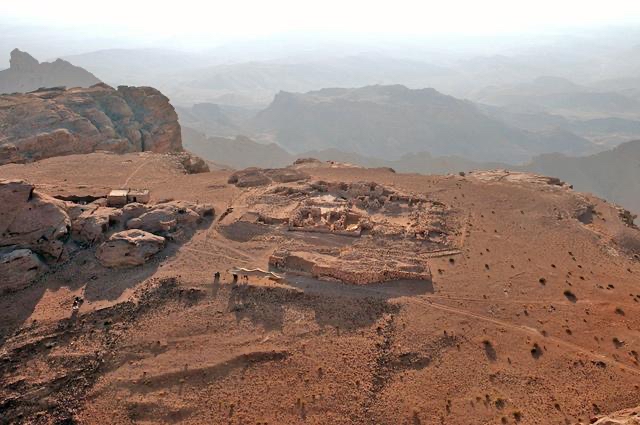
There we encountered a team of archaeologists from Finland and Sweden excavating a large complex spread across the mountainside. Our guide explained that the camels could go no farther. The final ascent was too steep and the summit too narrow. The archaeologists kindly allowed us to leave the camels with them while we climbed the last rocky stretch on foot.
At the time, we had no idea what they were uncovering. We simply assumed they were excavating another ancient ruin.
Only years later did I discover how remarkable that meeting had been. The excavation had begun only two years earlier under the direction of scholars from the University of Helsinki. We had arrived during one of the most exciting periods in the site’s modern history.
What they uncovered transformed our understanding of Mount Hor.
Jabal Harun—“Mountain of Aaron” stands about three miles southwest of Petra and rises more than 4,400 feet above sea level, making it the highest peak in the Petra region. Living at nearly 7,000 feet in New Mexico, the altitude never bothered us. The descent, perched high on those sure-footed camels, demanded far more courage than the climb.
At the summit stands the familiar whitewashed shrine dedicated to the prophet Harun—Aaron in Arabic. The present structure dates to a restoration completed in A.D. 1320 during the Mamluk period, although it rests upon the remains of a much earlier Byzantine sanctuary. Inside is a simple memorial chamber honoring Aaron.
No archaeological discovery has confirmed that Aaron himself was buried there. Yet for nearly two thousand years Jews, Christians, and Muslims have revered this mountain as the place where Israel’s first high priest died. That tradition reaches back at least to Josephus in the first century.
Some modern scholars question whether this mountain lies too far inside ancient Edomite territory to be the biblical Mount Hor.
Perhaps. But a tradition preserved for nearly two thousand years carries considerable weight with me. Standing on that summit, looking across the wilderness stretching toward the land of promise, I found it difficult to imagine a more fitting place.
The Finnish excavations revealed that this mountain had become one of the oldest pilgrimage destinations. Beginning in the fourth and fifth centuries, Christians climbed the mountain believing they were approaching the place where Aaron died.
Archaeologists uncovered a large basilica, chapels, monks’ quarters, storerooms, kitchens, courtyards, water systems, and buildings that probably served as hostels for weary pilgrims. The complex measured roughly sixty-two by forty-eight meters—far larger than anyone expected.
This was a thriving center of worship that welcomed generations of pilgrims making the difficult ascent. Among the discoveries were thousands of pottery fragments, Byzantine coins, Greek inscriptions, a baptismal font, and even traces of an earlier Nabataean sanctuary beneath the Christian structures.
The mountain had been regarded as sacred long before the monastery was built. One inscription referred to Aaron as “the Holy High Priest.” The monks built an entire pilgrimage center around the memory of his death.
That tells us how they understood Numbers 20 and 33. When we read the account of Aaron’s death, it is easy to focus only on the man. The biblical writers focus on something larger. Aaron ascends the mountain. His priestly garments are removed. They are placed upon Eleazar. Israel mourns for thirty days. Then their journey resumes. The mountain becomes the place where one servant lays down his calling, and another receives it.
Throughout the ancient Near East, kings often passed through ceremonies of humiliation before enthronement. Royal garments were stripped away before new garments were bestowed. Humbling preceded exaltation. Aaron’s priestly garments are stripped away on Mount Hor before they are placed upon Eleazar. The priesthood continues. Garments signify office, identity and calling.
Standing on that mountain twenty-six years ago, I could not have appreciated all of this. I simply remember the breathtaking view, the white shrine shining beneath the blue sky and the Jordanian sun, the archaeologists working below us, and the long camel ride from and to Petra.
Joseph’s dream has long been read as a story of family rivalry. The sun, moon, and eleven stars bow before him, provoking jealousy and anger among his brothers. Jacob himself questions whether Joseph expects his father and mother to bow before him. Yet the dream announces something far greater than family authority. It introduces one of Scripture’s most enduring patterns: the beloved son who descends into suffering before being exalted to rule.
It begins with Isaac, the beloved son through whom the covenant continues. It is developed in Joseph, echoed in Moses and Joshua, and reaches its fulfillment in Yeshua. Throughout Scripture, God repeatedly chooses a royal heir whose path to authority leads first through rejection, humiliation, and apparent defeat.
Modern readers often miss another dimension of Joseph’s dream because we no longer live in the world of the ancient Near East. In Egypt, Mesopotamia, and later Rome, the sun, moon, and stars were not merely heavenly bodies. They formed the political language of empire. Kings associated themselves with the sun. Queens and royal households were linked with the moon. The stars represented princes, rulers, and members of the royal court. Joseph’s dream unfolds within that symbolic world.
When God commands Abraham, “Take your son, your only son, whom you love—Isaac,” most readers hear only the language of parental affection. Ancient audiences heard something more. Throughout Egypt and Mesopotamia, kings described the heir to their throne as the “beloved son,” the one chosen to inherit the dynasty and continue the royal line.
Genesis draws upon that same royal language
Isaac is not simply Abraham’s cherished child; he is the covenant heir through whom God’s kingdom purposes will continue.
The same pattern appears when Joseph is introduced. Genesis opens the story with, “These are the generations (toldot) of Jacob,” yet the narrative immediately turns to Joseph. Although Jacob has twelve sons, Joseph becomes the focus through whom the covenant story moves forward. In Genesis, the toldot formula consistently signals how God’s redemptive purposes advance. Joseph is presented as the beloved son, clothed with the ketonet passim, the long sleeved robe—a distinctive garment that marks his unique status within the family.
Then comes the dream.
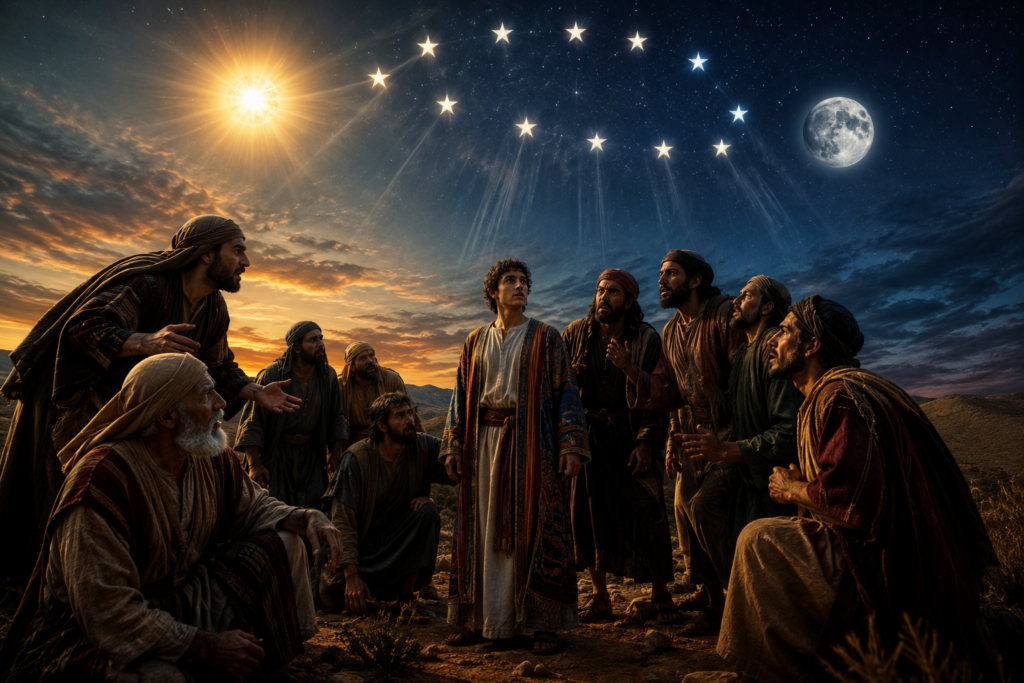
Joseph dreams that the sun, moon, and eleven stars bow before him. Traditionally, the symbols are identified with Jacob, Rachel, and Joseph’s brothers. That interpretation is certainly correct, but it is not complete.
In the world of Egypt and Mesopotamia, the same heavenly bodies carried royal meaning. The sun symbolized supreme authority. The moon represented the royal household and its stability. The stars portrayed princes and rulers who surrounded the throne. Joseph’s dream therefore speaks the symbolic language of kingship.
His brothers immediately understand its implications. Their response is not simply wounded pride but more likely political outrage.
“Are you indeed going to reign over us?”
They recognize the dream as a claim to royal authority.
And they are right.
God is revealing the destiny of the beloved son. Joseph will one day stand at the right hand of Pharaoh himself, exercising authority that preserves the covenant family during famine. The dream announces not personal ambition but divine appointment.
Yet Joseph does not move from dream to throne in a single step. Before the beloved son is exalted, he must first descend.
Ancient Near Eastern royal ideology often reflected this same pattern. Before a king received the symbols of authority, he first passed through ritual humiliation. Royal garments were removed, insignia stripped away, and only afterward was he clothed anew and invested with the signs of kingship. Humiliation preceded exaltation.
Joseph’s life embodies that royal pattern. His distinctive robe is stripped from him. He is cast into a pit, sold into slavery, carried into Egypt, falsely accused, and confined to prison. Only after this long descent is he summoned before Pharaoh, clothed in fine linen, given the royal signet ring, and elevated to rule over the land.
Joseph’s dream was never merely about one young man rising to power in Egypt. From the beginning, it pointed beyond Joseph himself. The beloved son would be rejected before he was exalted. He would descend before he ascended. Through his suffering, God would preserve His people and advance His kingdom.
That pattern reaches its fulfillment in Yeshua.
The pit gives way to the tomb, the prison to the grave, and the throne of Pharaoh to the throne of heaven itself. What began with eleven stars bowing before Joseph ends with every ruler, every authority, and every power acknowledging the Beloved Son.
Joseph saw the pattern in a dream. The Beloved Son now reigns from the throne of heaven, and one day every ruler, every kingdom, and every power will bow before Him.
The Beloved Son is not simply a pattern we should find fascinating; He is the King we are called to follow. From Joseph to Yeshua, Scripture tells the same story. The pit gives way to the palace. The prison gives way to the throne. God brings His purposes to completion in His own time, and no earthly power can prevent what He has determined to accomplish.
Few episodes in Israel’s wilderness journey have troubled modern readers more than the war against Midian. It is an event marked by the violence of the ancient world. Israel marches against Midian with twelve thousand soldiers, one thousand from each tribe. Cities are reduced to ashes. Five Midianite kings fall. Balaam, whose schemes had nearly brought Israel to ruin, dies by the sword. Livestock, precious metals, and every kind of spoil are gathered and brought back to Israel’s camp on the plains of Moab. Moses is outraged when he learns that the women who had led Israel into compromise and the worship of Baal-Peor have been spared, and he orders them put to death.
What follows the battle is just as important as the battle itself. Throughout the Torah, death is the great intruder into God’s creation, the visible mark of humanity’s exile from Eden. Even a war commanded by God leaves His people surrounded by its contamination. Before anyone may again dwell where God’s presence resides, everything and everyone touched by the battlefield must be cleansed. Nothing returns to the camp until it has been purified. The soldiers remain outside the camp for seven days. Their bodies, clothing, weapons, and even the gold and silver taken in battle must all be purified before they may return.
Only a short time earlier, Balak, king of Moab, had hired Balaam to curse Israel. Yet every attempt failed. Instead of curses, blessings poured from the prophet’s mouth because Israel stood under the covenant faithfulness of God. What no king and no prophet could accomplish through battle was nearly achieved by another means.
So, rather than confronting Israel on the battlefield, Midian and Moab attacked the covenant itself. At Baal-Peor, Israelite men joined sacrificial meals, embraced the fertility rites of the surrounding nations, and gave their allegiance to gods who promised prosperity, rain, and abundance. The consequences were devastating. Twenty-four thousand Israelites perished because Israel had begun to imitate the nations.
Crisis at Ba’al Peor
The campaign against Midian is therefore more than a military victory. It brings the crisis at Baal-Peor to its conclusion. Balaam could not separate Israel from God by cursing them, so he pursued a far more effective strategy: he enticed them to compromise. Military force had failed, but spiritual corruption nearly destroyed the covenant community.
Scripture often returns to this pattern. Egypt sought to shape Israel through slavery, Canaan through idolatry, Babylon through assimilation, and Rome through demands for ultimate allegiance. The greatest threat was never simply an invading army, but the pressure to adopt the worship and values of the surrounding world.
That is why this battle takes place where it does. Israel stands on the plains of Moab opposite Jericho with the Jordan before them and the Promised Land within sight. Before they cross into their inheritance, the influence that had nearly destroyed the covenant must be removed. God is preparing a people who will live under His rule in the land He has promised them.
The repeated instructions for purification now make sense. Contact with death rendered a person ceremonially unclean, so those who had fought remained outside the camp for seven days. War had touched everything, and nothing from the battlefield could simply be carried into the presence of God.
How to Deal with Contamination
Here the Torah teaches an important truth. Even if the battle is just, death leaves its mark. Victory does not remove its contamination. Before Israel could once again gather around the Tabernacle where God dwelt among His people, the effects of death had to be removed.
The Jordan River crossing was a liminal boundary. It was more than a river—it marked the place where one chapter of God’s purposes ended and another began. Israel could not cross into the Promised Land carrying the influence that had nearly destroyed the covenant at Peor.
The temptation at Peor was not simply immorality or idolatry. It was the invitation to seek blessing, security, and life from other gods rather than from Yahweh Himself—the one who had redeemed Israel. Balaam could not curse God’s people, so he chose a far more effective strategy. He persuaded them to compromise.
That strategy continues to this day. The names of the idols may change, but the temptation remains. God’s people are always being invited to measure success and security by the values of the culture around them rather than by the God who calls them into covenant. External opposition is not necessarily the enemy’s only weapon. More often, it is compromise that slowly reshapes God’s people until they no longer look any different from the world around them.
Israel stood on the edge of the Promised Land with the Jordan before them and their inheritance within reach. Yet before they could cross, one final enemy had to be confronted—not simply Midian’s army, but Midian’s influence. They could not inherit the covenant land while embracing the worship and values of the nations. That was Israel’s struggle on the plains of Moab, and it remains the challenge facing every generation that seeks to walk faithfully with the God who still calls His people to be set apart.
Every year on the Fourth of July, Americans pause to remember an act of resistance. This year, as we celebrate the 250th anniversary of American independence, that remembrance carries even greater significance. We reflect upon ordinary men and women who reached an extraordinary conclusion: there comes a moment when obedience to God and conscience means refusing to conform to the demands of an earthly power.
The signers of the Declaration of Independence understood that resistance would not come without cost. Severe cost. They risked their property, their reputations, and their lives because they believed that liberty was worth more than comfort and truth was worth more than security. We rightly admire their courage because history reminds us that freedom has rarely been preserved by those unwilling to resist the status quo.
Resistance Woven into the Biblical Story
Yet Independence Day raises a much older question, one that reaches far beyond the birth of a nation. Is resistance woven into the very fabric of the biblical story? More importantly, is it woven into the character of God Himself?
The God revealed in Genesis acts in a way the ancient world never imagined. While the surrounding civilizations told of order emerging through violence and conflict among the gods, the Creator simply speaks, and creation obeys. There is no battle because there is no rival. God accomplishes His purposes without adopting the world’s methods.
As the biblical story unfolds, empires trust armies, wealth, and political power. God begins a nation with an elderly couple who cannot have children. Egypt builds its greatness by enslaving others. God demonstrates His supremacy by delivering the slaves. Israel looks for a king who resembles the rulers of the nations. God chooses the shepherd.
Nowhere is this contrast more clear than in the Exodus. Pharaoh builds an empire through fear, oppression, and forced labor. God does not answer by constructing a greater empire or raising a stronger army. He redeems slaves, leads them into the wilderness, and forms a covenant people whose life together bears witness to an entirely different kingdom.
Sinai shows that God not only defeats differently—He governs differently. The laws of the ancient world were written to preserve kings and strengthen their kingdoms. God’s Torah repeatedly moves in a different direction, protecting the widow, the orphan, the stranger, the laborer, and the poor. The measure of His kingdom is not how well it serves the well connected, but how faithfully it protects those with no influence at all.
As centuries passed, the world’s understanding of dominance did not change. By the time Jesus entered history, another empire ruled the land, and once again many expected God to answer power with greater power.
First-century Judea lived beneath the shadow of Rome, the greatest military empire the Mediterranean world had ever known. Many longed for a Messiah who would answer Rome on its own terms. They expected another David, another conqueror, another king who would overthrow the empire through superior force.
A Kingdom Not of this World
But Jesus entered Jerusalem riding a donkey rather than a warhorse. He taught His followers to love their enemies rather than destroy them. Standing before Pilate, He declared that His kingdom was not of this world. Everything about His kingdom challenged the world’s definition of power.
Rome believed the cross displayed its absolute rule. God transformed it into the means by which death itself was defeated. The empire could execute the Son of God, but it could not stop the Creator from bringing life out of death. God overcame Rome without becoming like Rome.
Perhaps this explains why Paul writes to believers in Rome, “Do not be conformed to this world, but be transformed by the renewing of your mind.” Paul places conformity and transformation in direct opposition to one another. Every culture exerts pressure to conform, inviting us to see success and greatness through the world’s eyes. The Kingdom of God calls us to live a different way.
Transformation begins when God’s people refuse to be shaped by the world’s values. Christian resistance is not rebellion; it is the faithfulness of those who belong to another kingdom.
The earliest Christians expressed that faithfulness in a confession that changed the world: “Jesus is Lord.” Those words were far more than a personal statement of faith. They denied Caesar’s claim to ultimate authority and proclaimed that Messiah alone reigns.
The natural world reflects a similar truth. Muscles strengthen by bearing weight. Bones become denser under load. Trees exposed to the wind send their roots deeper into the earth. A butterfly emerges only by pressing through the resistance of its cocoon. Even the flow of energy becomes useful when it encounters resistance. Throughout creation, resistance is not always the enemy of transformation; it is often the means by which transformation occurs.
Israel leaves Egypt before becoming a covenant people. David lays aside Saul’s armor before confronting Goliath. Daniel refuses to let Babylon define his identity. Jesus rejects Satan’s offer of the kingdoms of this world. The apostles refuse to be silenced. The early Church refuses to worship Caesar. In every generation, God’s people are formed by remaining faithful where the world demands conformity. Again and again, God advances His kingdom through people who refuse to conform.
Perhaps this is why Jesus called His followers to take up a cross. The way of His kingdom has never been shaped by the world’s pursuit of power or the path of least resistance. Faithfulness begins with the refusal to conform, trusting that God’s way leads not simply to victory, but to transformation.
As we celebrate Independence Day, it is right to remember those who believed liberty was worth resisting oppression. Their courage deserves our gratitude. Yet the biblical story calls us to an even greater act of faithfulness. The earliest Christians understood that there are moments when allegiance to our Messiah demands resistance to the values and claims of the world.
That challenge has never disappeared. Every generation faces voices that compete for our allegiance and cultures that invite us to conform. We may not be tempted to burn incense before Caesar, but we face constant pressure to measure success by wealth, influence, comfort, and self-interest rather than by the values of God’s kingdom. God’s people transform the world by remaining faithful to the King of Kings.