Author: Dinah Dye

chaos

When Chaos Rules the World

Why did the ancient world fill its temples and palaces with strange creatures unlike anything found in nature? Winged lions guarded palace gates. Serpents adorned temple walls. Human-headed bulls stood beside royal entrances, while other composite beings watched over places associated with kings and the divine. To modern eyes they may seem like little more than relics of ancient mythology. To those who carved them, however, they reflected a world in which order was never secure, and the forces of chaos were never far away.

That understanding grew out of everyday experience. A year’s harvest could disappear beneath floodwaters. Drought reduced fertile valleys to dust. Disease swept through villages, and invading armies left cities in ruins with families scattered in their wake. Kingdoms rose only to fall again, and every generation buried its dead. No matter how hard people worked to build a stable world, disorder eventually returned.

Chaos in the Ancient World

Every civilization searched for an explanation. Why did chaos always seem to return? Egypt, Babylon, Assyria, and Canaan answered that question in different ways, but they all shared one conviction: chaos was the great enemy of life. Egypt spoke of Apophis, the serpent of darkness. Babylon told of Tiamat, the chaotic waters. Canaan described Yam, the sea and Leviathan, the twisting sea monster that resisted rulership. The dragon, the serpent, the raging sea, and the monsters of the deep gave visible form to the unseen forces that threatened order. Even the cherubim guarding Eden belong to this larger world of ancient imagery.

It is into this world that the opening pages of Scripture speak. After centuries of stories describing gods struggling against rival deities, the Bible begins in an entirely unexpected way. “In the beginning God created the heavens and the earth.” There is no genealogy of competing gods, no cosmic struggle, and no uncertainty over who will prevail. Before a single creative act takes place, God already reigns.

The earth is tohu va-bohu—unformed and unfilled. Darkness covers the face of the deep, yet none of these things threaten the Creator’s sovereignty. God speaks, and creation responds. Light fills the darkness. Waters are given their boundaries. Dry land appears. Life begins to flourish. What is unformed becomes formed. What is empty becomes full. Step by step, the world is prepared as a place where God will dwell with humanity.

Yet the story immediately presents another question. If God created the world for life, fruitfulness, and His presence, why does chaos continue to dominate human experience? Here the Bible parts company with the stories of the surrounding nations. Chaos does not begin with a battle among the gods. It enters history through human rebellion.

The serpent’s appearance in Eden marks a decisive turning point in the biblical story. What follows is not a collection of unrelated stories but an unfolding pattern. Rebellion gives way to exile. Exile is followed by the murder of a brother. Violence spreads until it corrupts the whole earth. The Flood reverses creation as the waters once again cover the land. Babel fractures humanity into scattered nations. With each generation chaos extends its reach, moving from one couple to one family, from one family to all humanity.

The story continues throughout the Hebrew Scriptures. Pharaoh becomes another face of chaos as he enslaves Israel and orders the death of the baby boys. The sea once again stands as an obstacle to life. The wilderness becomes a place where hunger, serpents, hostile nations, and rebellion continually threaten God’s people. Yet each time the Lord acts, He is reclaiming His creation from everything that opposes His purposes and restoring a people through whom His presence will once again dwell in the midst of the earth.

Chaos in the Gospels

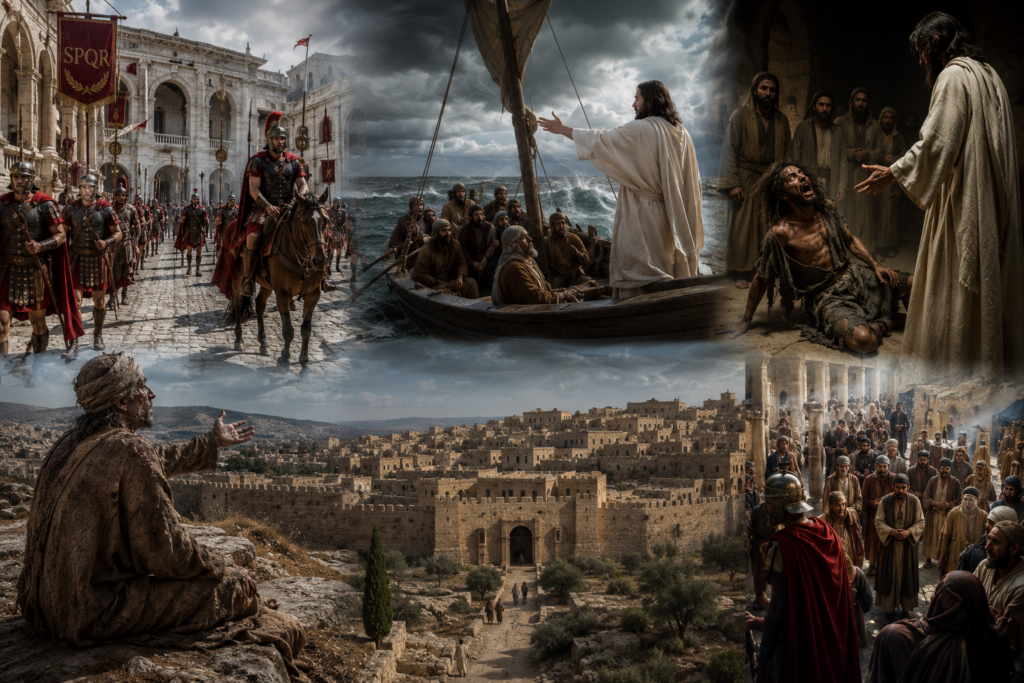
When the Gospels open, the symbols of chaos have become painfully recognizable. Israel lives beneath the weight of Roman occupation. The Temple itself has become entangled with corruption and political compromise. Blind men sit beside the roads. The lame wait outside the gates. Lepers remain isolated from their communities. Demonic powers torment men and women created in God’s image. Storms threaten the disciples on the Sea of Galilee, and death casts its shadow over villages Jesus enters. The biblical story has brought the problem of chaos into full view.

This is why the ministry of Jesus cannot be reduced to a collection of miracles or isolated acts of compassion. Every healing restores life where chaos has left its mark. Every exorcism drives back the powers that resist God’s kingdom. Every calming of the sea reveals His authority over the forces that threaten creation. Even His confrontation with death itself declares that the deepest consequence of humanity’s exile will not be the final word. The same story that began in Genesis continues to unfold as God moves toward the restoration of His creation.

The Bible ends where it began—with God’s dwelling once again among humanity. Death is abolished, mourning gives way to joy, and the exile that began in Eden finally comes to an end. Creation is restored, and the story that opened in a garden reaches its fulfillment in the presence of God.

Our own generation has not escaped the realities that confronted the ancient world. Floods still destroy homes. Wars continue their destructive path. Disease reminds us how fragile life remains. Violence, injustice, and broken relationships leave deep wounds that no generation has been able to avoid. Knowing that these experiences are ancient does not make them easier to bear, nor does it lessen the grief they bring into our lives.

Yet we are invited to see these realities within a much larger story. The chaos we experience today is not evidence that God has abandoned His creation. From Genesis to Revelation, the Bible tells one continuous story of a God who enters history, confronts everything that opposes life, and faithfully accomplishes His purposes. That promise sustained God’s people in the ancient world, and it continues to sustain ours as we await the day when death, sorrow, and exile will finally give way to life in the presence of God.
chaos
hyssop

Hyssop: The Little Plant in God’s Story of Redemption

Among the many plants mentioned in the Bible, none has generated more discussion than hyssop. For generations, botanists and biblical scholars have debated its identity. Was it the common hyssop known today, or the wild marjoram, Origanum syriacum, still called za’atar throughout Israel and Jordan? R. K. Harrison described hyssop as “one of the more problematical species of herbs,” observing that despite extensive study, its precise identification remains uncertain.

Most modern scholars associate the Hebrew ezov with a small aromatic plant that grows naturally throughout the hill country of Israel and Jordan. I remember seeing it growing from the rocks in Wadi Rum near Petra, where its ability to flourish in the harsh desert landscape brought Solomon’s description of “the hyssop that springs out of the wall” to life.

In the ancient world, hyssop was valued as both a culinary herb and a medicinal plant. Its leaves were dried for seasoning, while its aromatic oils were believed to possess cleansing properties. Ancient writers such as Pliny the Elder describe its use in treating skin disorders and digestive ailments, and later Jewish tradition likewise associated the plant with cleansing. Harrison also observes that its slender branches could easily be gathered into a bundle, making it well suited for use as a ritual sprinkler.

None of this, however, explains why hyssop occupies such an important place in Israel’s worship. Aromatic herbs and purification rituals were common throughout Egypt, Canaan, and Mesopotamia, where water, incense, fragrant plants, and sprinkling prepared temples for the presence of their gods. The Torah adopts none of the magical associations attached to such rituals. Instead, it gives hyssop a distinctive covenantal purpose.

Hyssop connected to sacred space

That realization shifted my attention away from identifying the plant and toward the role it plays throughout Scripture. Throughout the Torah, hyssop is consistently held in someone’s hand, conveying blood or water to a house, a sanctuary, or the people who belong within God’s dwelling. It appears whenever sacred space is being restored to covenant holiness.

The pattern begins on the night of the first Passover. Israel is instructed to take a bundle of hyssop, dip it into the blood of the Passover lamb, and apply the blood to the lintel and doorposts of every house. With a bundle of hyssop, covenant blood marks each household setting it apart from the judgment falling upon Egypt and preserving those within from death. The first place associated with hyssop is not the Tabernacle or the Temple, but an ordinary Israelite home that becomes sacred space as the Lord Himself passes over its threshold.

Here the Torah departs from the religious world around it. Egypt and Mesopotamia purified temples so their gods might dwell within them. Israel’s God does not summon His people into an earthly sanctuary here. He comes to their homes. Through blood applied with hyssop, an ordinary house becomes the first sacred space of the Exodus.

The pattern continues in Leviticus 14, where the object requiring purification is once again a house. A dwelling afflicted with ritual impurity undergoes an elaborate ceremony involving cedar wood, hyssop, scarlet yarn, the blood of a sacrificed bird, a living bird, and fresh running water. This is the first of several places where cedar, hyssop, and sheni tola’at appear together as part of Israel’s purification rites.

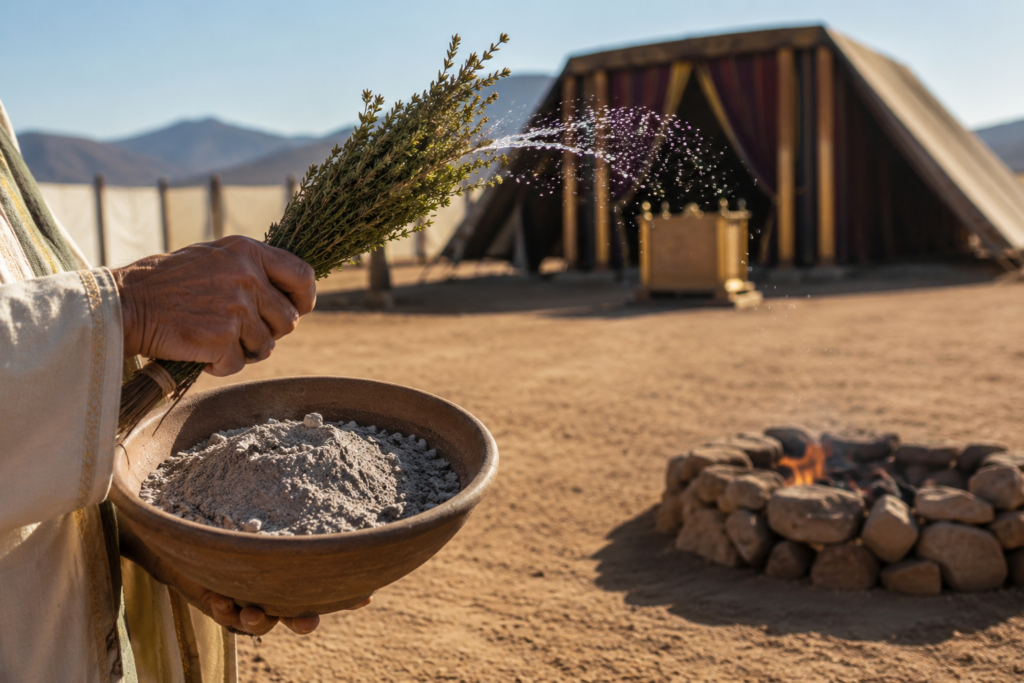
Numbers 19 expands the pattern. Here the issue is no longer disease but death itself. The ashes of the red heifer are combined with living water, and a clean person takes hyssop to sprinkle the tent, its vessels, and everyone defiled through contact with death. The same ritual elements appear again, but the concern now extends beyond individuals to everything associated with God’s dwelling. Death has interrupted covenant fellowship, and the ritual restores what death has defiled.

Every major occurrence of hyssop in the Torah is connected with sacred space—Israelite homes, houses restored after ritual impurity, and the Tabernacle with its furnishings and covenant community. The object of purification is not primarily the individual but the place where God’s presence dwells among His people.

David understands this when he cries, “Purge me with hyssop, and I shall be clean.” No priest stands over him with a bundle of hyssop. David speaks metaphorically, presenting himself as though he has become the sanctuary requiring purification. His deepest longing is not merely forgiveness but restored fellowship with the God whose presence had seemed so distant after his sin.

Hyssop for Consecration

The writer of Hebrews gathers these passages into a single image. Moses took blood, water, scarlet wool, and hyssop and sprinkled both the book of the covenant and all the people. The tabernacle and its vessels were likewise consecrated. The emphasis is not on the plant itself but on the consecration of God’s dwelling and His covenant people through blood and purification.

John alone tells us that the sponge filled with sour wine was lifted to Jesus on hyssop. Matthew and Mark mention only a reed, but John deliberately identifies the plant.

From the opening of his Gospel, John presents Jesus as both the Lamb of God who takes away the sin of the world and the place where God dwells among humanity. Throughout the Torah, hyssop served as the instrument by which covenant blood and the water of purification were applied to houses, sanctuaries, vessels, and God’s covenant people. Now, at the very moment the Lamb bears the sin of the world, that same instrument is lifted to Him. Throughout the Torah, hyssop accompanied the restoration of places where God chose to dwell. Now it is lifted to the One who bears the world’s defilement so that God may once again dwell among His people.

The same instrument that marked Israel’s houses at Passover, purified defiled dwellings, and restored the Tabernacle now appears at the cross. The pattern reaches its fulfillment in the Messiah. The One who bears the world’s sin accomplishes what every earlier act of purification anticipated: the restoration of God’s dwelling among humanity.

The little plant reminds us that God has always been restoring places where He chooses to dwell. The work that began in Israel’s homes reached its fulfillment in the Messiah and now continues in the lives of those who belong to Him. God’s purpose has never changed. He is still restoring His dwelling among His people.

hyssop
Korah

The Earth Gives Back Its Dead (Korah’s Rebellion)

As I was studying this week’s Torah portion, Korah, I expected to encounter the familiar themes of rebellion, priesthood, and judgment. What I did not expect was to find myself back in Matthew 27. Yet there it was again: the earth splitting open, the realm of death exposed, questions of holiness and priesthood, and a boundary between life and death laid bare.

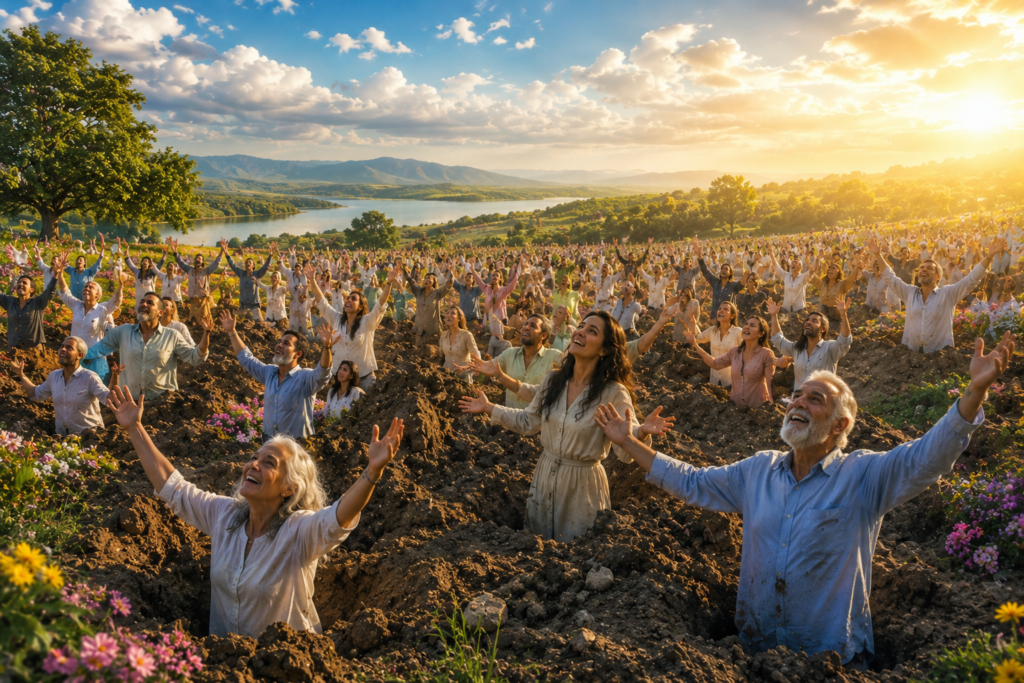
Over the past several weeks, I have explored Matthew’s account of the torn veil, the earthquake, the splitting rocks, and the opened tombs. At first glance, Korah seems far removed from those events. Yet both passages revolve around the same mystery. In Numbers, the earth opens and the rebellious descend alive into Sheol. In Matthew, the earth shakes and holy ones emerge from their tombs alive. The same movement only reversed.

If you have not read the previous four essays in this series, I encourage you to do so. What began as an investigation into Matthew’s unusual resurrection account has opened into a much larger biblical theme: the boundary between life and death and the moments when God breaches it.

The heart of the Korah narrative is found in this statement. Moses declares, “If the Lord creates a new thing…” (Num. 16:30). The Hebrew word is bara, the same word used in Genesis 1 when God creates the heavens and the earth. The earth itself becomes the instrument through which God confirms His chosen priesthood.

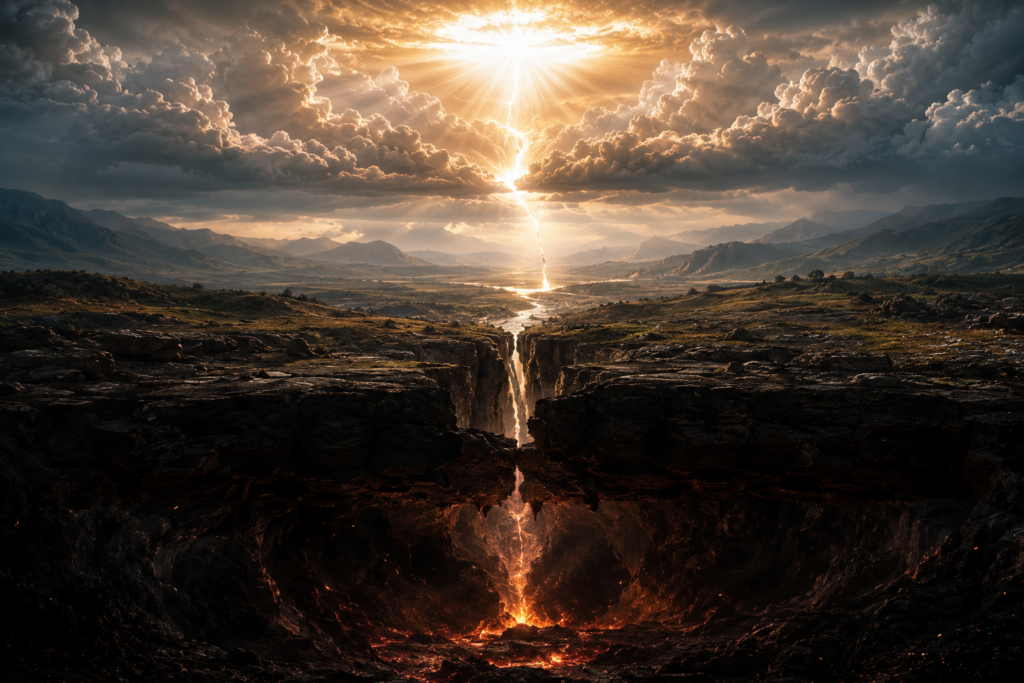
The ground splits (bakah) beneath the rebels. The earth opens its mouth and swallows. They go down alive into Sheol. For a brief moment, the people see what lies beyond the boundary between life and death. The earth becomes a doorway into the realm of the dead.

The biblical story consistently portrays death as a descent. The grave receives its captives and closes over them. In the Korah rebellion, that hidden reality becomes visible. The earth opens, the rebels descend, and Israel witnesses the realm of death exposed before them.

This imagery appears throughout the Hebrew Scriptures. The psalmists speak of going down to the pit. Jonah describes the bars of the earth closing around him. Throughout the biblical story, death is portrayed as a realm that receives and holds its captives. The grave receives kings and servants, priests and prophets, the righteous and the wicked. Death remains the great destination of humanity’s exile from the presence of God. The Korah rebellion provides a glimpse into the larger human condition.

Now consider the direction of movement in Matthew’s account. At the death of Yeshua, the veil is torn, the earth shakes, the rocks split, and the tombs are opened. Though discussions generally focus on the identity of the holy ones who appear in Jerusalem, the direction of movement has changed.

In the Korah rebellion, the earth opens and people go down alive into Sheol. The grave receives them. Death claims its captives.

Matthew records something different. The tombs are opened and holy ones emerge. The movement has reversed. The grave that once received its captives now yields them. The earth that swallowed now releases.

From Adam onward, humanity entered the domain of death and remained there. At the death of Messiah, Matthew records the first signs that the pattern is changing.

The creation language of Numbers 16 points in the same direction. Moses declares that the Lord will create (bara) a new thing. The opening of the earth accompanies the confirmation of God’s appointed order. Matthew records another moment when creation itself responds to God’s work. The tombs are opened, and the grave begins to surrender what it holds. The movement that carried Korah and his followers down into Sheol is now reversed.

The Korah narrative is ultimately a dispute over priesthood. Korah challenges Aaron’s right to approach God’s presence, arguing that the entire congregation is holy. The opening of the earth settles the question. God’s chosen priesthood is confirmed.

When a plague breaks out among the people, Aaron takes a censer filled with incense and runs into the midst of the congregation. He stands between the dead and the living and makes atonement for the people. The plague stops.

Matthew presents a greater priestly reality. The opened tombs appear in the context of Messiah’s death. He enters the realm of death itself. Aaron’s ministry preserved life for a time. Jesus confronts the enemy that has held humanity captive since Eden.

The swallowing of Korah and his company and Matthew’s opened tombs stand on opposite sides of the same biblical pattern. In Numbers, the earth opens and the rebellious descend into Sheol. In Matthew, the tombs open and holy ones emerge. This helps explain why the opened tombs occupy such an important place in Matthew’s account. The boundary that had held humanity since Eden has been breached.

The prophets anticipated such a day. Isaiah declares, “Your dead shall live; their bodies shall rise. You who dwell in the dust, awake and sing for joy” (Isa. 26:19). What appears briefly in Matthew’s account becomes a promise for God’s people.

The same theme appears at the end of the biblical story. Revelation declares that “Death and Hades gave up the dead who were in them” (Rev. 20:13). The realm that once received its captives releases them. The grave is compelled to surrender its dead.

The opened tombs of Matthew 27 stand between Korah and Revelation, between the earth swallowing its dead and the earth giving them back. The direction has changed. The realm of death still exists, but its final victory has been challenged. The earth that once opened to receive now opens to release.

This is the promise. What appears briefly at the death of Yeshua anticipates the day Isaiah foresaw and Revelation describes, when the dead are called forth and death relinquishes its claim. The boundary between life and death still stands, but Matthew records the moment it was breached.

Korah
holy ones

The Holy Ones and the Return Home to Jerusalem

Part 4 Splitting, Tearing and New Creation

Matthew’s account of the crucifixion contains one of the most puzzling passages in the New Testament: “Many bodies of the holy ones who had fallen asleep were raised; and coming out of the tombs after His resurrection, they entered the holy city and appeared to many” (Matthew 27:52,53).

Matthew’s description has generated centuries of debate. Readers have long wrestled with questions surrounding the event. Who were these holy ones? Were they physically resurrected? Did they die again? If not, where did they go? These are legitimate questions, yet the text itself offers remarkably few answers. Matthew provides no names, no identities, and no explanation of what became of them afterward. In fact, he seems almost uninterested in the very questions that have occupied so many.

For that reason, the aim of this essay is not to explain the mechanics of the event but to explore the biblical imagery Matthew employs and the larger story it may be invoking.

Throughout this series, we have examined Matthew’s description of Jesus’s death as a sequence of breached boundaries. The veil is torn. The earth shakes. The rocks split. The tombs are opened. Each sign reflects a deeper consequence of humanity’s exile from God. The torn veil addresses separation from God’s Presence. The earthquake and splitting rocks affect the created order itself. The opened tombs reach into the realm of death.

The Holy Ones Appear in Jerusalem

Matthew then directs our attention to where the holy ones go. After emerging from the tombs, they enter Jerusalem—the holy city. His description is raising a different question. It suggests the significance doesn’t lie in their appearance but rather in where they go afterward. The movement is not from death to life as much as it is from death to Jerusalem.

Throughout Scripture, Jerusalem is the center of covenant life, the place of God’s dwelling among His people, and the destination of restoration. Again and again, the prophets envision God’s people returning to Jerusalem after judgment and exile. The prophets also saw a day when the Lord Himself would return to Zion and dwell among His people.

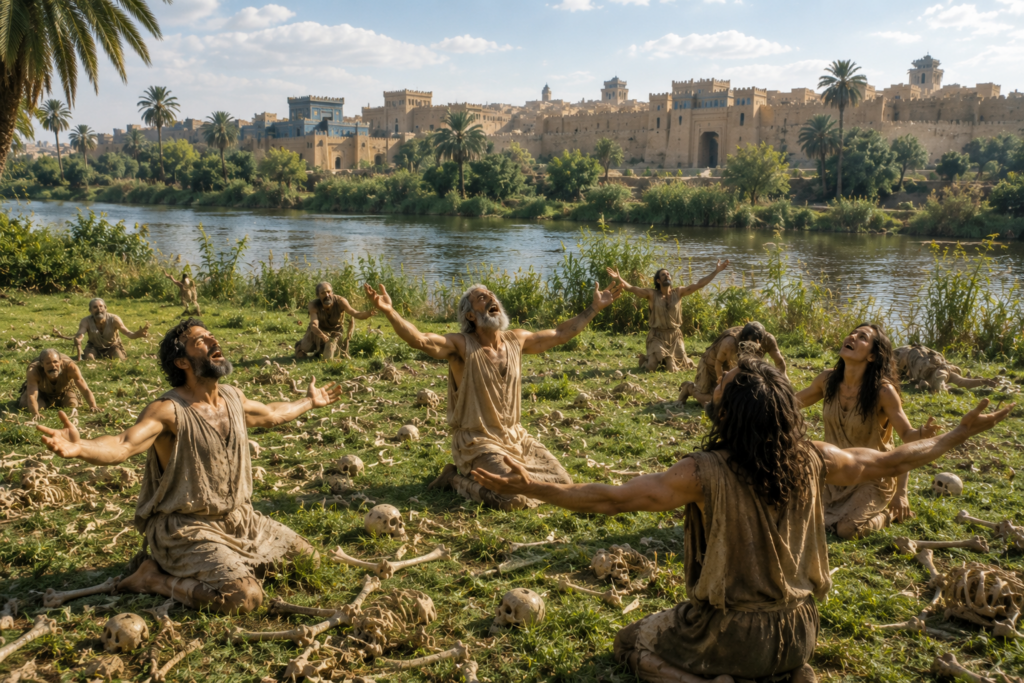
The prophets often described restoration from exile in terms of resurrection. Nowhere is that connection clearer than in Ezekiel 37. There the nation laments, “Our bones are dried up, and our hope is lost.” God’s response comes in the language of resurrection: “I will open your graves and bring you up from your graves, my people.”

For those carried away to Babylon, exile was far more than a political disaster. Jerusalem lay behind them. The Temple was in ruins. The life God had established for His people in the land had been torn apart. The Davidic throne was empty, worship had ceased, and the nation that had once flourished in the land now sat beside foreign rivers weeping when it remembered Zion. Israel was still alive physically, but covenant life had been shattered. Exile had become a form of national death.

Ezekiel sees a valley filled with dry bones and hears God’s promise to open graves and restore His people. The vision is often read as a prediction of bodily resurrection, yet its primary concern is restoration after exile. Graves are opened. The dead rise. God’s people are brought home. In the prophetic imagination, resurrection becomes the language of return.

The prophets anticipated not only Israel’s return to Zion but the return of Yahweh Himself. Isaiah describes the day when the watchmen rejoice because they see the Lord returning to Zion. The psalmist celebrates the restoration of Zion with the words, “When the Lord brought back the captives from Zion, we were like those who dream.” Zechariah envisions God gathering His scattered people and bringing them once again to dwell in Jerusalem.

These themes reappear in Matthew’s account. Like Ezekiel, Matthew speaks of opened tombs and the raising of God’s people. The appearance of the holy ones in Jerusalem echoes the larger biblical hope of return and the renewed presence of God among His people. The holy ones emerge from their tombs and make their way to the city that stood at the center of Israel’s hope.

In Matthew’s account, the Messiah comes first. Only afterward do the holy ones enter the city. Matthew places the Messiah before the holy ones who follow.

This scene belongs within Scripture’s larger story of exile and return. The holy ones do not simply come back to life. They come home.

Ezekiel’s Dry Bones

This, of course, does not prove that Matthew is directly interpreting Ezekiel 37, nor does it mean that these figures represent those who died during the Babylonian exile. Matthew never says that. Yet the imagery belongs to the same theological pattern. In both passages, opened graves are connected to restoration. And the parallels are difficult to dismiss. The prophets saw a day when God would restore His people, overcome their enemies, and dwell among them once again. Every earlier deliverance pointed toward that hope but never fully achieved it. The return from Babylon was real, but death remained undefeated. The deeper exile endured.

In each case, restoration culminates in return, and Jerusalem is where exiles come home.

The same pattern appears throughout this four-part series. Humanity’s story begins with exile from Eden. Israel’s story unfolds through repeated exiles and restorations. Yet every restoration leaves one enemy undefeated. Jerusalem may be restored but death remains—that is until the resurrection of Jesus the Messiah.

The appearance of the holy ones may be functioning as more than a resurrection account. It may be a sign that the restoration anticipated by the prophets is now reaching beyond the land and beyond the Temple into the realm of death itself. They do not appear until after Jesus’s resurrection. He comes first. Only then do they enter Jerusalem. If Matthew presents Jesus as the embodiment of God’s Presence among His people, then His resurrection becomes more than a victory over death. It becomes the return of the King.

Matthew’s account is ultimately the story of barriers giving way. The journey that began with exile from Eden is moving toward its long-awaited restoration. Through His death and resurrection, Jesus confronts the deepest consequence of humanity’s separation from God. Now even that final enemy has been challenged. The holy ones entering Jerusalem stand as a sign that the journey home has begun.

We live in an age that often appears dominated by disorder, violence, and death. Yet, the Messiah has entered the grave and emerged victorious. The powers that enslave humanity have been breached. The holy ones appear only briefly in Matthew’s account, yet their arrival in Jerusalem announces something far greater than themselves: death’s captivity has been broken. The King has returned, and the long exile is beginning to end.

holy ones

tombs

The Opened Tombs and the End of Exile

The third article in this series (Splitting, Tearing, and New Creation: A Matthew 27 Study.) 

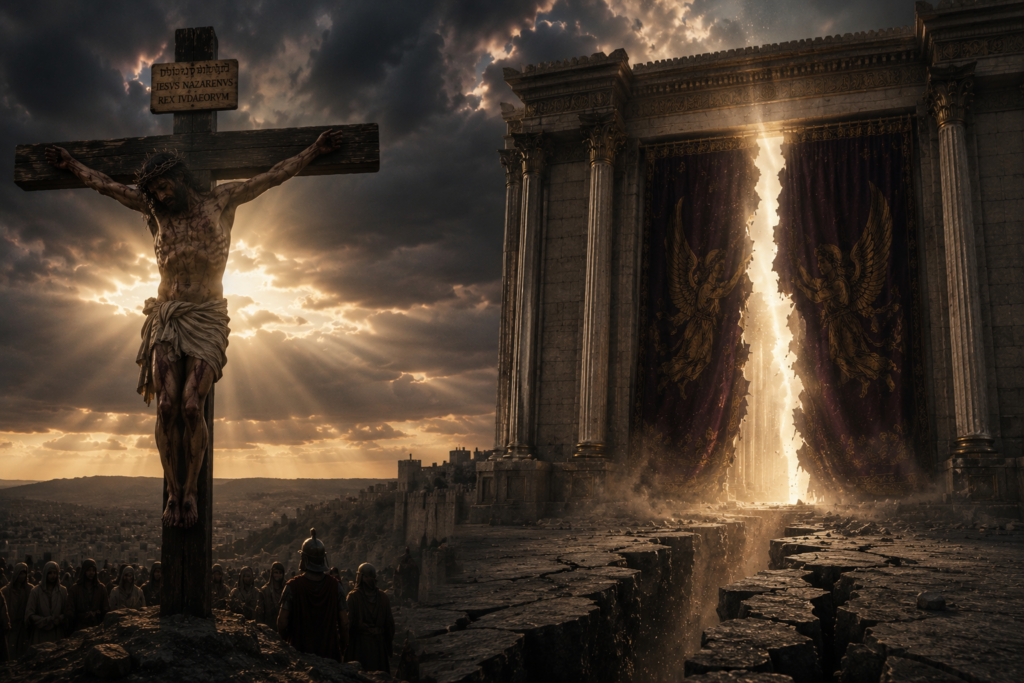
In the previous essays, we examined Matthew’s description of the moment Jesus died. The veil of the Temple was torn from top to bottom. The earth shook. The rocks split. The tombs opened. These dramatic signs accompany the Messiah’s death and prepare the reader for what comes next.

Immediately after describing the torn veil and the earthquake, Matthew adds a detail found only in his Gospel: “The tombs also were opened” (Matthew 27:52). Why does he move directly from the torn veil and the earthquake to the opening of tombs? The answer lies in the larger story Scripture has been telling from the beginning.

The signs surrounding Jesus’s death unfold in a deliberate progression. What begins with the torn veil continues through the earthquake and splitting rocks before reaching the opened tombs. Matthew is not describing isolated miracles but a victory advancing through successive barriers. To understand why the opening of tombs matters, we must place it within the larger story that begins in Eden.

The biblical story unfolds as a story of exile and restoration. When Adam and Eve were expelled from Eden, they were driven from God’s Presence and barred from the Tree of Life. Their exile was separation from the source of life itself. Death entered the human story, and from that moment exile and death became inseparable.

Israel’s story repeatedly mirrors Adam’s. Humanity is driven from Eden; Israel is driven from the land. Humanity loses access to the Tree of Life; Israel loses access to sacred space. Again and again, God’s people experience separation from the blessings of covenant life. Yet even when restoration comes, the deeper problem remains. Israel returns to the land, but death still reigns. The Temple is rebuilt, but graves continue to fill.

For this reason, the prophets look beyond national restoration to a greater redemption. Isaiah foresees the day when God will swallow up death forever and remove the reproach of His people. Daniel speaks of those who sleep in the dust awakening to new life. Throughout the Psalms, death is portrayed as a realm of darkness, confinement, and separation. The biblical hope is not simply that Israel will return home, but that death itself will finally be overcome.

If death is the deepest form of exile, then resurrection is the ultimate restoration.

The hope of Israel is not merely the recovery of land, city, or Temple. It is the return of life itself.

This larger context helps explain why the opening of tombs matters. If the torn veil signals the reversal of humanity’s separation from God, the opened tombs signal that the final barrier is beginning to give way.

To make sense of Matthew’s imagery, we must understand what first-century tombs looked like. Modern readers often picture individual graves in the ground, but that was not Matthew’s world. In Judea, many families used rock-hewn tombs carved into the limestone hills surrounding cities and villages. These were family burial chambers designed to hold multiple generations.

Inside were narrow burial niches called kokhim, where bodies were initially placed. After decomposition, the bones were gathered into stone boxes known as ossuaries, making room for future burials. A single tomb could therefore contain the remains of several generations.

The entrance was typically sealed with a large stone, either fitted into the doorway or rolled across the opening. The stone marked the separation between the living and the dead. When Matthew says the tombs were opened, he is not describing people emerging from holes in the ground. He is describing family burial chambers standing open, their stone barriers removed.

The significance of these tombs becomes clearer when viewed against Scripture’s portrayal of the realm of the dead. The Hebrew Bible describes Sheol as a place of gates, bars, depths, and darkness. Jonah speaks of the bars of the earth closing behind him, while the Psalms depict those who await deliverance from the shadow of death. Death is portrayed as a prison from which only God can rescue His people. In this light, the tomb was more than a burial place. It marked the entrance to that captivity.

Against this backdrop, Matthew’s description takes on greater significance. The tombs are not merely shaken by the earthquake; they are opened. Matthew presents Yeshua’s death within that pattern. He is not recording a series of events surrounding the crucifixion but a single victory unfolding across creation.

The veil is torn. The earth shakes. The rocks split. The tombs are opened.

Each sign extends the scope of the last. The veil marks the divide between God’s Presence and humanity. The earthquake and splitting rocks show creation responding to the death of its King. The opened tombs reach death itself. One by one, the barriers yield before the Messiah’s victory.

The sequence recalls key moments in Israel’s story. Just as God split the sea at the Exodus, He now tears the veil. Just as Sinai shook at His Presence, the earth trembles at the death of His Son. Just as God opened a path through the waters, He now opens the tombs. Matthew gathers these images into a single moment, presenting the crucifixion not as a defeat but as God’s victory over humanity’s deepest enemy.

Since Eden, death has remained the final consequence of humanity’s exile from God. As long as death reigns, exile remains unfinished. Only when death is overcome can restoration be complete.

The opening of the tombs signals that this final obstacle is beginning to give way.

This is where Jesus’s death differs from every exile that came before it. Adam was driven from Eden. Israel was driven from the land. Both experienced the consequences of disobedience. Yeshua enters the realm of death willingly. He embraces the deepest expression of exile in order to overcome it. What Adam lost and Israel could not restore, the Messiah now confronts directly.

Matthew places the opened tombs after the torn veil because the signs belong together. The torn veil reaches into the heavenly realm represented by the Temple. The earthquake and splitting rocks shake the world of the living. The opening of the tombs penetrates the realm of death itself. Together they reveal the full scope of the Messiah’s victory. Its effects do not stop at the sanctuary but extend through the whole structure of creation, reaching even the deepest consequence of humanity’s exile.

Seen in this light, this is not an isolated miracle. It declares that the victory accomplished at Golgotha reaches beyond sin to the deeper captivity that has shadowed humanity since Eden. Here the Messiah confronts death itself and challenges its claim on humanity.

Before Matthew tells us who emerged from these tombs, he first directs our attention to the tombs themselves. The emphasis falls on the breach. A barrier that had stood since Eden has given way. The consequences will soon become visible, but Matthew first invites his readers to consider what that opening means.


tombs


veil

The Torn Veil and the Return of God’s Presence

The first article in this series (Splitting, Tearing, and New Creation: A Matthew 27 Study.) explored the biblical pattern based on the Hebrew word bakah—splitting. From the dividing of the waters in Genesis, to the splitting of the sea in Exodus, and even the splitting of the Mount of Olives, Scripture repeatedly uses the language of rupture to describe moments when God intervenes in history. One order collapses and another emerges. Matthew’s account of the crucifixion brings that pattern to its climax. At the moment of Jesus’s death, the veil of the Temple is torn in two, the earth quakes, and the rocks split.

Why does the veil tear at that precise moment?

Many interpretations focus on humanity gaining access to God. While that is certainly part of the story, there may be something even larger. The torn veil is the announcement that God has begun to restore what was lost in Eden.

Eden was sacred space, the place where heaven and earth overlapped and where God dwelt with His creatures. Adam and Eve did not ascend into God’s heavenly realm. God placed them in the garden to dwell with Him. The human tragedy of the garden episode is not simply disobedience. It is exile from the presence of God.

Humanity is driven eastward from the garden. The way back is closed. Cherubim stand guard at the entrance, marking the boundary between God’s realm and the world beyond. From that moment forward, the biblical story becomes a story of exile and return—the return of God’s Presence to humanity and humanity’s return to sacred space.

This theme appears again and again throughout Scripture. Adam is exiled from Eden. Israel is exiled from the land. Ezekiel sees the glory depart from the Temple. Humanity lives east of Eden, separated from the fullness of God’s Presence.

The Tabernacle and later the Temple preserved the memory of that separation.

Scholars debate which veil Matthew has in view when he records that “the veil of the Temple was torn in two.” Some identify it as the great outer curtain described by Josephus, while others point to the inner veil separating the Holy Place from the Holy of Holies. For our purposes, the focus is not on which veil Matthew meant, but on what the veil represented.

The veil was a boundary.

Woven into it were cherubim, recalling the cherubim stationed at Eden’s gate. Before there was a curtain in the Temple, there were cherubim guarding the way back into sacred space. The veil continued that same function. The barrier still stood. The exile remained unresolved.

Once each year, on the Day of Atonement, the high priest approached that barrier carrying blood and incense. He entered God’s Presence on behalf of the people, but he did not remain there. His ritual acts repaired sacred space, but they did not remove the separation. The blood addressed the breach, yet the veil remained.

Though the Temple mediated God’s Presence, it did not fully resolve the problem that began in Eden. This is why the longing of the prophets is so striking. Their hope was not that humanity might ascend into heaven. Their hope was that God would return.

Isaiah gives voice to that longing in one of the most dramatic prayers in Scripture: “Oh, that You would rend the heavens and come down” (Is. 64:1). Isaiah does not pray, Let us go up to heaven. He prays, Come down…that the mountains might “shake” at Your presence.

Throughout Scripture the movement is consistently one of divine descent. God comes to Adam in the garden. God comes down at Babel. He descends upon Sinai. He fills the Tabernacle with His glory. He fills Solomon’s Temple. The Word becomes flesh and dwells among us. Even the story’s final vision is not humanity escaping the earth but the New Jerusalem descending from heaven.

The goal has always been the same: God dwelling among His people—permanently.

Elsewhere Isaiah speaks of God stretching out the heavens like a curtain and spreading them out like a tent. The heavens themselves are portrayed as God’s dwelling place. When Isaiah cries out for God to rend the heavens and come down, he is asking God to tear open the barrier that separates realms and return to His people.

Isaiah 63–64 are filled with themes of exile, restoration, divine intervention, and the hope of a renewed creation. Isaiah longs for the day when God will once again act decisively in history, defeat His enemies, restore His people, and dwell among them. Matthew may be presenting the torn veil as the answer to that ancient prayer. The barrier is torn. God has acted. The long exile is reaching its turning point. What Isaiah anticipated, Matthew sees unfolding at the cross.

Against this background, the tearing of the veil becomes the defining moment in Matthew’s story. At the very moment Jesus dies, the veil of the Temple is torn from top to bottom.

The action begins from above.

The tearing of the veil is a declaration that the barrier has been breached. The long exile from God’s Presence is nearing its end.

It becomes even clearer when we remember how Matthew presents Jesus throughout his Gospel. He is Emmanuel—God with us. In John’s Gospel, Jesus speaks of His own body as the Temple. If Jesus is the true dwelling place of God among humanity, then His death becomes a Temple event.

There may be another dimension to Matthew’s account that is often overlooked. Throughout His ministry, Jesus repeatedly confronted the corruption of the Temple and its leadership. His cleansing of the Temple was not so much a protest against commercial activity, but spoke of the coming judgment against a system that had failed. In the first century, the Temple had become associated with corruption, uncleanness, and spiritual blindness.

Matthew’s account raises a fascinating question: Is he presenting the death of Yeshua as a Temple crisis?

Jesus is the true dwelling place of God among humanity. The true Temple is struck. The earthly Temple now responds to that action. At the moment Jesus enters death—the deepest point of exile—the veil of the Temple is torn.

Death itself represents the ultimate intrusion of corruption into creation and the deepest expression of separation from God. A corpse brings impurity. Death contaminates sacred space. The God of life does not dwell in death. When Yeshua cries, “My God, my God, why have You forsaken me?” His words echo the language of abandonment and exile that has marked, not only Israel, but the entire human condition since Eden. Yet in entering fully into humanity’s exile, impurity, corruption, and death, Jesus begins to reverse their power.

This is why the tearing of the veil is so significant.

The torn veil becomes the visible sign that God is reclaiming and expanding His creation and restoring sacred space once again. The goal of both the Tabernacle and the Temple was never to confine God. They existed because God desired to dwell among His people. The torn veil signals that the barrier separating God’s Presence from creation has been breached. This is why Matthew records that the earth quaked and the rocks split. These are not merely images of access. They are images of restoration.

The effects of the cross extend beyond worship and into creation itself. A cosmic victory has occurred. The visible tearing of the veil reveals an invisible reality. The torn veil reminds us that the story of Scripture is not about escaping the world. It is about God repossessing it.

Immediately after the veil tears, the earth shakes, the rocks split, and the graves open.

We might ask: Why does the healing of the cosmos extend into the realm of the dead? That question leads us to the next stage of Matthew’s narrative. Stay tuned!


veil
worship

Worship and Wrestle: Finding God at Jabbok

The framework that once carried Christianity through American life is collapsing. In the decades following World War II, churches existed within a society that largely reinforced a Christian worldview. Schools, neighborhoods, civic institutions, entertainment, and public discourse all contributed to moral and ethical standards shaped largely by biblical ideas.

That world has disappeared before our eyes.

The challenge facing the church today is not primarily political, institutional, or technological. It is a question of worship. What captures our attention will ultimately shape our affections. Everyday millions of people are formed by the liturgies of distraction, comparison, outrage, self-promotion, and anxiety. The question confronting believers is not merely what we believe, but what has our attention, our loyalty, and ultimately our worship.

Yet this struggle is not new.

From the opening chapters of Scripture, humanity has faced the same fundamental choice. In the garden, the serpent’s temptation was not simply disobedience. It was an invitation to self-exaltation. Humanity was enticed to define good and evil on its own terms, to determine reality apart from God, and to become the source of its own wisdom and authority. The temptation was fundamentally about worship. Would humanity trust the Creator, or seek to take His place?

The same conflict appears in the wilderness. After forty days of fasting, Yeshua confronts haSatan—the adversary. Each temptation offers a shortcut to glory, authority, and power apart from obedience to the Father. Each temptation is a counterfeit form of worship. The wilderness becomes a battlefield where the question is: worship God or worship self.

The same choice confronts every generation. It confronts us now.

We often imagine that transformation happens through dramatic moments, but Scripture consistently portrays character as the result of countless decisions. Every day we choose what will shape us. Every day we choose whether to pursue righteousness or pursue ourselves. Every day we choose responsibility or resentment, trust or anxiety, obedience or self-determination. Over time, these choices become the path upon which we pattern our lives.

The story of Jacob speaks powerfully to our present moment.

Jacob is one of Scripture’s most recognizable portraits of humanity. He is flawed, ambitious, deceptive, manipulative, fearful, and yet remarkably successful. Again and again, he secures what he wants through strategy and persistence. He obtains the birthright. He deceives Isaac. He survives Laban. He accumulates wealth. He builds a household. By every visible measure, Jacob succeeds.

Yet prosperity and transformation are not the same thing.

God has blessed Jacob, but Jacob remains Jacob.

When God calls Jacob to return to the land, he is forced to confront the consequences of his past in the person of his brother Esau. The report from Jacob’s servants is alarming. Esau is approaching with four hundred men. Suddenly all of Jacob’s strategies seem inadequate. The text says he was greatly afraid and greatly distressed. The language evokes pressure and tribulation. Jacob finds himself in a place from which there appears to be no escape—no backup plan.

His first instinct is the same instinct that has governed his entire life. He calculates. He divides the camp. He develops contingency plans. If one group is attacked, perhaps another can survive. Even his prayer reflects the tension between faith and fear. He reminds God of the promises. He asks for deliverance (natzal) from Esau’s hand, using language that later echoes Israel’s deliverance from Egypt. Yet even while praying, Jacob continues arranging gifts and devising ways to appease his brother.

He is still trying to save himself.

Then night falls.

Jacob sends everyone across the river and remains alone. The isolation is key. Throughout Scripture, moments of transformation often occur when every support system and every backup plan has failed. No family. No servants. No flocks. No strategy left. Jacob is finally left with nothing but himself and God.

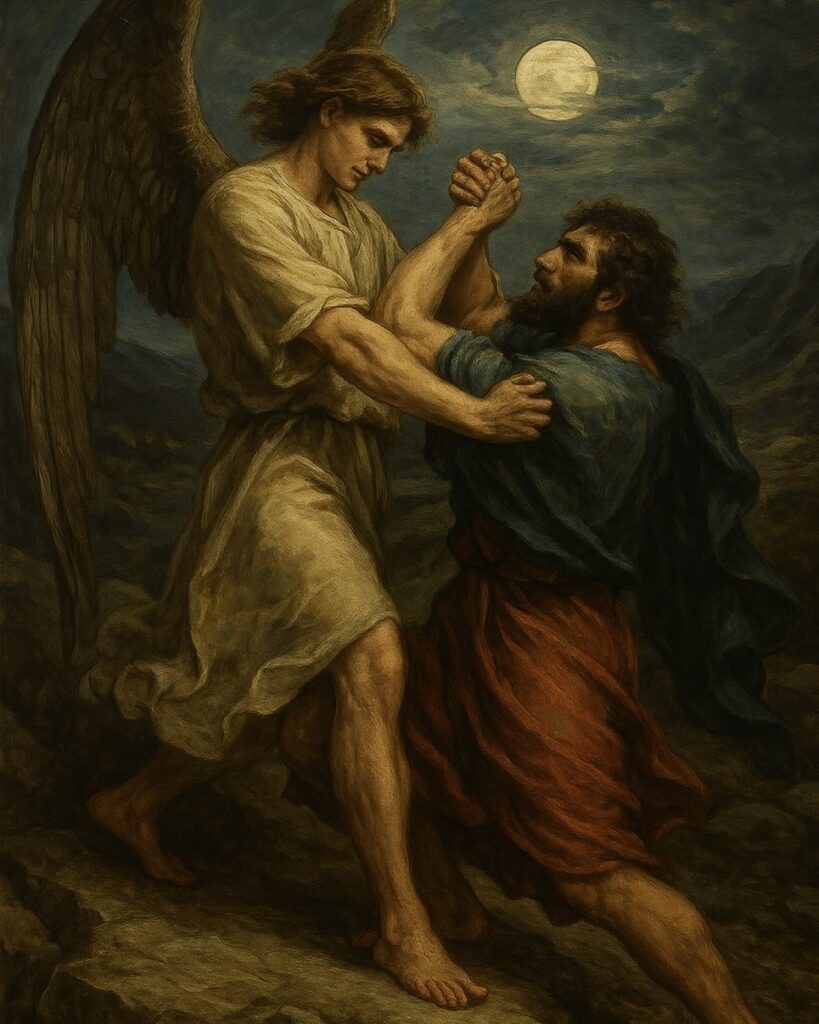
The encounter that follows is one of the most mysterious in all of Scripture. A “man” wrestles with him until the breaking of dawn. The Hebrew narrative is deliberately structured with a series of wordplays that intertwine Jacob’s identity with the place where the encounter occurs. Jacob, Ya’aqov, wrestles, ye’abeq, at the Jabbok River, Yabboq. The words echo one another in a way that simply can’t be accidental.

Many scholars have observed that the rare verb abaq likely carries the imagery of dust being stirred into the air. The scene depicts a violent struggle in the dirt beside the riverbank. Dust rises as these two figures grapple through the darkness.

Jacob has spent his entire life wrestling. He wrestled with Esau in the womb. He grasped his brother’s heel at birth. He fought for inheritance, blessing, prosperity, and security. Every major chapter of his life has been marked by struggle. Now, beside the Jabbok, all those struggles converge into one final encounter.

Many commentators suggest that Jacob is not only wrestling a mysterious divine opponent. He is wrestling his own past, his fears, his identity, and the person he has spent a lifetime becoming.

Dust is significant in Scripture. Humanity was formed from the dust of the earth. Dust reminds us of mortality, limitation, and dependence upon God. Jacob’s struggle unfolds in the very substance that testifies to human weakness. Everything he has trusted in himself is being exposed. His cleverness cannot secure the future. His plans cannot guarantee blessing. His manipulations cannot produce reconciliation.

What Jacob requires cannot come from Jacob. Wrestling is Required

The encounter also bears a striking resemblance to the combat scenes familiar throughout the ancient world. Heroes meet divine beings at rivers, mountains, and wilderness boundaries. The setting is liminal, standing between one reality and another. Darkness, struggle, blessing, and transformation all belong to this pattern. Jacob crosses the Jabbok as one man and emerges as another.

The irony of the story is that Jacob prevails not because he overpowers God, but because he refuses to let go. As dawn begins to rise, he clings to the One who has wounded him. The struggle leaves him limping, yet the limp itself becomes a sign of transformation. The wound ensures that he will never again confuse God’s blessing with his own strength.

When the encounter ends, Jacob receives a new name. The deceiver becomes Israel. The manipulator becomes one who has striven with God and endured. The dust settles. The old identity gives way to something new.

Perhaps this is where the faith community finds itself today.

The collapse of cultural Christianity has brought us to our own Jabbok. The structures and institutions that once reinforced faith are fading. The strategies that once seemed effective are proving insufficient. Like Jacob, we find ourselves standing between an old world that likely cannot be recovered and a future we can’t yet see clearly.

Yet it is often in such places that God does His deepest work.

The questions before us are not ultimately about political and institutional survival. They are questions about worship. Who is God? What is He doing in the world? What is His character? How does He transform human beings? How do we learn to trust Him when the familiar disappears?

Those questions are answered in the presence of God. They are answered through worship. They are answered through the long and often painful struggle of learning to trust Him more than we trust ourselves.

The cultural canopy that once carried Christianity is unlikely to return. But perhaps that is precisely the point. God has often done His most transformative work when His people could no longer rely upon the systems supporting them.

Like Jacob, we will discover that the path forward is found in surrendering our strengths. We will discover that blessing comes after the wrestling. We will discover that reconciliation with others begins with an encounter with God. And we may well discover that the collapse we so feared was actually the place where transformation began.

The choice remains what it has always been: worship God or worship self. Every day that choice stands before us. Every day we decide what will shape our hearts. Every day we choose whether we will cling to our own wisdom or hold fast to the God who meets us in the darkness and carries us into the dawn.

worship
shavuot

🔥 SHAVUOT, RUTH, AND THE BREAD THAT NEVER RUNS OUT 🔥

Seven weeks of seven days after Passover, Israel stood at Sinai—the mountain of God’s Presence—having passed through the sea and crossed the wilderness and finally into covenant communion with Yahweh. In later Jewish tradition, Shavuot (called Pentecost in the NT) became associated with the giving of Torah when God descended upon the mountain and established His covenant with Israel.

This festival stood at the intersection of harvest, kingship, and sacred space. At its center were two leavened wheat loaves waved before Yahweh in the Temple. Leaven was normally absent from Temple ritual, yet inside the Holy Place were twelve unleavened loaves called the Continual Bread, a sign of God’s covenant provision. At Shavuot the first fruits of the wheat harvest were openly presented before Yahweh as a celebration of abundance.

Imagery of the threshing floor runs throughout the biblical story. At the threshing floor, grain was crushed beneath oxen while the chaff was separated and blown away so the seed could be gathered and stored. Most significantly, the Temple itself stood on the threshing floor of Araunah purchased by King David. David was not merely acquiring agricultural land. The threshing floor would become the site of Jerusalem’s Temple on Mt Moriah —where the Presence of God dwelt among His people.

From Sinai to the Threshing Floor

Threshing floor imagery also becomes important in the book of Ruth, which according to Jewish tradition is read at Shavuot. The story unfolds during the barley and wheat harvests, and eating dominates the narrative because food represented survival, inheritance, blessing, and life itself.

In the ancient Near East, threshing floors were not only agricultural sites; they were elevated places associated with judgment, covenant, and sacred encounter. Ruth’s nighttime meeting with Boaz at the threshing floor carries strong royal and covenantal overtones. Boaz acts as kinsman-redeemer. Ruth approaches him seeking covering and protection, and Boaz spreads his garment—or “wing”—over her, echoing covenant and marriage imagery associated with Yahweh sheltering Israel beneath His wings. The scene points beyond romance toward redemption and the renewal of covenant life.

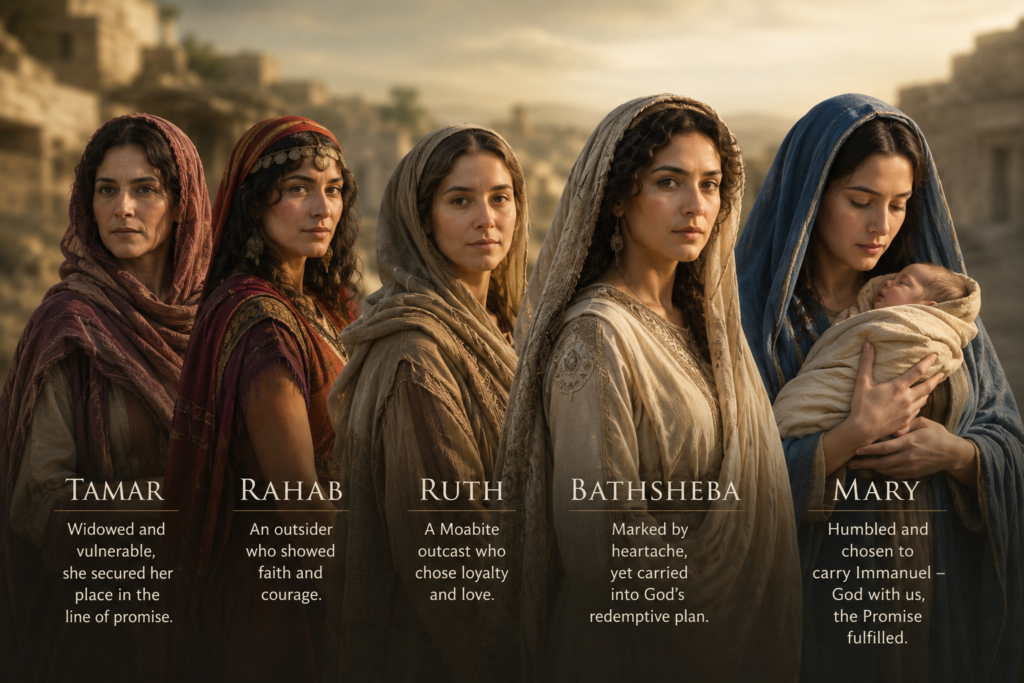
Genealogy also plays a central role in Ruth and later in Matthew 1. Ruth becomes the great-grandmother of King David. Through a Moabite woman gleaning grain in Bethlehem, the royal line emerges. Matthew intentionally highlights this connection by including five women in the genealogy of Yeshua: Tamar, Rahab, Ruth, Bathsheba, and Mary. Ruth stands at the center as the third woman in the sequence, a placement that may carry significance.

On the third day of creation, dry land emerges from the “waters” and the earth begins producing vegetation and fruit-bearing trees. The third day becomes associated with food, fertility, and abundance.

Genesis 1:11 uses the Hebrew term deshe—fresh green growth, tender vegetation, the first emergence of life from the earth. Over time this imagery becomes associated with flourishing, kingship, and ordered life. A related word, tzemach (“Branch”), later becomes associated with the royal Davidic line.

Scholars such as Othmar Keel suggest that ancient royal ideology frequently portrayed kings as guarantors of fertility and agricultural production. Flourishing gardens, sacred trees, rivers, and abundance symbolized righteous rule. Psalm 72 describes mountains yielding prosperity, grain flourishing upon the earth, peace spreading outward, and abundance flowing from righteous kingship. The king becomes a restorer of the Edenic order.

Psalm 23 reflects similar imagery. “He makes me lie down in green pastures.” Again, the Hebrew word deshe evokes fresh green growth associated with divine provision. Green pastures were often symbolical of the Temple itself—places where ordered life flows outward from the Presence of God.

Ruth fits naturally within this framework. Her story revolves around gleaning, grain, and provision. Her story takes place in Bethlehem (House of Bread).Boaz is a righteous landowner whose fields become a place of protection and even flourishing.

Bread, Fullness, and the Table of the Redeemer

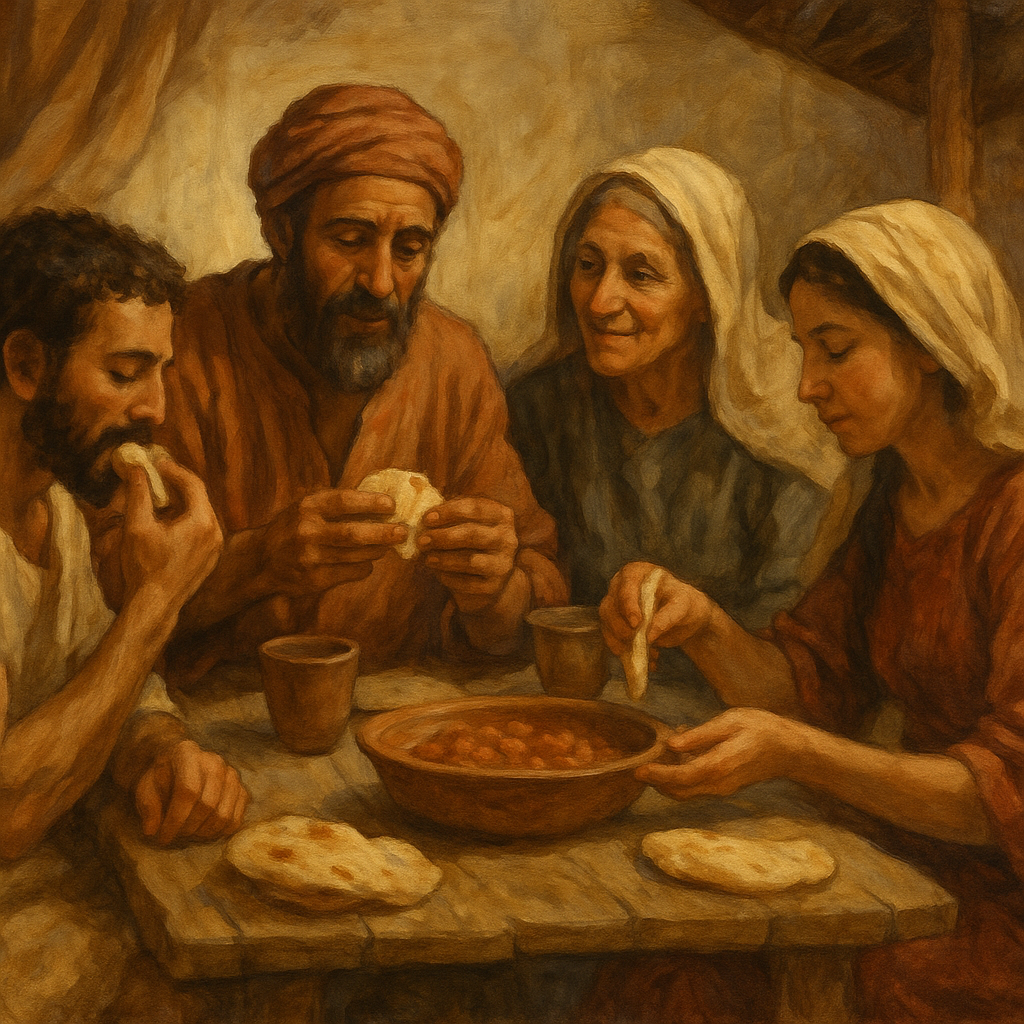
At mealtime Boaz tells Ruth, “Come here and eat some bread and dip your piece into the vinegar.” Then the text states: “She ate and was filled and had leftovers” (Ruth 2:14).

On one level, the scene reflects hospitality. Ruth the foreigner is welcomed to the table of the redeemer. Dipping also appears repeatedly within covenant meal traditions. At Passover, bitter herbs were dipped as part of the covenant meal. In the Gospels, Yeshua identifies the betrayer through the dipping of the “sop” into the dish. Shared dipping signifies fellowship and covenant participation.

The language also reaches backward toward Exodus and forward toward the Gospels. “She ate and was filled and had leftovers” echoes the manna narrative in Exodus 16 and anticipates the feeding miracles in Matthew where the crowds “ate and were full,” with baskets full leftover.

In the wilderness, manna descended daily as Israel learned dependence upon God. Each day enough was provided for survival. Yet on the sixth day a double portion remained for the seventh-day. Normally manna spoiled overnight, but the leftovers for Shabbat remained fresh. The leftovers symbolized fullness and divine provision. God provided more than enough.

Inside the Holy Place of both the Tabernacle and the Temple, opposite the lampstand, rested the Bread of the Presence upon a golden table. Twelve loaves were continually arranged before Yahweh as a perpetual covenant offering. Each loaf contained two omers—a double portion—again echoing Sabbath provision.

The bread was renewed continually. Fresh loaves replaced old ones each Sabbath while the priests ate before Yahweh within sacred space. The bread symbolized divine wisdom, continual provision, and God’s sustaining Presence. Bread and wine placed together upon the table reflected abundance ordered life flowing outward from God’s Presence.

The Bread of the Kingdom Spreads Outward

This imagery becomes crucial in Matthew’s feeding miracles.

Matthew intentionally places these events upon mountains in wilderness settings. Yeshua takes five loaves and feeds the multitudes reclining upon the green grass. The people recline as at a covenant meal. The five loaves likely echo the five loaves of the Bread of the Presence associated with the High Priest. Jewish tradition held that of the twelve loaves placed in the Holy Place, five belonged to the High Priest and seven to the priests serving that week.

Yeshua takes the bread, blesses it, breaks it, and gives it to the disciples who distribute it to the people. Everyone eats. Everyone is filled. Twelve baskets are leftover.

The language deliberately echoes Ruth, manna, and Sabbath fullness. Matthew presents Yeshua as the righteous shepherd-king upon the mountain providing the continual bread of the covenant. Divine sustenance now flows outward through the Messiah to the gathered people.

Mark and Luke note that the crowds sat in groups of hundreds and fifties, echoing Israel’s organization under Moses in Exodus 18. Wilderness, mountain, bread, covenant order, and divine provision converge together. Just as the twelve loaves testified continually to the twelve tribes before Yahweh, the twelve baskets of leftovers testify that there is more than enough bread within the kingdom being established.

The pattern repeats in Gentile territory with the feeding of the four thousand. This time seven loaves are multiplied and seven baskets are leftover. Seven signifies fullness, while four evokes the four corners of the earth. The symbolism points outward toward the nations.

Here the connection to Ruth becomes especially compelling. Ruth herself was a Gentile outsider welcomed to the covenant table. She ate and was filled and had leftovers. Jewish tradition later reflected on Ruth’s meal by saying: “She ate in this world, was filled in the days of Messiah, and had leftovers in the world to come.”

The feeding of the four thousand extends that same vision outward. The Bread of Heaven is no longer restricted to Israel alone.

The feedings in Matthew reveal Jesus was not just a miracle worker, but a priestly king distributing the continual bread of God’s Presence to a new covenant assembly. What was once within the Holy Place now moves outward into the world—the continual bread for everyone.

The biblical pattern stretches—from manna in the wilderness, to the Continual Bread in the Holy Place, to the loaves waved before Yahweh at Shavuot, to the grain fields of Boaz, to the mountain feedings in Matthew, and finally to Pentecost/Shavuot itself.

The story moves toward one great reality: God restoring life to a world marked by famine, exile, emptiness, and chaos. Bread multiplies. The outsider is welcomed. The barren become fruitful. Abundant life flows outward.

We are therefore invited to participate in the life of the Kingdom here and now. Shavuot celebrates fullness, harvest, bread, and covenant renewal before God. That pattern reaches its fulfillment in Jesus, who identifies Himself as the Bread of Life. To take and eat from Him is to partake of the ordered life of the Kingdom itself.

Like Ruth, we come empty, yet we are invited to the table of our Redeemer where there is more than enough. We eat, we are filled, and there are still leftovers. The provision of the Bread of Heaven does not diminish as it is shared. It multiplies. And those who partake of that Bread are called to carry His abundance and provision outward into the world.

shavuot
fire

When the Holy Fire Left the Temple

Many Christians speak about salvation as though the ultimate goal is entering the Holy of Holies and remaining there forever. Worship songs often describe believers moving inward through the courts of the Temple until finally standing before God in heaven.

One well-known song says, “Take me past the outer court into the holy place.” The imagery is beautiful and sincere. It reflects the longing every believer has for intimacy with God. The language draws from Hebrews and priestly imagery about access to God through the blood of Jesus.

But the larger biblical story may actually be moving in the opposite direction.

Scripture begins not with human beings ascending into heaven, but with God descending into creation. Eden is sacred space where heaven and earth overlap. It is where God “walks” among humanity. After the fall, the biblical narrative becomes the story of restoring that union.

The movement throughout Scripture is outward as glory fills, sacred space expands and heaven touches earth. The Bible ends the same way it begins. Revelation does not conclude with humanity permanently escaping earth for heaven. Instead, the New Jerusalem descends from heaven and a voice declares, “Behold, the dwelling of God is with humanity.” The final vision is creation transformed by divine Presence.

Fire in the Wilderness: God’s Presence Among His People

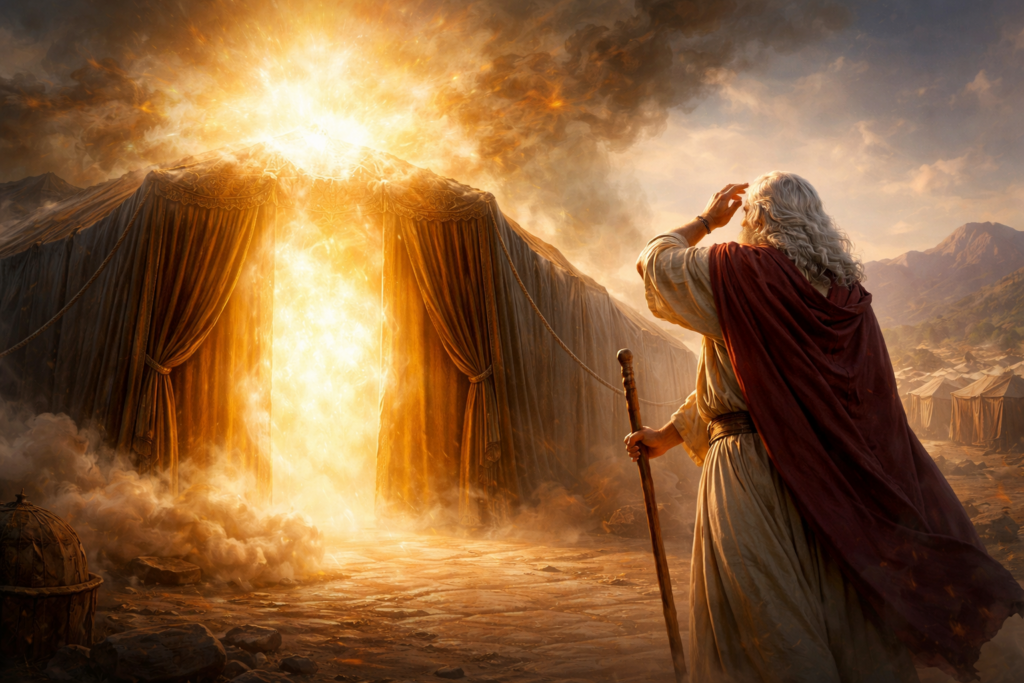
This pattern appears repeatedly in the Exodus story. Israel enters the wilderness, a place associated with chaos and de-creation. It is dangerous, dry, untamed and filled with threats. It is the place of serpents, scorpions, hunger, thirst, fear and death. Yet it is precisely there that God manifests Himself as fire. The pillar of fire stands between Israel and her enemies. It protects the people through the darkness of night and guides them through the wilderness where no path exists.

There in the middle of the darkness stands the fiery Presence of God leading His people toward new creation. The pillar is the visible manifestation of God’s Presence connecting heaven and earth in the midst of chaos. The Tabernacle itself becomes a living organism on the move through the wilderness. Carried by designated priests and filled with divine glory, it functions as a living mobile temple carrying the Presence of God through chaos toward promised rest.

Throughout Scripture, God repeatedly manifests Himself as fire. The burning bush burns without being consumed. Sinai is wrapped in fire and smoke. Fire descends upon Elijah’s altar. Ezekiel sees fiery throne imagery. Daniel describes the Ancient of Days with streams of fire flowing from His throne. At Pentecost, tongues of fire rest upon the gathered people.

This may even shed light on the strange Sabbath command not to kindle fire. Israel was surrounded by nations who fashioned gods in visible form. But at Sinai, Israel heard a voice and saw fire, yet saw no form. Deuteronomy emphasizes this connection immediately before warning against idolatry.

God cannot be reduced to an image.

In this sense, idols are frozen gods while Yahweh appears as living fire. Whether or not the Sabbath prohibition directly concerns image-making, the tension is striking. Human beings repeatedly attempt to manufacture divine presence while the God of Israel reveals Himself through heavenly fire descending from above.

The Tabernacle and later the Temple became earthly models of heaven itself. Ancient Jewish writers and historians understood this clearly. Josephus describes the Temple veil as embroidered with stars, constellations and cosmic imagery. The veil represented the heavens. The Holy of Holies symbolized the throne room of God. The ancients often understood heaven, mountain and temple as overlapping realities. Sinai, Zion and the heavenly sanctuary mirrored one another as sacred space where heaven and earth met.

Some Second Temple Jewish writings describe the heavenly sanctuary itself in fiery terms. In 1 Enoch, the heavenly Temple blazes with fire. Streams of flaming fire flow beneath the throne. Fiery cherubim surround the sanctuary. Some scholarly discussions even refer to the Holy of Holies as the “House of the Tongues of Fire.” Scholars have drawn attention to these traditions and their importance for understanding early Christianity.

The Holy of Holies Opens to the World

This background should shape how we read Pentecost.

Acts 2 is not simply the “birthday of the church” in the modern sense. It is Shavuot, the Feast of Weeks, celebrated seven weeks after Passover. Jewish tradition associated this feast with Sinai and the giving of Torah. Pilgrims came to Jerusalem bringing first fruits into the Temple. The feast already carried themes of covenant, revelation and divine Presence.

At Sinai, fire descends from heaven and God gives His oracles to the world. Torah is not merely “law” in the modern sense. It is divine wisdom ordering creation and forming covenant people. Sinai becomes a kind of cosmic Holy of Holies where heaven and earth overlap.

Luke intentionally fills the Pentecost/Shavuot story with Sinai and Temple imagery. There is heavenly sound, rushing wind, visible fire, divine Presence and the filling of sacred space. Scholar John D. Griffiths argues that Pentecost should be understood as a Temple inauguration theophany. In the Hebrew Scriptures, divine fire descends upon sanctuaries, altars and holy places to consecrate them. Fire falls at Sinai. Fire fills the Tabernacle. Fire consecrates Solomon’s Temple.

But in Acts 2 something unique happens.

The fire no longer rests upon a building. The fire divides. Tongues as of fire spread and rest upon people.

The movement is not humanity entering into the Holy of Holies and remaining there forever. The movement is God, manifested in fire, coming outward from the Holy of Holies into the world. The Presence once localized above the Ark, upon Sinai, within the Temple and ultimately within Yeshua Himself is now spread among the gathered covenant people. Heaven’s fire moves outward into the world through living human beings.

This may also explain the tearing of the Temple veil at Yeshua’s death. The veil that was torn appears to have been the great outer veil described by Josephus with its cosmic imagery representing the heavens. The tearing of the veil was not simply about human beings gaining permission to enter sacred space. It represented a rupture between heaven and earth. The barrier separating realms was being removed.

G. K. Beale describes this tearing as the chaos between one kingdom order and the emergence of another. N. T. Wright repeatedly argues that the Christian hope is not escaping earth for heaven, but heaven and earth reunited. Beale similarly argues that Eden itself was always intended to expand until all creation became sacred space. The Temple symbolized that expansion.

Pentecost becomes the next stage in that process. The fire leaves the confinement of the sanctuary and spreads outward like wildfire.

Pentecost reverses Babel. At Babel humanity attempted to ascend into heaven through technological achievement, kiln-fired bricks and centralized power. Humanity sought to make a name for itself by building upward.

At Pentecost heaven descends instead. Languages multiply redemptively rather than divisively. The Presence disperses rather than centralizes. Sacred fire spreads outward into the nations. The Kingdom advances not by escape from earth, but by the spread of God’s Presence into the world through proclamation. It spreads by the Word and Spirit of God.

Tongues of Fire and the Wisdom of God

This also reframes the controversy surrounding speaking in tongues in the Christian world. Much of the modern debate has reduced tongues to a private prayer language, ecstatic speech, emotional experience or arguments about whether miraculous gifts continue. Honestly, much of the discussion sounds closer to the oracles of Delphi than to Sinai.

The ancient world already knew ecstatic religious speech. At Delphi, the Pythia delivered inspired utterances believed to come from Apollo. Her speech was often obscure and required interpretation by priests. Such oracles could easily be manipulated for personal, political or imperial gain. Across the Greco-Roman world there were prophetic frenzies, mystery cults and ecstatic speech phenomena.

Acts 2 is presented very differently.

Luke places the event squarely within Sinai imagery, Temple imagery, covenant imagery and divine Presence imagery. Luke is intentionally portraying Pentecost as a new Sinai event. At Sinai, God descended in fire upon the mountain and spoke His wisdom into the world. At Pentecost, the tongues of fire no longer rest upon one mountain. The fire divides and rests upon people.

And the Word that follows is not meaningless chaos.

The nations hear “the mighty works of God.” The miracle is the spread of divine proclamation outward into the nations. The tongues of fire are connected to the dissemination of divine wisdom into the world.

Some Jewish traditions even imagined the voice at Sinai dividing into many languages so the nations could hear the revelation of God. Whether Luke consciously draws upon those traditions is debated, but the parallels are striking. Fire, divided speech, covenant revelation, divine wisdom and proclamation to the nations all converge at Pentecost/Shavuot. Divine fire now produces proclamation about the risen King whose victory over death is announced to the nations.

In this sense, tongues are not primarily about private mystical ascent into heaven. They are about heaven’s fire spreading outward through people carrying divine wisdom into the nations after the resurrection victory over death. The Presence that once dwelt in Eden, upon Sinai and within the Holy of Holies now spreads outward through people carrying the message that death itself has been defeated.

The fire can no longer be contained. The Presence is on the move, spreading into the world through people filled with the Spirit of God. The message carried by that fire is that the Kingdom of God is breaking into the earth. And the invitation remains open: “Whosoever shall call upon the name of the Lord shall be saved.” Saved from death itself. We are invited into this expanding work of new creation until the knowledge of the glory of the Lord fills the earth as the waters cover the sea.

fire
Numbers

From Egypt to Immanuel: The Forty-Two Pattern in Numbers

Hidden within the book of Numbers is a remarkable pattern: Israel’s forty-two wilderness encampments not only trace the journey from Egypt to the Promised Land but also foreshadow the forty-two generations leading up to the birth of Jesus in the Gospel of Matthew.

At first glance, the list of camps in Numbers appears more like an ancient geographical map —a sequence of unfamiliar places and unpronounceable names scattered across the desert. Yet the journey is far more than a travel log—the forty-two encampments form a map of transformation. They tell the story of a people being led from slavery to inheritance, from chaos to covenant, and ultimately toward a model of new creation.

This pattern reappears intentionally in the opening chapter of Matthew’s Gospel. Matthew structures the genealogy of Jesus into three sets of fourteen generations, creating a total of forty-two generations. Matthew is deliberately echoing Israel’s forty-two wilderness encampments because he wants his readers to understand that the story of Israel has always been moving toward the Messiah. These are not two disconnected stories. They are one unfolding journey woven together by God.

The Wilderness in Numbers as a Spiritual Classroom

The sages counted forty-two distinct encampments. Every stop was directed by God. Each resting place part of Israel’s formation as a covenant people. Though the wilderness was a de-creation environment filled with life threatening dangers, it also functioned as a spiritual classroom where God stripped away the mentality of slavery and taught His people dependence upon Him.

The Numbers stations themselves tell the story. Israel moves from the bondage of Egypt to the shelter of Sukkot. They pass through the bitter waters of Marah and arrive at the springs of Elim. They face hunger, thirst, rebellion, serpents, enemies, and the desolation of the desert. Every encampment exposes something within them. Every crisis reveals whether they will trust the God who delivered them through the sea.

God was dismantling Egypt inside His people. He was breaking the grip of fear, idolatry, and self-reliance. He taught them contentment. Manna fell from heaven. Water came from the rock. Their clothing endured. Their survival depended entirely upon His provision. The forty-two encampments in Numbers show how God transformed Israel from a fearful people shaped by slavery into a people learning to live in His Divine Presence.

The journey in Numbers even echoes creation itself. In Genesis, God speaks life into a world that is formless and void. In the wilderness, He shapes a new people out of a disordered multitude rescued from Egypt. The wilderness becomes a place where God brings order out of chaos.

At the center of Israel’s wilderness journey in Numbers stood the Tabernacle—the dwelling place of God moving in the midst of His people. They carried the Presence of God with them. The cloud by day and the fire by night rested over the Tabernacle, guiding every stage of the journey. When the cloud lifted, Israel moved. When it rested, Israel encamped. The wilderness was therefore not merely a journey toward a destination; it was a journey in which they carried the Presence of God in a mobile sanctuary.

Even the length of the journey in Numbers carries birthing imagery. Israel wandered for forty years in the wilderness, mirroring the forty weeks of human gestation. The wilderness functioned like a womb where God formed and shaped His covenant people before bringing them into the land. What emerged on the other side of the Jordan was a people born anew under the Presence of God.

Matthew’s Genealogy and Israel’s Journey

Matthew opens his Gospel with the same pattern. His genealogy unfolds in forty-two generations: from Abraham to David, from David to the exile, and from the exile to the Messiah. Abraham represents promise. David represents kingship. The exile represents the collapse of human self-rule and the consequences of covenant unfaithfulness. And Jesus represents fulfillment—the One who completes Israel and her journey, and brings the story home.

Matthew echoes the wilderness pattern through the women he highlights in the genealogy. Unusual for the ancient world. Tamar, Rahab, Ruth, Bathsheba, and ultimately Mary each carry the promise forward through seasons of uncertainty, danger, shame, and exile. These women are wilderness figures in their own right. Tamar was widowed and vulnerable. Rahab was a Canaanite prostitute. Ruth was a Moabite outsider. Bathsheba endured exploitation and tragedy. Mary faced public shame and misunderstanding. Yet God placed them into the redemptive story leading to Messiah.

The story culminates in Mary carrying within her womb the Presence of God. The wilderness journey of Israel reaches its fulfillment in the birth of Immanuel—“God with us.” What the Tabernacle foreshadowed in the wilderness now becomes flesh and blood in Jesus. He is the living Tabernacle moving among His people, the embodiment of the divine Presence once carried through the desert beneath the cloud and fire. The God who dwelt in the midst of Israel now walks among humanity in the person of the Messiah.

Matthew immediately presents Jesus as the fulfillment of Israel’s story. Like Israel, He passes through the waters at the Jordan. His immersion mirrors Israel crossing the sea. Then He is driven into the wilderness for forty days where He confronts haSatan—the serpent, the accuser, the embodiment of the chaos Israel repeatedly failed to overcome. Where Israel grumbled and rebelled in the wilderness, Jesus remains faithful. He defeats the counterfeit powers not through military force, but by the Word of God.

Then He ascends the mountain. Like Moses ascending Sinai, Jesus climbs a mountain in Galilee and delivers the Torah anew in the Sermon on the Mount. Matthew is presenting Him as far more than a teacher. He is the living Torah, the divine Lawgiver, the One through whom heaven and earth are being reordered.

Matthew is showing us from the very beginning that God’s kingdom gathers the outcasts, restores the broken, and brings life out of situations that appear hopeless.

From Chaos to New Creation

The wilderness journey is not simply Israel’s story. It is humanity’s story. And it is still our story today.

We also live between Egypt and promise. We pass through wilderness seasons where our illusions are stripped away and our hearts exposed. Wilderness storms reveal who we truly are. They force us to decide whether we will trust God or surrender to fear.

The Bible is filled with such moments. Abraham faced famine and displacement. David endured betrayal from his own son. Ruth lost her husband and entered exile alongside Naomi. Abraham lied out of fear. David fell into adultery and murder. Ruth came from a people Israel despised. Yet God worked through them because they trusted Him in the midst of their storms.

The forty-two encampments in Numbers and the forty-two generations in Matthew remind us that every stage of the journey matters. Every trial, every wilderness season, every storm, and every victory becomes part of God’s redemptive work in forming His people.

The wilderness still teaches us today. It teaches dependence instead of self-sufficiency. It teaches contentment in a culture of excess. It teaches us that survival itself is sustained by the hand of God. Most importantly, it teaches us that the wilderness is never the final destination.

That is the deeper question of the Numbers wilderness. Not whether storms come—they always do. The real question is how we respond when they arrive. Will chaos define us? Or will we allow God to shape us through it?

Numbers
Skip to content