

🔥 SHAVUOT, RUTH, AND THE BREAD THAT NEVER RUNS OUT 🔥
Seven weeks of seven days after Passover, Israel stood at Sinai—the mountain of God’s Presence—having passed through the sea and crossed the wilderness and finally into covenant communion with Yahweh. In later Jewish tradition, Shavuot (called Pentecost in the NT) became associated with the giving of Torah when God descended upon the mountain and established His covenant with Israel.
This festival stood at the intersection of harvest, kingship, and sacred space. At its center were two leavened wheat loaves waved before Yahweh in the Temple. Leaven was normally absent from Temple ritual, yet inside the Holy Place were twelve unleavened loaves called the Continual Bread, a sign of God’s covenant provision. At Shavuot the first fruits of the wheat harvest were openly presented before Yahweh as a celebration of abundance.
Imagery of the threshing floor runs throughout the biblical story. At the threshing floor, grain was crushed beneath oxen while the chaff was separated and blown away so the seed could be gathered and stored. Most significantly, the Temple itself stood on the threshing floor of Araunah purchased by King David. David was not merely acquiring agricultural land. The threshing floor would become the site of Jerusalem’s Temple on Mt Moriah —where the Presence of God dwelt among His people.
From Sinai to the Threshing Floor
Threshing floor imagery also becomes important in the book of Ruth, which according to Jewish tradition is read at Shavuot. The story unfolds during the barley and wheat harvests, and eating dominates the narrative because food represented survival, inheritance, blessing, and life itself.
In the ancient Near East, threshing floors were not only agricultural sites; they were elevated places associated with judgment, covenant, and sacred encounter. Ruth’s nighttime meeting with Boaz at the threshing floor carries strong royal and covenantal overtones. Boaz acts as kinsman-redeemer. Ruth approaches him seeking covering and protection, and Boaz spreads his garment—or “wing”—over her, echoing covenant and marriage imagery associated with Yahweh sheltering Israel beneath His wings. The scene points beyond romance toward redemption and the renewal of covenant life.
Genealogy also plays a central role in Ruth and later in Matthew 1. Ruth becomes the great-grandmother of King David. Through a Moabite woman gleaning grain in Bethlehem, the royal line emerges. Matthew intentionally highlights this connection by including five women in the genealogy of Yeshua: Tamar, Rahab, Ruth, Bathsheba, and Mary. Ruth stands at the center as the third woman in the sequence, a placement that may carry significance.
On the third day of creation, dry land emerges from the “waters” and the earth begins producing vegetation and fruit-bearing trees. The third day becomes associated with food, fertility, and abundance.
Genesis 1:11 uses the Hebrew term deshe—fresh green growth, tender vegetation, the first emergence of life from the earth. Over time this imagery becomes associated with flourishing, kingship, and ordered life. A related word, tzemach (“Branch”), later becomes associated with the royal Davidic line.
Scholars such as Othmar Keel suggest that ancient royal ideology frequently portrayed kings as guarantors of fertility and agricultural production. Flourishing gardens, sacred trees, rivers, and abundance symbolized righteous rule. Psalm 72 describes mountains yielding prosperity, grain flourishing upon the earth, peace spreading outward, and abundance flowing from righteous kingship. The king becomes a restorer of the Edenic order.
Psalm 23 reflects similar imagery. “He makes me lie down in green pastures.” Again, the Hebrew word deshe evokes fresh green growth associated with divine provision. Green pastures were often symbolical of the Temple itself—places where ordered life flows outward from the Presence of God.
Ruth fits naturally within this framework. Her story revolves around gleaning, grain, and provision. Her story takes place in Bethlehem (House of Bread).Boaz is a righteous landowner whose fields become a place of protection and even flourishing.
Bread, Fullness, and the Table of the Redeemer
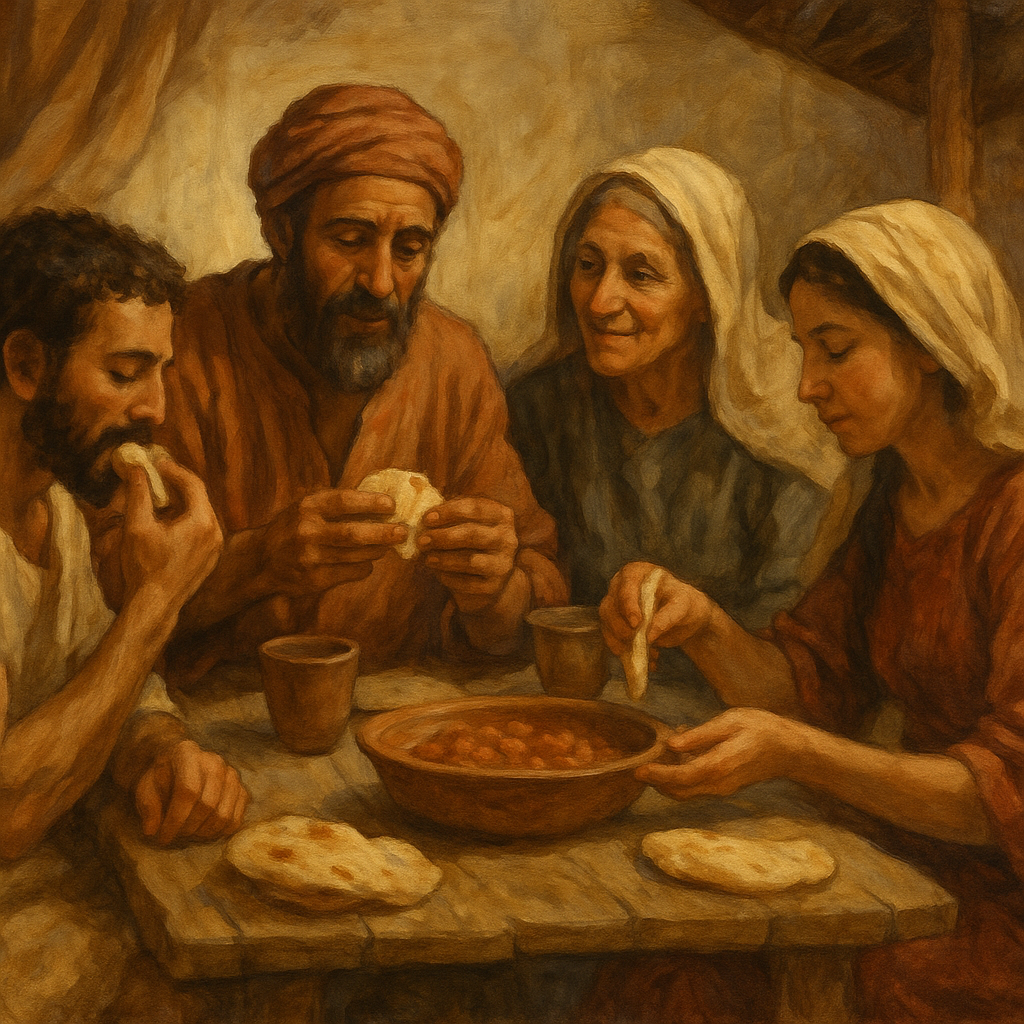
At mealtime Boaz tells Ruth, “Come here and eat some bread and dip your piece into the vinegar.” Then the text states: “She ate and was filled and had leftovers” (Ruth 2:14).
On one level, the scene reflects hospitality. Ruth the foreigner is welcomed to the table of the redeemer. Dipping also appears repeatedly within covenant meal traditions. At Passover, bitter herbs were dipped as part of the covenant meal. In the Gospels, Yeshua identifies the betrayer through the dipping of the “sop” into the dish. Shared dipping signifies fellowship and covenant participation.
The language also reaches backward toward Exodus and forward toward the Gospels. “She ate and was filled and had leftovers” echoes the manna narrative in Exodus 16 and anticipates the feeding miracles in Matthew where the crowds “ate and were full,” with baskets full leftover.
In the wilderness, manna descended daily as Israel learned dependence upon God. Each day enough was provided for survival. Yet on the sixth day a double portion remained for the seventh-day. Normally manna spoiled overnight, but the leftovers for Shabbat remained fresh. The leftovers symbolized fullness and divine provision. God provided more than enough.
Inside the Holy Place of both the Tabernacle and the Temple, opposite the lampstand, rested the Bread of the Presence upon a golden table. Twelve loaves were continually arranged before Yahweh as a perpetual covenant offering. Each loaf contained two omers—a double portion—again echoing Sabbath provision.
The bread was renewed continually. Fresh loaves replaced old ones each Sabbath while the priests ate before Yahweh within sacred space. The bread symbolized divine wisdom, continual provision, and God’s sustaining Presence. Bread and wine placed together upon the table reflected abundance ordered life flowing outward from God’s Presence.
The Bread of the Kingdom Spreads Outward
This imagery becomes crucial in Matthew’s feeding miracles.
Matthew intentionally places these events upon mountains in wilderness settings. Yeshua takes five loaves and feeds the multitudes reclining upon the green grass. The people recline as at a covenant meal. The five loaves likely echo the five loaves of the Bread of the Presence associated with the High Priest. Jewish tradition held that of the twelve loaves placed in the Holy Place, five belonged to the High Priest and seven to the priests serving that week.
Yeshua takes the bread, blesses it, breaks it, and gives it to the disciples who distribute it to the people. Everyone eats. Everyone is filled. Twelve baskets are leftover.
The language deliberately echoes Ruth, manna, and Sabbath fullness. Matthew presents Yeshua as the righteous shepherd-king upon the mountain providing the continual bread of the covenant. Divine sustenance now flows outward through the Messiah to the gathered people.
Mark and Luke note that the crowds sat in groups of hundreds and fifties, echoing Israel’s organization under Moses in Exodus 18. Wilderness, mountain, bread, covenant order, and divine provision converge together. Just as the twelve loaves testified continually to the twelve tribes before Yahweh, the twelve baskets of leftovers testify that there is more than enough bread within the kingdom being established.
The pattern repeats in Gentile territory with the feeding of the four thousand. This time seven loaves are multiplied and seven baskets are leftover. Seven signifies fullness, while four evokes the four corners of the earth. The symbolism points outward toward the nations.
Here the connection to Ruth becomes especially compelling. Ruth herself was a Gentile outsider welcomed to the covenant table. She ate and was filled and had leftovers. Jewish tradition later reflected on Ruth’s meal by saying: “She ate in this world, was filled in the days of Messiah, and had leftovers in the world to come.”
The feeding of the four thousand extends that same vision outward. The Bread of Heaven is no longer restricted to Israel alone.
The feedings in Matthew reveal Jesus was not just a miracle worker, but a priestly king distributing the continual bread of God’s Presence to a new covenant assembly. What was once within the Holy Place now moves outward into the world—the continual bread for everyone.
The biblical pattern stretches—from manna in the wilderness, to the Continual Bread in the Holy Place, to the loaves waved before Yahweh at Shavuot, to the grain fields of Boaz, to the mountain feedings in Matthew, and finally to Pentecost/Shavuot itself.
The story moves toward one great reality: God restoring life to a world marked by famine, exile, emptiness, and chaos. Bread multiplies. The outsider is welcomed. The barren become fruitful. Abundant life flows outward.
We are therefore invited to participate in the life of the Kingdom here and now. Shavuot celebrates fullness, harvest, bread, and covenant renewal before God. That pattern reaches its fulfillment in Jesus, who identifies Himself as the Bread of Life. To take and eat from Him is to partake of the ordered life of the Kingdom itself.
Like Ruth, we come empty, yet we are invited to the table of our Redeemer where there is more than enough. We eat, we are filled, and there are still leftovers. The provision of the Bread of Heaven does not diminish as it is shared. It multiplies. And those who partake of that Bread are called to carry His abundance and provision outward into the world.
Leave a Reply