

The Holy Ones and the Return Home to Jerusalem
Part 4 Splitting, Tearing and New Creation
Matthew’s account of the crucifixion contains one of the most puzzling passages in the New Testament: “Many bodies of the holy ones who had fallen asleep were raised; and coming out of the tombs after His resurrection, they entered the holy city and appeared to many” (Matthew 27:52,53).
Matthew’s description has generated centuries of debate. Readers have long wrestled with questions surrounding the event. Who were these holy ones? Were they physically resurrected? Did they die again? If not, where did they go? These are legitimate questions, yet the text itself offers remarkably few answers. Matthew provides no names, no identities, and no explanation of what became of them afterward. In fact, he seems almost uninterested in the very questions that have occupied so many.
For that reason, the aim of this essay is not to explain the mechanics of the event but to explore the biblical imagery Matthew employs and the larger story it may be invoking.
Throughout this series, we have examined Matthew’s description of Jesus’s death as a sequence of breached boundaries. The veil is torn. The earth shakes. The rocks split. The tombs are opened. Each sign reflects a deeper consequence of humanity’s exile from God. The torn veil addresses separation from God’s Presence. The earthquake and splitting rocks affect the created order itself. The opened tombs reach into the realm of death.
The Holy Ones Appear in Jerusalem
Matthew then directs our attention to where the holy ones go. After emerging from the tombs, they enter Jerusalem—the holy city. His description is raising a different question. It suggests the significance doesn’t lie in their appearance but rather in where they go afterward. The movement is not from death to life as much as it is from death to Jerusalem.
Throughout Scripture, Jerusalem is the center of covenant life, the place of God’s dwelling among His people, and the destination of restoration. Again and again, the prophets envision God’s people returning to Jerusalem after judgment and exile. The prophets also saw a day when the Lord Himself would return to Zion and dwell among His people.
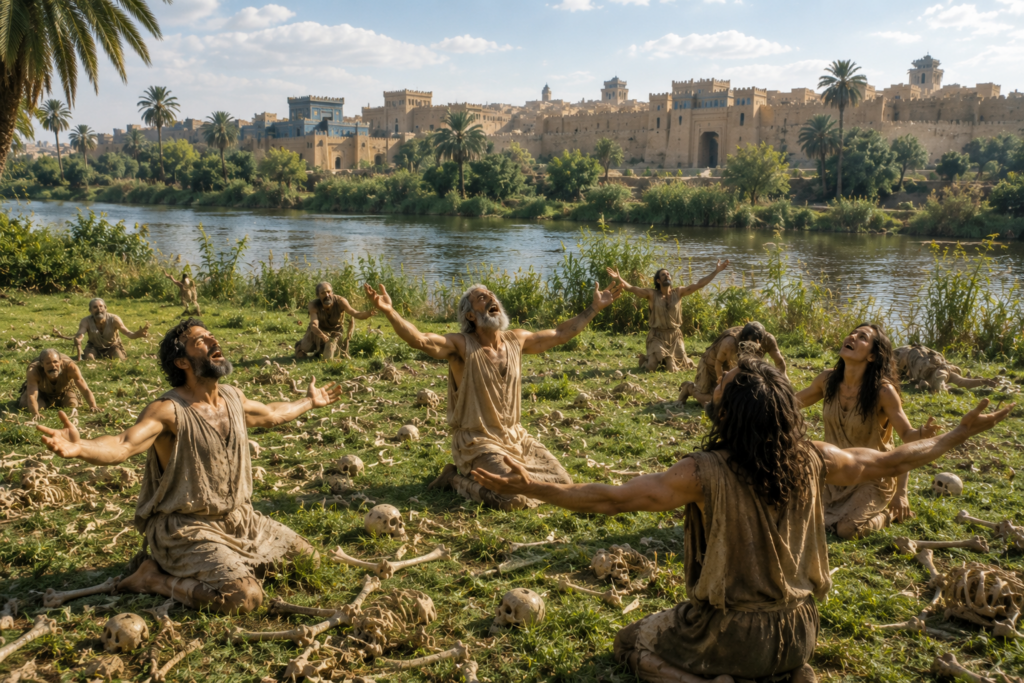
The prophets often described restoration from exile in terms of resurrection. Nowhere is that connection clearer than in Ezekiel 37. There the nation laments, “Our bones are dried up, and our hope is lost.” God’s response comes in the language of resurrection: “I will open your graves and bring you up from your graves, my people.”
For those carried away to Babylon, exile was far more than a political disaster. Jerusalem lay behind them. The Temple was in ruins. The life God had established for His people in the land had been torn apart. The Davidic throne was empty, worship had ceased, and the nation that had once flourished in the land now sat beside foreign rivers weeping when it remembered Zion. Israel was still alive physically, but covenant life had been shattered. Exile had become a form of national death.
Ezekiel sees a valley filled with dry bones and hears God’s promise to open graves and restore His people. The vision is often read as a prediction of bodily resurrection, yet its primary concern is restoration after exile. Graves are opened. The dead rise. God’s people are brought home. In the prophetic imagination, resurrection becomes the language of return.
The prophets anticipated not only Israel’s return to Zion but the return of Yahweh Himself. Isaiah describes the day when the watchmen rejoice because they see the Lord returning to Zion. The psalmist celebrates the restoration of Zion with the words, “When the Lord brought back the captives from Zion, we were like those who dream.” Zechariah envisions God gathering His scattered people and bringing them once again to dwell in Jerusalem.
These themes reappear in Matthew’s account. Like Ezekiel, Matthew speaks of opened tombs and the raising of God’s people. The appearance of the holy ones in Jerusalem echoes the larger biblical hope of return and the renewed presence of God among His people. The holy ones emerge from their tombs and make their way to the city that stood at the center of Israel’s hope.
In Matthew’s account, the Messiah comes first. Only afterward do the holy ones enter the city. Matthew places the Messiah before the holy ones who follow.
This scene belongs within Scripture’s larger story of exile and return. The holy ones do not simply come back to life. They come home.
Ezekiel’s Dry Bones
This, of course, does not prove that Matthew is directly interpreting Ezekiel 37, nor does it mean that these figures represent those who died during the Babylonian exile. Matthew never says that. Yet the imagery belongs to the same theological pattern. In both passages, opened graves are connected to restoration. And the parallels are difficult to dismiss. The prophets saw a day when God would restore His people, overcome their enemies, and dwell among them once again. Every earlier deliverance pointed toward that hope but never fully achieved it. The return from Babylon was real, but death remained undefeated. The deeper exile endured.
In each case, restoration culminates in return, and Jerusalem is where exiles come home.
The same pattern appears throughout this four-part series. Humanity’s story begins with exile from Eden. Israel’s story unfolds through repeated exiles and restorations. Yet every restoration leaves one enemy undefeated. Jerusalem may be restored but death remains—that is until the resurrection of Jesus the Messiah.
The appearance of the holy ones may be functioning as more than a resurrection account. It may be a sign that the restoration anticipated by the prophets is now reaching beyond the land and beyond the Temple into the realm of death itself. They do not appear until after Jesus’s resurrection. He comes first. Only then do they enter Jerusalem. If Matthew presents Jesus as the embodiment of God’s Presence among His people, then His resurrection becomes more than a victory over death. It becomes the return of the King.
Matthew’s account is ultimately the story of barriers giving way. The journey that began with exile from Eden is moving toward its long-awaited restoration. Through His death and resurrection, Jesus confronts the deepest consequence of humanity’s separation from God. Now even that final enemy has been challenged. The holy ones entering Jerusalem stand as a sign that the journey home has begun.
We live in an age that often appears dominated by disorder, violence, and death. Yet, the Messiah has entered the grave and emerged victorious. The powers that enslave humanity have been breached. The holy ones appear only briefly in Matthew’s account, yet their arrival in Jerusalem announces something far greater than themselves: death’s captivity has been broken. The King has returned, and the long exile is beginning to end.
Leave a Reply