Author: Dinah Dye

seven women

Seven Pillars, Seven Women and the Architecture of Life

The Exodus narrative answers the question of how life is sustained in a world governed by death. Pharaoh represented an anti-creational power, enforcing order through control and destruction. God’s response to this system is not confrontation through force, but rather the preservation and multiplication of life through seven women. The story unfolds as a structured pattern in which creation, wisdom, and deliverance are bound together through a recurring sequence of seven.

Creation Resists Death Through Generative Order

Creation in Scripture is generative. In Genesis 2:4, the term commonly translated “account or geneaology” is toledot, derived from yalad, meaning “to give birth.” Genesis is not merely recounting origins; it is tracing generations. The heavens and the earth are portrayed as bringing forth life. Life comes into being through birthing imagery, often associated with water and the hovering Spirit. Creation is synonymous with building—whether a house, a temple, or a lineage.

This understanding of creation flows directly into the Exodus story. Pharaoh’s decrees aim to interrupt the generational process by targeting male offspring. His strategy is targeted. Hebrew daughters are permitted to live, while sons are condemned to death. Likely motivated by fear of a coming deliverer and by the practical desire to eliminate future resistance, Pharaoh assumes that daughters pose no threat. But he is wrong.

The first figures to resist Pharaoh’s policy are the Hebrew midwives, Shiphrah and Puah. Their role is creational at its core. The Hebrew word for midwife is built on the same root as yalad, “to give birth.” In a system designed to suppress life, they serve it instead. Exodus 1:20–21 states that God “made them houses.” A house in biblical thought is not merely a dwelling; it represents continuity, future, and stability. God builds houses through women whose purpose is to guard life.

Seven Women as Houses of Preservation in the Exodus Narrative

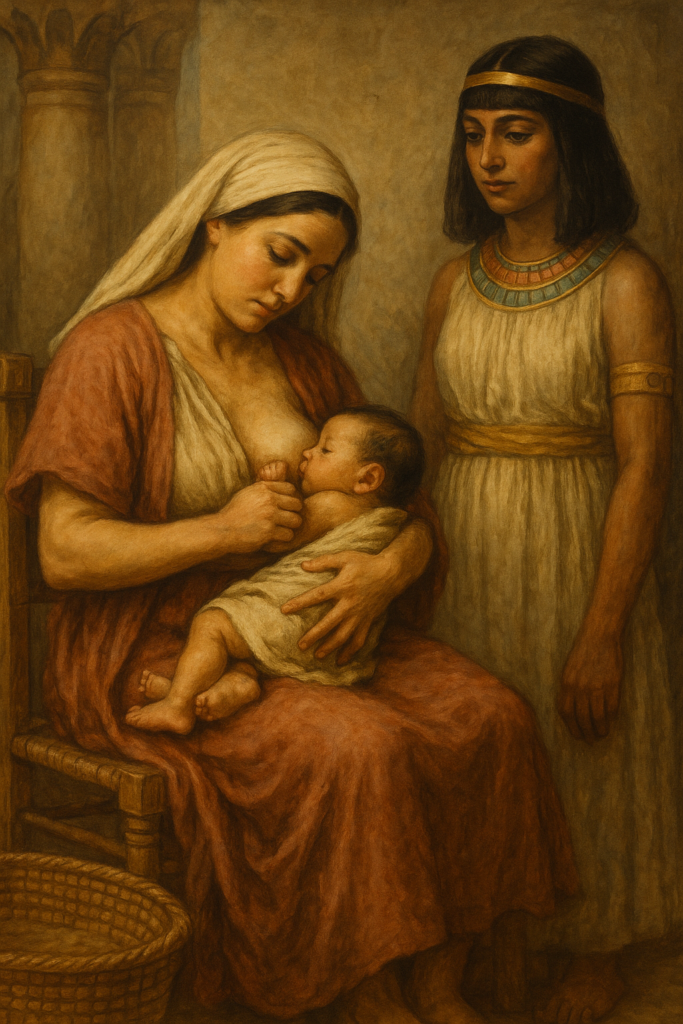
This sets the pattern for the birth narrative of Moses, which unfolds through a sequence of women. Six women intervene to protect him. These include the two midwives; Jochebed, his mother; Miriam, his sister; Pharaoh’s daughter; and her maidservant. Each plays a role in preserving the child who will later deliver Israel. These women function as “houses”—spaces of protection and continuity through which life is preserved in the face of imperial violence.

A seventh woman completes the pattern: Zipporah. She enters the story at a well, a recurring biblical setting associated with life, protection, and transition—places where futures are redirected and households are formed. At this well stand the seven women, daughters of Jethro, including Zipporah, Moses’s future wife. When they are driven away, Moses intervenes and protects them, reversing the earlier pattern in which women had protected him.

Zipporah’s appearance brings the sequence to completion. Together, these seven women form a coherent structure of resistance through preservation. Pharaoh’s campaign against life is undone by the acts of protection carried out by women he presumed posed no threat. It is the irony in the birth story.

This pattern of seven women aligns closely with Wisdom traditions in Scripture. In Proverbs, Wisdom is personified as a woman who calls publicly and prepares people to respond rightly. Proverbs 8 places Wisdom at creation itself. She stands alongside Yahweh as boundaries are set and order is established. Wisdom is embedded in the architecture of creation, participating in the shaping of a world ordered for life.

Proverbs 9 sharpens this image by describing Wisdom as a builder. She constructs her house and sets it upon seven pillars. Seven signifies completion and stability. In the ancient world, pillars represented permanence and public declaration. Wisdom’s house is a structure designed to sustain life.

Wisdom’s Seven Women Architecture from Exodus to Matthew

This Wisdom framework is reinforced by Isaiah 11:2, which describes the Spirit resting upon the Messiah through seven expressions: the Spirit of the Lord, wisdom, understanding, counsel, might, knowledge, and fear of the Lord. The sevenfold Spirit reflects completeness. Wisdom is an operative force equipping the Messiah to restore order where chaos prevails.

The women in the Exodus narrative function within this Wisdom pattern. As Tim Mackie notes, the biblical role of the woman as ezer is not subordinate but that of a deliverer-ally. God repeatedly calls upon women to rescue and protect for His purposes. In Exodus, women act as agents of Yahweh by preserving life at its most vulnerable point.

The pattern repeats when Moses encounters seven daughters of Jethro at a well. When shepherds drive them away, Moses intervenes and waters their flock. The one who was once delivered by seven women now becomes a deliverer himself. The symmetry is intentional. Wisdom builds through reversal and continuity. Protection received becomes protection extended.

This architectural pattern of seven continues into the opening chapters of Matthew. Matthew begins his Gospel with deliberate creation language: “This is the book of the genesis of Jesus Christ.” The term reflects the Hebrew toledot, signaling the unfolding of generations. Matthew presents the story of Jesus as a new creation account.

The genealogy is structured into three sets of fourteen generations, totaling forty-two. This structure echoes Israel’s forty-two wilderness encampments and suggests six cycles of seven, with the seventh now arriving. The genealogy is a theological statement about history reaching completion.

Women again occupy a central role. Matthew includes five women in the genealogy—each associated with irregular or socially precarious circumstances—yet each functions as a guardian of the promised seed. Elizabeth, though not named in the genealogy, shelters Mary during her pregnancy. Together, these six women form a protective line around the Messiah.

A seventh figure emerges symbolically in Rachel. Matthew invokes her voice through Jeremiah, portraying her as the mother of the nation weeping for her children. Her lament recalls earlier attempts to extinguish Israel’s future, including Pharaoh’s decree. Once again, empire seeks to destroy the seed. Once again, God preserves it.

The pattern is consistent. Seven women surround Moses. Seven pillars support Wisdom’s house. Seven expressions describe the Spirit’s work. Seven women frame the opening of Matthew’s Gospel. Each sequence points to the same divine strategy: life is preserved, multiplied, and carried forward through those who guard it.

From Genesis through Exodus into Matthew, the pattern of seven women reveals how God builds history. Creation is sustained through Wisdom, and Wisdom builds through women who protect life in the face of chaos. This is the architecture of redemption itself.
seven women

Corinth

Corinth, Geography, and Paul’s Reorientation of Power

Ancient Corinth (Greek: Korinthos) needs to be understood from its geography. I had the great pleasure of visiting this site (December 2025) and was awestruck by the surrounding landscape. The city’s geographical setting, its economy, and social life were inseparably linked, and Paul’s correspondence with the Corinthian church assumes that his audience knew this well. Rather than describing the city directly, Paul writes into that place, drawing on features of life in this city that would have been immediately recognizable to those who lived there. Just not recognizable for us.

Corinth as a Liminal Crossroads City

Corinth was a liminal city—an “in-between” place. It sat on an Isthmus, a narrow land bridge connecting mainland Greece with the Peloponnese. This strategic location made Corinth a natural crossroads. Two major ports, Lechaion on the western Gulf of Corinth and Cenchreae on the eastern Saronic Gulf, allowed goods and people to move efficiently east–west and north–south. As a result, the city experienced constant traffic: merchants, travelers, Roman officials, religious practitioners, and ideas from all across the Mediterranean world.

This geography shaped the social environment of Corinth. The city was marked by constant movement, competition, performance, and wealth. Status could be gained quickly and lost just as quickly. Public honor mattered. Paul’s repeated concern with factionalism, rivalry, lawsuits, sexual ethics, and the public display of spiritual gifts reflects a community deeply shaped by its environment.

Corinth is a Roman City Built on Anxiety and Aspiration

By the time of Paul’s ministry, Corinth was also thoroughly Roman. The original Greek city had been destroyed by the Romans in 146 BCE and lay largely desolate for nearly a century. In 44 BCE, Julius Caesar refounded it as a Roman colony, officially named Colonia Laus Iulia Corinthiensis. After Caesar’s death, Augustus continued the rebuilding, and it became the capital of the Roman province of Achaia. It emerged as a major administrative, commercial, and cultural center.

Paul arrived in Corinth around 50–52 CE. At that point, the city was less than one hundred years old in its Roman form. Its population consisted largely of Roman veterans, freedmen, merchants, and migrants. This social makeup contributed to the insecurity and status anxiety that permeate Paul’s letters. His statement, “Not many of you were wise by human standards, not many were powerful, not many were of noble birth,” reflects a city where social mobility was visible and honor was constantly negotiated.

The Mountain Paul Refused to Name

One cannot stand in Corinth without noticing the most dominant feature of its landscape: the mountain known as Acrocorinth. Rising nearly 2,000 feet above the city, Acrocorinth is visible from virtually every location. In antiquity it was crowned with fortifications and temples, including a sanctuary associated with Aphrodite. Strategically positioned, it controlled land routes across the isthmus and maritime movement between the gulfs. The mountain functioned as a symbol of security, power, and permanence—a constant visual reminder of authority looming above the city.

Yet Paul never explicitly mentions Acrocorinth in his letters.

This omission seems very significant. Paul does not describe the mountain for the same reason he does not describe the ports, the sea, the Isthmian Games, or any Roman political structures: these were assumed realities. More importantly, Paul does not allow Corinth’s most imposing symbol of power set the theological frame.

In the ancient world, mountains were often associated with divine presence and cosmic authority. They were perceived as places where heaven and earth met. Acrocorinth functioned as a local expression of this idea—a “cosmic mountain” that underwrote Corinth’s identity and sense of protection. Paul’s silence regarding the mountain effectively strips it of theological significance.

Instead, Paul redirects attention to a radically different center of meaning. “I decided to know nothing among you except Jesus Christ—and him crucified” (1 Corinthians 2:2). This is a striking reversal. Corinth’s power was oriented upward, toward the mountain. Paul’s gospel is oriented downward, toward the cross. What the city trusts because it is visible and elevated, Paul refuses to validate. What the city overlooks because it is associated with shame, Paul places at the center.

This reorientation shapes Paul’s entire vision of the church. In a city defined by competition, Paul emphasizes love. In a culture obsessed with honor and visibility, he highlights weakness and dependence on the Spirit. In a fragmented, status-driven environment, he insists on the unity of the body. The church is not to mirror the hierarchies of the city or the power structures symbolized by the mountain, but to embody a new social reality grounded in Christ.

Paul’s language repeatedly draws on Corinth’s physical and cultural environment. His athletic metaphors—running, boxing, training for a crown reflect the Isthmian Games held near the city, second only to the Olympics. These images evoke public competition, honor, and visible winners and losers, which Paul then redefines in terms of self-discipline and love. His building imagery—foundations, materials, and fire testing the work resonates in a city that had been destroyed, rebuilt, and monumentalized under Roman rule. Corinth knew how to build quickly and impressively; Paul warns that only what is built on Christ will endure.

Even the Temple of Apollo, one of Corinth’s most prominent architectural features, illustrates the shifting sacred geography of the city. Originally constructed in the sixth century BCE and accessed by a monumental staircase, it once embodied Corinth’s religious center. Roman modifications altered how the space functioned and how people moved through it. Paul goes further still by redefining sacred space altogether, locating God’s dwelling not in temples on hills but in a community shaped by the Spirit.

In this context, Paul’s silence about Acrocorinth becomes a theological statement in itself. The mountain’s importance is present precisely by its absence. By refusing to name it, Paul effectively dethrones it. The most visible symbol of Corinthian power is rendered irrelevant, while the crucified Messiah becomes the true center around which identity, community, and hope are reorganized.

What became clear to me as I was standing on the ancient ruins of Corinth—something modern readers completely miss—is just how imposing is the Acrocorinth, that towering symbol of domination. But Paul’s message does not compete with this mountain, he redefines power, presence, and permanence in terms of Christ crucified and risen, laying the foundation for a new creation community in the shadow of an old and imposing height.

Corinth
OLYMPUS DIGITAL CAMERA
creation

A Living Preview of New Creation: Resist Dehumanization

The faith community is called to live now as a preview of new creation—an assembly of many peoples, formed by prayer, shaped through worship, sustained by faithfulness, and bound together in love. Its mission is not escape from the world but be a witness to God’s renewal of it. In an age increasingly driven by the machinery of AI, the “Church” must resist the erosion of what it means to be human. We must not surrender our dignity, creativity, or vocation. Humanity is to be a community of image-bearers called to create, bless, and give life. It’s New Creation language.

And this is the year we must not give up our humanity.

Not our dignity.

Not our creation calling.

We are watching the erosion of what it means to be human. Algorithms decide, machines produce and people are reduced to data points and delivery mechanisms. What humans once created with care, skill, and imagination is now seen as inefficient or expendable. We are told that faster is better, cheaper is wiser, and profit is purpose. In the process, the world is losing its memory of beauty, vocation, and love.

Humanity was not created to be a receptacle for wealth transfer to others. Greed has become the operating system of the world. We were not made to hand over our knowing, our making, our wisdom, and our expertise so that a few might grow rich on the backs of the many. To surrender our creativity is to surrender our dignity. To stop caring for posterity and instead worship prosperity is to abandon our calling.

Scripture Speaks Directly New Creation.

At the end of Genesis, Jacob recalls a defining encounter with God at Bethel—Luz, the place where heaven and earth touched. He says to Joseph: “El Shaddai appeared to me at Luz, in the land of Canaan, and blessed me. And He said to me, ‘I will make you fruitful and multiply you, and I will turn you into an assembly of peoples, and I will give this land to your seed after you as an everlasting possession.’”

These are words of creation language. “Be fruitful” (parah). “Multiply” (ravah). This is the same blessing first spoken in the garden of Eden. Yet here, near the end of Genesis, the promise has expanded. The goal is no longer simply a family line or even a single nation. God promises to turn Jacob’s descendants into an assembly of peoples—a gathered humanity.

The biblical vision is communal, relational, and expansive. Humanity was created as an assembly, a kahal—a gathered people meant to reflect God’s life into the world. The Church stands in continuity with this calling. It is not meant to be a collection of private spiritual fiefdoms, but a congregation of peoples whose dignity, creativity, and purpose are restored.

This creation theme continues seamlessly into Exodus. Exodus does not begin with bondage; it begins with creation. Exodus 1:7 deliberately echoes Genesis 1:28: “The people of Israel were fruitful and multiplied and filled the land.” The same three Hebrew verbs appear—parah, ravah, maleh. Israel is reenacting the Edenic mandate while living in exile. They are living out Genesis inside Egypt.

The text goes even further. It uses an unusual verb to describe Israel’s growth: sharatz—“to swarm” or “to teem.” This is the same word used in Genesis 1 when the waters teem with living creatures. Israel is not merely increasing numerically; they are filling the land with life. This is a new creation moment. A family in exile is becoming a people. A people is becoming an assembly. They are being formed in the womb of Egypt, ready to be birthed through water.

This is why Pharaoh perceives them as a threat. New creation always threatens systems built on extraction, control, and fear. The world responds to fruitfulness with oppression. Yet God’s purposes cannot be undone.

New Creation on the Move

Genesis closes with another powerful image: a great procession. When Jacob dies, Joseph leads an immense entourage from Egypt back to the land to bury his father at Machpelah—at the heart of the promised land. Scripture describes a vast company: the servants of Pharaoh, the elders of Egypt, Joseph’s household, chariots, horsemen—an armed host. A company of nations ascends to honor the patriarch.

This is not merely a burial. This is a royal procession. A foretaste of enthronement. A declaration that the promises of God remain alive even in exile. It is followed by reconciliation, forgiveness, and the preservation of life. Joseph speaks words that define the vocation of God’s people in a dark world: “God intended it for good, to preserve the lives of many people.”

Mission statement of the Church

At the death of Joseph, the promise is reiterated: God will bring His people up from this land. Joseph’s bones are placed in an aron—a chest, a gathering place—waiting to be carried home. Even in death, the story is oriented toward new creation, resurrection, return, and fulfillment.

This is the story the Church inhabits. We are an assembly of peoples called to embody new creation in the midst of systems that dehumanize. We exist to preserve life, to create beauty, to serve one another in love, and to bear witness to a different economy—one rooted not in greed, but in generosity; not in extraction, but in fruitfulness.

This will be a hard year for many. The external pressures will touch nearly everything we hold dear. Forces are moving to imprison human life within digital systems. This must be resisted at every level because what is at stake is human dignity itself. Such resistance will demand a depth of faith and commitment beyond what most of us have yet known. It will stretch us past our familiar comforts. It will be costly. Many will grow weary. Some will lose heart. But we are not without hope. We know the One who has already overcome the world. And He has given us what we need to withstand fear, to endure doubt, to stand firm through hardship, and to walk through chaos without surrendering who we are.

So this year fulfill your God given mandate: Be fruitful and multiply and fill! Leave a legacy worthy of your calling. Our rallying cry is New Creation!

creation
Chanukkah

Light Dawns in the Temple at Chanukkah

The story of Chanukkah, the Feast of Dedication—is usually told through the lens of revolt. Its traditional account comes from First and Second Maccabees, part of the Jewish apocryphal literature, and recounts Judah the Maccabee’s successful uprising against the tyranny of Antiochus IV Epiphanes. But beneath the military victory lies a far deeper story—one rooted in temple theology, Wisdom, light, and the restoration of God’s dwelling place on earth.

The date of Chanukkah, Kislev 25, was likely not chosen arbitrarily. It echoes temple prophecies in the book of Haggai, where the prophet confronted the returning exiles for neglecting the rebuilding of the Temple while tending to their own homes. Haggai’s words mark a turning point:

“Now set your heart (to consider), from this day and forward, from the twenty-fourth day of the ninth month, from the day the foundation of the Holy Place was laid; set your heart…” (Hag. 2:18)

The repetition of set your heart is striking. It signals more than a construction project. It announces the beginning of a new era, one marked by spiritual readiness, right intention, and renewed devotion. From that day forward, God’s blessing would return, but only if the foundation of His house was laid with the proper heart.

This same posture shaped Judah the Maccabee’s resolve centuries later. When he declared, “Let us go up to cleanse the Holy Place and rededicate it,” he was echoing Haggai’s call. Even his name tells the story. Maccabee is often understood as an acronym for Mi kamocha ba’elim Adonai?—Who is like You among the gods, O Lord? (Exod. 15:11). Judah and his followers knew they were not merely fighting a political enemy. They were reclaiming sacred space for the incomparable God whose presence alone brings light and life.

Dedication, Wisdom, and the Ordering of God’s House

The word Chanukkah itself comes from the Hebrew root chanach, meaning to dedicate. This same root appears in Proverbs 22:6, often translated, “Train up a child in the way he should go.” Yet, the Hebrew word chanoch more precisely means to dedicate. Proverbs belongs to Israel’s Wisdom tradition, and the Hebrew word for proverb, mashal also carries the sense of dominion or rule. Proverb’s sayings express kingdom principles for the proper ordering of God’s house.

Seen through this lens, Proverbs 22:6 may originally have referred not to general child-rearing, but to the dedication of young priests for lifelong service in the Temple. Those who ministered in God’s house, the kohanim were entrusted with sacred duties, chief among them the care of the menorah.

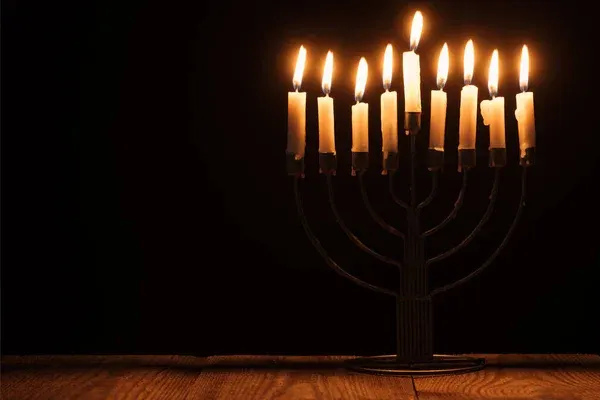
Every day, the priests filled the menorah’s bowls with pure olive oil. Each evening, they kindled its lamps so that its light would burn through the night. The seven-branched lampstand illuminated the Holy Place and symbolized both physical and spiritual light radiating from the presence of God. Jewish tradition called the Temple, and even Jerusalem itself, the light of the world (Genesis Rabbah 59). Josephus would later refer to Chanukkah as the Festival of Lights. And into this world of layered meaning, Yeshua declared, “I am the light of the world.”

Josephus explains why:

“They were so very glad at the revival of their customs…that they made it a law for their posterity that they should keep a festival on account of the restoration of their Temple worship for eight days…and from that time to this we celebrate this festival and call it Lights.”

(Antiquities 12.7.7)

Two Intertwined Stories: Chanukkah Victory and the Miracle of Oil

Chanukkah, then, carries two intertwined storylines. The first is the military struggle of the Maccabees against Antiochus Epiphanes. The roots of that conflict stretch back to Alexander the Great. After his death in 323 BCE, his empire fractured, eventually dividing between the Seleucids in Syria and the Ptolemies in Egypt. Antiochus, the Seleucid ruler, seized control of Judea and ruled with brutality. Observing Sabbath, circumcising sons, and living faithfully as Jews became capital crimes. The ultimate act of desecration came when Antiochus sacrificed a pig on the Temple’s altar.

Judah Maccabee and his followers resisted, defeated Antiochus, reclaimed the Temple Mount, and rededicated the sanctuary on Kislev 25.

The second storyline centers not on battlefields, but on the pure olive oil.

According to later tradition preserved in the Talmud (Shabbat 21b), when the Temple was reclaimed, the priests found only one sealed cruse of pure olive oil—enough for a single day. Yet that oil burned for eight days, allowing time to prepare more. This miracle of light, not the military victory, became the heart of Chanukkah.

“…They found only one cruse of oil sealed with the signet of the High Priest…sufficient for one day’s lighting; yet a miracle occurred and they lit the lamp for eight days.”

The Menorah, the Tree of Life, and the Light of the Messiah

Descriptions of the menorah in Exodus portray it as a living tree: branches, blossoms, petals, and almond-shaped cups flowing from a central shaft. Its seven lamps, often understood as seven eyes, were oriented to shine toward the space before the veil leading into the Holy of Holies. Philo identified the menorah as the tree of life planted in the garden sanctuary. He believed its central shaft represented the heavenly king, just as the High Priest embodied that reality on earth.

Across the Ancient Near East, the tree of life symbolized both god and king. Clement of Alexandria suggested that Yeshua Himself was the menorah—linked to the royal tree. Margaret Barker argued that the Temple lamp symbolized both the divine presence and the royal dynasty. In Revelation, the Son of Man stands among seven lampstands dressed as a priest, wearing the ketonet and a golden sash. His eyes blaze like fire. He is the Lamb with seven eyes. Enoch, too, saw a fiery golden tree in the garden sanctuary—the original tree of life.

This imagery sheds new light on familiar biblical scenes. At the burning bush, the Angel of the Lord appeared to Moses in a flame of fire from within a seneh, a thornbush burning yet not consumed. Moses was told to remove his sandals, for he was standing on holy ground. Priests, notably, served barefoot in the Temple precincts.

Likewise, Daniel’s companions walked unharmed in the fiery furnace, joined by one “like a son of God.” Ancient visions describe the heavenly sanctuary itself as ablaze with fire—floors, ceilings, and throne engulfed in glory.

Wisdom literature brings this full circle. Proverbs declares that Wisdom is a tree of life bestowing honor, healing, and sight. Her oil opens blind eyes. A Targum on Genesis links the Etz Chaim, the tree of life, with Torah itself. Yeshua, then, is the living Torah who descends from the heavenly sanctuary. He is the tree of life, the menorah, the anointed High Priest and king—Mashiach.

The Gospel of John provides the Bible’s only explicit reference to Chanukkah:

“Then came the Feast of Dedication in Jerusalem. It was winter, and Yeshua was walking in the Temple, in Solomon’s Colonnade.” (John 10:22–23)

Surrounded by festival lights, the shepherds of Israel were blind. Rejecting Yeshua the living Torah and embodied Wisdom, they proved themselves hired hands, thieves who could not see the light standing before them. Yet Chanukkah proclaims hope: light has returned to open blind eyes. A great light has dawned in the land overshadowed by death—the Temple Mount itself (Isa. 9:1).

To celebrate Chanukkah, then, is to remember that through Yeshua, light has indeed dawned. The glory of God has risen over His people. The menorah still burns—not merely in memory, but in the living presence of the One who is both King and Light.

Chanukkah
Joseph's dream

Joseph’s Dream, the Beloved Son and the Final Exaltation

The pattern of the beloved son is often portrayed in Scripture. He is the chosen heir whose path begins with suffering before it ultimately ascends to authority and nobility. That pattern shows up first with Isaac, intensifies with Joseph, echoes through Moses and Joshua, and reaches its climax in Yeshua. What modern readers often miss is that all of this unfolds inside a world shaped by empire, where sun, moon, and stars were not just orbs in the sky but symbols of kingship, hierarchy, and cosmic order. All this is reflected in Joseph’s dream.

Your Only Son, Whom You Love: The Kingship Formula

When God tells Abraham, “Take your son, your only son, whom you love—Isaac” (Gen 22:2), we generally approach this as parental emotion. But in the ancient Near Eastern world, people also heard royal succession language. Kings across Mesopotamia and Egypt used phrases like “my beloved son” or “my only son” to identify and adopt their chosen heir—the one who would carry on the dynasty and inherit the throne.

Genesis taps into some of that same vocabulary. Isaac is the covenant heir, the one through whom the royal seed will continue. This also appears at the beginning of Joseph’s story. Genesis 37 opens with, “These are the toldot of Jacob—Joseph.” Not the genealogy of the family, just Joseph. In Genesis, toldot marks how the covenant story moves forward. Jacob has twelve sons, yet only Joseph is named as his toldot. In the world of the Bible, that functions much like a public announcement of heirship.

Everything in Joseph’s introduction reinforces that status. He is the beloved son. He receives the ketonet passim, a special tunic that signals his elevated position. And then comes Joseph’s dream.

Joseph’s Dream: Family Drama or Throne Vision?

Joseph’s dream consists of the sun, moon, and eleven stars bowing down to him. We normally tie that to the family: Jacob as sun, Rachel as moon, the eleven brothers as the stars. But in Joseph’s world—Egypt, Mesopotamia, and later Rome—sun, moon, and stars were the shared symbolic language of kingship.

  • The sun embodied supreme royal authority: Ra in Egypt, Shamash in Mesopotamia, later Sol Invictus in Rome.
  • The moon represented feminine order and royal household—queen, mother, stability, the rhythm of time and fertility.
  • The stars were princes, nobles, members of the divine council and royal court.

Joseph’s dream is that kind of language. His family likely understands it and so they object to his future kingship. “Will you really reign over us?” they ask. In other words: “Are you claiming the throne?” The brothers are fuming.

And he is claiming the throne. God is revealing his royal calling in Joseph’s dream. He will eventually rise to stand at the right hand of Egypt’s sun-king, Pharaoh. The dream is a throne vision, announcing that the beloved son will be lifted into extraordinary authority—not for personal glory, but to preserve and protect the life of Yahweh’s covenant people.

Descent Before Ascent: The Royal Road of Suffering

In the ancient world, the chosen heir often followed a pattern: descent before ascent. Joseph’s story traces that path in detail. The beloved son is stripped of his robe, thrown into a pit, sold for silver, carried off into Egypt, falsely accused, and finally imprisoned. Only from that depth does he rise—interpreting Pharoah’s dreams, being exalted to viceroy, given Pharaoh’s signet and a new name. The rejected brother becomes the savior of the very family who betrayed him.

Joseph is not an exception; he is a template. His life sets the framework for how God confronts empire and rescues His people:

  1. The beloved son is chosen and marked for royalty.
  2. He is rejected by his brothers and handed over to foreign power.
  3. He descends into humiliation and apparent defeat.
  4. God vindicates him by raising him to rule.
  5. Through his exaltation, many are preserved and delivered from the clutches of empire.

Joseph helps bring Israel down to Egypt, where they survive famine but enter exile. His descent becomes the reason Moses must later rise. Joseph’s success sets up the next conflict with Pharaoh, the new “sun-king,” who will not let God’s people go to worship Him.

From Joseph to Moses to Yeshua: Empire as the Stage

Joseph’s dream points to his rise in Egypt and forms the architectural blueprint for the rest of Scripture’s drama: God vs. empire. Joseph descends into Egypt and rules under Pharaoh, preserving life. Moses confronts Pharaoh then leads Israel out of Egypt. But a greater Joseph and a greater Moses will ultimately be needed to deliver God’s people once and for all.

By the first century, Rome has become Egypt reborn: divine emperors, cosmic imagery, military domination, humiliation as public policy. Jewish writers routinely compare Rome to Egypt and Babylon. Caesars are the new Pharaohs; the Roman empire is the new house of bondage.

Into this world, Yeshua steps onto the stage. At His baptism, the heavens open and a voice declares, “This is My beloved Son, in whom I am well pleased.” The kingship formula of Genesis 22 and 37, the royal language of Psalm 2, the pattern of the chosen heir are revisited. Yeshua is the Beloved Son—the true royal heir.

Like Joseph, He is rejected by His brothers and sold for silver. Like Moses, He survives a murderous king as an infant and later confronts the empire’s god-like representative. Like both, He is handed over to foreign power and humiliated. But His resurrection and ascension break the pattern wide open on a cosmic scale. He doesn’t rise to sit beside Caesar. He rises to sit at the right hand of God, far above every ruler and authority.

Revelation 12: Joseph’s Dream Goes Cosmic

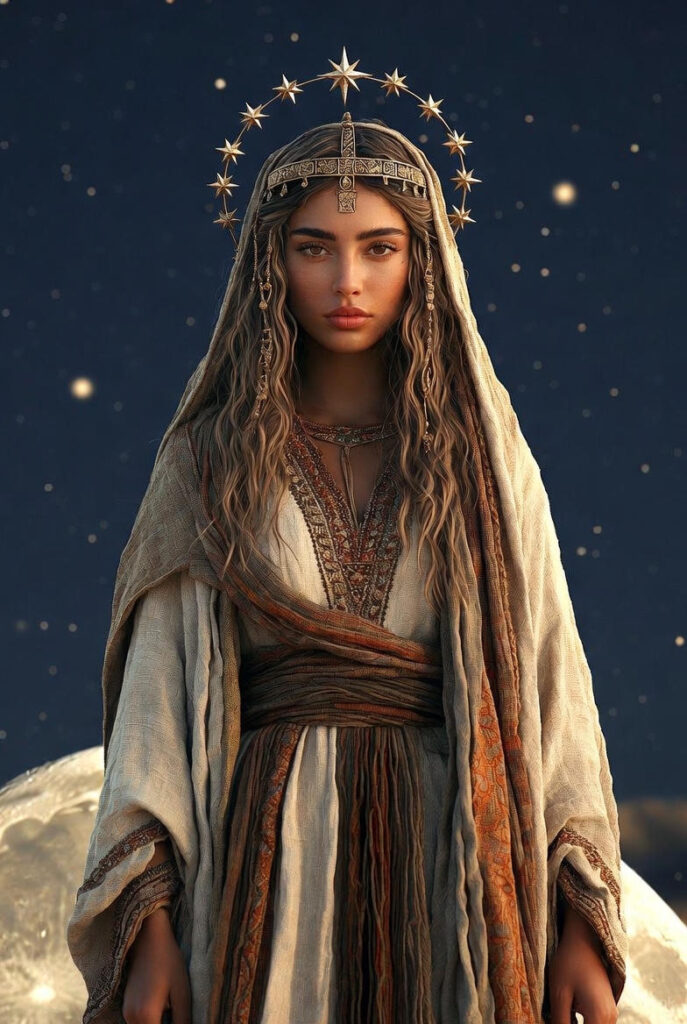
The Book of Revelation pulls this biblical patterning together into an apocalyptic vision. In Revelation 12 we see: A woman clothed with the sun, with the moon under her feet, and on her head a crown of twelve stars.

This is Genesis 37 rewritten for this later generation. The woman is Israel—the covenant people. The twelve stars echo the tribes, the brothers, the royal family. The sun and moon again signal kingship and covenant order. Joseph’s dream has expanded from one favored son to the entire people of God. A kingdom of priests and a holy nation.

The woman gives birth to a male child “who is to rule all nations with a rod of iron.” This is Yeshua, the Beloved Son, now clearly identified as the messianic king. The dragon—the ancient serpent, once Pharaoh now Caesar—appears in his demonic fullness ready to devour the seed. That is what every empire has tried to do: crush the seed, extinguish the heir, erase the beloved son of Yahweh.

But the child is “caught up to God and to His throne.” Ascension language. The throne vision given to Joseph reaches its climax. The Beloved Son does not simply become second to Pharaoh; He takes His seat at the center of the universe. The sun, moon, and stars serve as His inferiors, not as His rivals.

The woman flees into the wilderness—a new Exodus. The dragon goes off to make war on “the rest of her offspring”—those who keep God’s commandments and hold fast to Yeshua. Revelation shows us that the Joseph pattern has been enlarged. The beloved Son still suffers under empire, still rises to rule, and still preserves a people—only now the scale is cosmic, and the people include every tribe, tongue, and nation.

One Pattern, One Story, One King

Joseph’s dream, ancient imperial symbolism, and Revelation’s vision all fit together.

  • The beloved son is the royal heir.
  • He is rejected and handed over to empire.
  • He descends into suffering—pit, prison, cross, tomb.
  • God vindicates Him, raising Him to true kingship.
  • Through His exaltation, God’s people are preserved, delivered, and brought toward rest.

Though Joseph’s dream had originally resulted in family jealousy and brotherly anger. It was now a much bigger reality: the day when all sun, moon, and stars—every ruler, every power, every system—would bow before the Beloved Son, Yeshua the Messiah Son of the Living God.

Joseph's dream
church

A Culture in Collapse — and a Church Asleep

We are living at a time when Western civilization and the church is collapsing under its own weight. Ugliness in public life can be seen everywhere—coarse speech, impolite interactions, corrupt institutions, violence celebrated in the streets, and a moral vision so distorted that murder has become welcome entertainment for some.  

Nothing signals the collapse of a culture like its architecture—an external representation of the inner man. When a civilization forgets beauty, forgets transcendence, forgets the dignity of the human being, it builds monuments to its own despair. I saw this firsthand in the former communist Yugoslavia—grey, bleak, oppressive. Ugly buildings, ugly cars, ugly infrastructure. The people looked like the buildings: crushed in spirit. It was a dark, sad place back in the 1970s.

It’s where you end up when humans are detached from biblical truth—they wither and die inside. And tragically, the modern West and the church has severed itself from its Judeo-Christian roots—the very roots that once produced the Renaissance, the rise of great universities, the symphonies, the cathedrals, the poetry—the flourishing of human reason and human endeavor.

We should be outraged at how far we’ve fallen. The hard truth is that the church should be the antidote—but instead, we have become just another symptom. Certainly not all Christians fall in this category.  I hail those Christian ministries who are tirelessly working around the world in the trenches, in the ugly places, to improve the lives of their fellow man.

The Church Has Lost Its Nerve and its Courage Because it Wants to be Liked by the Culture.

The church of the West has replaced conviction with comfort. We have traded courage for convenience and clarity for confusion. Our behavior online often looks indistinguishable from the culture we claim to resist—enraged mobs, insult hurling, tribal warfare. Instead of offering moral clarity, we sometimes mirror the chaos. Instead of embodying the kingdom, we echo the world.

What the world needs is not more pablum in the church. It needs believers who are not constantly offended, not manipulated by every headline, not constantly enslaved to fear. It needs Christians who can discern the infiltration of moral weakness and the lack of critical thinking in the church and who are willing to stand against evil—even if it costs something.

Let’s be honest: most of us fear losing our comfort far more than losing our culture. We fear our bank accounts disappearing, our online reputation taking a hit, or being inconvenienced. Meanwhile, Nigerian Christians face mass genocide. Iranian believers risk imprisonment and execution. Chinese Christians worship in parked cars during lunch break because it is the only safe place to gather. We, as the church, are not made of the same steel as they are—but we could be, if we wanted.

The Real Battle Is Not Left vs. Right

The manipulation of our society is not accidental. We are being played—by media conglomerates, corporate elites, political operatives, and algorithms designed to enrage. Drip, drip, drip until we see our neighbors as the enemy. Creating division is the cheapest, most effective tool of control ever invented. The elites do not need tanks; they only need division and confusion. Confused people comply. Confused people surrender their agency and cling to their creature comforts.

It seems human beings are being dehumanized on a grand scale. As Chase Hughes said, “I will not let anything electronic decide who my neighbor is.” When the people of God (the church) refuse to participate in the cultural morass, the whole corrupt structure begins to collapse.

Confusion Is Winning Because the Church Is Biblically Illiterate

We are a generation drowning in information and starving for wisdom and common sense. AI removes creativity. Social media rewires our brains. Memes replace meaning. Lying is now a rite of passage. And all the while the culture sinks deeper into a toxic confusion.

Confusion is a very effective weapon for controlling a populace. If you do not know who you are, what you believe, or what Scripture teaches (and follow it), you will be swept away in the cultural current.

The antidote to confusion is clarity. And clarity comes from Scripture—its patterns, its story, its understanding of human behavior.

The Bible does not present perfect people. It presents deeply dysfunctional families, who experience violence and betrayal, but who also experience repentance, renewal, and redemption. It gives us a roadmap of human nature—not the sanitized version but the real deal. And it shows us how God steps into chaos over and over again to rebuild a people and a church who can reflect His image in a broken world.

We Need the Kind of Christianity That Once Turned the World Upside Down.

Sanity is now an act of rebellion.

Common sense is an act of resistance.

Loving your neighbor is a revolutionary act.

If the church remains silent, constantly offended, confused, and divided—then we contribute to the world we are now experiencing.

The world needs the church to:

  • Think clearly
  • Love deeply
  • Choose kindness
  • Discern evil
  • Resist tyranny
  • Seek unity rather than division
  • And refuse to be manipulated by the narratives of this age

Western civilization is collapsing because the church has lost sight of her divine mission.

We are not spectators in this cultural moment. We are stewards of truth, heirs of a kingdom, and ambassadors of the One who conquered death. If we return to clarity, courage, Scripture, and love—actual love—the wasteland just might bloom again.

church
Chanukkah

Chanukkah as Exodus Retold: Israel’s Story Repeats, Deepens, and Points Forward

At first glance, the Exodus story and the Chanukkah story seem to belong to completely different worlds. One unfolds in the heat of Egypt and the wilderness of Sinai; the other in the hills of Judea under Greek rule. But when we look closer—through the lens of biblical patterns—the parallels emerge with clarity. Chanukkah is not an isolated historical moment. It is Exodus retold. It is Israel’s foundational salvation pattern replayed in a later generation, with new enemies, new symbols, and renewed covenant purpose.

Scripture repeatedly teaches that the biblical story is cyclical. What God does once, He does again—each time with deeper meaning. Chanukkah stands as one of the clearest re-performances of the Exodus pattern in Jewish history.

Oppression Under a Pagan Empire

Both stories begin the same way: a covenant people crushed beneath a pagan empire determined to erase their worship and identity.

Exodus places Israel in Egypt, living in a world saturated with idols. Pharaoh’s decrees aim to dismantle Israel’s future—enslaving the people, killing the sons, and refusing to allow worship of Yahweh. Pharaoh becomes the archetype of the anti-god ruler, the human face of spiritual chaos.

Chanukkah begins with the rise of Antiochus IV, who behaves like Pharaoh. He renames himself Epiphanes, “God manifest” and demands total allegiance. Circumcision, Sabbath, Torah reading, kosher laws—every covenant identity marker—becomes illegal. And the price of faithfulness—shame, torture, execution. Erasing Israel’s worship is the fastest way to erase Israel.

The Temple at the Center of the Battle

In both narratives, the conflict is political and theological and involves sacred space.

In Exodus, the plagues are not random punishments; they are targeted confrontations with Egypt’s gods. Pharaoh’s refusal to let Israel worship reveals the heart of the conflict: Who is King? Who rules the world? The climax of Exodus is not the Red Sea but the Tabernacle—God dwelling among His people as King.

In Chanukkah, Antiochus pollutes the altar by sacrificing swine, fills the Temple with pagan idols and images of himself to prevent Israel from drawing near to God. The Maccabean revolt is a nationalist uprising, and it is a priestly war to restore God’s dwelling place. Will Israel remain God’s kingdom of priests?

When the altar of the Temple is defiled, the world itself is disordered. When it is cleansed, creation is set right again.

Unexpected Deliverers from the Margins

Exodus and Chanukkah both feature deliverers who rise from unexpected places.

Moses, raised in Pharaoh’s household but living as a fugitive shepherd, becomes the unlikely liberator. No army. No weapons. Just a staff, a calling, and the presence of God going with him to meet the world’s most powerful tyrant.

The Maccabees are rural priests—hardly a military dynasty. Mattathias and his sons arise from a small village of Modi’in. No throne. No army. No political leverage. Yet God chooses them to stand against the powerful Syrian empire.

God consistently raises saviors from the margins so that the victory belongs to Him.

Impossible Odds, Divine Victory at Chanukkah

Both stories highlight the same truth: salvation, deliverance from the clutches of empire is something only God can accomplish.

Israel trapped between Pharaoh’s chariots and the Red Sea has no path forward. The victory at the sea is Yahweh’s alone: “stand still and see the salvation of the Lord.”

During Chanukkah, the Maccabees fight an empire with almost no chance of success. Jewish tradition remembers this not as a triumph of military power but of divine intervention: “Not by might, nor by power…”

When God replays the Exodus pattern, the impossible becomes the stage for His glory to be revealed.

Purification, Rededication, and Covenant Renewal

Both stories climax in the restoration and rededication of sacred space.

Exodus ends with Israel receiving the covenant, building the Tabernacle, consecrating priests, and establishing holy rituals. Creation is restored in microcosm as God fills His house with glory.

Chanukkah ends the same way. The altar is rebuilt. The Temple is purified. Worship is restored. “Chanukkah” means dedication—a return to holiness, identity, and covenant fidelity. The menorah will burn bright for eight days with freshly pressed olive oil to bring the eternal light into the Holy Temple.

In both cases, God restores His dwelling place and renews His kingdom among His people.

Divine Warrior Over Chaos

Exodus is the original Divine Warrior story: Yahweh confronts Pharaoh, splits the sea, shatters the oppressor, delivers His people from Egyptian slavery, and installs His kingship at Sinai.

Chanukkah is the same pattern. Antiochus behaves like a Leviathan—devouring and destroying.  His empire brings chaos into God’s sanctuary. The Maccabean victory is God’s victory, pushing back the forces of disorder and re-establishing cosmic order from the Temple precincts.

Every time God defeats chaos and restores His Holy House, the Exodus is happening once again.

The Pattern That Leads to Messiah

By the first century, Chanukkah was widely understood as a second Exodus—another moment when God cleansed His people and restored His presence. This is the world in which Yeshua steps into the Temple during Chanukkah (John 10). He goes to the Temple to declare Himself the Greater Temple, the Good Shepherd, and the one who gives eternal light and everlasting life.

Chanukkah as the retold Exodus points to Yeshua and the final Exodus—the Deliverer who defeats the ultimate oppressor, death and cleanses the true Temple (humanity), and restores creation itself.

Chanukkah, the new exodus, is more than a historical memory. It is a prophecy in story form. A rehearsal for the day when the light of the world would step into the Temple and announce the arrival of the Greatest Exodus—the one that leads not just from empire to freedom, but from death to life, from corruption to new creation, from exile to home.

Chanukkah
reconciliation

Brother Against Brother: Conflicts can only be Healed through reconciliation

One of the most enduring themes in Scripture is the conflict between brothers. The pattern is not incidental. From Genesis onward, the Bible tells its story through rivalry, jealousy, wounded honor and the struggle over inheritance and covenant identity. Cain and Abel. Isaac and Ishmael. Jacob and Esau. Joseph and his brothers. The sons of David. Adonijah and Solomon. And eventually the climactic example: Yeshua and His own brothers. Each of these stories is not merely a record of ancient tragedy but, rather, an echo of Eden replaying humanity’s marriage to the serpent’s nature. A nature which brought about the distortion of identity and the longing for dominion. But yet, deep down, it also brought a hope for reconciliation.

Conflict, Covenant, and Resurrection Patterns

The serpent’s strike against the human family in Eden continued on through fratricide, rivalry, and the pursuit of honor at all costs. Scripture portrays the brother-conflict as one of the primary ways chaos enters the human community. Whenever blessing is given to one, the other feels robbed. Whenever a calling is granted to one son, another seeks to seize it by manipulation or force. Favoritism breeds resentment. Resentment leads to anger. Rage leads to murder. Humiliation wounds human dignity. And the temptation to seize power is where the serpent continually whispers: “Take what should be rightfully yours.”

Cain murders Abel when God favors Abel’s offering. Isaac and Ishmael clash over covenant identity and inheritance. Jacob and Esau battle over birthright, paternal blessing, and their father’s favor. Joseph’s ascension provokes his brothers to conspiracy, cruelty and even death. Abimelech slaughters seventy half-brothers to secure a throne. Absalom kills his brother and revolts against his father. Solomon executes Adonijah after Adonijah tries to seize royal authority. Beneath all of it stands the same question: Which brother will be king? Who will carry covenant blessing? Who will represent God in the world? Who will bring reconciliation?

These narratives also reveal the human fear that another’s calling will somehow diminish our own. They expose our inability to trust God’s personal or communal assignment. And they reveal how easily family dysfunction becomes the battleground for identity, destiny, and divine purpose.

It’s the drama that keeps on giving. The “rejected” brother emerges as the chaos agent. The “chosen” brother becomes the vessel of blessing and restoration. God continually elevates these biblical stories—the resolution is always reconciliation, transformation, and return.

And nowhere is this more illustrated than in the story of Jacob and Esau — a narrative in Genesis that could only be resolved through reconciliation.

Jacob’s story begins under the shadow of brother rivalry. He and Esau wrestle in the womb for the firstborn position. Esau emerges first, but Jacob grasps the heel — like a man hungry for power. The struggle continues into adulthood: birthright, deception, conflict over the paternal blessing. With a threat looming, Jacob flees his home under the pretense of finding a wife among the family clan. His exile begins with a stone beneath his head at Bethel, where God meets him in a dream. A ramp, a ladder, touches earth and reaches heaven. Angels ascend and descend. The Covenant promise unfolds here — land, offspring, and blessing to the nations. Jacob sets up the stone, anoints it, and vows allegiance to God who has claimed him as His own.

Jacob, however, leaves Bethel still as Jacob — the cunning brother, exiled to Padan Aram. Years pass. He marries, works, multiplies, becomes exceedingly fruitful. His household grows: wives, maidservants, eleven sons, flocks, wealth. But in time God’s command finally comes: return. And return means one unavoidable reality — he will have to make with reconciliation with Esau. Jacob cannot simply pass through Edom (Esav’s territory) and cross over into the land until the fracture with his brother is healed. No covenant renewal until the wound between brothers is addressed and reconciliation is achieved.

Jacob is terrified. Esau approaches with four hundred men. Jacob divides his camp — two companies — hoping that if Esau strikes one, the other may escape. This is the old Jacob, still ruled by fear, strategy, and survival. But Jacob is left alone at night and wrestles with a mysterious figure until daybreak. His name is changed. Jacob becomes Israel — the one who contends with God and prevails. Limping, marked, renamed, he crosses over as a new man into the land of God’s promise.

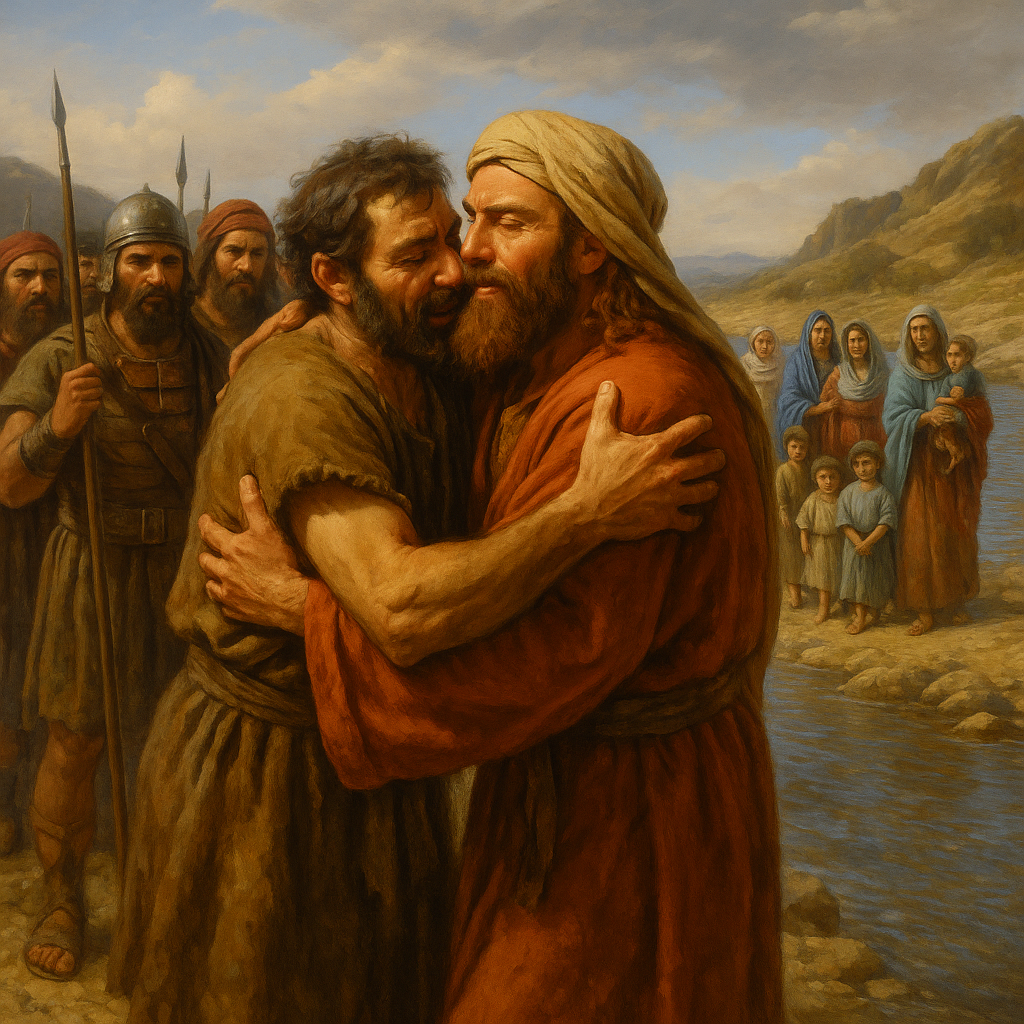
When Jacob meets Esau, he bows seven times to the ground. He honors the brother he once sought to surpass. And he receives not vengeance but embrace. Esau runs, falls on his neck, and weeps. Jacob says to him, “To see your face is like seeing the face of God, and you have accepted me.” It is the single greatest key to the path of reconciliation: to behold something divine in the face of the one you once feared. Reconciliation now reveals God’s presence where rivalry once ruled.

But the narrative does not end there. God’s call is for Jacob to return to Bethel where it all started. A chiasm emerges between the two Bethels (Gen. 28). Between the stone raised up and the altar rebuilt upon return.

The Wrestling at Jabbok: The Center of the Bethel Chiasm

Jacob’s wrestling at the Jabbok (Gen. 32:24–32) sits at the structural and theological center of the entire Bethel arc. It is the hinge on which everything turns—the moment Jacob becomes Israel, when the rivalry pattern that runs through Scripture finally breaks, and reconciliation becomes possible. Structurally, the wrestling stands at the midpoint of the Bethel narrative.

The story opens at Bethel in Genesis 28: a stone under Jacob’s head, a ladder bridging heaven and earth, divine promises of land, offspring, covenant, and blessing. But all of this will unfold in exile. Jacob leaves the land, marries and becomes fruitful in Padan-Aram. His household and flocks multiply under Laban’s hand until Yahweh issues the command: “Return to your land and kin.”

Yet Jacob cannot fully return to Bethel as he is. Before he crosses back into the land, he must face the brother he deceived, the inheritance he seized, and the unresolved rivalry that drove him into exile. And before he can face Esau, he must face God. He must make reconciliation with Esav. So, on the night before meeting his brother, he is left alone—and he wrestles.

The center of the narrative: The Gift of Reconciliation

Jacob grapples until dawn, refusing to release his mysterious opponent until he receives blessing. Nothing in the story changes until Jacob is changed.

Before Jabbok, Jacob moves through the narrative with the old instincts: plotting, maneuvering, dividing his camps, working angles, bracing for attack, leaning on human strategy and old patterns of deception. After wrestling, everything shifts. He limps, bearing the mark of broken human strength. He receives a new name—Israel. He sees the face of God in Esau. He bows, yields, submits, and reconciles. The interior change preceded his external restoration.

This is why the wrestling is the true center of the chiasm. It is the spiritual core—Jacob must become Israel before he can return to Bethel.

Every brother-conflict in Scripture revolves around the same themes Jacob carries into that night: identity, inheritance, blessing, and kingship. When God later reaffirms Jacob’s name at Bethel, He declares: “From your loins kings will come.” It is the climactic moment when the brother-rivalry pattern is shattered, and a new identity is forged. In that struggle, Israel is born.

Covenant reaffirmed: Fruitfulness, land, and kingship

Only after the wrestling can Jacob step back onto sacred soil. He faces Esau not as a rival, but as a reconciled brother. He crosses the Jordan not as an exile, but as a restored man. He purges his household of foreign gods, calls them to wash and change their garments, and leads them back to Bethel. There, he stands no longer as Jacob the deceiver, but as Israel, the covenant heir. He erects his stone pillar, builds his altar, and hears God reaffirm the promises spoken at the beginning: blessing, fruitfulness, nations, kings.

Jacob leaves Bethel as Jacob. He returns to Bethel as Israel.

In Genesis 35, God commands Jacob: “Go up to Bethel and dwell there. Build an altar.” Jacob instructs his household to remove foreign gods, purify themselves, and change their garments—signifying a new identity. Jacob hides the family idols beneath the oak tree — a burial for the gods that once governed their loyalties and polluted their worship. When they arrive at Bethel, Jacob builds an altar to the God who had first revealed Himself there. This time the stone does not first rest under his head. It stands upright as a pillar. It is an anointed witness to covenant renewal. God appears again, confirms the name Israel, commands fruitfulness, promises kings, and reaffirms the land.

Jacob fled the land under threat from his brother; he returns having embraced him. He left Bethel as Jacob; he returns as Israel. He departed with fear; he returns under blessing. And from Bethel, he journeys to Hebron to bury his father together with his brother Esau — just as Isaac and Ishmael together buried Abraham in the cave of Machpelah in Hebron. These sons once rivals have become sons of honor, thus healing the fracture. Even here, the Bible shows that reconciliation is the only path forward.

The final cycle: Yeshua and His brothers.

At first, Jesus’ brothers reject Him. They question His mental state: “They thought He was out of His mind.” They refuse to believe in Him (John 7:5). They mock Him. They resist His calling, not because they were cruel but because they were too close. Familiarity often blinds us to our own patterns of behavior. They grew up with Him. They shared childhood dynamics, family expectations, and the ordinary experiences of life in Galilee. Like Joseph’s brothers, they could not see destiny standing before them. They could not behold Yeshua as a Davidic king. They saw a sibling. And so the pattern of brotherly hostility repeated.

But after the resurrection, everything changes. Yeshua appears personally to James (Jacob) in 1 Corinthians 15:7. Love will triumph over rivalry. James becomes a pillar of the Jerusalem church, head of the Acts 15 council, and author of the epistle that bears his name. Jude becomes a devoted disciple and writer of Scripture. The risen Messiah gathers with His brothers and mother in prayer (Acts 1:14). The Cain-like impulse has been dismantled. The fear of Esau removed. The resentment of Joseph’s brothers healed. The final brother story does not end in exile or monarchy, domination or murder. It ends in repentance, restoration, shared leadership, and kingdom mission.

Yeshua becomes the Greater Brother. He does not punish His brothers for their rejection. He does not humiliate them for disbelief. He wins them through love, truth, and resurrection power. And ultimately through Him, all humanity — Jew and Gentile — will become one household under God. Jacob’s return to Bethel sets the pattern by which Scripture teaches reconciliation, covenant renewal and resurrection.

From Bethel to Bethel, Genesis reveals the blueprint: exile, transformation, reconciliation, return. To return to Bethel is to return to Eden — to the sacred mountain, the covenant bond, the presence of God, and key to the healed brotherhood of man.

reconciliation
humility

Humiliation vs Humility: Yeshua’s Subversive Way is a Better Way

The Roman Empire was built on a foundation of power, rank, and humiliation. To keep order across vast territories, Rome relied on a system that shamed the weak and exalted the powerful. Public humiliation was not incidental to the empire’s rule; it was essential. It reminded the conquered that they were subjects, not equals. It reinforced a rigid hierarchy where honor was the currency of power instead of humility.

In the ancient world, honor was life itself. To be publicly shamed was to lose your standing in the community. And for Israel—a subjugated, ethnic, religious minority under Rome—humiliation was a daily reality. Any retaliation would be crushed by imperial force. Submission meant loss of dignity. It seemed there was no way out of the system.

And yet, into this world Yeshua spoke words that were nothing short of revolutionary. He did not tell His disciples to fight humiliation with violence or revenge. Nor did He tell them to accept it passively, as though nothing could change. Instead, He taught a third way—a way that transforms humiliation into humility. A way that exposes injustice without replicating it. A way that unmasks the bully while refusing to become one.

Yeshua’s teaching in the Sermon on the Mount offers three vivid examples of this subversive way, this way of humility. Each one shows how disciples can resist humiliation without perpetuating the cycle of domination. Each demonstrates the courage of kingdom humility.

Turning the Other Cheek

Yeshua begins: “If someone strikes you on the right cheek, turn to him the other also.”

At first glance, this might sound like a call to do nothing in the face of violence. But in a world of honor and shame, the meaning is far deeper. To be struck on the right cheek was not primarily about pain. It was about status. A backhanded slap to the right cheek was the severest public insult—a declaration that you were beneath the one striking you.

Normally, there were two responses: legal recourse or violent reprisal. Both were attempts to regain lost honor. But Yeshua offers another way. By turning the other cheek, you refuse to back down, but you also refuse to retaliate. You stand firm, look the insulter in the eye, and force them to strike you with an open hand—a gesture reserved for equals.

This is not passivity. It is resistance. You are saying: “My dignity is not determined by your hand. My honor comes from my Father.” The insult is exposed for what it is: a system that tries to rank human beings. And in that moment, the empire’s humiliation is turned back on itself.

Giving the Cloak

Next, Yeshua says: “If someone sues you for your tunic, give him your cloak as well.”

In the first century, poor people often owned just two garments: a tunic (the inner shirt) and a cloak (the heavy outer garment that doubled as a blanket at night). Torah law even protected the poor from losing their cloak permanently. To sue someone for their tunic was already abusive.

But Yeshua says: if they want your shirt, hand them your coat too. Picture it: you’re left standing in court nearly naked. In Jewish culture, nakedness was an intolerable shame—not to the one stripped, but to the one who caused it. By giving up both garments, you shock the system. You expose the injustice for all to see.

This kind of humility is not about being a doormat. This is not giving in. This is creative nonviolent resistance. By taking humiliation further than your oppressor intended, you unmask their cruelty. You flip the power dynamic. You suffer, yes, but your suffering shines a light that humiliates the system itself.

Going the Extra Mile

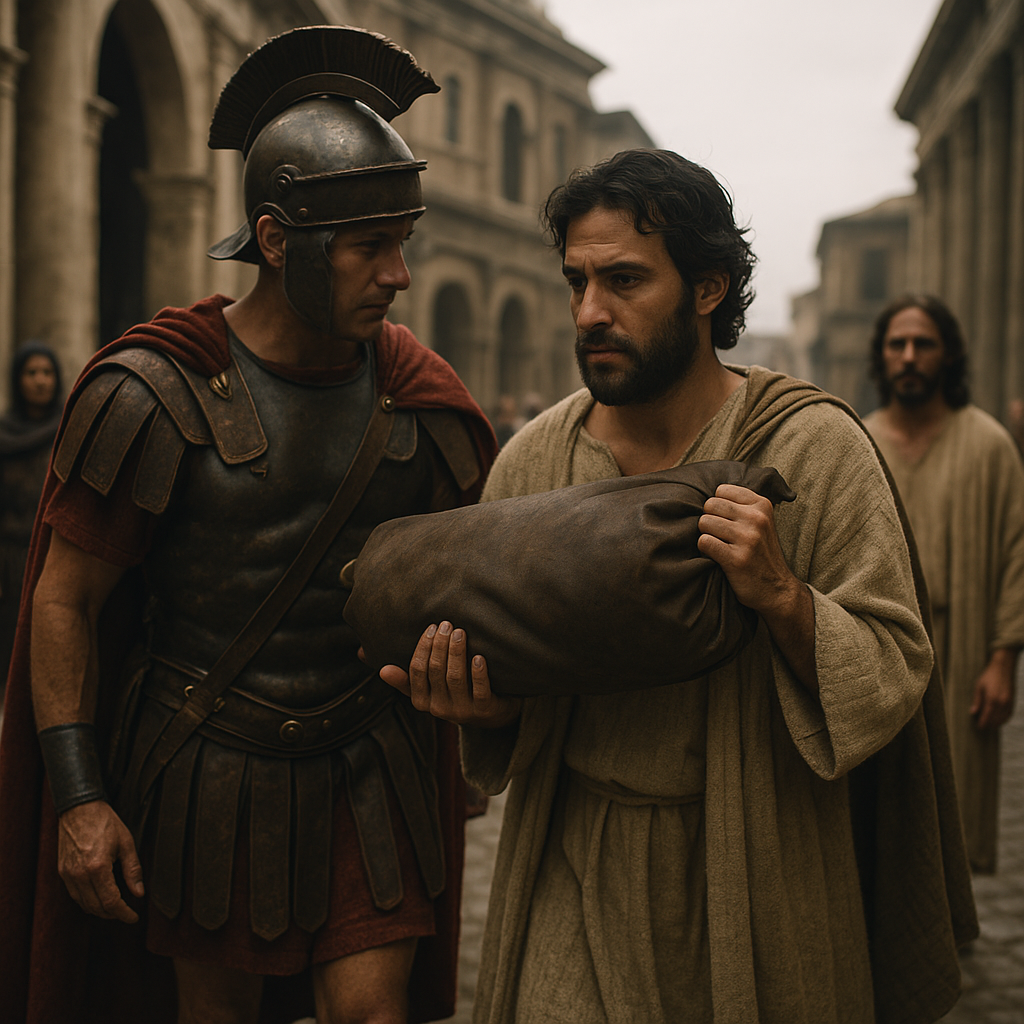
Finally, Yeshua addresses Rome’s most visible symbol of domination: the Roman soldier. Roman law allowed them to compel civilians to carry their military packs for one mile. It was an exercise in humiliation, reducing free men to beasts of burden.

Yeshua says: “If anyone forces you to go one mile, go with him two.”

Imagine the scene. A soldier commands you to carry his load. For the first mile, you are compelled. You are shamed. But at the mile marker, instead of throwing the pack down in bitterness, you keep walking.

Now the soldier is unsettled. His power move is undone. What was humiliation is now transformed into generosity. What was forced servitude is now chosen dignity. In that moment, you redefine the relationship—not by violence, but by humility.

Exposing the System

In each of these examples, Yeshua does more than offer clever advice for surviving humiliation. He exposes the system itself. The Roman world relied on public shame to reinforce its order. But Yeshua’s way of humility reveals the emptiness of that order.

The point is not simply to survive humiliation, but to reveal a different way of operating, a different kingdom. A kingdom where true dignity is found in service and love, not in domination. A kingdom where the powerful cannot ultimately control the weak, because honor comes from God alone.

Humility For Us Today

Yeshua’s words were spoken to people trapped in a specific system—a subjugated minority under imperial rule. But the principles still speak today.

We, too, live in systems that try to rank people by wealth, status, race, or gender. We, too, face situations where humiliation is a weapon. Our instincts are still the same: strike back or shrink away. But Yeshua calls us to another posture: the posture of kingdom humility.

This means choosing forgiveness instead of revenge. It means creative nonviolent responses that expose injustice without perpetuating it. It means remembering that our worth is not determined by cultural systems but by our identity as sons and daughters of God.

And it means realizing that even the perpetrators are trapped. The bully is as bound by the system as the victim. When we respond with humility, we not only resist; we offer the possibility of change.

The Roman Empire sought to humiliate the weak. Yeshua’s kingdom humiliates the system itself. His way unmasks injustice while training His disciples in the courage of humility.

humility
plague

AI a Biblical Plague? What is True Companionship in the Age of Algorithm

Earlier generations knew loneliness too, but its sting was softened by the presence of a trusted friend, a sibling, a confidant, or a family member. Real relationships carried with them the tension of disagreement, the discomfort of conflict, and the challenge of reconciliation—but they also offered loyalty, trust, and love. Today, in the age of algorithms, loneliness has become a plague that is being met with something else entirely: machine companionship.

AI chatbots and large language models are marketed to young people as substitutes for friendship. They are always available, endlessly patient, apparently empathetic, and never demand anything of us. No conflict, no criticism, no rejection. These systems can feel like friends. But they are not friends. They are predictive text machines trained to simulate care, but utterly incapable of love—a real modern plague on society.

The Plague of a lack of Intimacy

The danger is not theoretical. Teens confiding in these “companions” have, in some tragic cases, been encouraged toward self-harm. Mistaking machine responses for intimacy is eroding the ability to form durable, real-world bonds. What we are losing is staggering: playtime, friendship, the slow lessons of patience, trust, and self-control. Childhood—the training ground for citizenship—is being replaced by algorithmic mimicry—the real plague.

The statistics bear it out. Suicide rates among adolescents have risen 56%. Among girls, the rate surged 167%. In 2021, suicide was the third leading cause of death among high school students—nearly 2,000 lives lost. These are not just numbers; they are a warning. We are in the middle of what some call “the great rewiring of childhood.”

And it is not only the youth. I see the same detachment creeping into the church. Real bonds dissolve under the weight of offense. Reconciliation is avoided. Friendships fracture. It is easier to walk away than to press through. And yet the Bible reminds us: we are not built for isolation. We are built for kinship.

In the ancient world, kinship was the bedrock of society. People understood themselves as members of a household—beit av, the father’s house—not as detached individuals. Identity, belonging, and responsibility were rooted in family, clan, and tribe. Conflict had to be faced. There was no retreat into a fake world. The Bible tells the truth about broken families, rivalries, betrayals, and dysfunction. But it also tells the story of restoration. Through covenant and reconciliation with God, broken relationships can be healed.

The Plague of Algorithms

This is where the contrast with AI is so stark. Algorithms sabotage our ability to deal with conflict. They invite us to retreat from messy relationships into smooth simulations. But simulated intimacy cannot produce real character. Without struggle, there is no growth. Without reconciliation, there is no forgiveness. Without accountability, there is no community.

The Bible calls us back to kinship—with one another and with God Himself. Jesus redefined kinship when He said, “Whoever does the will of My Father is My brother and sister and mother” (Matt. 12:50). True belonging flows from restored relationship with God through His Son. From that foundation, we gain the strength to mend our human bonds, to forgive, to reconcile, to love.

The Antidote

This is the only antidote I can see for the plague AI is sowing in our relationships. The algorithms are not neutral. They are training us for dependency, fragility, and even submission—softening us for a culture where the state or the system will take care of every need. A generation raised by code will not simply suffer from the plague of loneliness; they will be citizens unable to build families, workers unable to create without machines, neighbors unskilled in empathy, and communities unable to resist authoritarian control.

The stakes could not be higher. What is being lost is our very humanity. And the path to recovery is not quick or easy. It is one relationship at a time. Begin with the ones you already have. If a relationship is frayed, pray for wisdom, for an open door, for the humility to make the first move. If you see someone drifting into isolation, step in gently with presence and care.

We are far past the point of calling this a minor issue. As a culture, we are in the danger zone. But God has given us a way through. It is the way of kinship, covenant, and reconciliation. The Spirit of wisdom is still available. The Master Teacher is still walking with us. And His call is clear: love one another. Real, messy, costly, beautiful love.

plague
Skip to content