

When Heaven and Earth Overlap: Rethinking the “Supernatural” in the Ancient World
The ancient world did not divide reality into natural and supernatural categories. That distinction belongs to a later way of thinking—one shaped by modern assumptions about a closed universe governed by impersonal forces. For Israel and its Ancient Near Eastern (ANE) neighbors, the visible and invisible were not competing realities. They were intertwined dimensions of the same world.
Modern readers struggle with this. We elevate the physical, material world as the default. Nature, in our imagination, operates on its own. God, if He acts at all, must “intervene.” We place those interventions into a special category and call them miracles. But this framework would have been foreign to an ancient world. It is not simply a different vocabulary—it is a completely different way of seeing.
Distinguishing Between Seen and Unseen not Between Natural and Supernatural
The ANE distinguished between the seen and the unseen, while assuming both were always operating together. The world was not a closed system occasionally interrupted by divine action. It was an open system, sustained continuously by divine presence.
Rain was not simply a weather pattern. Clouds could gather, winds could shift, and rain could fall—but it was also understood as the action of the divine. Not either/or. Both at once.
This is precisely the kind of world described in Scripture.
When the sea parts, when nations rise and fall, when the sun darkens or the stars fall from heaven, the biblical text does not signal a break in normal reality. It assumes divine agency is always present. These moments are not anomalies—they are revelations. They are points where the unseen dimension is visible—we refer to it as a supernatural event.
So, what we call miracles were not understood as interruptions of nature. They were expressions of divine rule—moments when order pushed back against chaos.
This framework explains the overlap of language in the biblical and ANE world. The phrase “sons of God” can refer to divine beings, members of the heavenly council, but also to earthly rulers and kings. This is not meant to be confusing. It’s that Heaven and Earth are mirroring one another.
Scholars such as Michael S. Heiser have drawn attention to this divine council worldview, where the rule of God in heaven is reflected in the governance of rulers on earth. Similarly, John H. Walton emphasizes that the ancient world understood creation not as a self-sustaining mechanism, but as a system functionally ordered by divine presence. The world works because God is actively sustaining it.
Kingship Aligned the Earth
This is why kingship mattered so deeply. Earthly rulers were not merely political figures; they were mediators. Their role was to maintain order—to align the earthly realm with the divine order above. This is also why the failure of a king was so catastrophic.
The plagues of Egypt illustrate this dramatically. Pharaoh was not simply a ruler; he was the guarantor of order. His role was to maintain the balance between heaven and earth. When the God of Israel confronted Egypt, the plagues did more than disrupt the environment—they dismantled Egypt’s entire worldview. The Nile turned to blood. Darkness covered the land. The system collapsed. Pharaoh was exposed as weak and powerless. Another King had entered the arena.
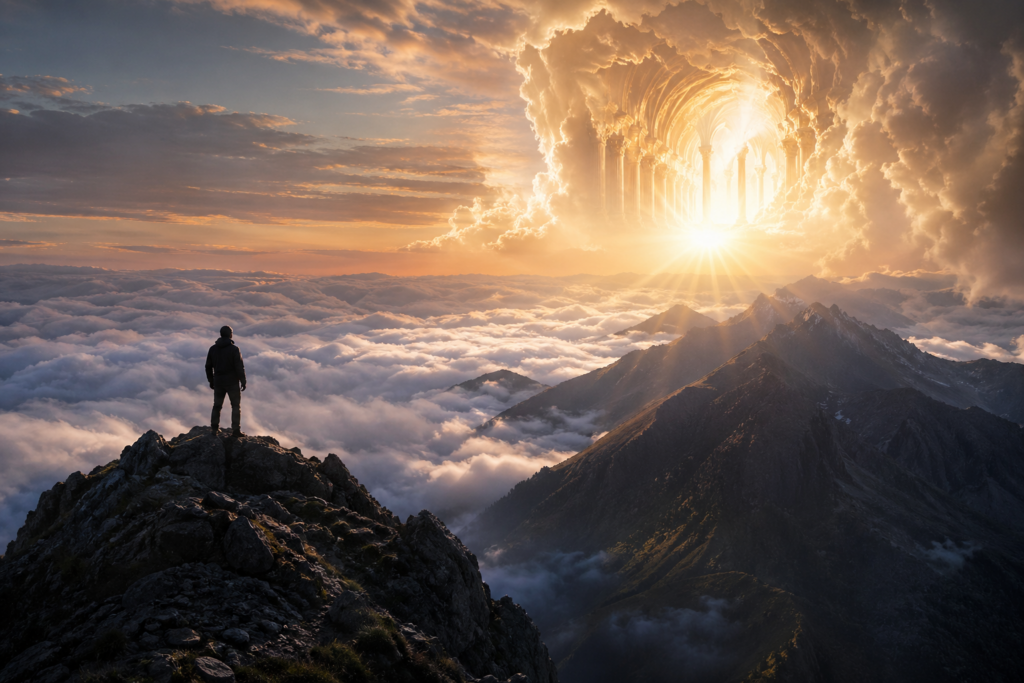
In the ANE imagination, heaven and earth were not separated realms but overlapping domains. N. T. Wright describes this as the intersection of heaven and earth—two spheres meant to overlap and ultimately unite. The supernatural realm. The connection between realms was anchored in concrete realities: mountains, temples, standing stones, monuments, altars, pillars etc.—places where heaven and earth were understood to meet.
The cosmos itself was seen as a temple. L. Michael Morales has shown how deeply temple theology is woven into Scripture. The temple was not merely a building. It was the point where divine presence filled creation. Humans were to be participants and mediators—called to serve as a kingdom of priests, maintaining the connection between realms.
There was no secular world. No so-called neutral space. Every place was sacred space because every place existed under the sovereignty of God within His Presence.
This is the world into which Jesus steps.
When He calms the sea, we generally read it as a comforting miracle—a display of power over nature. But in the ancient imagination, the sea represents chaos, the untamed forces that once covered the earth before God’s ordering word in Genesis. When He rebukes the wind and the waves, He is not suspending natural law. This is what we call supernatural. He is confronting chaos. He is acting as the Divine Warrior King, restoring order within creation.
The same is true when He casts out demons. This is not merely mental and physical relief. It is the expulsion of forces that distort a human’s image. When He heals the lame, gives sight to the blind, or raises the dead, these are not random acts detached from a larger framework.
They are new creation events.
These are moments when the original design of humankind—created in the image of God—is restored. The Kingdom is taking shape in real time, within the world.
We have placed these acts into a category called “miracle” because we do not know how else to describe them. But the category itself obscures what is really happening. It isolates these events from the ongoing reality of divine presence.
In the ancient world, they would not have asked, “Is this natural or supernatural?” That question would not make sense. Instead, they would recognize that the King is present, and where the King is present, order is restored.
Heaven and earth are aligning.
Kingdom and empire exist at the same time, just as the visible and invisible operate together. The Kingdom of God is not separate from the world; it is an overlay upon it. It is the reassertion of divine rule within creation. As Yeshua moves through Galilee and Judea, He is not stepping outside reality. He is revealing its true nature.
This is why His works are signs because they point to something deeper—the renewal of all things.
To rightly read Scripture, we should make the effort to recover this worldview. We should try to see as the ancient world saw: a reality that is not divided but layered.
When we do, the so-called supernatural question dissolves altogether. Miracles are not interruptions of reality, but revelations of it—moments when the true order of creation breaks through into the visible world. And for a brief moment, the veil is pulled back, and reality is seen as it truly is—held together, sustained, and ruled by the living God.
Leave a Reply