

Rooted to Rule: The Pattern of Psalm 1
Psalm 1 does not necessarily begin with advice or spiritual reflection—it begins with a claim about reality itself. There is a way of life that produces order, stability, and flourishing, and it begins with a king who is rightly planted in the wisdom of God.
We are accustomed to reading Psalm 1 as a word about ourselves—guidance for personal growth, a description of the righteous life. But that is not where the book of Psalms begins. Psalm 1 lays down the architecture for the entire Psalter. Its message is the necessity of the right king on the throne. When the right king rules, the world is ordered. When the right king is rooted in the wisdom of God, his rule brings flourishing to his realm and to the inner world of those who come under his authority.
The psalm begins with the Hebrew word ashrei. It is generally translated “blessed” or “happy,” but neither quite captures the true meaning. It is a recognition of a state that is publicly visible and undeniable. It carries the sense of flourishing, alignment, and rightness that can be seen and acknowledged within a community. In an honor-shame culture, it is the language of status.
Oh the honor of the one…
This is public recognition of a life rightly ordered.
Psalm 1 is not merely describing a man who feels blessed. It is identifying the one who stands in the place of honor because he has aligned himself with the order of creation as defined by the Torah—the oracles of God, the wisdom that governs the world. The psalm should be read in tandem with Psalm 2. The first introduces the honored man; the second reveals him as the anointed king who stands in the midst of rebellious nations. These two chapters frame the book and establish the kingship that governs everything that follows.
The honored one is defined first by what he refuses. He does not walk in the counsel of the rasha, the wicked. He does not stand in their path. He does not sit in the seat of mockers. These are descriptions of competing systems of order. The rasha represents a world structured apart from God’s wisdom, a world untethered from the wisdom that sustains creation. To walk, stand, and sit in that world is to come under its influence, to be shaped by its assumptions, to align oneself with its vision of reality.
Instead, his delight—his chefetz, his deep longing—is in the Torah of Yahweh because it is the wisdom of God. He meditates on it day and night, not as ritual but as covenantal alignment. The king orders his inner world according to divine wisdom. In doing so, he becomes the site where ordered creation is reestablished.
He will be like a tree.
In the ancient world, kings were often depicted as trees—strong, stable, life-giving. The tree connects heaven and earth, drawing life from deep waters and extending its canopy outward in fruit and shade. The trunk represents stability and endurance, the central structure upon which everything else depends.
This tree is planted—more precisely, transplanted—by streams of water. The language evokes irrigation channels, carefully directed flows of life that sustain the tree in every season. This is Eden language. The rivers of the garden that watered the earth now appear here as the source of the king’s stability—divine wisdom itself. He is intentionally placed within the life system of creation, rooted in the very waters that once flowed from the garden and later from the temple.
His fruit comes in its season. His leaf does not wither.
The Hebrew concept of withering carries the sense of collapse into folly, the unraveling of ordered life. To wither is not merely to dry up; it is to fall into confusion and a lack of discernment. In contrast, the righteous king remains green, enduring, productive. His life is sustained because it is aligned with wisdom. His fruit nourishes others. His leaves, in the language echoed later in Ezekiel and Revelation, become instruments of healing for the nations.
This is kingship as it was meant to be. Not domination, but sustenance. Not instability, but enduring life that radiates outward.
The contrast with Genesis 3 deepens the imagery.
There, the woman sees that the tree is good (tov), pleasing to the eyes, and desirable to make one wise. The language is drawn directly from creation itself. But she evaluates the tree apart from God’s word. She sees, desires, takes, and eats. Wisdom is seized rather than received. What was meant to be given is snatched, and in that moment, God’s wisdom is replaced with human judgment. Eating the fruit of the tree becomes a realignment away from the source of life.
Psalm 1 reverses that movement.
The righteous king does not seize wisdom. He meditates. He does not take; he receives. He does not eat from the tree in rebellion; he becomes the tree through covenantal obedience. His roots go down into the living waters, and from those waters life flows. Psalm 1 produces order through rootedness.
Yahweh knows the way of the righteous.
This is covenantal language. It is relational. The way of the righteous king is upheld because it is perfectly in sync with God’s design. But the way of the rasha is not so. They are like chaff driven by the wind. They are not anchored in the waters of wisdom. They cannot sustain life. They do not endure. Their way perishes, dissolving back into chaos.
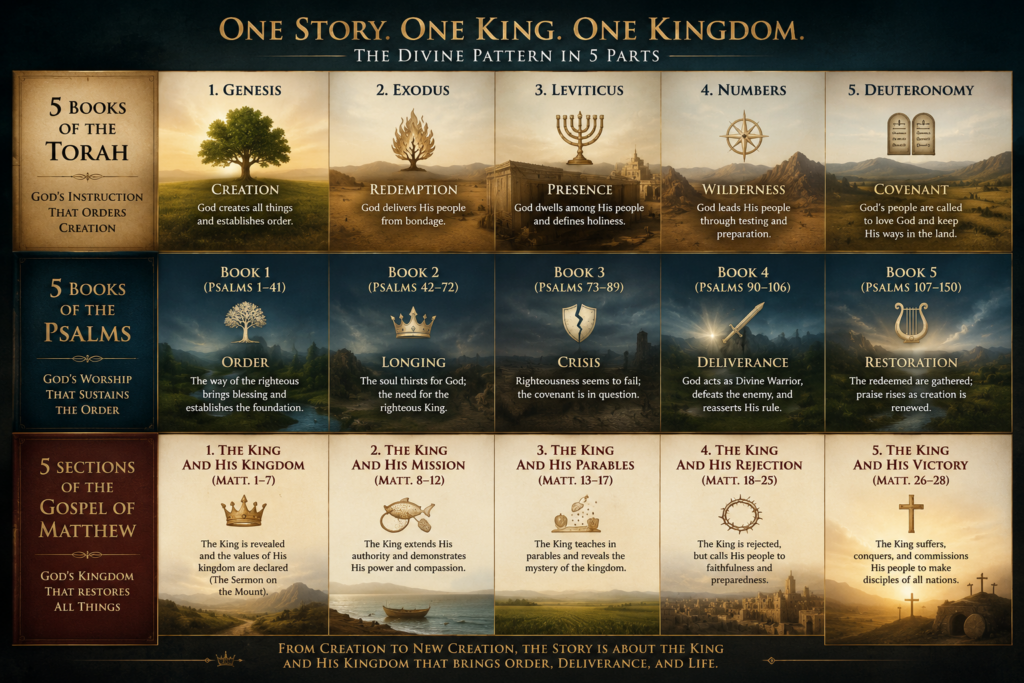
Psalm 1, then, is not an isolated meditation. It is the opening movement of a much larger composition. The book of Psalms is arranged in five books, mirroring the five books of the Torah. Just as the Torah provides the instruction that orders creation, the Psalms provide the liturgical response that sustains that order through worship.
The structure of the five sections of the Psalms traces a kingship narrative.
It unfolds as a movement from order to chaos and back to restoration. It begins with creation grounded in divine rule, where the king—like a tree planted by living waters—embodies the stability of Yahweh’s reign. But that order is contested. Pressure builds, distance from God’s presence is felt, and the need for righteous rule intensifies. The crisis comes when kingship appears to fail, the covenant fractures, and creation itself seems to unravel in exile and disorder.
The turning point is the reassertion of Yahweh’s kingship. He rises as the Divine Warrior (Psalm 104), subdues chaos, and establishes His rule once more. From there, the movement shifts toward restoration. The scattered are gathered, hope is renewed, and the Psalter closes in a rising chorus of praise as creation itself is drawn back into ordered worship under its rightful King.
This is the pattern of Scripture itself. Creation. Exile. Conflict. Divine intervention. Restoration. It is the pattern of Genesis. It is the pattern of the Exodus. And it is the pattern taken up again in the Gospel of Matthew, also structured in five major sections, presenting Jesus as the new Moses, the new Israel, the true King, the Messiah.
Matthew opens with the language of ashrei—the Beatitudes—rendered in Greek as makarios.
Oh the honor of the poor in spirit.
Oh the honor of the meek.
Oh the honor of those who mourn.
In the Roman world, honor belonged to power, wealth, and dominance. In Matthew, honor is reassigned to those whom the empire considers insignificant but publicly identified by God as part of His kingdom. The Beatitudes redefine kingship. They declare that true status belongs to those ordered according to God’s wisdom.
And this is where Psalm 1 finds its fulfillment. It anticipates a person.
The true Ashrei man.
Rooted in living waters.
Embodying wisdom.
The one whose life bears fruit in every season.
The one whose leaves bring healing to the nations.
Yeshua lives the pattern of Psalm 1. He is the tree planted by living waters. He is the wisdom of God made flesh. He is the king who stands unmoved by the counsel of the wicked, who refuses the kingdoms offered through compromise, who remains rooted in the will of the Father even unto death. And in His resurrection, the tree that could not wither, becomes the source of life for the world.
Psalm 1 is an invitation. Not first to self-improvement, but to recognize the sovereignty of the King.
Leave a Reply