

Two Birds, Two Goats, One Cross: The Biblical Pattern of True Cleansing
Purification in Scripture is never about managing impurity—it is about removing it entirely. The ritual for the metzora (one with a skin disease) and the service of Yom Kippur operate on the same underlying pattern. In Leviticus 14, the death and release of two birds restores the individual. In Leviticus 16, the death and release of two goats restores the sanctuary and the people.
The Pattern of Cleansing: Death and Release
Leviticus 14 begins outside the camp, where the metzora, cut off from the life of Israel, waits for restoration. The priest goes out to him, not the other way around. Two birds are brought. One bird is slaughtered over living water in a clay vessel. The other, still alive, is dipped—along with the wood, scarlet, and hyssop—into the blood of the slain bird. The blood and water are then sprinkled seven times upon the one being cleansed. Only after this does the living bird go free, released into the open field.
Blood applied and impurity removed. The metzora is washed, shaved, and gradually restored. He reenters the camp but remains outside his tent for seven days, undergoing a second cycle of washing and shaving before final reintegration on the eighth day. Cleansing is a process of reordering life back into alignment within sacred space.
Leviticus 16, the Day of Atonement, mirrors this structure on a corporate scale. Here the concern is not a single body but the body of Israel and the sanctuary itself. Over time, impurity accumulates through sin, disorder, and the reality of life in a fractured world. The tabernacle, as the meeting place of heaven and earth, must be cleansed.
Again, two animals stand at the center. One goat is designated “for Yahweh” and is slain. Its blood is carried into the Holy of Holies and sprinkled—again seven times—upon the kapporet (covering for the seat) and on the veil, the parokhet. The inner sanctum, the place of divine presence, is purified through blood. The second goat remains alive. The high priest lays his hands upon it, confessing the sins of the people, and it is sent away into the wilderness, carrying those sins into a place of desolation, never to return.
The blood purifies. Removal completes the act. One animal addresses defilement within sacred space; the other removes impurity from the community. In later Jewish tradition, the imagery expands. A scarlet thread is tied to the goat designated for the wilderness and, according to tradition, also to the Temple gate—possibly the Nicanor Gate, the main eastern entrance into the inner court.
When the thread turned white, it signaled that sins had been forgiven. Scarlet becomes white, the sign of cleansing that echoes the elements in the metzora ritual: cedar, hyssop, and scarlet bound together in purification.
The Temple, the Body, and the Removal of Impurity
What emerges from these two chapters is a unified vision of cleansing. The human body and the tabernacle function as parallel sacred spaces. The metzora is a defiled micro-temple, cut off from the community. The sanctuary is the macro-temple, bearing accumulated impurity. Both require cleansing. Both are restored through the same pattern: blood applied, impurity removed, life reestablished.
The pattern moves beyond Leviticus and into the Gospel narratives.
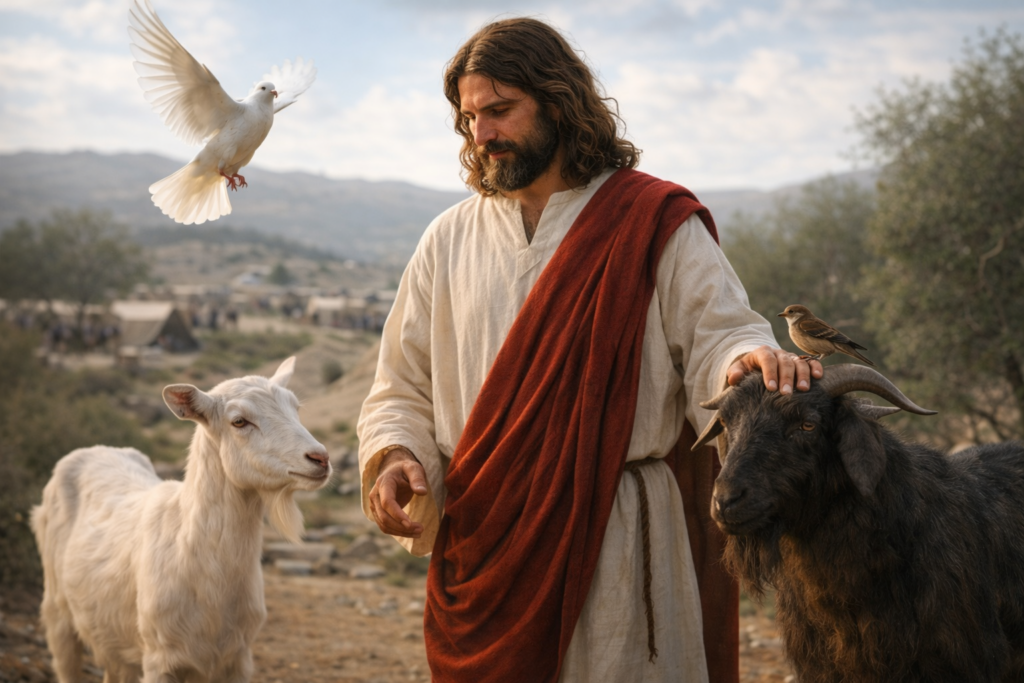
Yeshua is the slain one. Like the bird killed over living water, like the goat offered to Yahweh, His death is a purifying act. His blood is central. But He is also the one sent away. Like the living bird released into the open field and the goat driven into the wilderness, Yeshua is led outside the city. He is crucified beyond the walls of Jerusalem, in the place of exile away from the camp. He dies outside the camp, bearing reproach, carrying the weight of impurity beyond the boundary of sacred space.
In Leviticus 14, the bird is slain over living water, and the cleansing involves blood and water. In John’s Gospel, when Jesus’ side is pierced, blood and water flow out. The elements of purification are present at the moment of His death. Hyssop appears again at the crucifixion, used to lift sour wine to His lips. The threads of Leviticus are brought together in Him.
Even the movement of the ritual is preserved. The metzora waits outside the camp until the priest comes to him. On Yom Kippur, the high priest moves between spaces, carrying blood into the presence of God and sending impurity away. In the Gospel narrative, Yeshua embodies both priest and offering. He offers Himself. He goes outside. He returns in resurrection, not simply restored, but inaugurating access.
Fulfilled in Yeshua: Cleansing and Removal United
The pattern converges in one place. Yeshua is the priest who goes out, the sacrifice that is given, the one sent away, and the one who returns to restore. He embodies Israel, the temple, and the individual in need of cleansing. Through Him, impurity is both cleansed and removed, and the way back into the presence of God is opened fully.
This reframes the modern question: how do we purify ourselves?
We begin with the recognition that something must be dealt with—something that disrupts life, fractures relationships, and distances us from the presence of God. Scripture names this as impurity, sin, uncleanness, disorder. In modern life, it often appears as shame, anxiety, hidden habits, fractured identity, or the quiet sense that something is not as it should be.
Something must be addressed, and something must be removed.
In Leviticus, this takes the form of death and release. One bird is slain; another is sent away. One goat is sacrificed; another carries impurity into the wilderness. Impurity is dealt with and removed.
This is where the connection to Yeshua becomes practical. If He embodies this pattern, then purification today is not a ritual we perform but a reality we enter into. His removal outside the camp carries away what we cannot carry ourselves. But that work is ours to receive and to live within.
But receiving does not mean passivity. The metzora, once declared clean, still participates in a process. He washes. He shaves. He reenters the camp gradually. He is restored step by step into a new way of living.
To live as one who has been cleansed is to refuse to carry what has already been removed. The goat does not return to the camp. The living bird does not fly back. What has been sent away is meant to remain gone.
Yet, this is where many still struggle. We continue to carry what has already been released. We rehearse failures, revisit wounds, and allow past realities to define present identity. In doing so, we reject the second half of the pattern—the removal.
The call is not to achieve purity through effort, but to live as those who have been purified.
Confession is the act of stepping out of isolation and into the possibility of restoration. It also means allowing patterns of thought and behavior that produce disorder to be released. Just as the goat carries impurity away, there are habits, narratives, and attachments that must be relinquished. We let go because it has already been carried away.
This is where community becomes essential. The metzora is restored to the camp, not to isolation. The goal is not individual purity in abstraction, but reintegration into a people shaped by the presence of God. Healing is lived out in relationships where truth, accountability, and grace are present.
What God has removed is not meant to be carried again—true cleansing is learning to live as though it is completely gone.
Love this teaching.
thanks Linda!
Excellent Rticle
What is the difference between Passover and Day of Atonement
Passover is the restoration of covenant through a fellowship offering. YK is the restoration of covenant through a blood atonement.
Thank you sooo much Miss Dinah. We have always been blessed by your teachings
SHABBAT SHALOM ❤️ forever in Yeshua
Thank you so much for sharing that. Shabbat Shalom to you both!