

The Voice At Delphi and The God Who Speaks
Giants, Oracles, and the Battle Over Truth
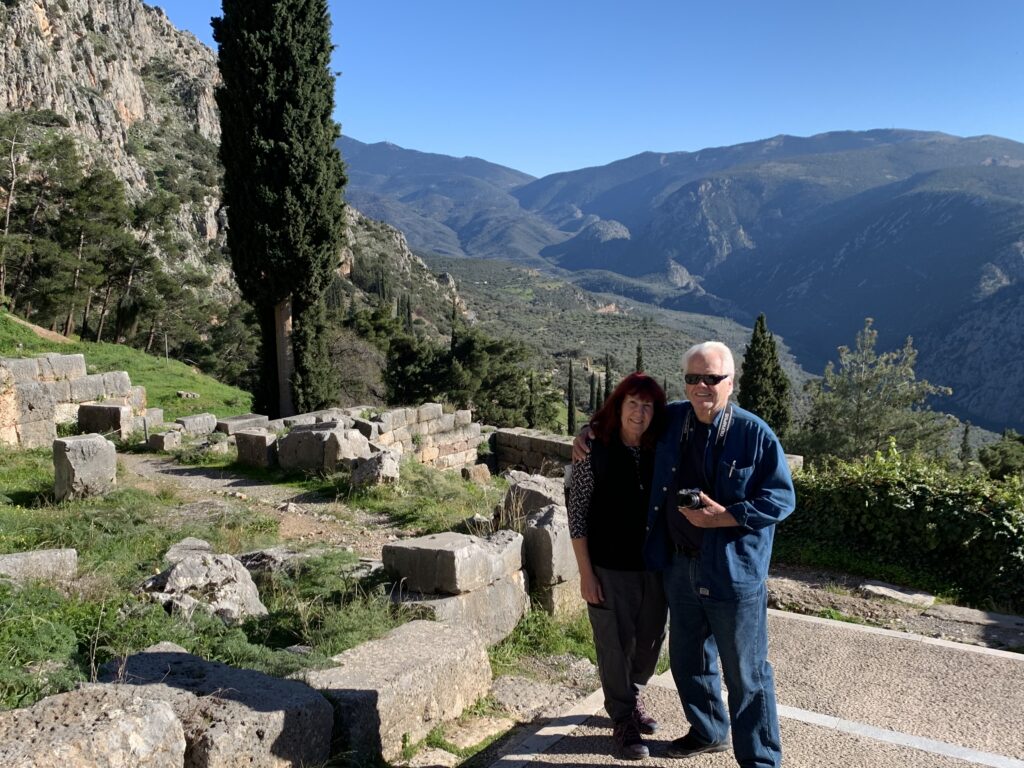
I had wanted to visit the oracle at Delphi (pronounced Delphee) for decades. I spent time in Greece in the 1970s but never made it there. In December 2025, I finally stood on that ancient, revered ground—after navigating a narrow, overcrowded road with impossible parking. It felt oddly appropriate for a site that once drew pilgrims from across the ancient world, including kings, generals, and rulers.
Some places are remembered. Others are felt. Delphi was both for me.
I could barely contain my excitement that day. The sky was a perfect blue, the air crisp, and the landscape itself truly otherworldly. This was not just a scenic location—it was a place chosen, layered with meaning, memory, and power. Delphi’s museum became an important key that unlocked the entire experience for me. Walking through it, I began to understand just how central the oracle was to Greek and Roman life.
This was the place where the gods spoke—and the world responded.
The Oracle and the Economy of Divine Speech
People came for direction—when to wage war, when to retreat, how to rule, how to live. The answers were believed to come from Apollo himself, delivered through a priestess known as the Pythia. For modern readers, the Pythia was a woman who served as the mouthpiece of the god. She would sit on a tripod in the innermost chamber—the adyton—and enter into an altered, frenzied state. Her speech, often fragmented or ecstatic, would then be interpreted by priests and shaped into responses. Not surprisingly, those interpretations could be—and often were—manipulated to suit the hearer.
The responses were famously ambiguous by design. At Delphi, they could guide, but they could also justify. A king might hear it was time to go to war. A general might interpret the words in a way that affirmed his plans for invasion. And all of this took place within a system that was not only religious, but economic. Delphi was a center of wealth, influence, and power. The more you brought, the more weight your question carried—and the more favorable the response.
As I moved through the museum, however, it was not only the oracle that captured my attention. It was the imagery that surrounded it.
Again and again, the same scenes appeared: gods in battle, giants rising in defiance, bodies falling in defeat. On the north side of the temple, the reliefs depict the Gigantomachy—the battle between the Olympian gods and the giants, the children of Gaia. The giants are not abstractions. They are armed, aggressive, and determined. They come with spears, stones, and shields, fighting against the gods. The gods, in turn, fight back with equal force. Apollo and Artemis stand against them. Zeus reigns above them. The outcome is not in doubt, but the struggle is intense.
This was one of the most important ideas in the ancient world: order is established through conflict and violence. Civilization survives because the gods defeat chaos. Power is maintained through victory. The world, in this telling, is held together by the triumph of the strong over the weaker.
Standing there at Delphi, surrounded by these scenes, I was struck by how familiar this narrative still is. It is not only ancient. It is human. We still believe, in many ways, that order can only be secured through force, and that power must be asserted in order to crush chaos.
A World Spoken Into Being
And yet, this is precisely where the biblical story takes a radically subversive path.
The Bible does not deny the existence of chaos or conflict. Genesis 6:1–4, with its reference to the “sons of God” and the Nephilim would not have seemed strange to an ancient audience. They lived in a world where the boundaries between the divine and human were not neatly separated, where rulers could be described in divine terms, and where stories of powerful, hybrid figures were part of the cultural imagination.
What the Bible does differently is refuse to ground creation in violence.
In the Greek and broader ancient Near Eastern imagination, the world emerges through conflict. The gods battle, and from that battle comes order. But in Genesis, God creates by speaking. There is no rival, no cosmic struggle, no war that produces the world. The world is ordered, named, and established by the Word and the Spirit of God.
This is a fundamental redefinition of reality.
Delphi, with its sacred omphalos—meaning the “navel” of the world was believed to mark the very center of the earth, the place from which divine knowledge flowed. According to myth, Zeus released two eagles from opposite ends of the world, and where they met, he marked the center with a stone. That stone stood in the temple, symbolizing the connection between the divine and human realms.
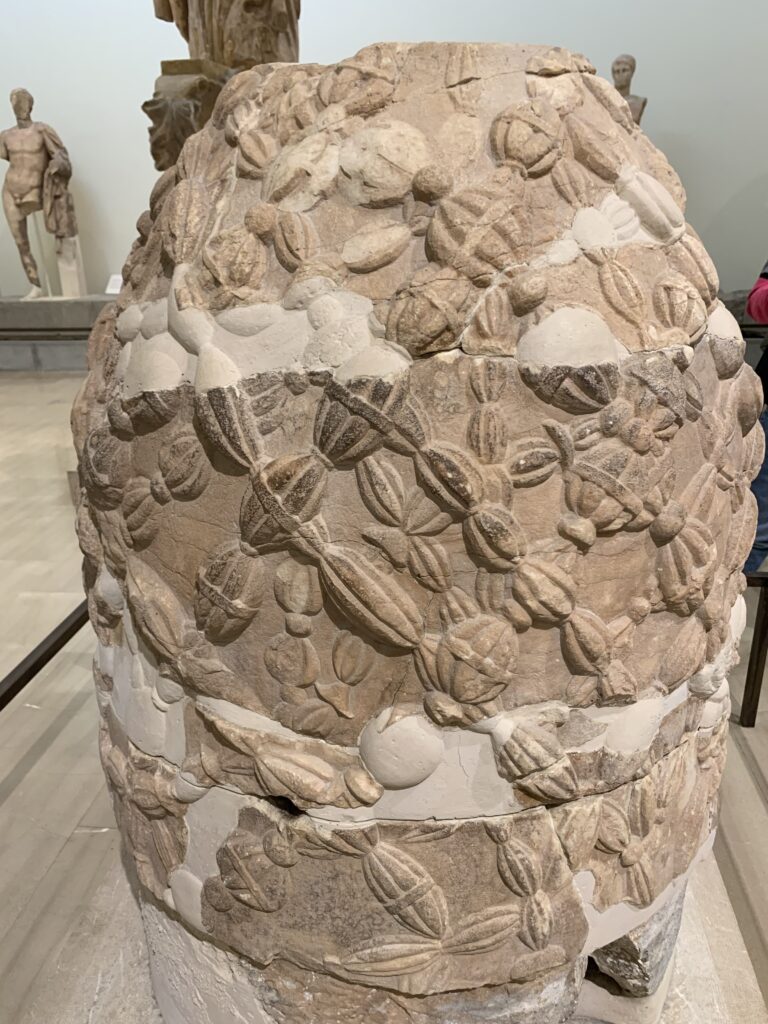
The Bible has its own center.
The Garden, with its tree of life, serves as a place of divine presence and instruction. Later, the Temple in Jerusalem builds upon this, with its inner chamber marking the place where God’s presence dwells. Rabbinic tradition even speaks of a foundation stone in the Holy of Holies as the true “navel” of the world, with the world’s waters lying beneath it.
This brings us to an unexpected but important connection in the New Testament.
The True Voice and the Liberation of Truth
In Acts 16, Paul encounters a slave girl in Philippi who is described as having a “spirit of divination”—in the Greek, a python spirit. This language directly connects her to the world of Delphi.
In Greek tradition, the Python was the serpent or dragon that dwelled at Pytho, near Delphi, guarding the oracle. Apollo was said to have slain this creature and established his prophetic center there. The term python became associated with prophetic spirits, particularly those connected to ecstatic, oracular speech.
In other words, this girl is functioning within that same tradition as the Pythia. She is, effectively, a portable oracle.
She follows Paul and his companions, declaring, “These men are servants of the Most High God, who are telling you the way to be saved.” Her words are accurate. But Paul does not affirm her.
Why? Because in the biblical framework, truth is not defined by accuracy alone—but by source.
This girl is embedded in a system of exploitation. Her owners profit from her condition. Her ability to speak is not a gift freely exercised—it is controlled, monetized, and used for gain. Like Delphi, this is a system where spiritual insight is entangled with power, economics, and manipulation.
Paul does not debate her. He does not reinterpret her message. He does something far more disruptive.
He casts the spirit out.
In doing so, he is dismantling the system. He is liberating a human being. He is restoring what has been distorted—giving her a new-creation life, her human nature delivered from what had enslaved it.
This raises a question. What does any of this have to do with us?
It is easy to relegate Delphi, giants, and oracles to the past. They seem distant, like artifacts from a world we no longer inhabit. But that is not entirely true. We have not outgrown Delphi—we have simply renamed it.
We still seek voices to guide us. We still look for authority—spiritual, political, technological—to tell us what is true, what is good, and what will lead to life. We still navigate a world of competing claims, loud and persuasive voices, and systems that deliver confusion.
The ancient world externalized these tensions through stories of gods and giants. The deeper question, then, is whether we understand the nature of the voice we are listening to. Delphi offered answers—but those answers were often shaped by human desire open to manipulation.
The biblical story moves in a different direction.
It presents a God who speaks clearly. A God who creates without violence. A God who does not manipulate but restores.
In Yeshua, this becomes visible in a way that confronts both ancient and modern assumptions. His works are not displays of power for their own sake. They are acts of deliverance—healing, freeing, and reordering lives that have been shaped by forces beyond their control.
The encounter in Acts 16 reminds us that not every spiritual voice is aligned with truth—even when it sounds convincing. It also reminds us that the work of God is not to exploit, but to liberate.
Standing in Delphi, surrounded by images of gods battling giants, I found myself reflecting on that contrast. The biblical story offers something altogether different.
A God who speaks.
A creation ordered without violence.
A voice that does not manipulate—but calls.
And that leaves us with a question.
Whose voice are we trusting to shape our understanding of truth, power, and the life we are building?
Leave a Reply