Tag: wisdom

psalm

Rooted to Rule: The Pattern of Psalm 1

Psalm 1 does not necessarily begin with advice or spiritual reflection—it begins with a claim about reality itself. There is a way of life that produces order, stability, and flourishing, and it begins with a king who is rightly planted in the wisdom of God.

We are accustomed to reading Psalm 1 as a word about ourselves—guidance for personal growth, a description of the righteous life. But that is not where the book of Psalms begins. Psalm 1 lays down the architecture for the entire Psalter. Its message is the necessity of the right king on the throne. When the right king rules, the world is ordered. When the right king is rooted in the wisdom of God, his rule brings flourishing to his realm and to the inner world of those who come under his authority.

The psalm begins with the Hebrew word ashrei. It is generally translated “blessed” or “happy,” but neither quite captures the true meaning. It is a recognition of a state that is publicly visible and undeniable. It carries the sense of flourishing, alignment, and rightness that can be seen and acknowledged within a community. In an honor-shame culture, it is the language of status.

Oh the honor of the one…

This is public recognition of a life rightly ordered.

Psalm 1 is not merely describing a man who feels blessed. It is identifying the one who stands in the place of honor because he has aligned himself with the order of creation as defined by the Torah—the oracles of God, the wisdom that governs the world. The psalm should be read in tandem with Psalm 2. The first introduces the honored man; the second reveals him as the anointed king who stands in the midst of rebellious nations. These two chapters frame the book and establish the kingship that governs everything that follows.

The honored one is defined first by what he refuses. He does not walk in the counsel of the rasha, the wicked. He does not stand in their path. He does not sit in the seat of mockers. These are descriptions of competing systems of order. The rasha represents a world structured apart from God’s wisdom, a world untethered from the wisdom that sustains creation. To walk, stand, and sit in that world is to come under its influence, to be shaped by its assumptions, to align oneself with its vision of reality.

Instead, his delight—his chefetz, his deep longing—is in the Torah of Yahweh because it is the wisdom of God. He meditates on it day and night, not as ritual but as covenantal alignment. The king orders his inner world according to divine wisdom. In doing so, he becomes the site where ordered creation is reestablished.

He will be like a tree.

In the ancient world, kings were often depicted as trees—strong, stable, life-giving. The tree connects heaven and earth, drawing life from deep waters and extending its canopy outward in fruit and shade. The trunk represents stability and endurance, the central structure upon which everything else depends.

This tree is planted—more precisely, transplanted—by streams of water. The language evokes irrigation channels, carefully directed flows of life that sustain the tree in every season. This is Eden language. The rivers of the garden that watered the earth now appear here as the source of the king’s stability—divine wisdom itself. He is intentionally placed within the life system of creation, rooted in the very waters that once flowed from the garden and later from the temple.

His fruit comes in its season. His leaf does not wither.

The Hebrew concept of withering carries the sense of collapse into folly, the unraveling of ordered life. To wither is not merely to dry up; it is to fall into confusion and a lack of discernment. In contrast, the righteous king remains green, enduring, productive. His life is sustained because it is aligned with wisdom. His fruit nourishes others. His leaves, in the language echoed later in Ezekiel and Revelation, become instruments of healing for the nations.

This is kingship as it was meant to be. Not domination, but sustenance. Not instability, but enduring life that radiates outward.

The contrast with Genesis 3 deepens the imagery.

There, the woman sees that the tree is good (tov), pleasing to the eyes, and desirable to make one wise. The language is drawn directly from creation itself. But she evaluates the tree apart from God’s word. She sees, desires, takes, and eats. Wisdom is seized rather than received. What was meant to be given is snatched, and in that moment, God’s wisdom is replaced with human judgment. Eating the fruit of the tree becomes a realignment away from the source of life.

Psalm 1 reverses that movement.

The righteous king does not seize wisdom. He meditates. He does not take; he receives. He does not eat from the tree in rebellion; he becomes the tree through covenantal obedience. His roots go down into the living waters, and from those waters life flows. Psalm 1 produces order through rootedness.

Yahweh knows the way of the righteous.

This is covenantal language. It is relational. The way of the righteous king is upheld because it is perfectly in sync with God’s design. But the way of the rasha is not so. They are like chaff driven by the wind. They are not anchored in the waters of wisdom. They cannot sustain life. They do not endure. Their way perishes, dissolving back into chaos.

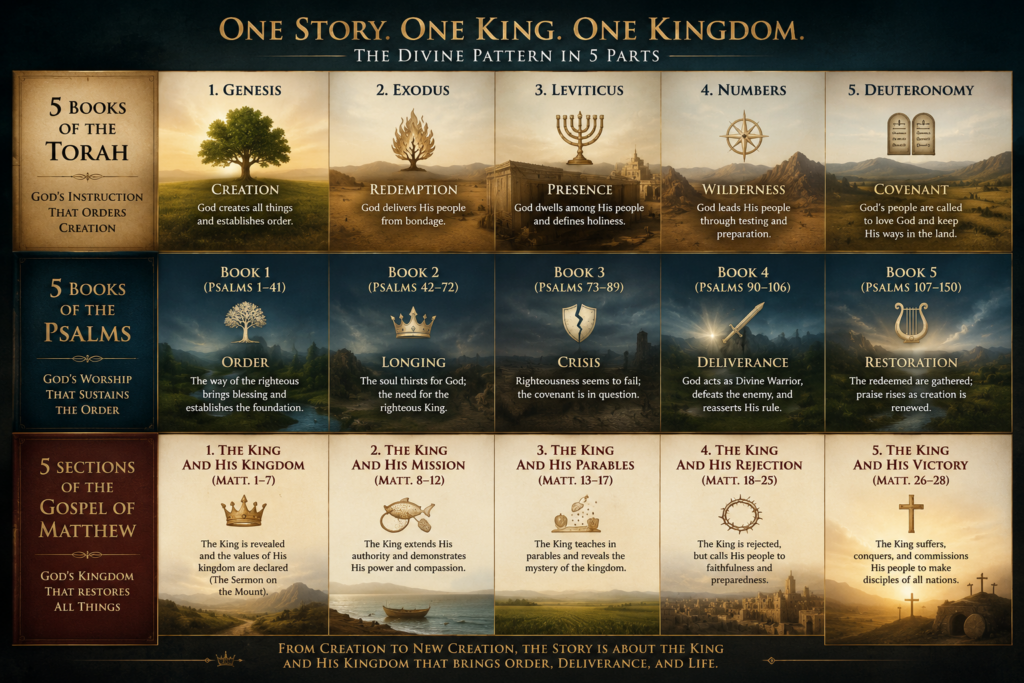
Psalm 1, then, is not an isolated meditation. It is the opening movement of a much larger composition. The book of Psalms is arranged in five books, mirroring the five books of the Torah. Just as the Torah provides the instruction that orders creation, the Psalms provide the liturgical response that sustains that order through worship.

The structure of the five sections of the Psalms traces a kingship narrative.

It unfolds as a movement from order to chaos and back to restoration. It begins with creation grounded in divine rule, where the king—like a tree planted by living waters—embodies the stability of Yahweh’s reign. But that order is contested. Pressure builds, distance from God’s presence is felt, and the need for righteous rule intensifies. The crisis comes when kingship appears to fail, the covenant fractures, and creation itself seems to unravel in exile and disorder.

The turning point is the reassertion of Yahweh’s kingship. He rises as the Divine Warrior (Psalm 104), subdues chaos, and establishes His rule once more. From there, the movement shifts toward restoration. The scattered are gathered, hope is renewed, and the Psalter closes in a rising chorus of praise as creation itself is drawn back into ordered worship under its rightful King.

This is the pattern of Scripture itself. Creation. Exile. Conflict. Divine intervention. Restoration. It is the pattern of Genesis. It is the pattern of the Exodus. And it is the pattern taken up again in the Gospel of Matthew, also structured in five major sections, presenting Jesus as the new Moses, the new Israel, the true King, the Messiah.

Matthew opens with the language of ashrei—the Beatitudes—rendered in Greek as makarios.

Oh the honor of the poor in spirit.
Oh the honor of the meek.
Oh the honor of those who mourn.

In the Roman world, honor belonged to power, wealth, and dominance. In Matthew, honor is reassigned to those whom the empire considers insignificant but publicly identified by God as part of His kingdom. The Beatitudes redefine kingship. They declare that true status belongs to those ordered according to God’s wisdom.

And this is where Psalm 1 finds its fulfillment. It anticipates a person.

The true Ashrei man.
Rooted in living waters.
Embodying wisdom.
The one whose life bears fruit in every season.
The one whose leaves bring healing to the nations.

Yeshua lives the pattern of Psalm 1. He is the tree planted by living waters. He is the wisdom of God made flesh. He is the king who stands unmoved by the counsel of the wicked, who refuses the kingdoms offered through compromise, who remains rooted in the will of the Father even unto death. And in His resurrection, the tree that could not wither, becomes the source of life for the world.

Psalm 1 is an invitation. Not first to self-improvement, but to recognize the sovereignty of the King.
psalm
creation tabernacle

Creation, Tabernacle, and Messiah: The Pattern of Work (Melachah) and Sabbath Fulfilled

From the opening lines of Genesis, Scripture presents God as a craftsman at work. He speaks, separates, shapes, and orders. The Spirit of God hovers over the waters as divine energy poised to create. The refrain repeats: “And God saw that it was good.” The work is good because it is ordered. The work, melachah, the labor of building, moves steadily toward completion. Building creation and tabernacle.

Then comes the seventh day. “Thus the heavens and the earth were finished… and He rested” (Gen. 2:1–2). Creation is an ordered working construction model. The cosmos has become sacred space, and the Sabbath is the sign that the work is complete. Rest is not inactivity. Rest is enthronement. Rest is God’s dwelling place. And he fills it with Himself and his human image bearer artisans who will be responsible to maintain the upkeep of their part of the cosmos – the earth.

Exodus 31: Melachah and the Pattern Repeated

When we turn to Exodus 31, the language is strikingly familiar. Bezalel is “filled with the Spirit of God, with wisdom, understanding, and knowledge” (Ex. 31:3). The same triad used to describe divine creative activity now describes a human artisan serving in a priestly capacity. He is commissioned to perform melachah, skilled work, constructing the tabernacle and its furnishings.

Immediately following this commission comes the command concerning Sabbath (Ex. 31:12–17). The pattern is unmistakable: sacred work followed by sacred rest.

In the narrative, another craftsman tradition stands in the background. The god Ptah was revered as a creator-deity and master artisan in Egypt. He fashioned the world through wisdom and speech, and his earthly manifestation was the Apis bull — a living symbol of strength, fertility, and divine presence. The Pharaoh of Moses’ generation would have known this cult well. It is therefore difficult to ignore the proximity between Israel’s construction of a golden calf and the Egyptian bull imagery that had shaped their former world. Several scholars have noted that the calf of Exodus 32 almost certainly reflects Egyptian iconography, likely drawing upon the Apis tradition. Israel does not invent a new symbol at Sinai; they revert to one they knew.

The juxtaposition is striking. In Exodus 31, Bezalel is filled with the Spirit of God, endowed with wisdom, understanding, and knowledge to construct sacred space according to a heavenly pattern. In Exodus 32, those same human capacities are redirected toward crafting an image — an attempt to localize divine presence through familiar form. One act of craftsmanship prepares a dwelling for the invisible God; the other reduces divine glory to visible representation. Sacred melachah can either order space for God’s indwelling or distort worship through imitation—what we would call idolatry. The question at Sinai is not whether Israel will build, but what kind of dwelling their work will produce.

It Is Finished: Creation, Tabernacle, and the Work of the Craftsman

Scholars such as Naftali Cohn observe that the tabernacle instructions are arranged in a seven-fold structure mirroring Genesis 1, culminating in the Sabbath command. He notes that the narrative of building the tabernacle “echoes the creation story in Genesis 1–2:4a,” suggesting that the tabernacle is portrayed as a new creation—a microcosm of ordered sacred space. The language of completion reinforces this connection. In Genesis, God “finished” (kalah) His work and rested. In Exodus 39–40, Moses inspects the work, sees that it is done, and the work is “finished.” The verbal parallels are deliberate and theological.

G. K. Beale goes further. In The Temple and the Church’s Mission, he argues that the tabernacle represents a symbolic cosmos. Eden was the first sanctuary; the tabernacle replicates that reality in portable form. The sacred structure embodies the ordered world in miniature. As Beale writes, “The tabernacle and temple were microcosmic models of the universe… symbolizing that God’s dwelling place was intended to encompass the whole creation.” If creation culminates in divine rest, then the tabernacle culminates in divine indwelling.

Exodus 31 places Sabbath immediately after the artisan’s commission for a reason. Sacred construction does not eclipse sacred rest. The work of building God’s dwelling culminates in Shabbat. The Sabbath is called a “sign” between God and Israel—a reminder that creation and covenant share the same rhythm. Work that orders space for divine presence is followed by rest that acknowledges completion. Melachah leads to kalah. Completion leads to filling. And filling requires the ongoing maintenance of sacred space through ritual re-enactment—what Scripture calls worship.

This pattern does not end in the wilderness at Sinai.

The Word Tabernacled Among Us

John’s Gospel opens with unmistakable Genesis language: “In the beginning.” But John 1:14 intensifies the pattern: “The Word became flesh and tabernacled among us.” The Greek verb eskēnōsen deliberately evokes tabernacle imagery. The dwelling of God in the wilderness now takes on human flesh. Jesus does not merely visit sacred space; He embodies it.

If the tabernacle was a microcosm, Jesus is the living temple. Beale states plainly, “Jesus is the true temple… the locus of God’s dwelling presence.” In Him, heaven and earth meet again. The creative Word through whom all things were made now stands within creation as the true sanctuary.

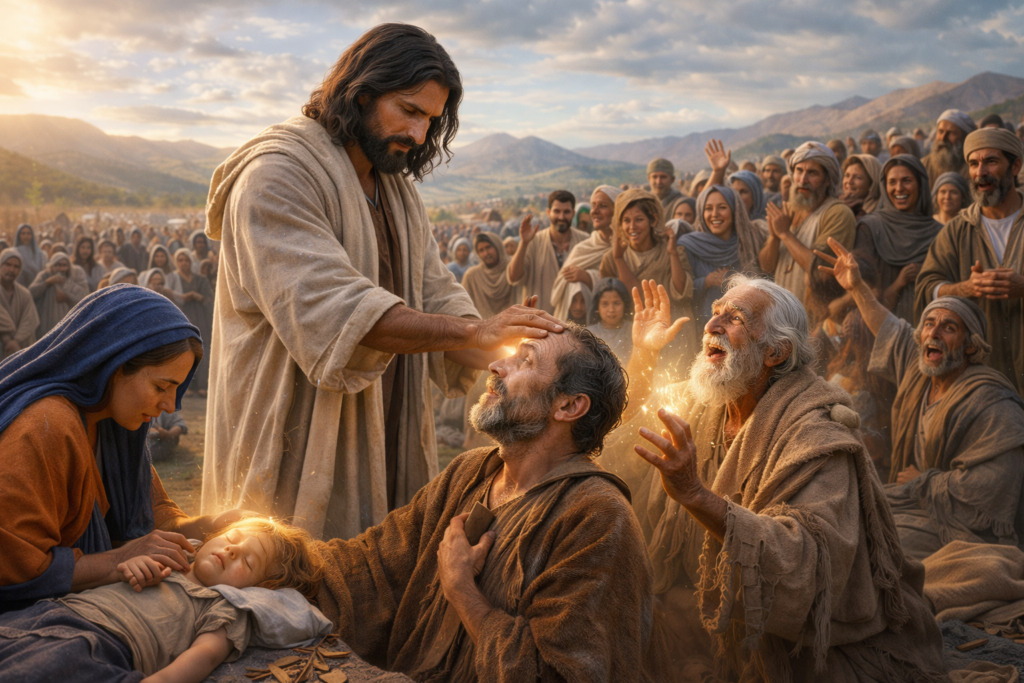
Notice the language of work in John’s Gospel. Yeshua repeatedly speaks of the “works” the Father has given Him to accomplish (John 5:36; 17:4). Though the Greek term differs from Hebrew melachah, the echo is unmistakable. The Son carries out the Father’s work of restoring and reordering creation. His miracles are acts of construction—rebuilding human beings into sacred space for the indwelling of the Holy Spirit. Sight is restored. Flesh is healed. Chaos is rebuked. Bread multiplies in the wilderness. The waters obey. Each sign reveals the Craftsman at work, shaping lives into places fit for divine presence and worship.

Bezalel was filled with the Spirit to construct sacred space. Jesus is anointed by the Spirit at His baptism and begins His ministry of holy work. Wisdom, understanding, and knowledge characterize the Spirit’s activity in Exodus 31. In the Gospels, the crowds marvel at Jesus’ wisdom, and the Spirit descends upon Him. The pattern continues—but now at a cosmic scale.

In Genesis, God finishes His work and rests. In Exodus, the tabernacle work is completed and the glory fills the tent. In John 19:30, Jesus declares, “It is finished.” The Greek tetelestai carries the weight of completion. The work entrusted to Him has reached its appointed end. The mortal body—the true tabernacle—is offered. The veil will soon be torn, opened for access.

If Sabbath in Genesis signified completion, and Sabbath in Exodus marked covenant fulfillment, then the death and resurrection of Jesus announce the completion of the greater pattern. Hebrews 4 speaks of a “rest that remains” for the people of God, tying that rest back to creation and forward to Christ. The new creation emerges from resurrection morning. The Craftsman has finished His work.

The Work of the Living Tabernacle is Finished

The pattern of work and rest does not end with crucifixion; it culminates in resurrection and ascension—divine enthronement once more. The rest of God becomes the rest of Messiah. The tabernacle of flesh gives way to the indwelling Spirit. The Gospels present Jesus as the living tabernacle who performs the Father’s work and declares its completion. Creation, tabernacle, and Messiah form a single theological arc.

Work, melachah, is the building of sacred space so that God may dwell. Rest—Shabbat is the sign that what was intended has been brought to fulfillment.

And when He says, “It is finished,” we are hearing the Craftsman announce that the true dwelling place of God among humanity has been established. The greater Bezalel has finished His work. God’s glory will fill the house.

creation tabernacle
Athena

Creation by Conflict: Athena, the Gods, the Giants, and the World They Made

One of the highlights of my trip to Athens was a visit to the Acropolis, literally the “high city” and to the Acropolis Museum—a must-see before visiting the Parthenon, the Erechtheion, and the remains of the old Temple of Athena. The museum provides essential context, allowing the visitor to understand how the Athenians envisioned order, power, and the divine.

Athena, the Acropolis, and the Architecture of Order

The Parthenon was dedicated primarily to Athena Parthenos, Athena the Virgin. It housed a massive gold-and-ivory statue of the goddess and emphasized civic order and protection, military readiness and victory, and imperial identity and power. The Erechtheion, by contrast, was dedicated to Athena Polias, Athena of the city. This was the older and more sacred cult, tied to the earliest history and identity of Athens.

According to tradition, the Erechtheion marked the site of the contest between Athena and Poseidon for patronage of the city. Poseidon struck the rock and produced salt water, a symbol of raw power and domination. Athena offered an olive tree. The Athenians judged her gift superior, and she became Athena Polias, guardian of the city. The olive tree mattered because it represented a different kind of order. It provided food, oil, light, medicine, wood, and long-term stability.

The Erechtheion was built around this sacred tree, preserving it within the architectural heart of the Acropolis. Even when the Persians destroyed Athens in 480 BCE, the olive tree was said to have resprouted immediately, reinforcing its symbolism that life cannot be extinguished.

Gigantomachy: When Creation Is Secured Through Violence

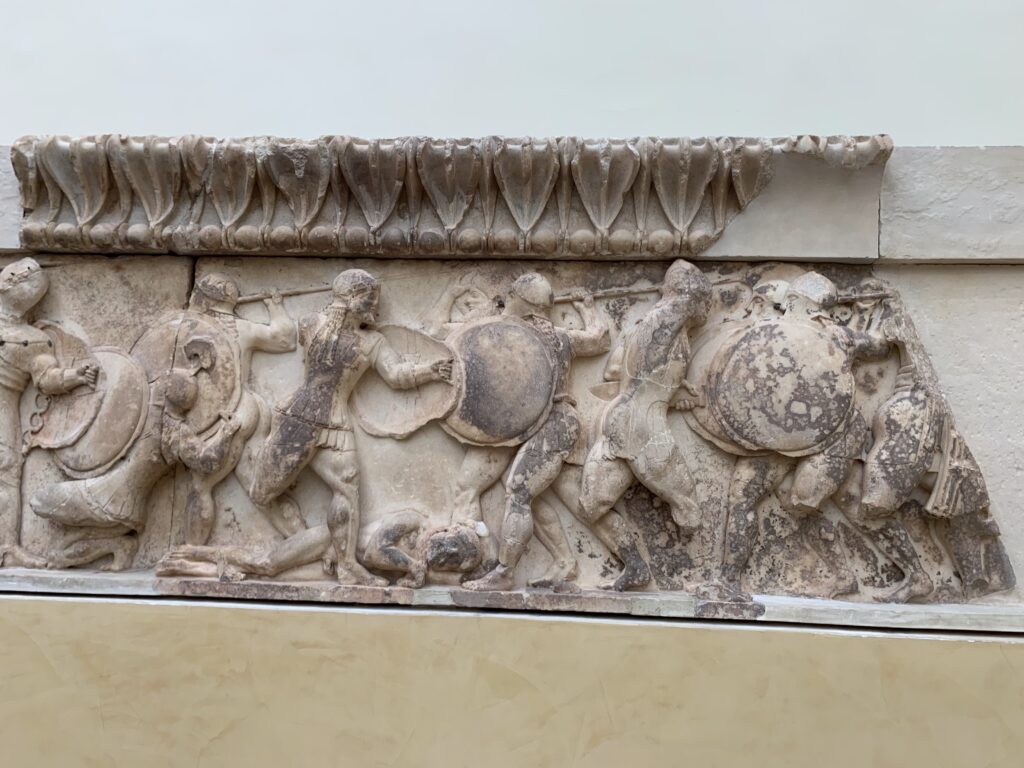
The museum also preserves the clearest visual expressions of how the ancient world understood creation, order, and power. Throughout its galleries, especially the Archaic Gallery and the Parthenon Gallery, Athena and the Olympian gods are repeatedly shown in violent conflict with the Giants. These scenes belong to a mythic cycle known as the Gigantomachy, a classic theme of divine struggle that shaped Greek religious imagination and civic identity.

The Gigantomachy depicts the battle between the Olympian gods and the Giants, a primordial race born from the earth itself. In Greek thought, the Giants were not merely large enemies; they embodied chaos, excess, and instability. They represented forces that threatened cosmic order and civic life. The defeat of the Giants was therefore necessary for the world to remain habitable.

Athena occupies a central role in these scenes. Marble reliefs in the Archaic Gallery, originating from the earlier Temple of Athena Polias, show Athena in the act of spearing a Giant. The east metopes (rectangular sculpted panels) of the Parthenon continue this theme in a more formalized and monumental style. Here, Athena appears in full battle gear alongside other gods, engaged in a long and violent struggle that culminates in the defeat of the Giants. One of the most striking examples is Athena’s combat with a Giant, one of the few clearly identifiable mythic combat scenes in which her warrior role is unmistakable.

These images communicated a worldview. In the ancient imagination, creation and stability emerged through violence. Order was born from conflict, and civilization endured only because the gods had crushed rival divine or semi-divine forces. The Gigantomachy captures this assumption with remarkable clarity. Chaos does not recede voluntarily; it must be subdued. The Giants are remnants of primordial disorder, and their destruction secures the cosmos.

Athena herself embodies a particular version of this logic. She is one of the most complex figures in Greek mythology, representing wisdom, strategic warfare, craft, and civic order. Unlike gods associated with uncontrolled violence, Athena represents measured power: intelligence applied to conflict, restraint guiding force. Her mythic birth reinforces this identity. According to Greek tradition, Athena is born fully armed from the head of Zeus, not from a womb. Order, in this account, emerges from divine intellect rather than generative process. She is Zeus’s ally, not his rival, and her authority reinforces the stability of the pantheon rather than threatening it.

As Athena Polias, guardian of Athens, she presides over law, political life, architecture, weaving, and education. The Parthenon stands as a civic and religious monument to her role as the one who secures the city’s order. When Athena battles Giants in temple sculpture, the message is clear: the city remains stable because chaos has been defeated. Divine violence underwrites civic peace.

This pattern reflects a widespread ancient assumption. Creation is not sustained through speech or covenant, but through the ongoing suppression of rival powers. Violence is not a tragic necessity; it is the engine of order. The world exists because someone stronger won.

God Speaks: The Bible’s Alternative Vision of Creation

Contrast this with the biblical worldview. Although the Bible speaks into this same symbolic world, it tells a strikingly different story. While it acknowledges chaos and opposition, often personified through sea monsters, hostile powers, and giants, it does not ground creation in divine warfare among equals. In Genesis, God does not fight other gods to create. He speaks. He separates. He orders. Light, land, and life emerge not from violence, imperial power, or bloodshed, but from divine command.

Even when biblical texts employ combat imagery, the emphasis differs sharply from the ancient mythic pattern. God’s authority is never in question. He will prevail. Chaos is real, but in the biblical story it is not ultimate. It does not rival God’s creative power; rather, it resists it.

This distinction becomes clear when considering giants in the biblical tradition. Like their ancient Near Eastern counterparts, biblical giants symbolize disorder, violence, and corruption. Yet they are never portrayed as cosmic equals to God. They threaten human faithfulness, not divine sovereignty. The struggle, then, is not between gods, but within human nature—between trust and fear, obedience and moral corruption.

The biblical battle is fundamentally moral rather than mythic. Where ancient myths portray creation as the outcome of divine rivalry, the Bible presents creation as sustained through wisdom and covenant fidelity. Violence does appear in certain biblical narratives, but it is never the foundation of order or divine will.

Seen in this light, the Gigantomachy panels in the Acropolis Museum provide a visual theology of the ancient world, a worldview in which stability depends on continual domination and creation emerges from conflict. Against this backdrop, the biblical creation account stands apart. It offers a vision of order grounded in the Word of God, moral restraint, and faithful governance. Scripture insists that the world endures because God speaks and what He speaks holds it together.

Athena
Skip to content