Tag: Tabernacle

place

The Place He Chose: What it means for God to put His Name among His people.

One of the great biblical themes is “the place that the LORD your God will choose to put His Name.” Moses directs Israel to one location where sacrifices are offered and covenant life is centered. This is the sacred center—the place where heaven and earth meet because God Himself chooses to dwell.

In the ancient world, names carried far greater significance than they do today. A name represented identity, character, authority, and existence itself. God reveals Himself to Moses as the One “who was and is and is to come,” the eternal One whose very Name declares His unchanging existence. To place His Name somewhere is to establish His presence, His rule, and His covenant authority there.

The Hebrew word is makom, meaning “place.” In Jewish tradition, HaMakom, “The Place,” becomes one of God’s titles. God, in a very real sense, is the Place. He is the One in whom all creation exists and finds its stability. The sacred place is where His presence is established, where His covenant is confirmed, and where His people come to stand before Him.

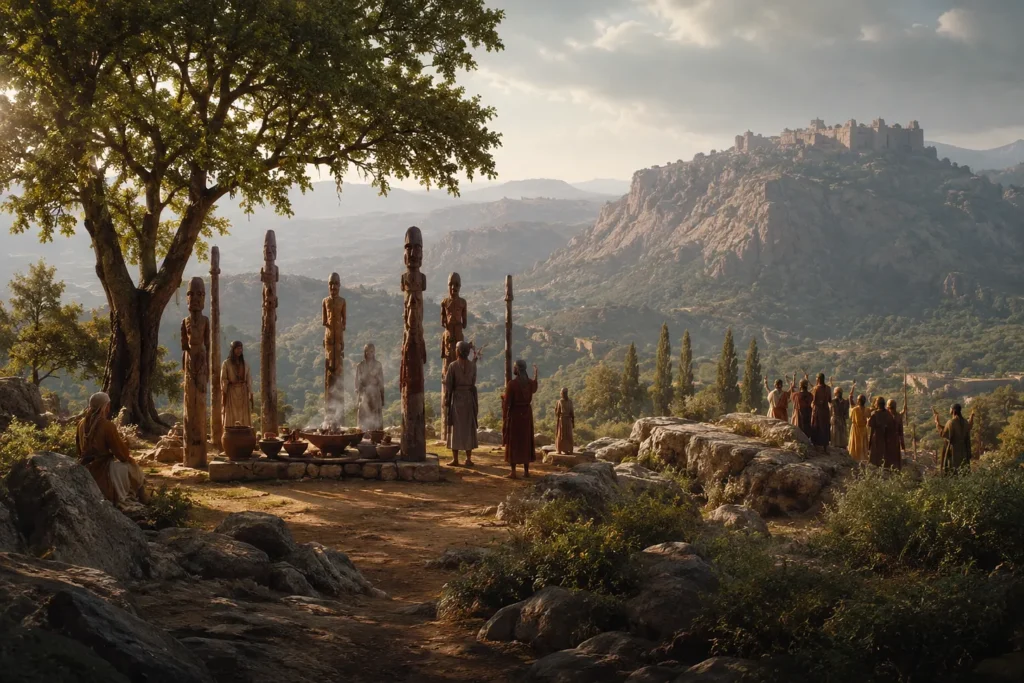
The nations saw sacred space differently. They believed their gods inhabited mountains, hills, and sacred groves. Elevated places became centers of worship. Every leafy green tree could become a place of fertility worship. Sacred poles and carved images marked locations where particular deities were believed to dwell. Every locality possessed its own sacred center. The nations themselves determined where their gods would reside.

Moses’ repeated reference to “the place where the LORD your God will choose to put His Name” only becomes clear when viewed against the ancient world’s understanding of sacred space. Every civilization believed there was a sacred center—the point where heaven and earth touched and where the divine realm intersected with human existence. It was considered the heart of reality itself, the place from which order flowed into the world and where creation was continually sustained.

Temples and sanctuaries were always built at this sacred center. But before a temple could be constructed, the sacred center first had to be identified. In the surrounding cultures this was often determined through oracles, omens, or divination. An image of the deity was then installed to validate the site’s sacred status, while the architecture of the sanctuary carefully reflected and protected its holiness.

Elevated mountains and hills naturally became favored locations because they symbolized the meeting point between heaven and earth. These sanctuaries functioned as miniature worlds, places where rituals and ceremonies renewed the relationship between the gods and humanity. In many ways they were understood as a microcosm of paradise—a center where the ordered world overcame the forces of chaos.

Israel also possesses a sacred center, but unlike the nations, it is never established by human initiative. The place is holy for one reason alone: the living God chooses it. From Eden onward, sacred space exists only because God establishes His presence there. It is where creation is restored and where His covenant people gather before Him.

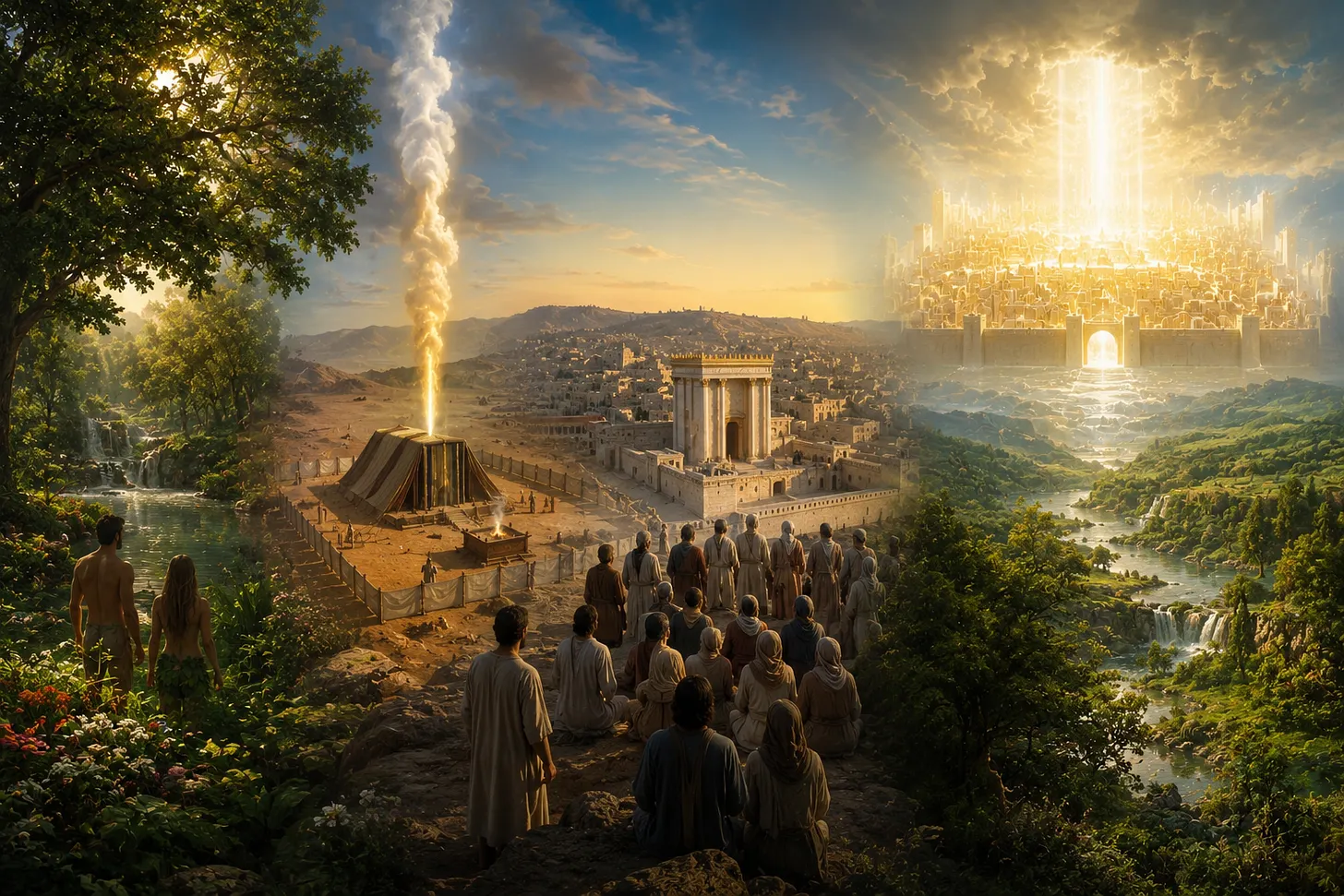
The nations chose where their gods would live. Israel waited for God to choose the place of His dwelling. The sacred center did not originate from human imagination. It originated from divine initiative. God planted the garden. He placed Adam and Eve within it and walked among them. Eden became the first sacred center because God caused His presence to dwell there.

After humanity’s exile from Eden, God continually establishes places where His presence dwells. The patriarchs encounter Him in their tents and at divinely appointed locations. The Tabernacle in the wilderness becomes the center of Israel’s camp, where the glory of God dwells among His covenant people. Solomon’s Temple becomes the place where God causes His Name to dwell in Jerusalem.

Jerusalem certainly became that place within Israel’s history, yet it pointed beyond itself toward something greater.

The prophets looked beyond the earthly Temple toward a renewed creation where God’s presence would once again fill the entire world. The New Testament reveals that promise unfolding through the Messiah. John declares that “the Word became flesh and dwelt among us.” The language deliberately echoes the Tabernacle. God once again dwells among humanity, not in a building made with hands but in the person of Jesus Himself.

What began in a garden, moved through a tent and a temple, now lives within the covenant community. Revelation brings the entire movement to its glorious conclusion as the New Jerusalem descends from heaven. No temple stands within the city because God Himself dwells there. The whole renewed creation becomes the holy place. Heaven and earth are fully united once again.

God’s purpose has always been to restore His dwelling with humanity until His presence fills the whole earth. God meets His people everywhere through His Spirit. Yet humanity never determines where God dwells. We do not invite Him to bless our agendas, our kingdoms, or our ambitions. Instead, we are invited into His purposes.

God chooses.

We respond.

The place where God puts His Name is ultimately the place where His rule is welcomed. It is where His people willingly bend their will to His until His desires become their own. The sacred center is not defined by geography but by submission. It is the place where our plans yield to His purposes, where our desires are reshaped by His wisdom, and where our lives come into alignment with His covenant.

Throughout Deuteronomy, worship always gathers families, servants, strangers, and entire households before the Lord. They rejoice together in His presence because covenant life is lived in community. God’s dwelling is not simply about private spirituality; it creates a people who live under one King and one covenant.

While the nations scattered worship among countless sacred sites, Israel gathered around one sanctuary because there was one God, one covenant, and one King.

The same remains true today. The place where God chooses to put His Name is the place where His people willingly bend their will to His until His desires become their own. There chaos is overcome by God’s order, divided people become one covenant community, and self-rule is replaced by the reign of God’s Kingdom.

Every covenant community that lives under His rule bears witness to the day when all creation will become the place where He has chosen to put His Name.
place
hyssop

Hyssop: The Little Plant in God’s Story of Redemption

Among the many plants mentioned in the Bible, none has generated more discussion than hyssop. For generations, botanists and biblical scholars have debated its identity. Was it the common hyssop known today, or the wild marjoram, Origanum syriacum, still called za’atar throughout Israel and Jordan? R. K. Harrison described hyssop as “one of the more problematical species of herbs,” observing that despite extensive study, its precise identification remains uncertain.

Most modern scholars associate the Hebrew ezov with a small aromatic plant that grows naturally throughout the hill country of Israel and Jordan. I remember seeing it growing from the rocks in Wadi Rum near Petra, where its ability to flourish in the harsh desert landscape brought Solomon’s description of “the hyssop that springs out of the wall” to life.

In the ancient world, hyssop was valued as both a culinary herb and a medicinal plant. Its leaves were dried for seasoning, while its aromatic oils were believed to possess cleansing properties. Ancient writers such as Pliny the Elder describe its use in treating skin disorders and digestive ailments, and later Jewish tradition likewise associated the plant with cleansing. Harrison also observes that its slender branches could easily be gathered into a bundle, making it well suited for use as a ritual sprinkler.

None of this, however, explains why hyssop occupies such an important place in Israel’s worship. Aromatic herbs and purification rituals were common throughout Egypt, Canaan, and Mesopotamia, where water, incense, fragrant plants, and sprinkling prepared temples for the presence of their gods. The Torah adopts none of the magical associations attached to such rituals. Instead, it gives hyssop a distinctive covenantal purpose.

Hyssop connected to sacred space

That realization shifted my attention away from identifying the plant and toward the role it plays throughout Scripture. Throughout the Torah, hyssop is consistently held in someone’s hand, conveying blood or water to a house, a sanctuary, or the people who belong within God’s dwelling. It appears whenever sacred space is being restored to covenant holiness.

The pattern begins on the night of the first Passover. Israel is instructed to take a bundle of hyssop, dip it into the blood of the Passover lamb, and apply the blood to the lintel and doorposts of every house. With a bundle of hyssop, covenant blood marks each household setting it apart from the judgment falling upon Egypt and preserving those within from death. The first place associated with hyssop is not the Tabernacle or the Temple, but an ordinary Israelite home that becomes sacred space as the Lord Himself passes over its threshold.

Here the Torah departs from the religious world around it. Egypt and Mesopotamia purified temples so their gods might dwell within them. Israel’s God does not summon His people into an earthly sanctuary here. He comes to their homes. Through blood applied with hyssop, an ordinary house becomes the first sacred space of the Exodus.

The pattern continues in Leviticus 14, where the object requiring purification is once again a house. A dwelling afflicted with ritual impurity undergoes an elaborate ceremony involving cedar wood, hyssop, scarlet yarn, the blood of a sacrificed bird, a living bird, and fresh running water. This is the first of several places where cedar, hyssop, and sheni tola’at appear together as part of Israel’s purification rites.

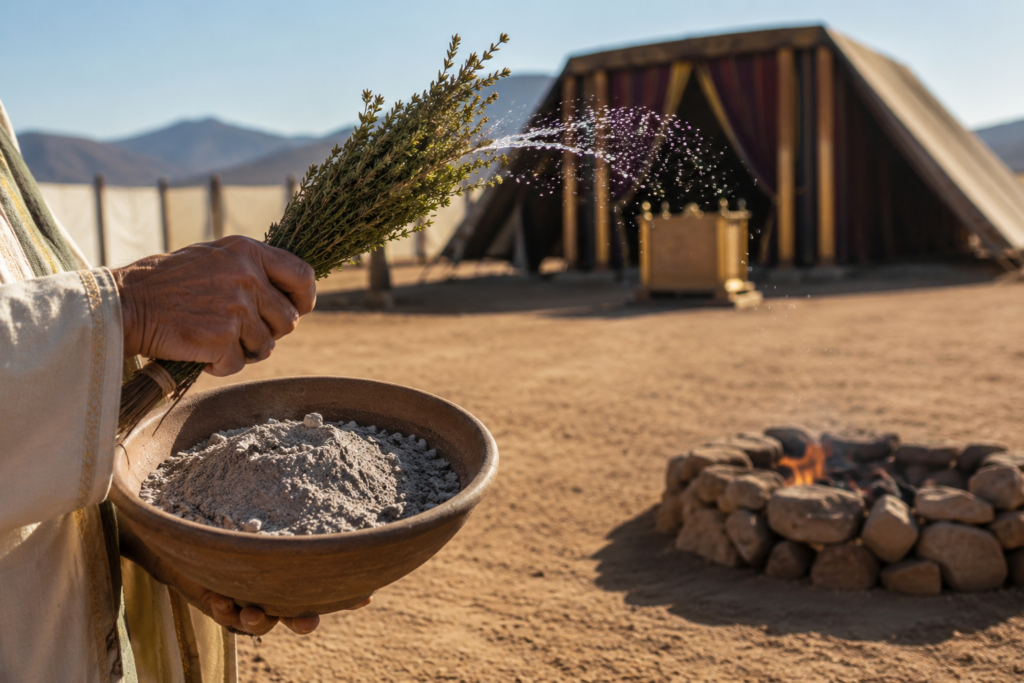
Numbers 19 expands the pattern. Here the issue is no longer disease but death itself. The ashes of the red heifer are combined with living water, and a clean person takes hyssop to sprinkle the tent, its vessels, and everyone defiled through contact with death. The same ritual elements appear again, but the concern now extends beyond individuals to everything associated with God’s dwelling. Death has interrupted covenant fellowship, and the ritual restores what death has defiled.

Every major occurrence of hyssop in the Torah is connected with sacred space—Israelite homes, houses restored after ritual impurity, and the Tabernacle with its furnishings and covenant community. The object of purification is not primarily the individual but the place where God’s presence dwells among His people.

David understands this when he cries, “Purge me with hyssop, and I shall be clean.” No priest stands over him with a bundle of hyssop. David speaks metaphorically, presenting himself as though he has become the sanctuary requiring purification. His deepest longing is not merely forgiveness but restored fellowship with the God whose presence had seemed so distant after his sin.

Hyssop for Consecration

The writer of Hebrews gathers these passages into a single image. Moses took blood, water, scarlet wool, and hyssop and sprinkled both the book of the covenant and all the people. The tabernacle and its vessels were likewise consecrated. The emphasis is not on the plant itself but on the consecration of God’s dwelling and His covenant people through blood and purification.

John alone tells us that the sponge filled with sour wine was lifted to Jesus on hyssop. Matthew and Mark mention only a reed, but John deliberately identifies the plant.

From the opening of his Gospel, John presents Jesus as both the Lamb of God who takes away the sin of the world and the place where God dwells among humanity. Throughout the Torah, hyssop served as the instrument by which covenant blood and the water of purification were applied to houses, sanctuaries, vessels, and God’s covenant people. Now, at the very moment the Lamb bears the sin of the world, that same instrument is lifted to Him. Throughout the Torah, hyssop accompanied the restoration of places where God chose to dwell. Now it is lifted to the One who bears the world’s defilement so that God may once again dwell among His people.

The same instrument that marked Israel’s houses at Passover, purified defiled dwellings, and restored the Tabernacle now appears at the cross. The pattern reaches its fulfillment in the Messiah. The One who bears the world’s sin accomplishes what every earlier act of purification anticipated: the restoration of God’s dwelling among humanity.

The little plant reminds us that God has always been restoring places where He chooses to dwell. The work that began in Israel’s homes reached its fulfillment in the Messiah and now continues in the lives of those who belong to Him. God’s purpose has never changed. He is still restoring His dwelling among His people.

hyssop
Numbers

From Egypt to Immanuel: The Forty-Two Pattern in Numbers

Hidden within the book of Numbers is a remarkable pattern: Israel’s forty-two wilderness encampments not only trace the journey from Egypt to the Promised Land but also foreshadow the forty-two generations leading up to the birth of Jesus in the Gospel of Matthew.

At first glance, the list of camps in Numbers appears more like an ancient geographical map —a sequence of unfamiliar places and unpronounceable names scattered across the desert. Yet the journey is far more than a travel log—the forty-two encampments form a map of transformation. They tell the story of a people being led from slavery to inheritance, from chaos to covenant, and ultimately toward a model of new creation.

This pattern reappears intentionally in the opening chapter of Matthew’s Gospel. Matthew structures the genealogy of Jesus into three sets of fourteen generations, creating a total of forty-two generations. Matthew is deliberately echoing Israel’s forty-two wilderness encampments because he wants his readers to understand that the story of Israel has always been moving toward the Messiah. These are not two disconnected stories. They are one unfolding journey woven together by God.

The Wilderness in Numbers as a Spiritual Classroom

The sages counted forty-two distinct encampments. Every stop was directed by God. Each resting place part of Israel’s formation as a covenant people. Though the wilderness was a de-creation environment filled with life threatening dangers, it also functioned as a spiritual classroom where God stripped away the mentality of slavery and taught His people dependence upon Him.

The Numbers stations themselves tell the story. Israel moves from the bondage of Egypt to the shelter of Sukkot. They pass through the bitter waters of Marah and arrive at the springs of Elim. They face hunger, thirst, rebellion, serpents, enemies, and the desolation of the desert. Every encampment exposes something within them. Every crisis reveals whether they will trust the God who delivered them through the sea.

God was dismantling Egypt inside His people. He was breaking the grip of fear, idolatry, and self-reliance. He taught them contentment. Manna fell from heaven. Water came from the rock. Their clothing endured. Their survival depended entirely upon His provision. The forty-two encampments in Numbers show how God transformed Israel from a fearful people shaped by slavery into a people learning to live in His Divine Presence.

The journey in Numbers even echoes creation itself. In Genesis, God speaks life into a world that is formless and void. In the wilderness, He shapes a new people out of a disordered multitude rescued from Egypt. The wilderness becomes a place where God brings order out of chaos.

At the center of Israel’s wilderness journey in Numbers stood the Tabernacle—the dwelling place of God moving in the midst of His people. They carried the Presence of God with them. The cloud by day and the fire by night rested over the Tabernacle, guiding every stage of the journey. When the cloud lifted, Israel moved. When it rested, Israel encamped. The wilderness was therefore not merely a journey toward a destination; it was a journey in which they carried the Presence of God in a mobile sanctuary.

Even the length of the journey in Numbers carries birthing imagery. Israel wandered for forty years in the wilderness, mirroring the forty weeks of human gestation. The wilderness functioned like a womb where God formed and shaped His covenant people before bringing them into the land. What emerged on the other side of the Jordan was a people born anew under the Presence of God.

Matthew’s Genealogy and Israel’s Journey

Matthew opens his Gospel with the same pattern. His genealogy unfolds in forty-two generations: from Abraham to David, from David to the exile, and from the exile to the Messiah. Abraham represents promise. David represents kingship. The exile represents the collapse of human self-rule and the consequences of covenant unfaithfulness. And Jesus represents fulfillment—the One who completes Israel and her journey, and brings the story home.

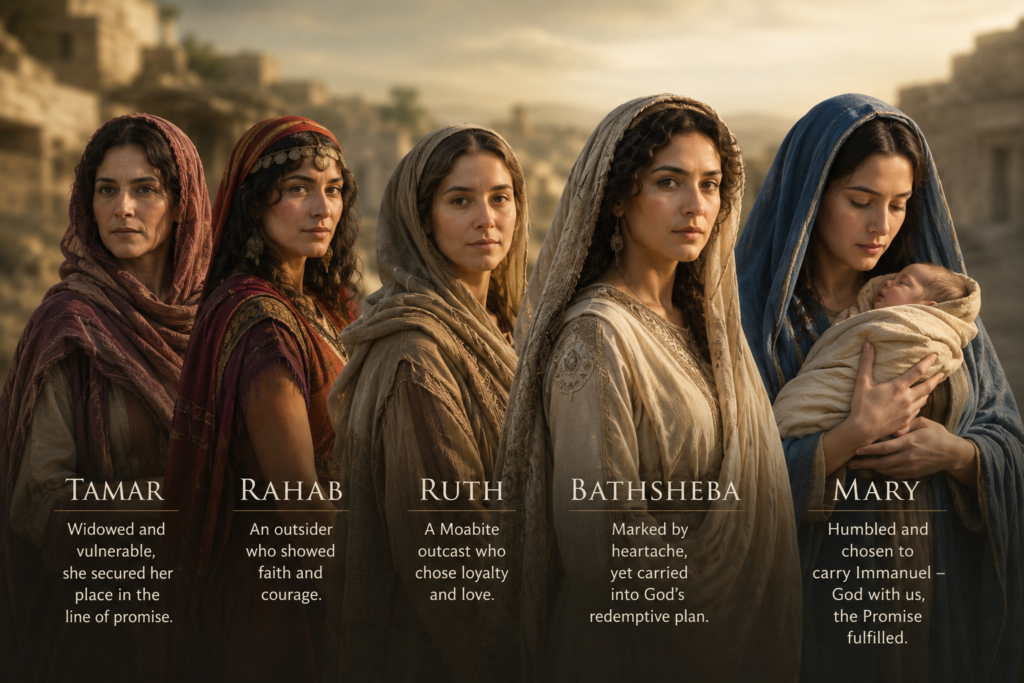
Matthew echoes the wilderness pattern through the women he highlights in the genealogy. Unusual for the ancient world. Tamar, Rahab, Ruth, Bathsheba, and ultimately Mary each carry the promise forward through seasons of uncertainty, danger, shame, and exile. These women are wilderness figures in their own right. Tamar was widowed and vulnerable. Rahab was a Canaanite prostitute. Ruth was a Moabite outsider. Bathsheba endured exploitation and tragedy. Mary faced public shame and misunderstanding. Yet God placed them into the redemptive story leading to Messiah.

The story culminates in Mary carrying within her womb the Presence of God. The wilderness journey of Israel reaches its fulfillment in the birth of Immanuel—“God with us.” What the Tabernacle foreshadowed in the wilderness now becomes flesh and blood in Jesus. He is the living Tabernacle moving among His people, the embodiment of the divine Presence once carried through the desert beneath the cloud and fire. The God who dwelt in the midst of Israel now walks among humanity in the person of the Messiah.

Matthew immediately presents Jesus as the fulfillment of Israel’s story. Like Israel, He passes through the waters at the Jordan. His immersion mirrors Israel crossing the sea. Then He is driven into the wilderness for forty days where He confronts haSatan—the serpent, the accuser, the embodiment of the chaos Israel repeatedly failed to overcome. Where Israel grumbled and rebelled in the wilderness, Jesus remains faithful. He defeats the counterfeit powers not through military force, but by the Word of God.

Then He ascends the mountain. Like Moses ascending Sinai, Jesus climbs a mountain in Galilee and delivers the Torah anew in the Sermon on the Mount. Matthew is presenting Him as far more than a teacher. He is the living Torah, the divine Lawgiver, the One through whom heaven and earth are being reordered.

Matthew is showing us from the very beginning that God’s kingdom gathers the outcasts, restores the broken, and brings life out of situations that appear hopeless.

From Chaos to New Creation

The wilderness journey is not simply Israel’s story. It is humanity’s story. And it is still our story today.

We also live between Egypt and promise. We pass through wilderness seasons where our illusions are stripped away and our hearts exposed. Wilderness storms reveal who we truly are. They force us to decide whether we will trust God or surrender to fear.

The Bible is filled with such moments. Abraham faced famine and displacement. David endured betrayal from his own son. Ruth lost her husband and entered exile alongside Naomi. Abraham lied out of fear. David fell into adultery and murder. Ruth came from a people Israel despised. Yet God worked through them because they trusted Him in the midst of their storms.

The forty-two encampments in Numbers and the forty-two generations in Matthew remind us that every stage of the journey matters. Every trial, every wilderness season, every storm, and every victory becomes part of God’s redemptive work in forming His people.

The wilderness still teaches us today. It teaches dependence instead of self-sufficiency. It teaches contentment in a culture of excess. It teaches us that survival itself is sustained by the hand of God. Most importantly, it teaches us that the wilderness is never the final destination.

That is the deeper question of the Numbers wilderness. Not whether storms come—they always do. The real question is how we respond when they arrive. Will chaos define us? Or will we allow God to shape us through it?

Numbers
temple

Where Chaos Ends, Presence Begins (in God’s Temple)

There is a pattern that runs like a deep current shaping Scripture from beginning to end. In the ancient world, a temple was never built in the absence of conflict. A temple always followed victory. A king subdued a threat, defeated an enemy, secured the land, and by doing so established order. Only then did he take his seat on the throne—his rest—within a house prepared for his presence. The story of the Bible is the story of a God who confronts an enemy, establishes order, and then dwells among His people.

From Chaos to Sacred Space

The opening chapter of Genesis begins with a world that is unformed, unpredictable, and untamed—waters that represent something unstructured and without boundary. The Spirit of God hovers like a mother bird over her nest, preparing a world waiting to be shaped into something that can sustain life. This hovering is a sign of divine intention—the quickening presence of God.

God speaks, and the world takes shape. Light is separated from darkness. Waters are gathered and restrained. Dry land appears, providing a fixed point for new life. Life begins to flourish within the boundaries that have been set. This is the first great act of victory—not through violence, but through sovereign authority. Chaos is brought under control and placed under the rule of God. What follows is sacred space for His divine presence—a garden established on a mountain, a place where heaven and earth meet.

Eden is the first temple where God’s presence dwells, where He walks, and where life flows outward. Within this space, humanity is placed as image bearers. Adam and Eve are installed within the garden temple as representatives of God’s rule, called to extend the order of this sacred space outward into the world.

The story of Noah returns to this pattern in a dramatic fashion. The world once again descends into disorder, where human corruption and violence mirror the chaos of untamed waters. Creation begins to unravel, and the waters return as instruments of judgment and cleansing. Yet even here, the story is one of preservation and renewal. Noah is instructed to build a house, a vessel that will carry life through the flood—a kind of floating temple carrying the presence of God through the chaos.

As the waters rise, the ark is lifted above them, echoing a new beginning. The world is once again covered in water, and once again there is a sign of life returning—a dove sent out over the waters. The dove signals that the waters are receding. The ark comes to rest on a mountain, the place of stability where heaven and earth meet. When Noah emerges, he builds an altar. The re-entry into the world is marked by worship and the recognition that life continues because God’s presence has carried it through judgment.

Victory Leads to Dwelling

With Abraham, the pattern becomes more personal. When he confronts the coalition of kings, he steps into a conflict that mirrors the larger struggle between order and disorder. After his victory, he does not choose the fertile plains. Instead, he moves toward the mountains, toward Hebron. There he dwells in tents, establishing a household that carries the presence forward. The structure may be temporary, but the pattern remains: after victory, a dwelling is established, and the presence of God is carried into the world.

This pattern comes into even greater clarity in the book of Exodus. Chaos is embodied in a system that oppresses, enslaves, and destroys life. Egypt becomes a representation of anti-creation. Yahweh enters as the Divine Warrior, confronting the powers that hold His people in bondage. The plagues dismantle that system, revealing that the gods of Egypt have no real power or authority.

The climax comes at the sea, the ultimate symbol of chaos. The waters are divided at the command of God, and Israel passes through on dry ground, echoing creation itself. The same waters collapse upon the Egyptian army, bringing a decisive end to their power.

The story, however, does not end at the sea. Israel is led into the wilderness and brought to the mountain, where covenant is established and order is defined. Instructions are given for the Tabernacle, a mobile temple reflecting the cosmos, the mountain, and the garden. The presence of God fills this space and becomes the center of Israel’s life. Once again, chaos is defeated, order is established, and a dwelling place for God is created.

The story continues through the conquest and monarchy. Under Joshua, the people cross the Jordan into a new phase of life, with the Tabernacle ensuring the presence of God remains central. David defeats Israel’s enemies and secures Jerusalem. Solomon builds the temple on Mount Moriah—a permanent house for the presence of God. After victory, a house is built, and God dwells among His people.

The Temple Becomes a Person—and Then a People

In the Gospels, this pattern reaches its fullest expression in Jesus. He enters the waters, confronts the adversary in the wilderness, and demonstrates authority over the sea and the demonic realm that manifests in human brokenness. Each act confronts chaos. Each act sets captives free. His greatest victory comes through entering the realm of death itself. The cross becomes the battlefield, and the resurrection the victory over death that results in a new creation temple.

Yeshua embodies that temple. He becomes the place where heaven and earth meet. The temple is no longer confined to a stone building; it is present in a person, and through Him extends into His people.

Revelation brings the story to its conclusion. Chaos rises once more, depicted as beasts and empires, but is ultimately defeated. A city descends—a dwelling place that is also a mountain, a temple, and a garden. The entire city is filled with the presence of God. Heaven and earth are united, and the pattern reaches fulfillment.

If the pattern has always moved from victory to dwelling, where does that leave us now? We do not stand in Eden or gather at a temple in Jerusalem.

The dwelling place of God is now found within His people. The presence that once filled the garden, the ark, the Tabernacle, and the temple now resides within those who have been renewed. With the resurrection, humanity is being restored as the image-bearing temple of God. The Spirit that hovered over the waters now dwells within, bringing life, order, and transformation.

Through regenerated humanity, that presence is carried into every place and every act of faithful living. We become a living temple, bearing the presence of God into a world that still struggles with chaos and very real evil.

The Temple in a World That Still Feels Broken

temple

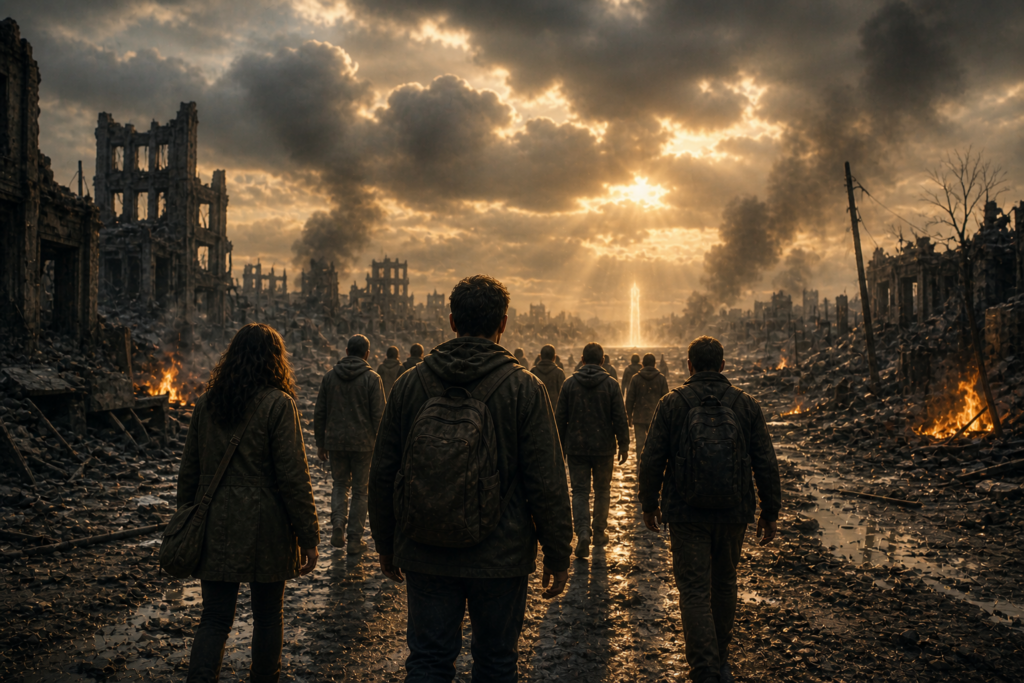
When we look at the world, it does not feel like chaos has been defeated. Disorder, suffering, and death remain very real. It can appear as though evil is winning and God is absent. But Scripture never presents victory as instant completion. There is always a space between decisive victory and final restoration.

In the Gospels, Jesus defeats death, yet the world is not immediately transformed.

To say we are the temple is not to deny the darkness around us, but to recognize that God has chosen to dwell within humanity and move through it. Like the Tabernacle in the wilderness, the presence now travels into places still marked by chaos.

To those looking toward a future temple in Jerusalem, we are still called not to stand idle, but to live now as the dwelling place of God—carrying His presence into the world even as we watch for what is yet to come.

We carry the presence not because the world is finished, but because God is still restoring it—through us.

two birds

Two Birds, Two Goats, One Cross: The Biblical Pattern of True Cleansing

Purification in Scripture is never about managing impurity—it is about removing it entirely. The ritual for the metzora (one with a skin disease) and the service of Yom Kippur operate on the same underlying pattern. In Leviticus 14, the death and release of two birds restores the individual. In Leviticus 16, the death and release of two goats restores the sanctuary and the people.

The Pattern of Cleansing: Death and Release

Leviticus 14 begins outside the camp, where the metzora, cut off from the life of Israel, waits for restoration. The priest goes out to him, not the other way around. Two birds are brought. One bird is slaughtered over living water in a clay vessel. The other, still alive, is dipped—along with the wood, scarlet, and hyssop—into the blood of the slain bird. The blood and water are then sprinkled seven times upon the one being cleansed. Only after this does the living bird go free, released into the open field.

Blood applied and impurity removed. The metzora is washed, shaved, and gradually restored. He reenters the camp but remains outside his tent for seven days, undergoing a second cycle of washing and shaving before final reintegration on the eighth day. Cleansing is a process of reordering life back into alignment within sacred space.

Leviticus 16, the Day of Atonement, mirrors this structure on a corporate scale. Here the concern is not a single body but the body of Israel and the sanctuary itself. Over time, impurity accumulates through sin, disorder, and the reality of life in a fractured world. The tabernacle, as the meeting place of heaven and earth, must be cleansed.

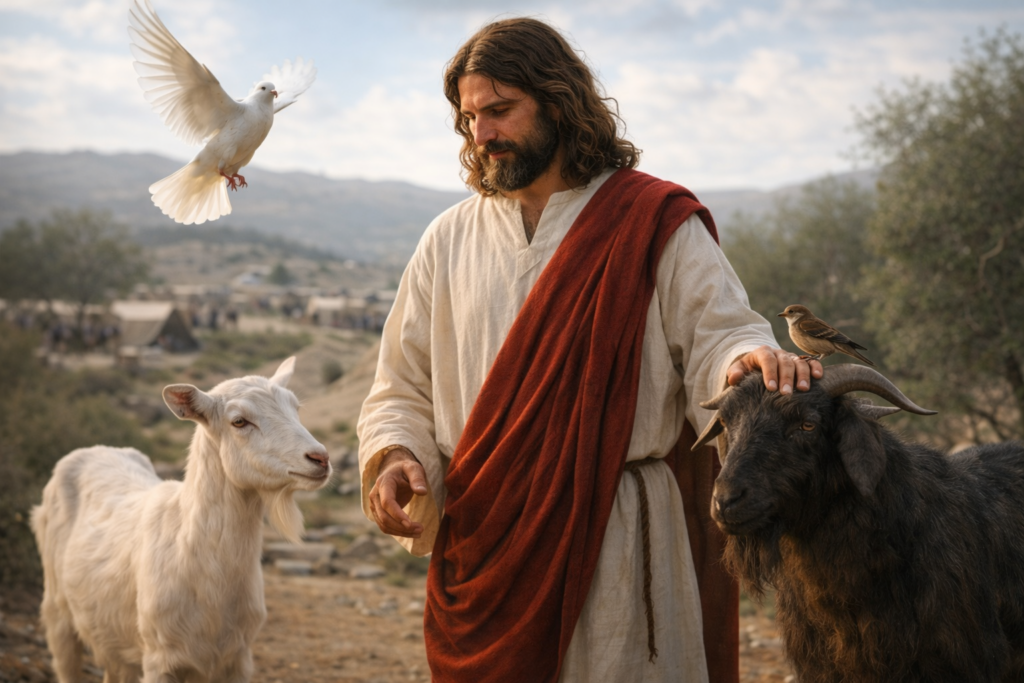
Again, two animals stand at the center. One goat is designated “for Yahweh” and is slain. Its blood is carried into the Holy of Holies and sprinkled—again seven times—upon the kapporet (covering for the seat) and on the veil, the parokhet. The inner sanctum, the place of divine presence, is purified through blood. The second goat remains alive. The high priest lays his hands upon it, confessing the sins of the people, and it is sent away into the wilderness, carrying those sins into a place of desolation, never to return.

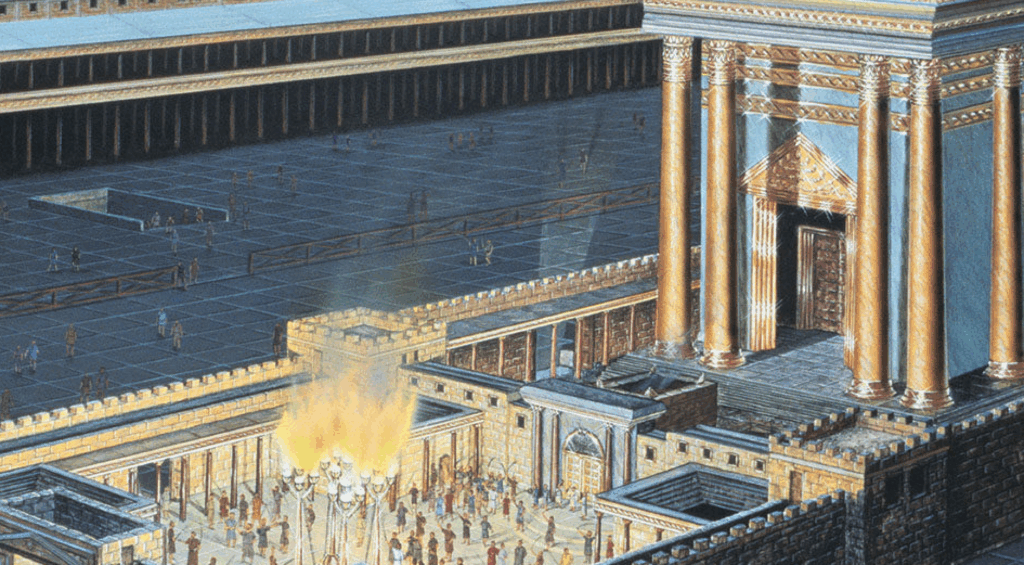
The blood purifies. Removal completes the act. One animal addresses defilement within sacred space; the other removes impurity from the community. In later Jewish tradition, the imagery expands. A scarlet thread is tied to the goat designated for the wilderness and, according to tradition, also to the Temple gate—possibly the Nicanor Gate, the main eastern entrance into the inner court.

When the thread turned white, it signaled that sins had been forgiven. Scarlet becomes white, the sign of cleansing that echoes the elements in the metzora ritual: cedar, hyssop, and scarlet bound together in purification.

The Temple, the Body, and the Removal of Impurity

What emerges from these two chapters is a unified vision of cleansing. The human body and the tabernacle function as parallel sacred spaces. The metzora is a defiled micro-temple, cut off from the community. The sanctuary is the macro-temple, bearing accumulated impurity. Both require cleansing. Both are restored through the same pattern: blood applied, impurity removed, life reestablished.

The pattern moves beyond Leviticus and into the Gospel narratives.

Yeshua is the slain one. Like the bird killed over living water, like the goat offered to Yahweh, His death is a purifying act. His blood is central. But He is also the one sent away. Like the living bird released into the open field and the goat driven into the wilderness, Yeshua is led outside the city. He is crucified beyond the walls of Jerusalem, in the place of exile away from the camp. He dies outside the camp, bearing reproach, carrying the weight of impurity beyond the boundary of sacred space.

In Leviticus 14, the bird is slain over living water, and the cleansing involves blood and water. In John’s Gospel, when Jesus’ side is pierced, blood and water flow out. The elements of purification are present at the moment of His death. Hyssop appears again at the crucifixion, used to lift sour wine to His lips. The threads of Leviticus are brought together in Him.

Even the movement of the ritual is preserved. The metzora waits outside the camp until the priest comes to him. On Yom Kippur, the high priest moves between spaces, carrying blood into the presence of God and sending impurity away. In the Gospel narrative, Yeshua embodies both priest and offering. He offers Himself. He goes outside. He returns in resurrection, not simply restored, but inaugurating access.

Fulfilled in Yeshua: Cleansing and Removal United

The pattern converges in one place. Yeshua is the priest who goes out, the sacrifice that is given, the one sent away, and the one who returns to restore. He embodies Israel, the temple, and the individual in need of cleansing. Through Him, impurity is both cleansed and removed, and the way back into the presence of God is opened fully.

two birds

This reframes the modern question: how do we purify ourselves?

We begin with the recognition that something must be dealt with—something that disrupts life, fractures relationships, and distances us from the presence of God. Scripture names this as impurity, sin, uncleanness, disorder. In modern life, it often appears as shame, anxiety, hidden habits, fractured identity, or the quiet sense that something is not as it should be.

Something must be addressed, and something must be removed.

In Leviticus, this takes the form of death and release. One bird is slain; another is sent away. One goat is sacrificed; another carries impurity into the wilderness. Impurity is dealt with and removed.

This is where the connection to Yeshua becomes practical. If He embodies this pattern, then purification today is not a ritual we perform but a reality we enter into. His removal outside the camp carries away what we cannot carry ourselves. But that work is ours to receive and to live within.

But receiving does not mean passivity. The metzora, once declared clean, still participates in a process. He washes. He shaves. He reenters the camp gradually. He is restored step by step into a new way of living.

To live as one who has been cleansed is to refuse to carry what has already been removed. The goat does not return to the camp. The living bird does not fly back. What has been sent away is meant to remain gone.

Yet, this is where many still struggle. We continue to carry what has already been released. We rehearse failures, revisit wounds, and allow past realities to define present identity. In doing so, we reject the second half of the pattern—the removal.

The call is not to achieve purity through effort, but to live as those who have been purified.

Confession is the act of stepping out of isolation and into the possibility of restoration. It also means allowing patterns of thought and behavior that produce disorder to be released. Just as the goat carries impurity away, there are habits, narratives, and attachments that must be relinquished. We let go because it has already been carried away.

This is where community becomes essential. The metzora is restored to the camp, not to isolation. The goal is not individual purity in abstraction, but reintegration into a people shaped by the presence of God. Healing is lived out in relationships where truth, accountability, and grace are present.

What God has removed is not meant to be carried again—true cleansing is learning to live as though it is completely gone.

creation tabernacle

Creation, Tabernacle, and Messiah: The Pattern of Work (Melachah) and Sabbath Fulfilled

From the opening lines of Genesis, Scripture presents God as a craftsman at work. He speaks, separates, shapes, and orders. The Spirit of God hovers over the waters as divine energy poised to create. The refrain repeats: “And God saw that it was good.” The work is good because it is ordered. The work, melachah, the labor of building, moves steadily toward completion. Building creation and tabernacle.

Then comes the seventh day. “Thus the heavens and the earth were finished… and He rested” (Gen. 2:1–2). Creation is an ordered working construction model. The cosmos has become sacred space, and the Sabbath is the sign that the work is complete. Rest is not inactivity. Rest is enthronement. Rest is God’s dwelling place. And he fills it with Himself and his human image bearer artisans who will be responsible to maintain the upkeep of their part of the cosmos – the earth.

Exodus 31: Melachah and the Pattern Repeated

When we turn to Exodus 31, the language is strikingly familiar. Bezalel is “filled with the Spirit of God, with wisdom, understanding, and knowledge” (Ex. 31:3). The same triad used to describe divine creative activity now describes a human artisan serving in a priestly capacity. He is commissioned to perform melachah, skilled work, constructing the tabernacle and its furnishings.

Immediately following this commission comes the command concerning Sabbath (Ex. 31:12–17). The pattern is unmistakable: sacred work followed by sacred rest.

In the narrative, another craftsman tradition stands in the background. The god Ptah was revered as a creator-deity and master artisan in Egypt. He fashioned the world through wisdom and speech, and his earthly manifestation was the Apis bull — a living symbol of strength, fertility, and divine presence. The Pharaoh of Moses’ generation would have known this cult well. It is therefore difficult to ignore the proximity between Israel’s construction of a golden calf and the Egyptian bull imagery that had shaped their former world. Several scholars have noted that the calf of Exodus 32 almost certainly reflects Egyptian iconography, likely drawing upon the Apis tradition. Israel does not invent a new symbol at Sinai; they revert to one they knew.

The juxtaposition is striking. In Exodus 31, Bezalel is filled with the Spirit of God, endowed with wisdom, understanding, and knowledge to construct sacred space according to a heavenly pattern. In Exodus 32, those same human capacities are redirected toward crafting an image — an attempt to localize divine presence through familiar form. One act of craftsmanship prepares a dwelling for the invisible God; the other reduces divine glory to visible representation. Sacred melachah can either order space for God’s indwelling or distort worship through imitation—what we would call idolatry. The question at Sinai is not whether Israel will build, but what kind of dwelling their work will produce.

It Is Finished: Creation, Tabernacle, and the Work of the Craftsman

Scholars such as Naftali Cohn observe that the tabernacle instructions are arranged in a seven-fold structure mirroring Genesis 1, culminating in the Sabbath command. He notes that the narrative of building the tabernacle “echoes the creation story in Genesis 1–2:4a,” suggesting that the tabernacle is portrayed as a new creation—a microcosm of ordered sacred space. The language of completion reinforces this connection. In Genesis, God “finished” (kalah) His work and rested. In Exodus 39–40, Moses inspects the work, sees that it is done, and the work is “finished.” The verbal parallels are deliberate and theological.

G. K. Beale goes further. In The Temple and the Church’s Mission, he argues that the tabernacle represents a symbolic cosmos. Eden was the first sanctuary; the tabernacle replicates that reality in portable form. The sacred structure embodies the ordered world in miniature. As Beale writes, “The tabernacle and temple were microcosmic models of the universe… symbolizing that God’s dwelling place was intended to encompass the whole creation.” If creation culminates in divine rest, then the tabernacle culminates in divine indwelling.

Exodus 31 places Sabbath immediately after the artisan’s commission for a reason. Sacred construction does not eclipse sacred rest. The work of building God’s dwelling culminates in Shabbat. The Sabbath is called a “sign” between God and Israel—a reminder that creation and covenant share the same rhythm. Work that orders space for divine presence is followed by rest that acknowledges completion. Melachah leads to kalah. Completion leads to filling. And filling requires the ongoing maintenance of sacred space through ritual re-enactment—what Scripture calls worship.

This pattern does not end in the wilderness at Sinai.

The Word Tabernacled Among Us

John’s Gospel opens with unmistakable Genesis language: “In the beginning.” But John 1:14 intensifies the pattern: “The Word became flesh and tabernacled among us.” The Greek verb eskēnōsen deliberately evokes tabernacle imagery. The dwelling of God in the wilderness now takes on human flesh. Jesus does not merely visit sacred space; He embodies it.

If the tabernacle was a microcosm, Jesus is the living temple. Beale states plainly, “Jesus is the true temple… the locus of God’s dwelling presence.” In Him, heaven and earth meet again. The creative Word through whom all things were made now stands within creation as the true sanctuary.

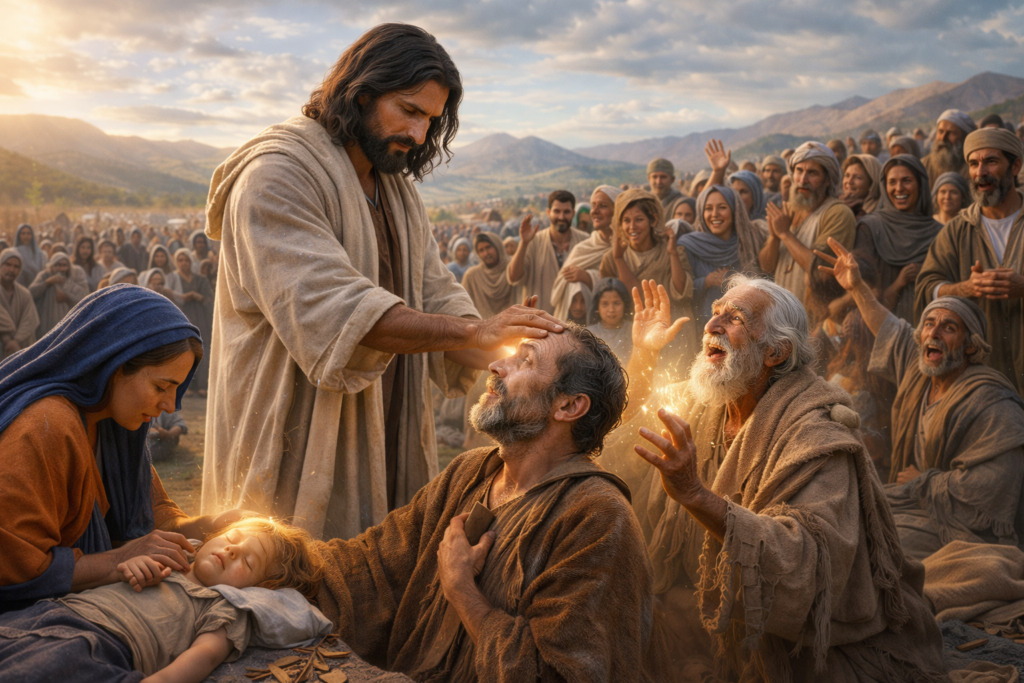
Notice the language of work in John’s Gospel. Yeshua repeatedly speaks of the “works” the Father has given Him to accomplish (John 5:36; 17:4). Though the Greek term differs from Hebrew melachah, the echo is unmistakable. The Son carries out the Father’s work of restoring and reordering creation. His miracles are acts of construction—rebuilding human beings into sacred space for the indwelling of the Holy Spirit. Sight is restored. Flesh is healed. Chaos is rebuked. Bread multiplies in the wilderness. The waters obey. Each sign reveals the Craftsman at work, shaping lives into places fit for divine presence and worship.

Bezalel was filled with the Spirit to construct sacred space. Jesus is anointed by the Spirit at His baptism and begins His ministry of holy work. Wisdom, understanding, and knowledge characterize the Spirit’s activity in Exodus 31. In the Gospels, the crowds marvel at Jesus’ wisdom, and the Spirit descends upon Him. The pattern continues—but now at a cosmic scale.

In Genesis, God finishes His work and rests. In Exodus, the tabernacle work is completed and the glory fills the tent. In John 19:30, Jesus declares, “It is finished.” The Greek tetelestai carries the weight of completion. The work entrusted to Him has reached its appointed end. The mortal body—the true tabernacle—is offered. The veil will soon be torn, opened for access.

If Sabbath in Genesis signified completion, and Sabbath in Exodus marked covenant fulfillment, then the death and resurrection of Jesus announce the completion of the greater pattern. Hebrews 4 speaks of a “rest that remains” for the people of God, tying that rest back to creation and forward to Christ. The new creation emerges from resurrection morning. The Craftsman has finished His work.

The Work of the Living Tabernacle is Finished

The pattern of work and rest does not end with crucifixion; it culminates in resurrection and ascension—divine enthronement once more. The rest of God becomes the rest of Messiah. The tabernacle of flesh gives way to the indwelling Spirit. The Gospels present Jesus as the living tabernacle who performs the Father’s work and declares its completion. Creation, tabernacle, and Messiah form a single theological arc.

Work, melachah, is the building of sacred space so that God may dwell. Rest—Shabbat is the sign that what was intended has been brought to fulfillment.

And when He says, “It is finished,” we are hearing the Craftsman announce that the true dwelling place of God among humanity has been established. The greater Bezalel has finished His work. God’s glory will fill the house.

creation tabernacle
breath

Great Salvation

The Feast of Tabernacles (Sukkot) concludes with Hoshana Rabbah, or the Great Salvation. It is the seventh day of the feast, when priests in the Temple circled the altar seven times, waving palm and willow branches, crying “Hoshana: Save us now!” and blowing the shofar. The ritual echoed Israel’s ancient memory: the wilderness wanderings had ended, and God’s presence had guided them to the promised land. They built booths to remember how the Divine Presence—cloud by day, fire by night tabernacled among them.

Forty-two encampments marked their journey, and at the end, a Sukkot type fulfillment. At Jericho, the priests once again marched seven times around the city and on the seventh day— blowing trumpets, carrying the ark of covenant, the visible throne of God’s Presence and Jericho’s walls fell by worship. The conquest of Canaan had begun with a Sukkot-like procession: the Divine Presence taking possession of the land. This feast points to the Great Salvation that God promised from the beginning.

Forty-two Generations leads to the Great Salvation

Generations later, Matthew’s Gospel mirrors this pattern. He lists forty-two generations from Abraham to Messiah, six cycles of seven, announcing that the seventh has dawned. The wandering has reached its destination. “The Word became flesh and tabernacled among us.” (John 1:14). The conquest of the world has begun with a special Sukkot.

Yeshua is the living tabernacle of Divine Presence whose likely birth at Sukkot fulfills the ancient pattern: God once dwelled in a tent among Israel, then entered the land at Jericho, and now dwells in human flesh. Immanuel “God with us” is a declaration of the end of the wilderness journey and the final Hoshana Rabbah, the Great Salvation. Yeshua Himself is the Great Salvation that Sukkot anticipates.

The shofar is sounding announcing the Presence has returned and is dwelling among us. The long journey has converged in Him, Yeshua the Messiah. Draw near to Him and you’ll be drawing near to the Presence of God. Here’s to the Great Salvation: Chag Sukkot Sameach.

Great Salvation
Skip to content