Tag: sabbath

shavuot

🔥 SHAVUOT, RUTH, AND THE BREAD THAT NEVER RUNS OUT 🔥

Seven weeks of seven days after Passover, Israel stood at Sinai—the mountain of God’s Presence—having passed through the sea and crossed the wilderness and finally into covenant communion with Yahweh. In later Jewish tradition, Shavuot (called Pentecost in the NT) became associated with the giving of Torah when God descended upon the mountain and established His covenant with Israel.

This festival stood at the intersection of harvest, kingship, and sacred space. At its center were two leavened wheat loaves waved before Yahweh in the Temple. Leaven was normally absent from Temple ritual, yet inside the Holy Place were twelve unleavened loaves called the Continual Bread, a sign of God’s covenant provision. At Shavuot the first fruits of the wheat harvest were openly presented before Yahweh as a celebration of abundance.

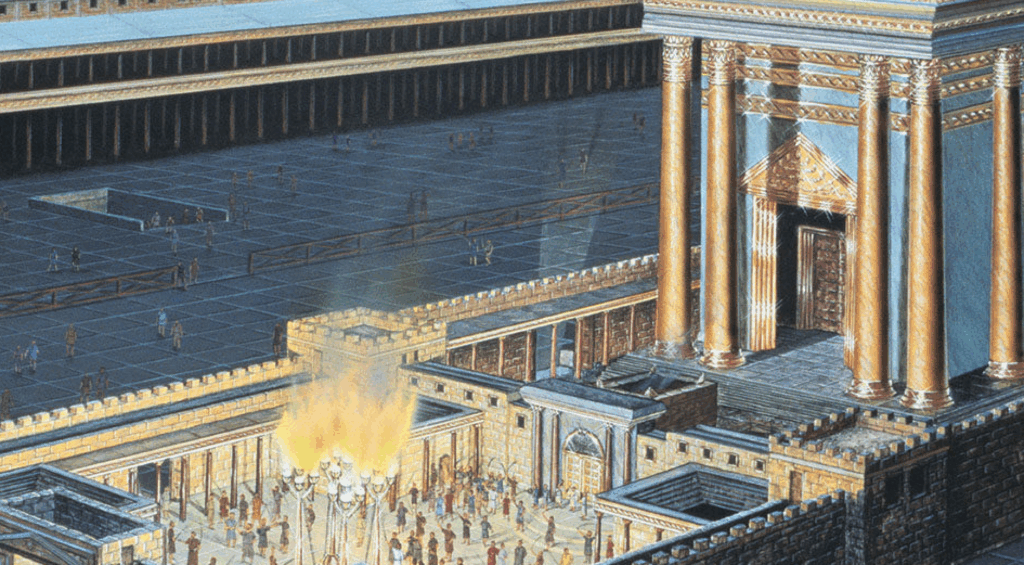
Imagery of the threshing floor runs throughout the biblical story. At the threshing floor, grain was crushed beneath oxen while the chaff was separated and blown away so the seed could be gathered and stored. Most significantly, the Temple itself stood on the threshing floor of Araunah purchased by King David. David was not merely acquiring agricultural land. The threshing floor would become the site of Jerusalem’s Temple on Mt Moriah —where the Presence of God dwelt among His people.

From Sinai to the Threshing Floor

Threshing floor imagery also becomes important in the book of Ruth, which according to Jewish tradition is read at Shavuot. The story unfolds during the barley and wheat harvests, and eating dominates the narrative because food represented survival, inheritance, blessing, and life itself.

In the ancient Near East, threshing floors were not only agricultural sites; they were elevated places associated with judgment, covenant, and sacred encounter. Ruth’s nighttime meeting with Boaz at the threshing floor carries strong royal and covenantal overtones. Boaz acts as kinsman-redeemer. Ruth approaches him seeking covering and protection, and Boaz spreads his garment—or “wing”—over her, echoing covenant and marriage imagery associated with Yahweh sheltering Israel beneath His wings. The scene points beyond romance toward redemption and the renewal of covenant life.

Genealogy also plays a central role in Ruth and later in Matthew 1. Ruth becomes the great-grandmother of King David. Through a Moabite woman gleaning grain in Bethlehem, the royal line emerges. Matthew intentionally highlights this connection by including five women in the genealogy of Yeshua: Tamar, Rahab, Ruth, Bathsheba, and Mary. Ruth stands at the center as the third woman in the sequence, a placement that may carry significance.

On the third day of creation, dry land emerges from the “waters” and the earth begins producing vegetation and fruit-bearing trees. The third day becomes associated with food, fertility, and abundance.

Genesis 1:11 uses the Hebrew term deshe—fresh green growth, tender vegetation, the first emergence of life from the earth. Over time this imagery becomes associated with flourishing, kingship, and ordered life. A related word, tzemach (“Branch”), later becomes associated with the royal Davidic line.

Scholars such as Othmar Keel suggest that ancient royal ideology frequently portrayed kings as guarantors of fertility and agricultural production. Flourishing gardens, sacred trees, rivers, and abundance symbolized righteous rule. Psalm 72 describes mountains yielding prosperity, grain flourishing upon the earth, peace spreading outward, and abundance flowing from righteous kingship. The king becomes a restorer of the Edenic order.

Psalm 23 reflects similar imagery. “He makes me lie down in green pastures.” Again, the Hebrew word deshe evokes fresh green growth associated with divine provision. Green pastures were often symbolical of the Temple itself—places where ordered life flows outward from the Presence of God.

Ruth fits naturally within this framework. Her story revolves around gleaning, grain, and provision. Her story takes place in Bethlehem (House of Bread).Boaz is a righteous landowner whose fields become a place of protection and even flourishing.

Bread, Fullness, and the Table of the Redeemer

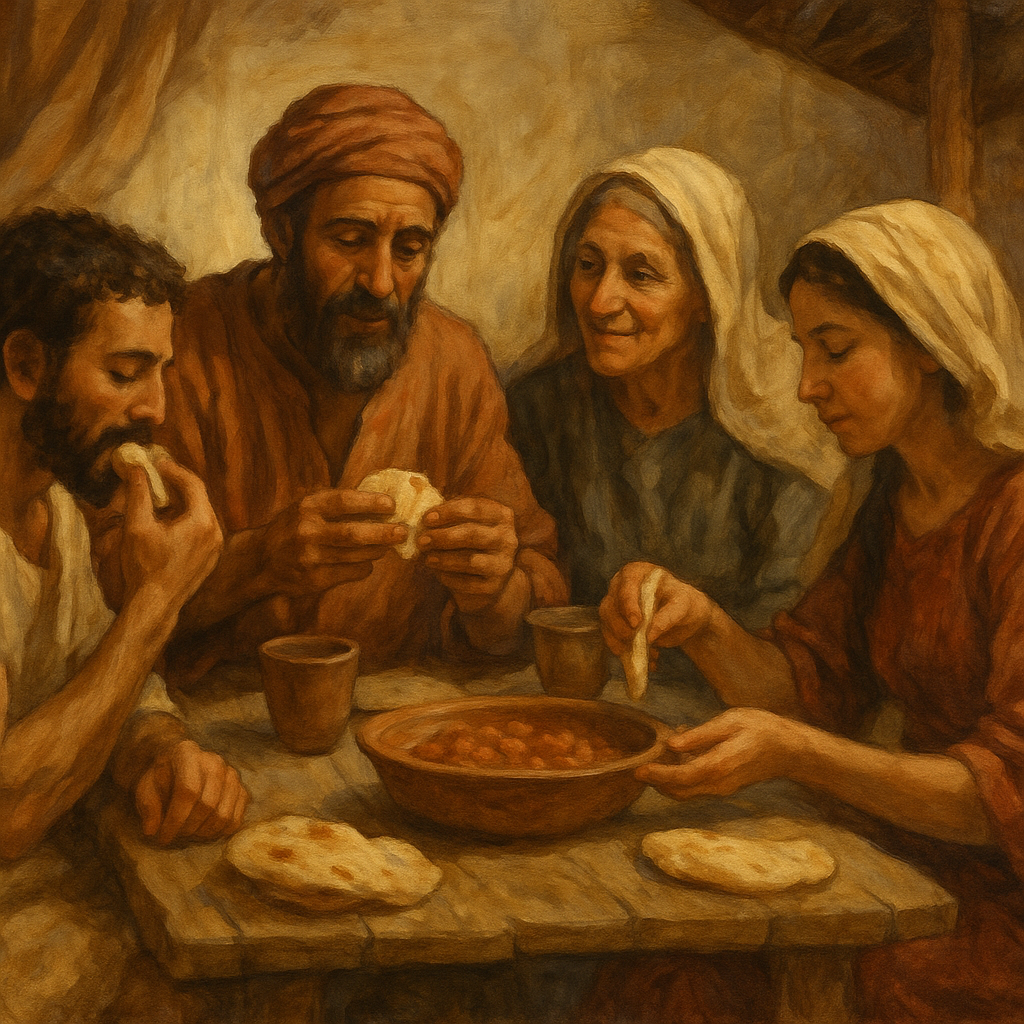
At mealtime Boaz tells Ruth, “Come here and eat some bread and dip your piece into the vinegar.” Then the text states: “She ate and was filled and had leftovers” (Ruth 2:14).

On one level, the scene reflects hospitality. Ruth the foreigner is welcomed to the table of the redeemer. Dipping also appears repeatedly within covenant meal traditions. At Passover, bitter herbs were dipped as part of the covenant meal. In the Gospels, Yeshua identifies the betrayer through the dipping of the “sop” into the dish. Shared dipping signifies fellowship and covenant participation.

The language also reaches backward toward Exodus and forward toward the Gospels. “She ate and was filled and had leftovers” echoes the manna narrative in Exodus 16 and anticipates the feeding miracles in Matthew where the crowds “ate and were full,” with baskets full leftover.

In the wilderness, manna descended daily as Israel learned dependence upon God. Each day enough was provided for survival. Yet on the sixth day a double portion remained for the seventh-day. Normally manna spoiled overnight, but the leftovers for Shabbat remained fresh. The leftovers symbolized fullness and divine provision. God provided more than enough.

Inside the Holy Place of both the Tabernacle and the Temple, opposite the lampstand, rested the Bread of the Presence upon a golden table. Twelve loaves were continually arranged before Yahweh as a perpetual covenant offering. Each loaf contained two omers—a double portion—again echoing Sabbath provision.

The bread was renewed continually. Fresh loaves replaced old ones each Sabbath while the priests ate before Yahweh within sacred space. The bread symbolized divine wisdom, continual provision, and God’s sustaining Presence. Bread and wine placed together upon the table reflected abundance ordered life flowing outward from God’s Presence.

The Bread of the Kingdom Spreads Outward

This imagery becomes crucial in Matthew’s feeding miracles.

Matthew intentionally places these events upon mountains in wilderness settings. Yeshua takes five loaves and feeds the multitudes reclining upon the green grass. The people recline as at a covenant meal. The five loaves likely echo the five loaves of the Bread of the Presence associated with the High Priest. Jewish tradition held that of the twelve loaves placed in the Holy Place, five belonged to the High Priest and seven to the priests serving that week.

Yeshua takes the bread, blesses it, breaks it, and gives it to the disciples who distribute it to the people. Everyone eats. Everyone is filled. Twelve baskets are leftover.

The language deliberately echoes Ruth, manna, and Sabbath fullness. Matthew presents Yeshua as the righteous shepherd-king upon the mountain providing the continual bread of the covenant. Divine sustenance now flows outward through the Messiah to the gathered people.

Mark and Luke note that the crowds sat in groups of hundreds and fifties, echoing Israel’s organization under Moses in Exodus 18. Wilderness, mountain, bread, covenant order, and divine provision converge together. Just as the twelve loaves testified continually to the twelve tribes before Yahweh, the twelve baskets of leftovers testify that there is more than enough bread within the kingdom being established.

The pattern repeats in Gentile territory with the feeding of the four thousand. This time seven loaves are multiplied and seven baskets are leftover. Seven signifies fullness, while four evokes the four corners of the earth. The symbolism points outward toward the nations.

Here the connection to Ruth becomes especially compelling. Ruth herself was a Gentile outsider welcomed to the covenant table. She ate and was filled and had leftovers. Jewish tradition later reflected on Ruth’s meal by saying: “She ate in this world, was filled in the days of Messiah, and had leftovers in the world to come.”

The feeding of the four thousand extends that same vision outward. The Bread of Heaven is no longer restricted to Israel alone.

The feedings in Matthew reveal Jesus was not just a miracle worker, but a priestly king distributing the continual bread of God’s Presence to a new covenant assembly. What was once within the Holy Place now moves outward into the world—the continual bread for everyone.

The biblical pattern stretches—from manna in the wilderness, to the Continual Bread in the Holy Place, to the loaves waved before Yahweh at Shavuot, to the grain fields of Boaz, to the mountain feedings in Matthew, and finally to Pentecost/Shavuot itself.

The story moves toward one great reality: God restoring life to a world marked by famine, exile, emptiness, and chaos. Bread multiplies. The outsider is welcomed. The barren become fruitful. Abundant life flows outward.

We are therefore invited to participate in the life of the Kingdom here and now. Shavuot celebrates fullness, harvest, bread, and covenant renewal before God. That pattern reaches its fulfillment in Jesus, who identifies Himself as the Bread of Life. To take and eat from Him is to partake of the ordered life of the Kingdom itself.

Like Ruth, we come empty, yet we are invited to the table of our Redeemer where there is more than enough. We eat, we are filled, and there are still leftovers. The provision of the Bread of Heaven does not diminish as it is shared. It multiplies. And those who partake of that Bread are called to carry His abundance and provision outward into the world.
shavuot
carpenter

From the Son of a Carpenter to Master Builder of New Creation

The Son of a Carpenter— and the Son of the Master Craftsman

We read that Yeshua was a carpenter, the son of a carpenter, and we move on. The Greek word tekton refers to a builder, a craftsman, a construction artisan someone trained to shape raw materials into a structure. His father, Joseph was such a man. But in the larger biblical narrative, Jesus is not only the son of Joseph the craftsman. He is the Son of the Master Craftsman, Yahweh.

Genesis presents God as the One who orders, separates, shapes, and forms creation. The world does not emerge chaotically but through structured building. Six days of intentional work, melachah, culminate in Sabbath rest. The Hebrew Scriptures use the same term to describe skilled construction — purposeful labor that produces structure. Creation itself is the first great act of divine melachah.

Spirit-Filled Craftsmanship in Exodus

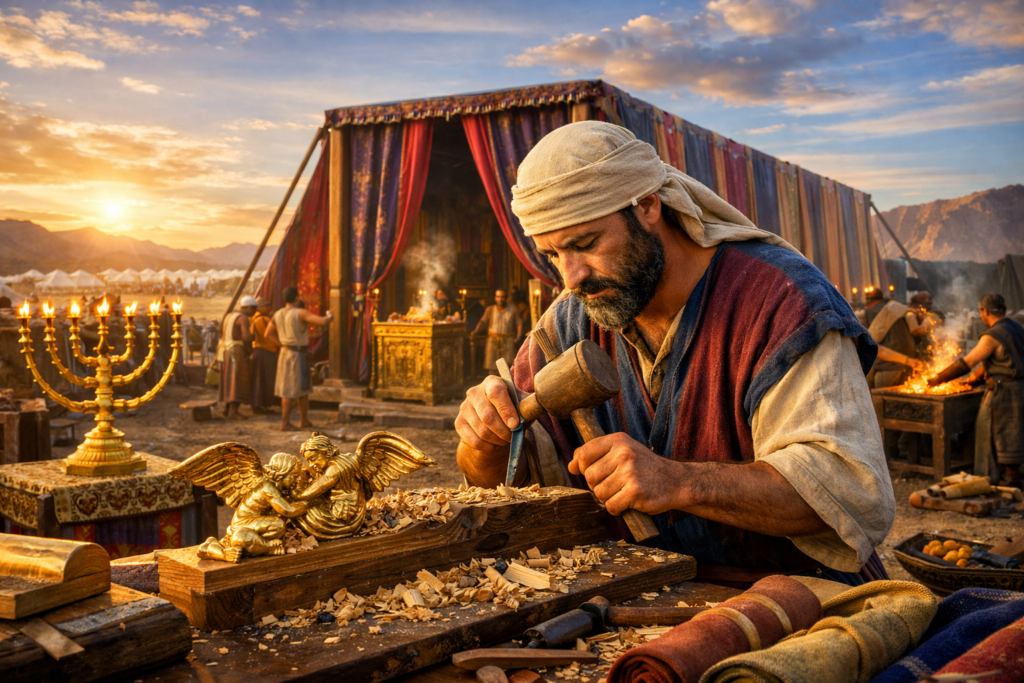
When Exodus introduces Bezalel and Oholiav, the language deliberately echoes Genesis. Bezalel, whose name means “in the shadow (or image) of El,” and Oholiav, “father’s tent,” are filled with the Spirit of God with wisdom (chokmah), understanding (tevunah), and knowledge (da’at) to perform melachah and build the Tabernacle. This is Spirit-empowered craftsmanship. They are master carpenters entrusted with a dwelling place where heaven and earth meet once again.

The placement of the Sabbath command in Exodus 35–40 reinforces the creation pattern. In both Genesis and Exodus, six days of construction precede rest. Completion precedes Yahweh’s indwelling glory.

The parshah Pekudei concludes the book of Exodus. Pekudei means “accounts” or “oversight” and refers to the administrative reckoning of the Tabernacle. The materials are numbered, inspected, and reviewed. The Hebrew root pāqad carries covenantal weight: to visit, to oversee, to reckon. The same word also describes God “visiting” Sarah to bring life and “visiting” Israel to bring deliverance. Divine visitation advances covenant purpose.

Yeshua the Tekton and the True Temple

In the New Testament, Yeshua is called a tekton — a builder, a craftsman, the son of a builder,  and the Son of God, the One who ordered creation itself. Within the broader temple framework this identification is significant. Jesus presents Himself as the true Temple, the locus of divine presence. The Father is the Architect of creation, and the Son embodies that dwelling place.

Greater Works Than This…

Yet the story does not end with Messiah alone. In John 14:12, Jesus, the carpenter states, “He who believes in Me, the works that I do he will do also; and greater works than these he will do, because I go to My Father.” The Greek word for works, ergon, corresponds conceptually to the Hebrew idea of melachah — work accomplished, work that produces structure and result, work that includes worship and sacred action. Yeshua, as carpenter is speaking of the continuing work of New Creation. The ordering, restoring, building work continues.

Paul reinforces this in Ephesians 2:10: “For we are His workmanship, created in Christ Jesus for good works, which God prepared beforehand that we should walk in them.” We are His workmanship, crafted, intentionally formed in order to participate in His crafting work. The language recalls Genesis and Exodus. We were created to create.

Shavuot and the Expansion of Sacred Construction

The Spirit who hovered over the waters in Genesis, who filled Bezalel and Oholiav with wisdom, understanding, and knowledge, and who descended upon Messiah, is poured out at Shavuot upon a gathered people. In the Torah portion V’yakhel, Moses gathers the congregation and declares that work is to be done for six days and rest observed on the seventh. Sacred construction is communal. The skill set for building sacred space does not disappear; it expands.

Wisdom, understanding, and knowledge are the tools of the trade. They are the equipment necessary for sacred craftsmanship. Bezalel worked according to divine pattern. He measured, designed, calculated, and executed with skill. Scripture makes clear that he was Spirit-filled — but he was also disciplined and trained. Gifting requires development. Sacred craftsmanship demands apprenticeship.

Builders of the Greater Tabernacle

We often assume that such building belongs to a spiritual elite — leaders, clergy, scholars. Yet the Tabernacle was constructed in the midst of a gathered congregation. Sacred construction is communal. In the garden, humanity cultivated soil and tended life. In Messiah, that vocation expands. We cultivate communities, restore fractured relationships, construct ordered families, and build just systems. We are builders of the greater Tabernacle — the universal body of Messiah.

This body is structured and ordered. It requires wisdom, understanding, and knowledge. Yeshua’s promise of “greater works” signals expansion because He goes to the Father and the Spirit is poured out universally. The Temple becomes global.

The Ongoing Movement of the Greatest Exodus

Our faith is not passive belief or private spirituality. It is participation in divine melachah. The Father builds. The Son completes. The Spirit equips. The people construct. This is the biblical pattern from Genesis to Exodus to Messiah: God restores His dwelling place by restoring His image in humanity, and that restoration involves skilled, intentional work.

Sabbath marks order. Creation rested because it was complete. The Tabernacle rested because it was finished. Messiah rested in the tomb because His work was fulfilled. Now the work continues through a Spirit-filled people.

The question is not whether renewal is happening. Scripture affirms that it is. The question is whether we recognize ourselves as apprentices in the workshop of the Master Craftsman.

We were created to create. We were formed to build. The tools given to Bezalel and Oholiav — wisdom, understanding, and knowledge remain the equipment of the covenant community. The greater Tabernacle is being assembled. The task before us is faithful construction according to the pattern already given.

This is the ongoing movement of The Greatest Exodus, the rebuilding of humanity into a dwelling place for the presence of God.

carpenter
creation tabernacle

Creation, Tabernacle, and Messiah: The Pattern of Work (Melachah) and Sabbath Fulfilled

From the opening lines of Genesis, Scripture presents God as a craftsman at work. He speaks, separates, shapes, and orders. The Spirit of God hovers over the waters as divine energy poised to create. The refrain repeats: “And God saw that it was good.” The work is good because it is ordered. The work, melachah, the labor of building, moves steadily toward completion. Building creation and tabernacle.

Then comes the seventh day. “Thus the heavens and the earth were finished… and He rested” (Gen. 2:1–2). Creation is an ordered working construction model. The cosmos has become sacred space, and the Sabbath is the sign that the work is complete. Rest is not inactivity. Rest is enthronement. Rest is God’s dwelling place. And he fills it with Himself and his human image bearer artisans who will be responsible to maintain the upkeep of their part of the cosmos – the earth.

Exodus 31: Melachah and the Pattern Repeated

When we turn to Exodus 31, the language is strikingly familiar. Bezalel is “filled with the Spirit of God, with wisdom, understanding, and knowledge” (Ex. 31:3). The same triad used to describe divine creative activity now describes a human artisan serving in a priestly capacity. He is commissioned to perform melachah, skilled work, constructing the tabernacle and its furnishings.

Immediately following this commission comes the command concerning Sabbath (Ex. 31:12–17). The pattern is unmistakable: sacred work followed by sacred rest.

In the narrative, another craftsman tradition stands in the background. The god Ptah was revered as a creator-deity and master artisan in Egypt. He fashioned the world through wisdom and speech, and his earthly manifestation was the Apis bull — a living symbol of strength, fertility, and divine presence. The Pharaoh of Moses’ generation would have known this cult well. It is therefore difficult to ignore the proximity between Israel’s construction of a golden calf and the Egyptian bull imagery that had shaped their former world. Several scholars have noted that the calf of Exodus 32 almost certainly reflects Egyptian iconography, likely drawing upon the Apis tradition. Israel does not invent a new symbol at Sinai; they revert to one they knew.

The juxtaposition is striking. In Exodus 31, Bezalel is filled with the Spirit of God, endowed with wisdom, understanding, and knowledge to construct sacred space according to a heavenly pattern. In Exodus 32, those same human capacities are redirected toward crafting an image — an attempt to localize divine presence through familiar form. One act of craftsmanship prepares a dwelling for the invisible God; the other reduces divine glory to visible representation. Sacred melachah can either order space for God’s indwelling or distort worship through imitation—what we would call idolatry. The question at Sinai is not whether Israel will build, but what kind of dwelling their work will produce.

It Is Finished: Creation, Tabernacle, and the Work of the Craftsman

Scholars such as Naftali Cohn observe that the tabernacle instructions are arranged in a seven-fold structure mirroring Genesis 1, culminating in the Sabbath command. He notes that the narrative of building the tabernacle “echoes the creation story in Genesis 1–2:4a,” suggesting that the tabernacle is portrayed as a new creation—a microcosm of ordered sacred space. The language of completion reinforces this connection. In Genesis, God “finished” (kalah) His work and rested. In Exodus 39–40, Moses inspects the work, sees that it is done, and the work is “finished.” The verbal parallels are deliberate and theological.

G. K. Beale goes further. In The Temple and the Church’s Mission, he argues that the tabernacle represents a symbolic cosmos. Eden was the first sanctuary; the tabernacle replicates that reality in portable form. The sacred structure embodies the ordered world in miniature. As Beale writes, “The tabernacle and temple were microcosmic models of the universe… symbolizing that God’s dwelling place was intended to encompass the whole creation.” If creation culminates in divine rest, then the tabernacle culminates in divine indwelling.

Exodus 31 places Sabbath immediately after the artisan’s commission for a reason. Sacred construction does not eclipse sacred rest. The work of building God’s dwelling culminates in Shabbat. The Sabbath is called a “sign” between God and Israel—a reminder that creation and covenant share the same rhythm. Work that orders space for divine presence is followed by rest that acknowledges completion. Melachah leads to kalah. Completion leads to filling. And filling requires the ongoing maintenance of sacred space through ritual re-enactment—what Scripture calls worship.

This pattern does not end in the wilderness at Sinai.

The Word Tabernacled Among Us

John’s Gospel opens with unmistakable Genesis language: “In the beginning.” But John 1:14 intensifies the pattern: “The Word became flesh and tabernacled among us.” The Greek verb eskēnōsen deliberately evokes tabernacle imagery. The dwelling of God in the wilderness now takes on human flesh. Jesus does not merely visit sacred space; He embodies it.

If the tabernacle was a microcosm, Jesus is the living temple. Beale states plainly, “Jesus is the true temple… the locus of God’s dwelling presence.” In Him, heaven and earth meet again. The creative Word through whom all things were made now stands within creation as the true sanctuary.

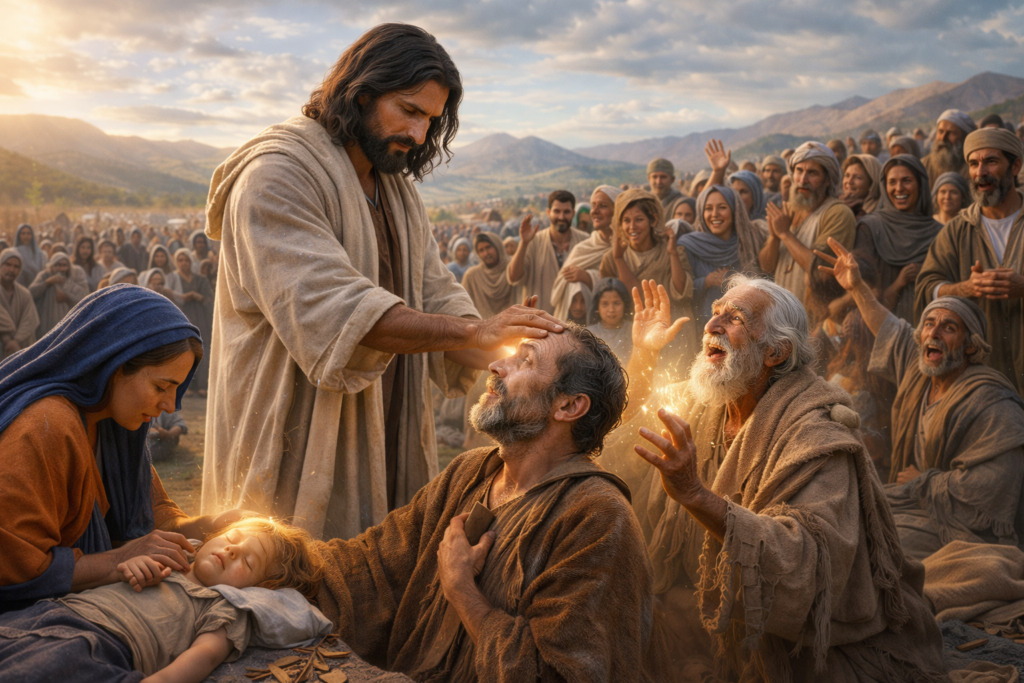
Notice the language of work in John’s Gospel. Yeshua repeatedly speaks of the “works” the Father has given Him to accomplish (John 5:36; 17:4). Though the Greek term differs from Hebrew melachah, the echo is unmistakable. The Son carries out the Father’s work of restoring and reordering creation. His miracles are acts of construction—rebuilding human beings into sacred space for the indwelling of the Holy Spirit. Sight is restored. Flesh is healed. Chaos is rebuked. Bread multiplies in the wilderness. The waters obey. Each sign reveals the Craftsman at work, shaping lives into places fit for divine presence and worship.

Bezalel was filled with the Spirit to construct sacred space. Jesus is anointed by the Spirit at His baptism and begins His ministry of holy work. Wisdom, understanding, and knowledge characterize the Spirit’s activity in Exodus 31. In the Gospels, the crowds marvel at Jesus’ wisdom, and the Spirit descends upon Him. The pattern continues—but now at a cosmic scale.

In Genesis, God finishes His work and rests. In Exodus, the tabernacle work is completed and the glory fills the tent. In John 19:30, Jesus declares, “It is finished.” The Greek tetelestai carries the weight of completion. The work entrusted to Him has reached its appointed end. The mortal body—the true tabernacle—is offered. The veil will soon be torn, opened for access.

If Sabbath in Genesis signified completion, and Sabbath in Exodus marked covenant fulfillment, then the death and resurrection of Jesus announce the completion of the greater pattern. Hebrews 4 speaks of a “rest that remains” for the people of God, tying that rest back to creation and forward to Christ. The new creation emerges from resurrection morning. The Craftsman has finished His work.

The Work of the Living Tabernacle is Finished

The pattern of work and rest does not end with crucifixion; it culminates in resurrection and ascension—divine enthronement once more. The rest of God becomes the rest of Messiah. The tabernacle of flesh gives way to the indwelling Spirit. The Gospels present Jesus as the living tabernacle who performs the Father’s work and declares its completion. Creation, tabernacle, and Messiah form a single theological arc.

Work, melachah, is the building of sacred space so that God may dwell. Rest—Shabbat is the sign that what was intended has been brought to fulfillment.

And when He says, “It is finished,” we are hearing the Craftsman announce that the true dwelling place of God among humanity has been established. The greater Bezalel has finished His work. God’s glory will fill the house.

creation tabernacle
pattern

Study Bible Tools: Pattern recognition in Creation

When people study the Bible, they often have trouble seeing the Scriptures as a unifed whole. One of the most important tools is learning to recognize patterns. Biblical pattern recognition means noticing recurring structures, themes, symbols, cycles, and repeated narratives that appear again and again. Instead of treating passages as isolated texts, we need to see how everything connects. Names, numbers, geography, identities, rituals and architectural elements that repeat. These patterns form meaning. They are the Bible’s internal language.

This approach wasn’t invented by modern interpreters. Ancient Near Eastern literature was intentionally layered. Writers used repetition, inversion, mirroring, and numerical sequencing as normal methods for interpretation. Scripture is built this same way. Chiastic structures, creation-shaped story arcs, wordplays, key numbers, and recurring figures reappear as a part of the overall design. Scripture is not built on fragments of text.  The Bible is a coordinated story, woven across generations by the biblical writers.

Creation as the Master Pattern

The Bible’s first and most foundational pattern is creation. Creation is not simply the moment the world comes into existence; it is the structure into which the rest of the biblical story fits. Genesis 1–2 serves as the blueprint: God confronts chaos, brings order, forms sacred space, installs His image-bearers, blesses them, and then rests as King. That sequence, moving from disorder to ordered life, becomes the model for everything that follows.

Genesis opens with tohu va-vohu, formlessness and emptiness—the ancient symbol of instability. In the ANE world, the waters of the deep represented ungoverned, unbounded and untamed regions. The Spirit hovering over the darkness is the turning point. The quickening agent to creation. And God does not destroy the deep; He shapes it. His word speaks to disorder and elevates it into a structure that is fruitful and full of life. This is creation as the Bible defines it: God raising up that which is lacking, chaotic, and unformed into an ordered, inhabited sacred space by the power of His Spirit.

Once you know the pattern, you begin to see it everywhere. Israel trapped at the sea is lifted from danger as the waters divide. Sinai wrapped in cloud, fire, and trembling rock sees the once slave population in Egypt being re-formed into a nation. Ezekiel’s valley of bones, a picture of exile and death, becomes a living people when the prophet speaks breath to dry bones. And the resurrection, the final new creation, raises humanity from mortality into eternal life. Creation is God always forming, filling, and restoring.

Creation as Elevation

The biblical story never treats chaos, collapse, or dysfunction as a permanent state. God repeatedly descends into the broken places in order to lift up His people. Redemption scenes are simply creation scenes being replayed with judgment, rescue, and covenant renewal.

Israel’s history continually illustrates the pattern. The Bible, then, is not a stack of disconnected stories. It is architectural in nature — like a temple with every stone set with intention. Creation is the design that holds it all together.

Creation Patterns Throughout Scripture

The biblical writers deliberately echo Genesis throughout the entire Bible to show continuity. For example, the Exodus story mirrors creation as waters are subdued and a people are formed. The Tabernacle is constructed as Eden-like in miniature. Psalms use creation language to describe divine kingship over the nations. The Gospels announce new creation in Yeshua using the imagery of the garden, breath, and Spirit.

Seeing the creation pattern can help modern readers see the big picture. There’s a single narrative. God elevates, forms, fills, blesses, governs, and rests. That same rhythm underlies the flood, Abraham’s covenant, Israel’s deliverance, the establishment of David’s throne, the incarnation, the cross, and the resurrection. Creation in “pattern recognition” helps us to see God’s elevating work every time He acts.

Ezekiel 37 — A Creation Replay

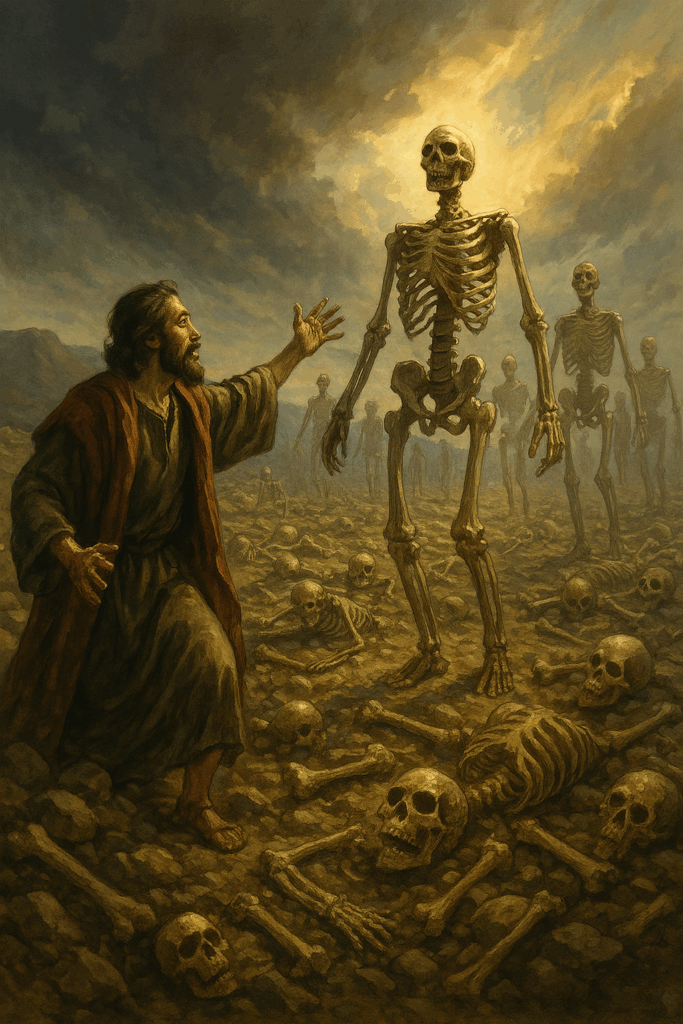
Ezekiel’s vision of the valley of dry bones is perhaps one of the clearest examples. The scene represents creation in reverse. Israel is in exile. They’ve lost their identity. There’s no central temple, no kingdom, and nothing left to build from. Israel sees itself as “cut off,” like a felled tree that can no longer bear fruit. In ancient symbolism, trees represented kingdoms, so Israel is a kingdom of dead trees.

God asks the key question: “Can these bones live?” From a human perspective, the answer is no. But chaos is always where God begins to work. He instructs Ezekiel to speak, to bring divine breath into the void. Genesis is being deliberately echoed — breath entering dry bones. Bones are reconnected, structure returns and the nation will rise again. Israel is not merely revived; she is re-created.

Ezekiel 37 is a replay of Genesis. From chaos and disorder to the hovering of the Spirit, and a people restored to life for a sacred purpose. It also anticipates the Gospel, where resurrection becomes the final elevation: humanity lifted from death, crowned with glory, and restored to God’s design.

pattern
temple pattern

Creation Temple Pattern in the Bible

Here we are again at Beresheet, “in the beginning.” A story that starts not with chaos but with a pattern. The first seven words of Scripture form a covenant preamble, an oath that sets the stage for everything that follows. What follows is the seven days of creation, a temple in the bible, of forming and filling, of separating and joining, until the whole cosmos becomes one unified day: the Sabbath, the seventh, the day of divine rest. This is picture of the temple pattern in the bible.

From the start, God was building a house—a cosmic temple, a temple pattern, for His presence to dwell and the number seven was its blueprint. Throughout the Bible, “seven” isn’t just symbolic of completeness or perfection, it really signals a finished cosmos, a world brought into order where God can rest.

Seven Day Temple Pattern in the bible

The ancient world knew this temple pattern well. Across the Near East, gods built temples in seven days or dedicated them through seven-day festivals. When Baʿal defeated the sea/yamm or chaos, his temple was constructed in seven days, and His throne called “his resting place.” The Bible, however, re-interprets the number seven as a Yahweh centered reality.

Scripture carries the imagery everywhere: seven lamps on the menorah, seven weeks to Shavuot, seven seals and trumpets, patterns of seven throughout the festival cycle, sevenfold patterns in the tabernacle speeches and Exodus texts. Each “seven” marking a transition from work to rest, from building to indwelling, from chaos to creation. Genesis 1–2 is itself a cosmic temple story where God builds, then rests, and enthroned.

So, what does this mean for us? It means this is the year for building up, not tearing down. You are part of God’s temple cycle. Every seventh day, every sacred festival, every rhythm of life is an invitation to order your world for His dwelling place. Build your home, build new habits, build relationships, build community around divine rest—so that the King of Glory may rest in your midst.

BUILD your world—and let God’s presence fill what you have built. Be your own temple pattern in the bible.

temple pattern

Skip to content