Tag: Creation

psalm

Rooted to Rule: The Pattern of Psalm 1

Psalm 1 does not necessarily begin with advice or spiritual reflection—it begins with a claim about reality itself. There is a way of life that produces order, stability, and flourishing, and it begins with a king who is rightly planted in the wisdom of God.

We are accustomed to reading Psalm 1 as a word about ourselves—guidance for personal growth, a description of the righteous life. But that is not where the book of Psalms begins. Psalm 1 lays down the architecture for the entire Psalter. Its message is the necessity of the right king on the throne. When the right king rules, the world is ordered. When the right king is rooted in the wisdom of God, his rule brings flourishing to his realm and to the inner world of those who come under his authority.

The psalm begins with the Hebrew word ashrei. It is generally translated “blessed” or “happy,” but neither quite captures the true meaning. It is a recognition of a state that is publicly visible and undeniable. It carries the sense of flourishing, alignment, and rightness that can be seen and acknowledged within a community. In an honor-shame culture, it is the language of status.

Oh the honor of the one…

This is public recognition of a life rightly ordered.

Psalm 1 is not merely describing a man who feels blessed. It is identifying the one who stands in the place of honor because he has aligned himself with the order of creation as defined by the Torah—the oracles of God, the wisdom that governs the world. The psalm should be read in tandem with Psalm 2. The first introduces the honored man; the second reveals him as the anointed king who stands in the midst of rebellious nations. These two chapters frame the book and establish the kingship that governs everything that follows.

The honored one is defined first by what he refuses. He does not walk in the counsel of the rasha, the wicked. He does not stand in their path. He does not sit in the seat of mockers. These are descriptions of competing systems of order. The rasha represents a world structured apart from God’s wisdom, a world untethered from the wisdom that sustains creation. To walk, stand, and sit in that world is to come under its influence, to be shaped by its assumptions, to align oneself with its vision of reality.

Instead, his delight—his chefetz, his deep longing—is in the Torah of Yahweh because it is the wisdom of God. He meditates on it day and night, not as ritual but as covenantal alignment. The king orders his inner world according to divine wisdom. In doing so, he becomes the site where ordered creation is reestablished.

He will be like a tree.

In the ancient world, kings were often depicted as trees—strong, stable, life-giving. The tree connects heaven and earth, drawing life from deep waters and extending its canopy outward in fruit and shade. The trunk represents stability and endurance, the central structure upon which everything else depends.

This tree is planted—more precisely, transplanted—by streams of water. The language evokes irrigation channels, carefully directed flows of life that sustain the tree in every season. This is Eden language. The rivers of the garden that watered the earth now appear here as the source of the king’s stability—divine wisdom itself. He is intentionally placed within the life system of creation, rooted in the very waters that once flowed from the garden and later from the temple.

His fruit comes in its season. His leaf does not wither.

The Hebrew concept of withering carries the sense of collapse into folly, the unraveling of ordered life. To wither is not merely to dry up; it is to fall into confusion and a lack of discernment. In contrast, the righteous king remains green, enduring, productive. His life is sustained because it is aligned with wisdom. His fruit nourishes others. His leaves, in the language echoed later in Ezekiel and Revelation, become instruments of healing for the nations.

This is kingship as it was meant to be. Not domination, but sustenance. Not instability, but enduring life that radiates outward.

The contrast with Genesis 3 deepens the imagery.

There, the woman sees that the tree is good (tov), pleasing to the eyes, and desirable to make one wise. The language is drawn directly from creation itself. But she evaluates the tree apart from God’s word. She sees, desires, takes, and eats. Wisdom is seized rather than received. What was meant to be given is snatched, and in that moment, God’s wisdom is replaced with human judgment. Eating the fruit of the tree becomes a realignment away from the source of life.

Psalm 1 reverses that movement.

The righteous king does not seize wisdom. He meditates. He does not take; he receives. He does not eat from the tree in rebellion; he becomes the tree through covenantal obedience. His roots go down into the living waters, and from those waters life flows. Psalm 1 produces order through rootedness.

Yahweh knows the way of the righteous.

This is covenantal language. It is relational. The way of the righteous king is upheld because it is perfectly in sync with God’s design. But the way of the rasha is not so. They are like chaff driven by the wind. They are not anchored in the waters of wisdom. They cannot sustain life. They do not endure. Their way perishes, dissolving back into chaos.

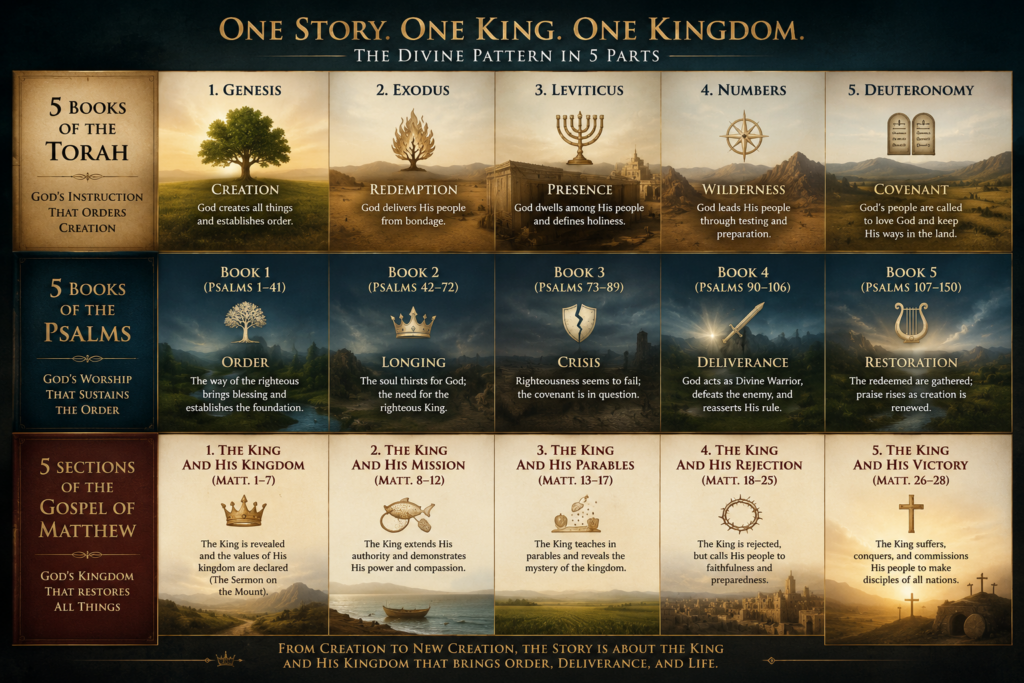
Psalm 1, then, is not an isolated meditation. It is the opening movement of a much larger composition. The book of Psalms is arranged in five books, mirroring the five books of the Torah. Just as the Torah provides the instruction that orders creation, the Psalms provide the liturgical response that sustains that order through worship.

The structure of the five sections of the Psalms traces a kingship narrative.

It unfolds as a movement from order to chaos and back to restoration. It begins with creation grounded in divine rule, where the king—like a tree planted by living waters—embodies the stability of Yahweh’s reign. But that order is contested. Pressure builds, distance from God’s presence is felt, and the need for righteous rule intensifies. The crisis comes when kingship appears to fail, the covenant fractures, and creation itself seems to unravel in exile and disorder.

The turning point is the reassertion of Yahweh’s kingship. He rises as the Divine Warrior (Psalm 104), subdues chaos, and establishes His rule once more. From there, the movement shifts toward restoration. The scattered are gathered, hope is renewed, and the Psalter closes in a rising chorus of praise as creation itself is drawn back into ordered worship under its rightful King.

This is the pattern of Scripture itself. Creation. Exile. Conflict. Divine intervention. Restoration. It is the pattern of Genesis. It is the pattern of the Exodus. And it is the pattern taken up again in the Gospel of Matthew, also structured in five major sections, presenting Jesus as the new Moses, the new Israel, the true King, the Messiah.

Matthew opens with the language of ashrei—the Beatitudes—rendered in Greek as makarios.

Oh the honor of the poor in spirit.
Oh the honor of the meek.
Oh the honor of those who mourn.

In the Roman world, honor belonged to power, wealth, and dominance. In Matthew, honor is reassigned to those whom the empire considers insignificant but publicly identified by God as part of His kingdom. The Beatitudes redefine kingship. They declare that true status belongs to those ordered according to God’s wisdom.

And this is where Psalm 1 finds its fulfillment. It anticipates a person.

The true Ashrei man.
Rooted in living waters.
Embodying wisdom.
The one whose life bears fruit in every season.
The one whose leaves bring healing to the nations.

Yeshua lives the pattern of Psalm 1. He is the tree planted by living waters. He is the wisdom of God made flesh. He is the king who stands unmoved by the counsel of the wicked, who refuses the kingdoms offered through compromise, who remains rooted in the will of the Father even unto death. And in His resurrection, the tree that could not wither, becomes the source of life for the world.

Psalm 1 is an invitation. Not first to self-improvement, but to recognize the sovereignty of the King.
psalm
temple

Where Chaos Ends, Presence Begins (in God’s Temple)

There is a pattern that runs like a deep current shaping Scripture from beginning to end. In the ancient world, a temple was never built in the absence of conflict. A temple always followed victory. A king subdued a threat, defeated an enemy, secured the land, and by doing so established order. Only then did he take his seat on the throne—his rest—within a house prepared for his presence. The story of the Bible is the story of a God who confronts an enemy, establishes order, and then dwells among His people.

From Chaos to Sacred Space

The opening chapter of Genesis begins with a world that is unformed, unpredictable, and untamed—waters that represent something unstructured and without boundary. The Spirit of God hovers like a mother bird over her nest, preparing a world waiting to be shaped into something that can sustain life. This hovering is a sign of divine intention—the quickening presence of God.

God speaks, and the world takes shape. Light is separated from darkness. Waters are gathered and restrained. Dry land appears, providing a fixed point for new life. Life begins to flourish within the boundaries that have been set. This is the first great act of victory—not through violence, but through sovereign authority. Chaos is brought under control and placed under the rule of God. What follows is sacred space for His divine presence—a garden established on a mountain, a place where heaven and earth meet.

Eden is the first temple where God’s presence dwells, where He walks, and where life flows outward. Within this space, humanity is placed as image bearers. Adam and Eve are installed within the garden temple as representatives of God’s rule, called to extend the order of this sacred space outward into the world.

The story of Noah returns to this pattern in a dramatic fashion. The world once again descends into disorder, where human corruption and violence mirror the chaos of untamed waters. Creation begins to unravel, and the waters return as instruments of judgment and cleansing. Yet even here, the story is one of preservation and renewal. Noah is instructed to build a house, a vessel that will carry life through the flood—a kind of floating temple carrying the presence of God through the chaos.

As the waters rise, the ark is lifted above them, echoing a new beginning. The world is once again covered in water, and once again there is a sign of life returning—a dove sent out over the waters. The dove signals that the waters are receding. The ark comes to rest on a mountain, the place of stability where heaven and earth meet. When Noah emerges, he builds an altar. The re-entry into the world is marked by worship and the recognition that life continues because God’s presence has carried it through judgment.

Victory Leads to Dwelling

With Abraham, the pattern becomes more personal. When he confronts the coalition of kings, he steps into a conflict that mirrors the larger struggle between order and disorder. After his victory, he does not choose the fertile plains. Instead, he moves toward the mountains, toward Hebron. There he dwells in tents, establishing a household that carries the presence forward. The structure may be temporary, but the pattern remains: after victory, a dwelling is established, and the presence of God is carried into the world.

This pattern comes into even greater clarity in the book of Exodus. Chaos is embodied in a system that oppresses, enslaves, and destroys life. Egypt becomes a representation of anti-creation. Yahweh enters as the Divine Warrior, confronting the powers that hold His people in bondage. The plagues dismantle that system, revealing that the gods of Egypt have no real power or authority.

The climax comes at the sea, the ultimate symbol of chaos. The waters are divided at the command of God, and Israel passes through on dry ground, echoing creation itself. The same waters collapse upon the Egyptian army, bringing a decisive end to their power.

The story, however, does not end at the sea. Israel is led into the wilderness and brought to the mountain, where covenant is established and order is defined. Instructions are given for the Tabernacle, a mobile temple reflecting the cosmos, the mountain, and the garden. The presence of God fills this space and becomes the center of Israel’s life. Once again, chaos is defeated, order is established, and a dwelling place for God is created.

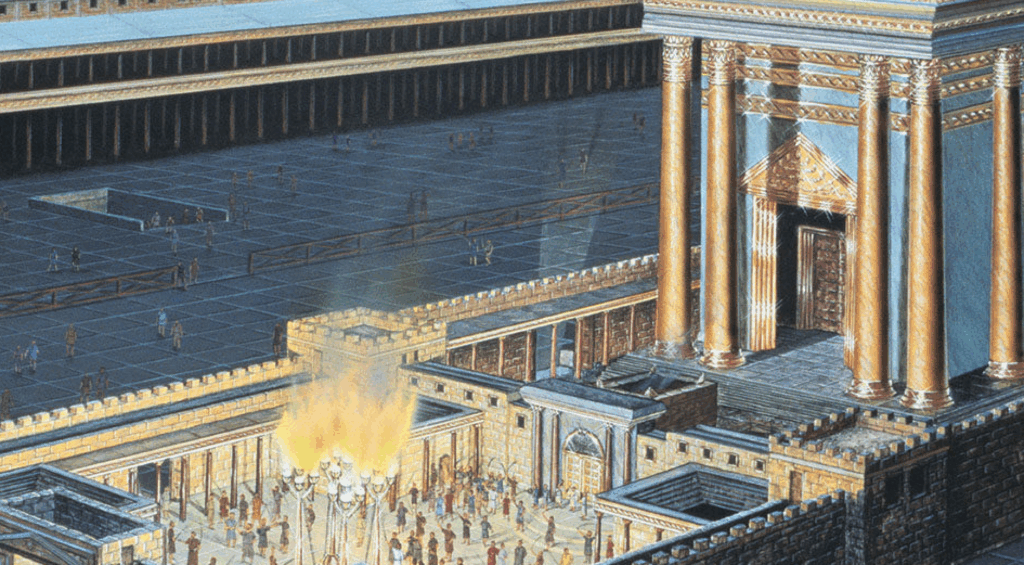
The story continues through the conquest and monarchy. Under Joshua, the people cross the Jordan into a new phase of life, with the Tabernacle ensuring the presence of God remains central. David defeats Israel’s enemies and secures Jerusalem. Solomon builds the temple on Mount Moriah—a permanent house for the presence of God. After victory, a house is built, and God dwells among His people.

The Temple Becomes a Person—and Then a People

In the Gospels, this pattern reaches its fullest expression in Jesus. He enters the waters, confronts the adversary in the wilderness, and demonstrates authority over the sea and the demonic realm that manifests in human brokenness. Each act confronts chaos. Each act sets captives free. His greatest victory comes through entering the realm of death itself. The cross becomes the battlefield, and the resurrection the victory over death that results in a new creation temple.

Yeshua embodies that temple. He becomes the place where heaven and earth meet. The temple is no longer confined to a stone building; it is present in a person, and through Him extends into His people.

Revelation brings the story to its conclusion. Chaos rises once more, depicted as beasts and empires, but is ultimately defeated. A city descends—a dwelling place that is also a mountain, a temple, and a garden. The entire city is filled with the presence of God. Heaven and earth are united, and the pattern reaches fulfillment.

If the pattern has always moved from victory to dwelling, where does that leave us now? We do not stand in Eden or gather at a temple in Jerusalem.

The dwelling place of God is now found within His people. The presence that once filled the garden, the ark, the Tabernacle, and the temple now resides within those who have been renewed. With the resurrection, humanity is being restored as the image-bearing temple of God. The Spirit that hovered over the waters now dwells within, bringing life, order, and transformation.

Through regenerated humanity, that presence is carried into every place and every act of faithful living. We become a living temple, bearing the presence of God into a world that still struggles with chaos and very real evil.

The Temple in a World That Still Feels Broken

temple

When we look at the world, it does not feel like chaos has been defeated. Disorder, suffering, and death remain very real. It can appear as though evil is winning and God is absent. But Scripture never presents victory as instant completion. There is always a space between decisive victory and final restoration.

In the Gospels, Jesus defeats death, yet the world is not immediately transformed.

To say we are the temple is not to deny the darkness around us, but to recognize that God has chosen to dwell within humanity and move through it. Like the Tabernacle in the wilderness, the presence now travels into places still marked by chaos.

To those looking toward a future temple in Jerusalem, we are still called not to stand idle, but to live now as the dwelling place of God—carrying His presence into the world even as we watch for what is yet to come.

We carry the presence not because the world is finished, but because God is still restoring it—through us.

creation tabernacle

Creation, Tabernacle, and Messiah: The Pattern of Work (Melachah) and Sabbath Fulfilled

From the opening lines of Genesis, Scripture presents God as a craftsman at work. He speaks, separates, shapes, and orders. The Spirit of God hovers over the waters as divine energy poised to create. The refrain repeats: “And God saw that it was good.” The work is good because it is ordered. The work, melachah, the labor of building, moves steadily toward completion. Building creation and tabernacle.

Then comes the seventh day. “Thus the heavens and the earth were finished… and He rested” (Gen. 2:1–2). Creation is an ordered working construction model. The cosmos has become sacred space, and the Sabbath is the sign that the work is complete. Rest is not inactivity. Rest is enthronement. Rest is God’s dwelling place. And he fills it with Himself and his human image bearer artisans who will be responsible to maintain the upkeep of their part of the cosmos – the earth.

Exodus 31: Melachah and the Pattern Repeated

When we turn to Exodus 31, the language is strikingly familiar. Bezalel is “filled with the Spirit of God, with wisdom, understanding, and knowledge” (Ex. 31:3). The same triad used to describe divine creative activity now describes a human artisan serving in a priestly capacity. He is commissioned to perform melachah, skilled work, constructing the tabernacle and its furnishings.

Immediately following this commission comes the command concerning Sabbath (Ex. 31:12–17). The pattern is unmistakable: sacred work followed by sacred rest.

In the narrative, another craftsman tradition stands in the background. The god Ptah was revered as a creator-deity and master artisan in Egypt. He fashioned the world through wisdom and speech, and his earthly manifestation was the Apis bull — a living symbol of strength, fertility, and divine presence. The Pharaoh of Moses’ generation would have known this cult well. It is therefore difficult to ignore the proximity between Israel’s construction of a golden calf and the Egyptian bull imagery that had shaped their former world. Several scholars have noted that the calf of Exodus 32 almost certainly reflects Egyptian iconography, likely drawing upon the Apis tradition. Israel does not invent a new symbol at Sinai; they revert to one they knew.

The juxtaposition is striking. In Exodus 31, Bezalel is filled with the Spirit of God, endowed with wisdom, understanding, and knowledge to construct sacred space according to a heavenly pattern. In Exodus 32, those same human capacities are redirected toward crafting an image — an attempt to localize divine presence through familiar form. One act of craftsmanship prepares a dwelling for the invisible God; the other reduces divine glory to visible representation. Sacred melachah can either order space for God’s indwelling or distort worship through imitation—what we would call idolatry. The question at Sinai is not whether Israel will build, but what kind of dwelling their work will produce.

It Is Finished: Creation, Tabernacle, and the Work of the Craftsman

Scholars such as Naftali Cohn observe that the tabernacle instructions are arranged in a seven-fold structure mirroring Genesis 1, culminating in the Sabbath command. He notes that the narrative of building the tabernacle “echoes the creation story in Genesis 1–2:4a,” suggesting that the tabernacle is portrayed as a new creation—a microcosm of ordered sacred space. The language of completion reinforces this connection. In Genesis, God “finished” (kalah) His work and rested. In Exodus 39–40, Moses inspects the work, sees that it is done, and the work is “finished.” The verbal parallels are deliberate and theological.

G. K. Beale goes further. In The Temple and the Church’s Mission, he argues that the tabernacle represents a symbolic cosmos. Eden was the first sanctuary; the tabernacle replicates that reality in portable form. The sacred structure embodies the ordered world in miniature. As Beale writes, “The tabernacle and temple were microcosmic models of the universe… symbolizing that God’s dwelling place was intended to encompass the whole creation.” If creation culminates in divine rest, then the tabernacle culminates in divine indwelling.

Exodus 31 places Sabbath immediately after the artisan’s commission for a reason. Sacred construction does not eclipse sacred rest. The work of building God’s dwelling culminates in Shabbat. The Sabbath is called a “sign” between God and Israel—a reminder that creation and covenant share the same rhythm. Work that orders space for divine presence is followed by rest that acknowledges completion. Melachah leads to kalah. Completion leads to filling. And filling requires the ongoing maintenance of sacred space through ritual re-enactment—what Scripture calls worship.

This pattern does not end in the wilderness at Sinai.

The Word Tabernacled Among Us

John’s Gospel opens with unmistakable Genesis language: “In the beginning.” But John 1:14 intensifies the pattern: “The Word became flesh and tabernacled among us.” The Greek verb eskēnōsen deliberately evokes tabernacle imagery. The dwelling of God in the wilderness now takes on human flesh. Jesus does not merely visit sacred space; He embodies it.

If the tabernacle was a microcosm, Jesus is the living temple. Beale states plainly, “Jesus is the true temple… the locus of God’s dwelling presence.” In Him, heaven and earth meet again. The creative Word through whom all things were made now stands within creation as the true sanctuary.

Notice the language of work in John’s Gospel. Yeshua repeatedly speaks of the “works” the Father has given Him to accomplish (John 5:36; 17:4). Though the Greek term differs from Hebrew melachah, the echo is unmistakable. The Son carries out the Father’s work of restoring and reordering creation. His miracles are acts of construction—rebuilding human beings into sacred space for the indwelling of the Holy Spirit. Sight is restored. Flesh is healed. Chaos is rebuked. Bread multiplies in the wilderness. The waters obey. Each sign reveals the Craftsman at work, shaping lives into places fit for divine presence and worship.

Bezalel was filled with the Spirit to construct sacred space. Jesus is anointed by the Spirit at His baptism and begins His ministry of holy work. Wisdom, understanding, and knowledge characterize the Spirit’s activity in Exodus 31. In the Gospels, the crowds marvel at Jesus’ wisdom, and the Spirit descends upon Him. The pattern continues—but now at a cosmic scale.

In Genesis, God finishes His work and rests. In Exodus, the tabernacle work is completed and the glory fills the tent. In John 19:30, Jesus declares, “It is finished.” The Greek tetelestai carries the weight of completion. The work entrusted to Him has reached its appointed end. The mortal body—the true tabernacle—is offered. The veil will soon be torn, opened for access.

If Sabbath in Genesis signified completion, and Sabbath in Exodus marked covenant fulfillment, then the death and resurrection of Jesus announce the completion of the greater pattern. Hebrews 4 speaks of a “rest that remains” for the people of God, tying that rest back to creation and forward to Christ. The new creation emerges from resurrection morning. The Craftsman has finished His work.

The Work of the Living Tabernacle is Finished

The pattern of work and rest does not end with crucifixion; it culminates in resurrection and ascension—divine enthronement once more. The rest of God becomes the rest of Messiah. The tabernacle of flesh gives way to the indwelling Spirit. The Gospels present Jesus as the living tabernacle who performs the Father’s work and declares its completion. Creation, tabernacle, and Messiah form a single theological arc.

Work, melachah, is the building of sacred space so that God may dwell. Rest—Shabbat is the sign that what was intended has been brought to fulfillment.

And when He says, “It is finished,” we are hearing the Craftsman announce that the true dwelling place of God among humanity has been established. The greater Bezalel has finished His work. God’s glory will fill the house.

creation tabernacle
Athena

Creation by Conflict: Athena, the Gods, the Giants, and the World They Made

One of the highlights of my trip to Athens was a visit to the Acropolis, literally the “high city” and to the Acropolis Museum—a must-see before visiting the Parthenon, the Erechtheion, and the remains of the old Temple of Athena. The museum provides essential context, allowing the visitor to understand how the Athenians envisioned order, power, and the divine.

Athena, the Acropolis, and the Architecture of Order

The Parthenon was dedicated primarily to Athena Parthenos, Athena the Virgin. It housed a massive gold-and-ivory statue of the goddess and emphasized civic order and protection, military readiness and victory, and imperial identity and power. The Erechtheion, by contrast, was dedicated to Athena Polias, Athena of the city. This was the older and more sacred cult, tied to the earliest history and identity of Athens.

According to tradition, the Erechtheion marked the site of the contest between Athena and Poseidon for patronage of the city. Poseidon struck the rock and produced salt water, a symbol of raw power and domination. Athena offered an olive tree. The Athenians judged her gift superior, and she became Athena Polias, guardian of the city. The olive tree mattered because it represented a different kind of order. It provided food, oil, light, medicine, wood, and long-term stability.

The Erechtheion was built around this sacred tree, preserving it within the architectural heart of the Acropolis. Even when the Persians destroyed Athens in 480 BCE, the olive tree was said to have resprouted immediately, reinforcing its symbolism that life cannot be extinguished.

Gigantomachy: When Creation Is Secured Through Violence

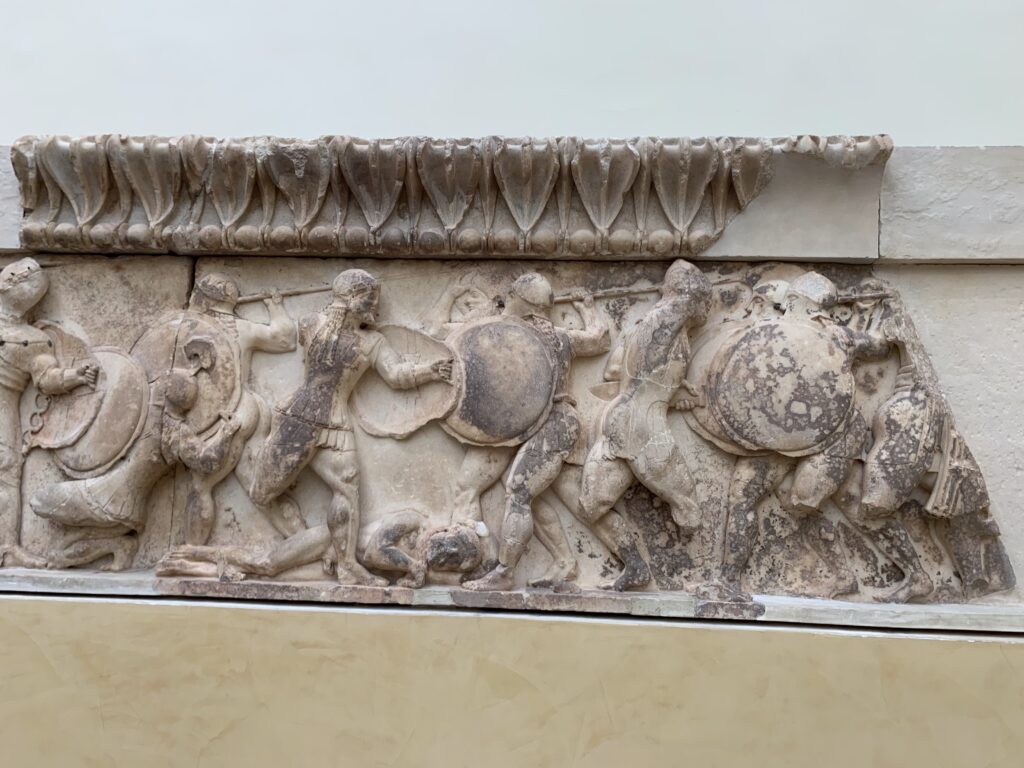
The museum also preserves the clearest visual expressions of how the ancient world understood creation, order, and power. Throughout its galleries, especially the Archaic Gallery and the Parthenon Gallery, Athena and the Olympian gods are repeatedly shown in violent conflict with the Giants. These scenes belong to a mythic cycle known as the Gigantomachy, a classic theme of divine struggle that shaped Greek religious imagination and civic identity.

The Gigantomachy depicts the battle between the Olympian gods and the Giants, a primordial race born from the earth itself. In Greek thought, the Giants were not merely large enemies; they embodied chaos, excess, and instability. They represented forces that threatened cosmic order and civic life. The defeat of the Giants was therefore necessary for the world to remain habitable.

Athena occupies a central role in these scenes. Marble reliefs in the Archaic Gallery, originating from the earlier Temple of Athena Polias, show Athena in the act of spearing a Giant. The east metopes (rectangular sculpted panels) of the Parthenon continue this theme in a more formalized and monumental style. Here, Athena appears in full battle gear alongside other gods, engaged in a long and violent struggle that culminates in the defeat of the Giants. One of the most striking examples is Athena’s combat with a Giant, one of the few clearly identifiable mythic combat scenes in which her warrior role is unmistakable.

These images communicated a worldview. In the ancient imagination, creation and stability emerged through violence. Order was born from conflict, and civilization endured only because the gods had crushed rival divine or semi-divine forces. The Gigantomachy captures this assumption with remarkable clarity. Chaos does not recede voluntarily; it must be subdued. The Giants are remnants of primordial disorder, and their destruction secures the cosmos.

Athena herself embodies a particular version of this logic. She is one of the most complex figures in Greek mythology, representing wisdom, strategic warfare, craft, and civic order. Unlike gods associated with uncontrolled violence, Athena represents measured power: intelligence applied to conflict, restraint guiding force. Her mythic birth reinforces this identity. According to Greek tradition, Athena is born fully armed from the head of Zeus, not from a womb. Order, in this account, emerges from divine intellect rather than generative process. She is Zeus’s ally, not his rival, and her authority reinforces the stability of the pantheon rather than threatening it.

As Athena Polias, guardian of Athens, she presides over law, political life, architecture, weaving, and education. The Parthenon stands as a civic and religious monument to her role as the one who secures the city’s order. When Athena battles Giants in temple sculpture, the message is clear: the city remains stable because chaos has been defeated. Divine violence underwrites civic peace.

This pattern reflects a widespread ancient assumption. Creation is not sustained through speech or covenant, but through the ongoing suppression of rival powers. Violence is not a tragic necessity; it is the engine of order. The world exists because someone stronger won.

God Speaks: The Bible’s Alternative Vision of Creation

Contrast this with the biblical worldview. Although the Bible speaks into this same symbolic world, it tells a strikingly different story. While it acknowledges chaos and opposition, often personified through sea monsters, hostile powers, and giants, it does not ground creation in divine warfare among equals. In Genesis, God does not fight other gods to create. He speaks. He separates. He orders. Light, land, and life emerge not from violence, imperial power, or bloodshed, but from divine command.

Even when biblical texts employ combat imagery, the emphasis differs sharply from the ancient mythic pattern. God’s authority is never in question. He will prevail. Chaos is real, but in the biblical story it is not ultimate. It does not rival God’s creative power; rather, it resists it.

This distinction becomes clear when considering giants in the biblical tradition. Like their ancient Near Eastern counterparts, biblical giants symbolize disorder, violence, and corruption. Yet they are never portrayed as cosmic equals to God. They threaten human faithfulness, not divine sovereignty. The struggle, then, is not between gods, but within human nature—between trust and fear, obedience and moral corruption.

The biblical battle is fundamentally moral rather than mythic. Where ancient myths portray creation as the outcome of divine rivalry, the Bible presents creation as sustained through wisdom and covenant fidelity. Violence does appear in certain biblical narratives, but it is never the foundation of order or divine will.

Seen in this light, the Gigantomachy panels in the Acropolis Museum provide a visual theology of the ancient world, a worldview in which stability depends on continual domination and creation emerges from conflict. Against this backdrop, the biblical creation account stands apart. It offers a vision of order grounded in the Word of God, moral restraint, and faithful governance. Scripture insists that the world endures because God speaks and what He speaks holds it together.

Athena
pattern

Study Bible Tools: Pattern recognition in Creation

When people study the Bible, they often have trouble seeing the Scriptures as a unifed whole. One of the most important tools is learning to recognize patterns. Biblical pattern recognition means noticing recurring structures, themes, symbols, cycles, and repeated narratives that appear again and again. Instead of treating passages as isolated texts, we need to see how everything connects. Names, numbers, geography, identities, rituals and architectural elements that repeat. These patterns form meaning. They are the Bible’s internal language.

This approach wasn’t invented by modern interpreters. Ancient Near Eastern literature was intentionally layered. Writers used repetition, inversion, mirroring, and numerical sequencing as normal methods for interpretation. Scripture is built this same way. Chiastic structures, creation-shaped story arcs, wordplays, key numbers, and recurring figures reappear as a part of the overall design. Scripture is not built on fragments of text.  The Bible is a coordinated story, woven across generations by the biblical writers.

Creation as the Master Pattern

The Bible’s first and most foundational pattern is creation. Creation is not simply the moment the world comes into existence; it is the structure into which the rest of the biblical story fits. Genesis 1–2 serves as the blueprint: God confronts chaos, brings order, forms sacred space, installs His image-bearers, blesses them, and then rests as King. That sequence, moving from disorder to ordered life, becomes the model for everything that follows.

Genesis opens with tohu va-vohu, formlessness and emptiness—the ancient symbol of instability. In the ANE world, the waters of the deep represented ungoverned, unbounded and untamed regions. The Spirit hovering over the darkness is the turning point. The quickening agent to creation. And God does not destroy the deep; He shapes it. His word speaks to disorder and elevates it into a structure that is fruitful and full of life. This is creation as the Bible defines it: God raising up that which is lacking, chaotic, and unformed into an ordered, inhabited sacred space by the power of His Spirit.

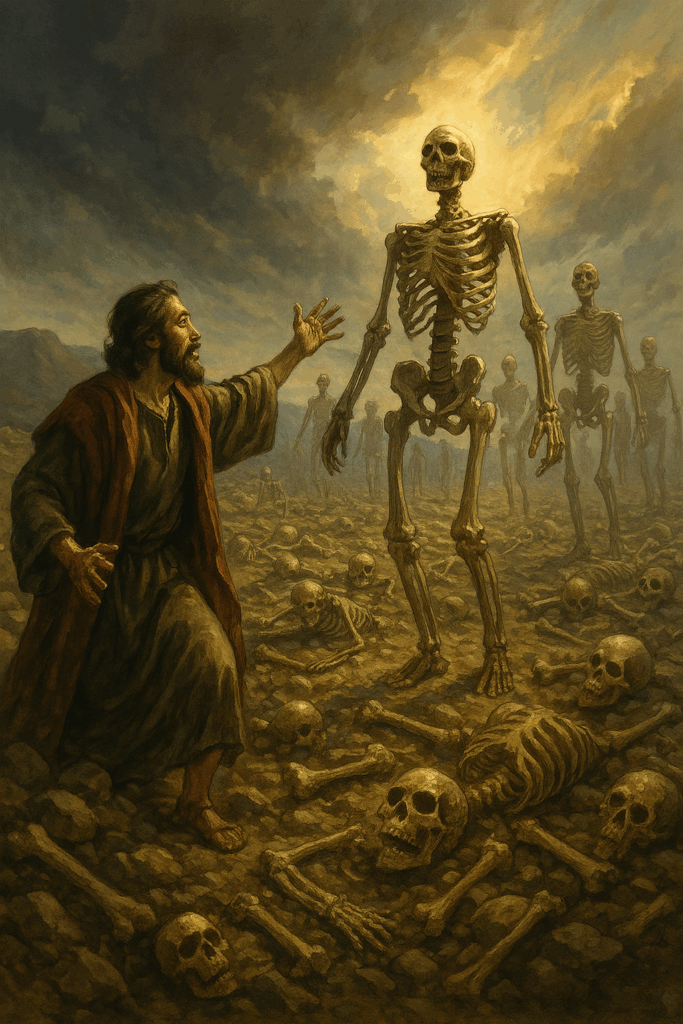
Once you know the pattern, you begin to see it everywhere. Israel trapped at the sea is lifted from danger as the waters divide. Sinai wrapped in cloud, fire, and trembling rock sees the once slave population in Egypt being re-formed into a nation. Ezekiel’s valley of bones, a picture of exile and death, becomes a living people when the prophet speaks breath to dry bones. And the resurrection, the final new creation, raises humanity from mortality into eternal life. Creation is God always forming, filling, and restoring.

Creation as Elevation

The biblical story never treats chaos, collapse, or dysfunction as a permanent state. God repeatedly descends into the broken places in order to lift up His people. Redemption scenes are simply creation scenes being replayed with judgment, rescue, and covenant renewal.

Israel’s history continually illustrates the pattern. The Bible, then, is not a stack of disconnected stories. It is architectural in nature — like a temple with every stone set with intention. Creation is the design that holds it all together.

Creation Patterns Throughout Scripture

The biblical writers deliberately echo Genesis throughout the entire Bible to show continuity. For example, the Exodus story mirrors creation as waters are subdued and a people are formed. The Tabernacle is constructed as Eden-like in miniature. Psalms use creation language to describe divine kingship over the nations. The Gospels announce new creation in Yeshua using the imagery of the garden, breath, and Spirit.

Seeing the creation pattern can help modern readers see the big picture. There’s a single narrative. God elevates, forms, fills, blesses, governs, and rests. That same rhythm underlies the flood, Abraham’s covenant, Israel’s deliverance, the establishment of David’s throne, the incarnation, the cross, and the resurrection. Creation in “pattern recognition” helps us to see God’s elevating work every time He acts.

Ezekiel 37 — A Creation Replay

Ezekiel’s vision of the valley of dry bones is perhaps one of the clearest examples. The scene represents creation in reverse. Israel is in exile. They’ve lost their identity. There’s no central temple, no kingdom, and nothing left to build from. Israel sees itself as “cut off,” like a felled tree that can no longer bear fruit. In ancient symbolism, trees represented kingdoms, so Israel is a kingdom of dead trees.

God asks the key question: “Can these bones live?” From a human perspective, the answer is no. But chaos is always where God begins to work. He instructs Ezekiel to speak, to bring divine breath into the void. Genesis is being deliberately echoed — breath entering dry bones. Bones are reconnected, structure returns and the nation will rise again. Israel is not merely revived; she is re-created.

Ezekiel 37 is a replay of Genesis. From chaos and disorder to the hovering of the Spirit, and a people restored to life for a sacred purpose. It also anticipates the Gospel, where resurrection becomes the final elevation: humanity lifted from death, crowned with glory, and restored to God’s design.

pattern
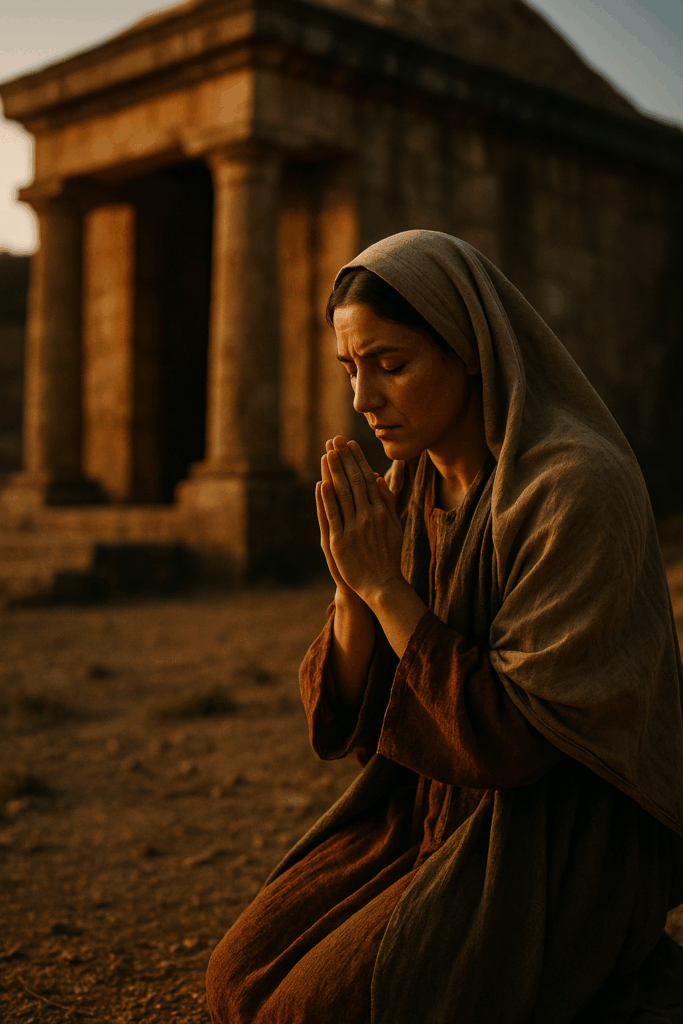
Hannah’s prayer in the bible — woman praying at temple

Hannah’s prayer in the bible: From Barrenness to New creation

Hannah’s warrior Prayer

Hannah’s prayer is in the book of Samuel. It opens, not with a king or a battle or a prophet, but with a woman in crisis. Hannah stands in the long line of barren matriarchs—Sarah, Rebekah, Rachel, women whose empty wombs reflect something deeper than personal longing. Barrenness in Scripture is never merely about infertility. It is a symbol of de-creation, the return to the primordial state before God spoke life into existence. Hannah is herself a living Genesis 1:2—tohu v’vohu, the emptiness and the void. Hers is story that God delights to transform. Hannah’s prayer reveals a powerful pattern of new creation and divine warrior reversal.

Elkanah: God Possesses

Even the names in the opening verses hint at creation imagery. Her husband is Elkanah, “God has created” or “God possesses,” a name that echoes the Creator-King who forms life from chaos. He is the son of Tohu, the same word used of the cosmic wilderness before creation. Hannah’s rival wife is Peninnah whose name carries the idea of a precious stone. She produces children easily—reflecting the ancient Near Eastern world where the highest honor for a woman was to bring forth sons. But Hannah, meaning grace, bears nothing but ridicule. Peninnah becomes her tzarah—her adversary, her tormentor, the embodiment of chaos taunting creation.

Each year the family ascends to Shiloh, possibly at the turn of the year, around the great fall festivals, when Israel gathered to remember God’s kingship, His covenant, and His ongoing creation of the world. There, in what might very well be a Yom Kippur setting of affliction and fasting, Hannah refuses to eat and weeps before Adonai. She cries out that God would “remember” her—evoking Rosh Hashanah, the Day of Remembrance, the coronation of the King, the sounding of the shofar that awakens creation from slumber. Her prayer is a cosmic cry for God to once again speak order into chaos.

Eli the priest misreads her silent prayer and accuses her of being drunk—perhaps an ironic hint of the spiritual dullness in Shiloh’s leadership. But Hannah is not drunk; she is a “woman of oppressed spirit,” a soul pressed down by chaos caused by infertility, ready for God to act. When Eli finally blesses her and sends her away, the text shifts. And at “the turn of the year”—a phrase implying festival imagery—Hannah conceives and bears a son. She names him Sh’muel, “God has heard,” an echo of shema, the great cry of Israel. A new creation is beginning.

The Rise of the Divine Warrior King and Hannah’s Prayer

But it is Hannah’s prayer of Thanksgiving after Samuel’s birth that unveils the true nature of her story. This is not a quiet thank-you note to God; it is a holy war song, a battle hymn announcing the rise of God’s anointed king. Her song sits at the chiastic center of Samuel’s birth narrative, the turning point upon which the book pivots. Samuel will anoint David, the shepherd-warrior who will become Israel’s great king. And Hannah, in her song, becomes the first herald of this divine warrior storyline.

Hannah’s prayer mirrors the Song of Moses and the Song of Deborah, the classic Divine Warrior hymns of Israel. She speaks of horns lifted high, a symbol of royal strength. She smiles over her enemies, not because of personal vindication, but because God has shattered the proud and lifted the humble. “There is no Rock like our God,” she declares—evoking the cosmic mountain, the foundation of creation upon which all stability rests. The bows of the mighty are broken. The stumbling are girded with strength. The barren woman gives birth to seven—perhaps an allusion to the seven-day creation, the full restoration of life from nothingness.

Hannah’s prayer proclaims that Adonai kills and makes alive, brings down to Sheol and raises up—language that stretches beyond her own story to the resurrection hope embedded in Israel’s Scriptures. God raises the helpless from the dust and seats the poor with nobles—images that resonate with the divine council, the heavenly courtroom where God enthrones His chosen ones. The pillars of the earth belong to Adonai, the cosmic architecture that joins heaven and earth. And then comes the climax: “He will give strength to His king and exalt the horn of His anointed one.”

There is no king in Israel at this time. Saul has not yet been born. David is generations away. But Hannah sees beyond her own deliverance. Hannah’s prayer prophesies the coming Messiah, the ultimate Divine Warrior who will overthrow chaos and establish God’s kingdom permanently. Her womb becomes the battleground where God overturns de-creation and brings forth the one who will prepare the way for King David.

“My Soul Magnifies the Lord”

Hannah’s prayer reverberates through the ages, echoing through Mary’s song in the New Testament (Luke 1.46-55). A young mother to be sings of God bringing down the mighty, lifting the lowly, filling the hungry, and scattering the proud. Her song is a declaration that the Davidic Warrior King has arrived in her womb and for that she says, “My soul magnifies the Lord.” Yeshua will be the final Davidic King, the fulfillment of Hannah’s vision, the One whose birth signals holy war against death, chaos, and every enemy of God.

Hannah’s prayer and her story follows a pattern in the biblical narrative. Her barrenness turning into birth mirrors the way God brings life out of places that are empty and unproductive. Her weakness becoming strength reflects the way God raises up His image-bearing warriors from unlikely places. And her humiliation turning into honor anticipates divine enthronement. Samuel, the child born from her de-creation state, will anoint David; David will foreshadow the Messiah; and the Messiah will ultimately bring the restoration of creation itself. In Hannah’s life we see the whole arc of God’s redemptive story, moving from chaos to new creation through the rise of God’s anointed king.

Hannah’s prayer is cosmic.

It is not personal thanksgiving; it is warfare.

It is the announcement that God fights for the powerless and overturns the world.


Hannah’s prayer in the bible

Hannah’s prayer in the Bible — woman praying at temple
temple pattern

Creation Temple Pattern in the Bible

Here we are again at Beresheet, “in the beginning.” A story that starts not with chaos but with a pattern. The first seven words of Scripture form a covenant preamble, an oath that sets the stage for everything that follows. What follows is the seven days of creation, a temple in the bible, of forming and filling, of separating and joining, until the whole cosmos becomes one unified day: the Sabbath, the seventh, the day of divine rest. This is picture of the temple pattern in the bible.

From the start, God was building a house—a cosmic temple, a temple pattern, for His presence to dwell and the number seven was its blueprint. Throughout the Bible, “seven” isn’t just symbolic of completeness or perfection, it really signals a finished cosmos, a world brought into order where God can rest.

Seven Day Temple Pattern in the bible

The ancient world knew this temple pattern well. Across the Near East, gods built temples in seven days or dedicated them through seven-day festivals. When Baʿal defeated the sea/yamm or chaos, his temple was constructed in seven days, and His throne called “his resting place.” The Bible, however, re-interprets the number seven as a Yahweh centered reality.

Scripture carries the imagery everywhere: seven lamps on the menorah, seven weeks to Shavuot, seven seals and trumpets, patterns of seven throughout the festival cycle, sevenfold patterns in the tabernacle speeches and Exodus texts. Each “seven” marking a transition from work to rest, from building to indwelling, from chaos to creation. Genesis 1–2 is itself a cosmic temple story where God builds, then rests, and enthroned.

So, what does this mean for us? It means this is the year for building up, not tearing down. You are part of God’s temple cycle. Every seventh day, every sacred festival, every rhythm of life is an invitation to order your world for His dwelling place. Build your home, build new habits, build relationships, build community around divine rest—so that the King of Glory may rest in your midst.

BUILD your world—and let God’s presence fill what you have built. Be your own temple pattern in the bible.

temple pattern

heaven

Did Heaven and Earth Marry?

John picks up where Genesis left off, completing the seven-day pattern. Genesis opens with God creating the world through Word and Breath; John begins with the Word made flesh—the Light Himself stepping into human history. Both Genesis 1 and John 1 unfold through seven days, a week of forming and filling Word and Spirit working together until creation reaches its goal: the union of heaven and earth.

In the ancient world, a king’s enthronement brought order to the chaos, and it was said that these two spheres earth became one—shalom restored.

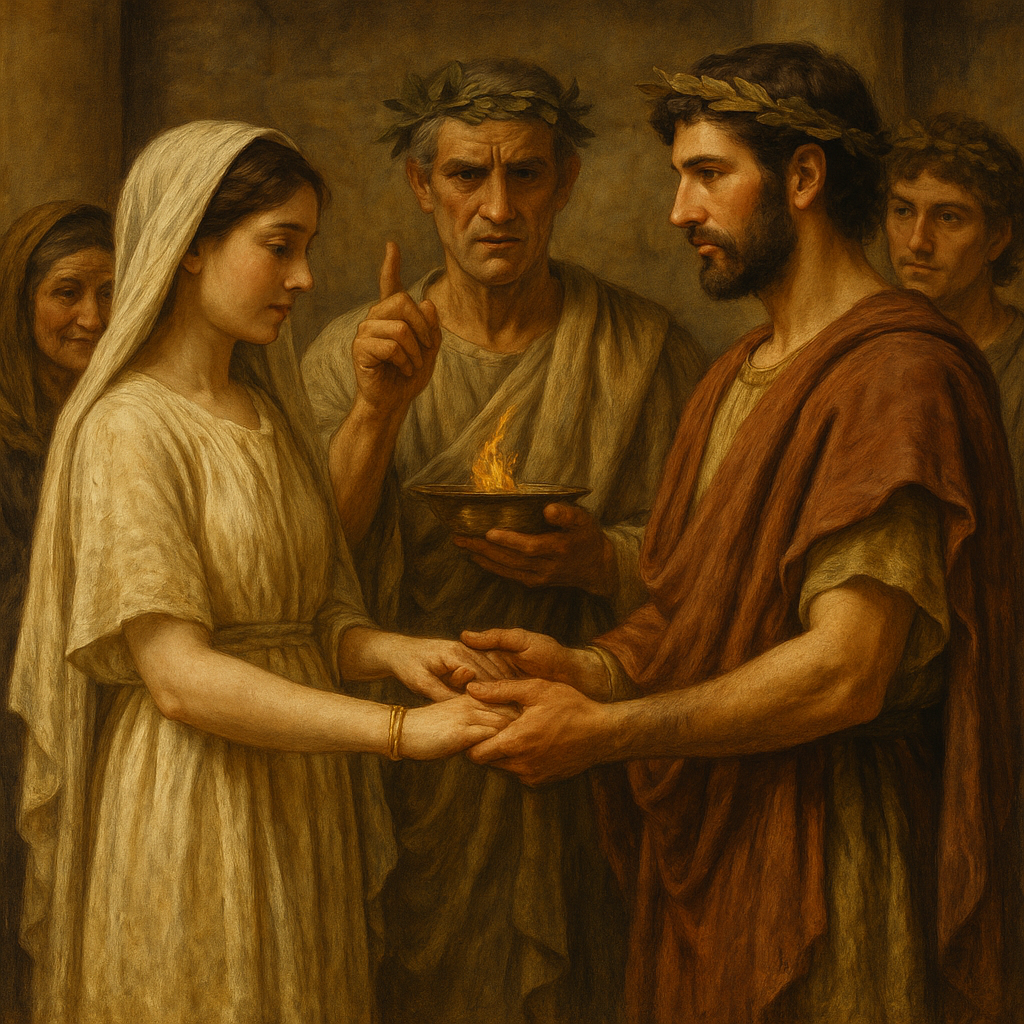
In Genesis, the seventh day crowns the work: The heavens and the earth were completed (Gen 2:1). The Hebrew kallah “completed” can also mean bride, the one who completes her husband. Creation week ends with a marriage: heaven and earth joined as one.

John’s Creation Week

John’s Gospel follows the same rhythm:

Day 1: John bears witness to the Light, the source of order.

Day 2: The Lamb of God who will remove human rebellion.

Day 3: Disciples rise up to follow their King.

Day 4: Nathanael beholds heaven opened with angels ascending and descending on the Son of Man, the bridge uniting heaven and earth.

Day 7: “On the third day,” a wedding in Cana becomes the climax of new creation.

Cana (Kanah) means nest, a place of new life.The Spirit who once hovered over the waters like a mother bird over her nest, an ancient idiom for the Temple, now rests upon Yeshua, the true Temple who will be raised up. And water becomes wine—the lifeblood of new creation.

The realms unite once more, not in a building but in a Person. Through Yeshua, the presence of God now fills humanity itself. And we are called to live as dwelling places of His Presence, bringing heaven’s order into earth’s chaos.

“Our Father who art in heaven, hallowed be Thy Name.

Thy kingdom come, Thy will be done, on earth as it is in heaven.”

heaven
Skip to content