Tag: Babylon

foundations

When the Foundations Shake

Many people feel as though the very foundations of life are being shaken. They watch the world around them and wonder what comes next. What will remain if the economic, political, and institutional structures that have shaped modern society continue to crumble? Families who spent decades saving for retirement watch the purchasing power of their money steadily decline. Wars drag on with no clear end, enriching powerful interests while ordinary families bear the cost in lives and livelihoods. Fraud, corruption, and the concentration of wealth and power in the hands of a few leave many wondering whether our institutions still serve the people—or merely preserve themselves.

Thousands of acres of productive farmland are being transformed into data centers while drought grips one part of the country, floods devastate another, and wildfires consume millions of acres. Inflation is eating away at people’s savings. Many are in debt living paycheck to paycheck. Trust in governments, financial institutions, corporations, and even religious leaders continues to erode. Everywhere people look, the pillars that once held society together are weakening.

Throughout history, ancient people naturally looked to the heavens to make sense of what was happening on earth. They did not separate the natural world from the spiritual world as neatly as we do. For them, what happened in the heavens revealed the meaning of what was happening on earth. The lights in the heavens proclaimed God’s order, and when the prophets spoke of those lights being shaken, they were announcing that the established order of human rule was about to be overturned.

The signs did not create history.

They revealed its meaning.

This is the world in which Daniel lived. Babylon’s kings identified themselves with the stars. Their empires appeared as permanent as the heavens themselves. Yet Isaiah mocked the king of Babylon as the bright morning star cast down from heaven. Ezekiel described the King of Tyre in similar language before portraying his downfall. The prophets were not describing astronomical catastrophes. They were announcing that proud rulers who imagined themselves untouchable would be humbled before the God of Israel.

The heavenly lights represented earthly thrones.

Daniel watched Babylon destroy Jerusalem and carry away the vessels of the Temple. From every earthly perspective, Babylon’s gods had triumphed over Israel’s God. Yet Daniel’s visions told a different story. The kingdoms of men would rise and fall, but the Ancient of Days remained seated upon His throne. Every beastly empire would eventually lose its dominion because every human kingdom built upon pride ultimately collapses under the weight of its own corruption.

This is the language Jesus inherited.

When the disciples asked about the destruction of the Temple in Matthew 24, Jesus answered with the language of Israel’s prophets. “The sun will be darkened, the moon will not give its light, the stars will fall from heaven, and the powers of the heavens will be shaken.”

Modern readers instinctively look for future cosmic disasters.

First-century Jews would have recognized prophetic judgment. The Temple stood at the center of Israel’s covenant life. It was the place where heaven and earth met, where God’s presence dwelt among His people. Yet by the time of Jesus, the Temple leadership had aligned itself with political power, burdening the people while protecting its own position. Those entrusted with shepherding Israel had become rulers protecting their own kingdom.

When Jesus announced that the heavenly lights would be shaken, He was declaring that the entire order represented by that Temple system was coming to an end. The destruction of Jerusalem in A.D. 70 was far more than the fall of a city. It was the collapse of a corrupt religious order that had rejected its Messiah.

The cosmic imagery reflected what was happening on earth. Heaven interpreted history.

Daniel’s vision reaches its climax when One like the Son of Man comes with the clouds of heaven to the Ancient of Days. For many modern readers, the clouds immediately suggest the Second Coming. But in Daniel’s vision, the Son of Man is not descending to earth. He is approaching the throne of God to receive an everlasting kingdom. This is the moment of His enthronement.

The New Testament declares that this vision was fulfilled in Jesus’ resurrection and ascension. By His resurrection He conquered death, the final enemy. By His ascension He was enthroned at the Father’s right hand, receiving the kingdom that no earthly empire could ever possess.

This is why the shaking of the heavens is immediately followed by the appearance of the Son of Man. The old order is passing away because the true King has taken His throne.

From His throne the King sends out His heralds. Throughout the ancient world, a newly enthroned ruler announced his reign and summoned his subjects to swear their allegiance. The Gospel follows the same pattern. The King’s messengers go into every nation proclaiming that Jesus now reigns and calling men and women into His everlasting kingdom.

This does not mean Jesus’ words have nothing to say to our generation. They have everything to say.

We also live in a world where institutions lose their way and leaders pursue power instead of justice and people wonder whether the foundations of society are collapsing.

Matthew 24 is not a forecast of modern events.

It is God’s interpretation of one of the greatest covenant judgments in Israel’s history. The lights of heaven were shaken because the old order centered on the Temple was passing away, and the Son of Man had received the kingdom that would never pass away.

Jesus’s words remind us that history has always been marked by the rise and fall of kingdoms, the corruption of institutions, and the collapse of leaders who imagine themselves all powerful. None of those events overturn the reign of the Son of Man. The signs in the heavens do not tell us to fear the future. They remind us that every human kingdom is temporary, but the kingdom of God is eternal.

When the foundations of our world seem to shake, Scripture calls us to lift our eyes to the throne. The heavens still proclaim the same truth they declared in Daniel’s day: the Son of Man reigns. His kingdom alone will endure.
foundatiaons
holy ones

The Holy Ones and the Return Home to Jerusalem

Part 4 Splitting, Tearing and New Creation

Matthew’s account of the crucifixion contains one of the most puzzling passages in the New Testament: “Many bodies of the holy ones who had fallen asleep were raised; and coming out of the tombs after His resurrection, they entered the holy city and appeared to many” (Matthew 27:52,53).

Matthew’s description has generated centuries of debate. Readers have long wrestled with questions surrounding the event. Who were these holy ones? Were they physically resurrected? Did they die again? If not, where did they go? These are legitimate questions, yet the text itself offers remarkably few answers. Matthew provides no names, no identities, and no explanation of what became of them afterward. In fact, he seems almost uninterested in the very questions that have occupied so many.

For that reason, the aim of this essay is not to explain the mechanics of the event but to explore the biblical imagery Matthew employs and the larger story it may be invoking.

Throughout this series, we have examined Matthew’s description of Jesus’s death as a sequence of breached boundaries. The veil is torn. The earth shakes. The rocks split. The tombs are opened. Each sign reflects a deeper consequence of humanity’s exile from God. The torn veil addresses separation from God’s Presence. The earthquake and splitting rocks affect the created order itself. The opened tombs reach into the realm of death.

The Holy Ones Appear in Jerusalem

Matthew then directs our attention to where the holy ones go. After emerging from the tombs, they enter Jerusalem—the holy city. His description is raising a different question. It suggests the significance doesn’t lie in their appearance but rather in where they go afterward. The movement is not from death to life as much as it is from death to Jerusalem.

Throughout Scripture, Jerusalem is the center of covenant life, the place of God’s dwelling among His people, and the destination of restoration. Again and again, the prophets envision God’s people returning to Jerusalem after judgment and exile. The prophets also saw a day when the Lord Himself would return to Zion and dwell among His people.

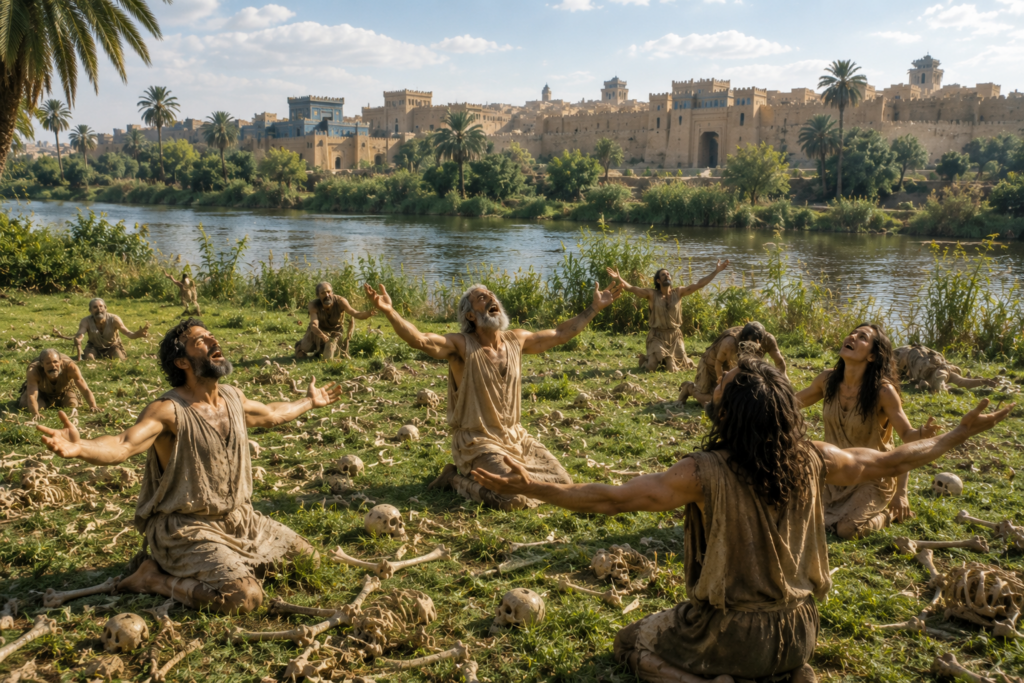
The prophets often described restoration from exile in terms of resurrection. Nowhere is that connection clearer than in Ezekiel 37. There the nation laments, “Our bones are dried up, and our hope is lost.” God’s response comes in the language of resurrection: “I will open your graves and bring you up from your graves, my people.”

For those carried away to Babylon, exile was far more than a political disaster. Jerusalem lay behind them. The Temple was in ruins. The life God had established for His people in the land had been torn apart. The Davidic throne was empty, worship had ceased, and the nation that had once flourished in the land now sat beside foreign rivers weeping when it remembered Zion. Israel was still alive physically, but covenant life had been shattered. Exile had become a form of national death.

Ezekiel sees a valley filled with dry bones and hears God’s promise to open graves and restore His people. The vision is often read as a prediction of bodily resurrection, yet its primary concern is restoration after exile. Graves are opened. The dead rise. God’s people are brought home. In the prophetic imagination, resurrection becomes the language of return.

The prophets anticipated not only Israel’s return to Zion but the return of Yahweh Himself. Isaiah describes the day when the watchmen rejoice because they see the Lord returning to Zion. The psalmist celebrates the restoration of Zion with the words, “When the Lord brought back the captives from Zion, we were like those who dream.” Zechariah envisions God gathering His scattered people and bringing them once again to dwell in Jerusalem.

These themes reappear in Matthew’s account. Like Ezekiel, Matthew speaks of opened tombs and the raising of God’s people. The appearance of the holy ones in Jerusalem echoes the larger biblical hope of return and the renewed presence of God among His people. The holy ones emerge from their tombs and make their way to the city that stood at the center of Israel’s hope.

In Matthew’s account, the Messiah comes first. Only afterward do the holy ones enter the city. Matthew places the Messiah before the holy ones who follow.

This scene belongs within Scripture’s larger story of exile and return. The holy ones do not simply come back to life. They come home.

Ezekiel’s Dry Bones

This, of course, does not prove that Matthew is directly interpreting Ezekiel 37, nor does it mean that these figures represent those who died during the Babylonian exile. Matthew never says that. Yet the imagery belongs to the same theological pattern. In both passages, opened graves are connected to restoration. And the parallels are difficult to dismiss. The prophets saw a day when God would restore His people, overcome their enemies, and dwell among them once again. Every earlier deliverance pointed toward that hope but never fully achieved it. The return from Babylon was real, but death remained undefeated. The deeper exile endured.

In each case, restoration culminates in return, and Jerusalem is where exiles come home.

The same pattern appears throughout this four-part series. Humanity’s story begins with exile from Eden. Israel’s story unfolds through repeated exiles and restorations. Yet every restoration leaves one enemy undefeated. Jerusalem may be restored but death remains—that is until the resurrection of Jesus the Messiah.

The appearance of the holy ones may be functioning as more than a resurrection account. It may be a sign that the restoration anticipated by the prophets is now reaching beyond the land and beyond the Temple into the realm of death itself. They do not appear until after Jesus’s resurrection. He comes first. Only then do they enter Jerusalem. If Matthew presents Jesus as the embodiment of God’s Presence among His people, then His resurrection becomes more than a victory over death. It becomes the return of the King.

Matthew’s account is ultimately the story of barriers giving way. The journey that began with exile from Eden is moving toward its long-awaited restoration. Through His death and resurrection, Jesus confronts the deepest consequence of humanity’s separation from God. Now even that final enemy has been challenged. The holy ones entering Jerusalem stand as a sign that the journey home has begun.

We live in an age that often appears dominated by disorder, violence, and death. Yet, the Messiah has entered the grave and emerged victorious. The powers that enslave humanity have been breached. The holy ones appear only briefly in Matthew’s account, yet their arrival in Jerusalem announces something far greater than themselves: death’s captivity has been broken. The King has returned, and the long exile is beginning to end.

holy ones

pattern

Reading Daniel’s Cosmic Language in Its Ancient World Setting

Cosmic Lights and Fallen Kings

When Scripture speaks of the sun darkening, the moon turning to blood, stars falling, and the powers of heaven shaking, our modern sensibilities picture complete cosmic collapse. But Daniel, the prophets, and Yeshua’s disciples would not have heard such astronomical disaster. Instead, in the ancient imagination, heaven was the political sphere for kingship. Sun, moon, and stars symbolized thrones, rulers, and gods. Their dimming meant rulers falling, kingdoms collapsing, and idols being dethroned.

The rhythms of life—planting, growing, and harvesting cycles were all evidence of divine order. When those cosmic rhythms were shaken, it suggested something amiss in the political realm. When the prophets spoke of lights failing, they weren’t warning of eclipses necessarily. They were declaring that human systems were crumbling under the weight of their own corruption.

Babylon’s kings took on starlike identities, tying their glory to the patterns in the skies. Nebuchadnezzar himself is the image of a fallen star in Isaiah 14: exalted, then humiliated. This is Daniel’s cosmic language—heaven shaking because thrones are shaking, dominions are failing because tyrants are failing.

Daniel’s Visions and the Fall of Empire

Daniel’s life unfolded in Babylon, the empire that razed the temple and hijacked temple vessels for its own purposes. In his visions, the shaking of heaven means the shaking of empire itself. The gods of Babylon, linked to lights in the sky, seemed triumphant when Jerusalem fell. But Daniel saw differently: the heavens would tremble, for Yahweh’s kingdom cannot be overthrown. His cosmic kingdom will endure forever. This language unmasks the fragility of every empire boasting eternal dominion.

The Son of Man Enthroned in Glory

Into that cosmic drama rises Daniel’s mysterious figure: the Son of Man. In Daniel 7, He comes “with the clouds of heaven” to the Ancient of Days. Modern readers hear second coming language. But Daniel saw it in terms of enthronement.

In Israel’s world, clouds belonged to Sinai and ascents to holy ground: Moses climbs into a cloud to encounter Yahweh. So, the Son of Man ascends in clouds to the throne room, receiving kingdom, dominion, and everlasting authority. Greek uses the word parousia to describe the royal arrival of kings. This is Daniel’s vision: the regal arrival of One like the Son of Man at His enthronement.

The apostles declared that this took place through resurrection and ascension. His rising is victory over the enemy that is death; His ascension is coronation. What Daniel foresaw in symbols, the Gospels proclaim through a visible manifestation.

Heralds, Kingdom, and the Gathering of the Loyal

Daniel’s vision continues with the nations mourning and the angels gathering the elect. When kings fell, entire tribes lamented; their security and identity died with the throne. Yet the Bible reshapes this lament: the fall of tyrants is the dawn of hope for the nations. The heavens shake because the true throne stands.

Then come the messengers. Angels are dispatched for proclamation. They are heralds, announcing victory and summoning the faithful to gather around the enthroned King. Ancient kings sent envoys ahead to declare triumph and assemble subjects for procession. Daniel’s imagery draws from the same ritual.

The biblical story reveals: Sinai formed a covenant assembly at the mountain. Zechariah foresaw Yahweh standing in triumph upon the Mount of Olives. Yeshua ascended from that same mountain with the promise of return. Heaven and earth meet in the King’s enthronement.

And beneath that vision is another pattern: whenever God moves to establish His reign, chaos rises to resist. The serpent in Eden. Pharaoh in Egypt. Amalek in the wilderness. Satan in the desert. Yet the pattern always ends the same: the King defeats the adversary and rest and enthronement follow.

Daniel’s cosmic language does not forecast the end of the universe. It announces the end of every rival throne. The heavens shake because the Son of Man has taken His seat. His kingdom is the one that advances.

cosmic
Skip to content