
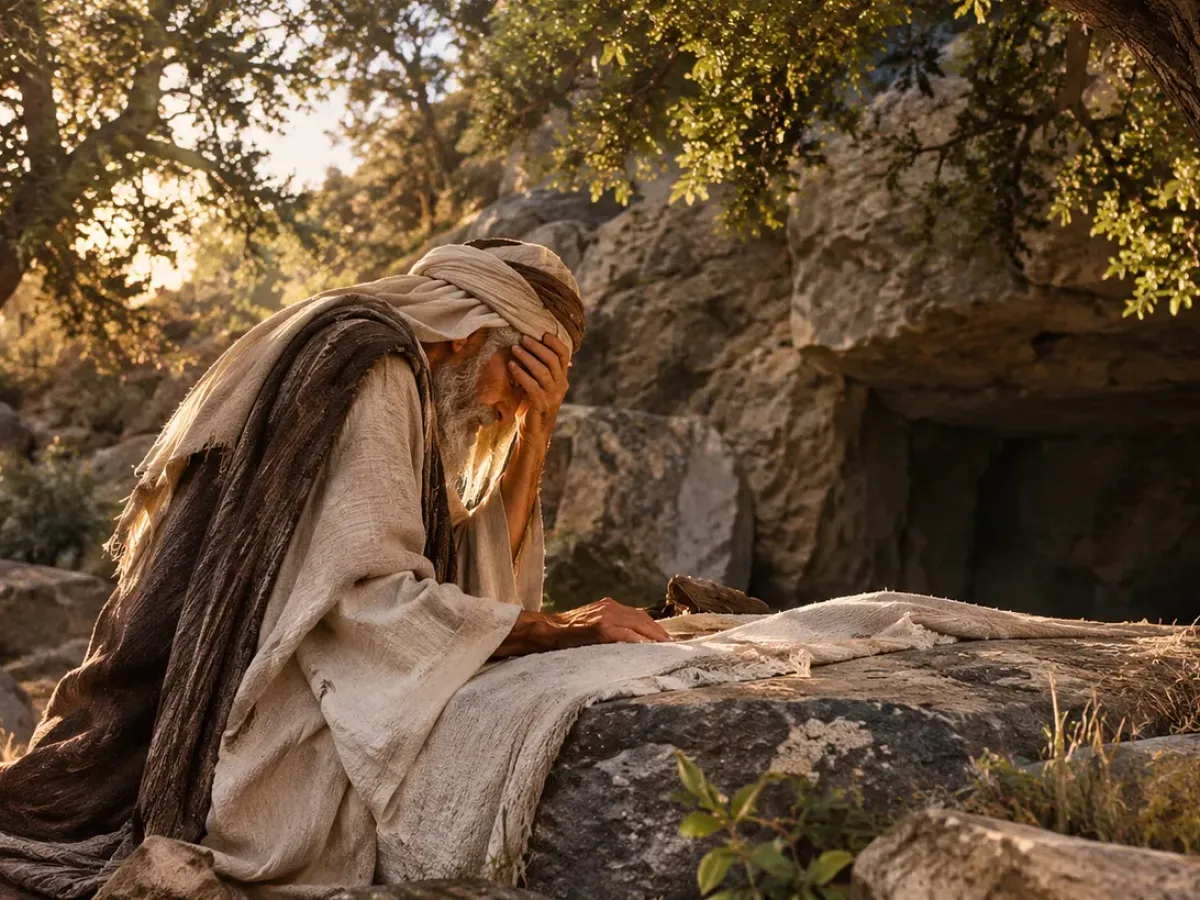
When Death Becomes the Doorway to Inheritance
The death of Sarah marks an important turning point in Abraham’s journey. After decades of walking in the promises of God, Abraham mourns the loss of his wife in Hebron, in the land of Canaan. Through Sarah’s death and burial, he acquires his first legally owned piece of the land God had promised him years earlier. What had existed as a divine promise now begins to take tangible form.
Sarah was Abraham’s wife, his covenant partner, and the one with whom he had become one flesh. It is significant that his first legal possession in the promised land came only after the death and burial of the woman who was his own flesh. This introduces a spiritual principle with implications for our own lives: before we can fully receive the inheritance God has prepared for us, something of our flesh must first die. Our pride, self-will, desire for control, and attachment to old ways of thinking can prevent us from entering into His promises. We cannot cling to the old nature and expect to experience the fullness of the new creation and the newness of life found in Yeshua the Messiah.
What makes this account so compelling is the extraordinary attention given to the purchase of Sarah’s burial place. Genesis 23 records the negotiations, the agreed price, the public witnesses, and even the trees, field, cave, and boundaries included in the transaction. These details go beyond what we might expect from a simple burial account. The repeated references to death, burial, possession, and ownership reveal how closely these themes are woven together. What begins with the loss of Abraham’s beloved wife concludes with the establishment of a permanent possession in the promised land. Death becomes the doorway to something new.
There is another aspect to this account. Abraham knows that God has promised him this land, yet he does not use that promise to justify seizing property belonging to others. Nor does he accept the offer to receive it without payment. Instead, he respects the rights of those who already own the land, insists on paying the full price, and ensures that the transaction is conducted openly and legally.
Death, Burial, and the Promise of Life
Burial language is repeated throughout Genesis 23.The Hebrew root qavar (קבר), meaning to bury, along with qever, meaning grave or burial place, appears thirteen times. In Genesis 23:6 alone, the root occurs four times. When we include references to death, mourning, the burial cave, and the possession Abraham seeks to acquire, the chapter contains approximately thirty-two references in just twenty verses. This concentration of burial language emphasizes that death is central to the story, but also that death is not where the story ends.
Sarah was the mother of Isaac, the woman through whom God had promised the covenant seed would come. Her death closes an important chapter in Abraham’s life. Together they had left their homeland, traveled through unfamiliar territory, endured famine, uncertainty, barrenness, and years of waiting for God’s promised seed. Now Abraham must lay to rest the woman who had shared every stage of that journey.
Yet even in his grief, Abraham demonstrates confidence in God’s promises. He does not return Sarah to Haran, the land of their ancestors. Instead, he buries her in Canaan, the land God has promised to his descendants. Her resting place becomes a testimony that the covenant will continue beyond her death, in the land God has chosen.
A Stranger in the Land of Promise
Abraham approaches the sons of Heth with these words: “I am a stranger and a sojourner among you.” The Hebrew expression ger ve-toshav identifies him as a resident alien, someone dwelling among a people who already possess the land.
Consider the tension. God has promised Abraham this territory, yet Abraham owns no permanent burial property within it. The sons of Heth recognize him as a mighty prince, a nasi Elohim, but that recognition does not grant him ownership. He must negotiate with those who possess the land.
The sons of Heth offer him the choice of their finest graves, but Abraham identifies a particular location: the cave of Machpelah, belonging to Ephron, at the end of his field. Ephron offers both the cave and the field, but Abraham insists on paying the full price. The agreed amount is 400 shekels of silver, weighed according to the accepted commercial standard. The transaction takes place publicly before the sons of Heth at the city gate, where legal and civic business was conducted.
The description of the property in Genesis 23:17–18 is precise. Ephron’s field in Machpelah, near Mamre, the cave within it, all the trees throughout the field, and everything within its surrounding boundaries are formally transferred to Abraham.
This description recalls the imagery of Eden. Genesis 2 describes a particular geographical place filled with trees and associated with life, divine presence, and humanity’s original inheritance.
In Eden, humanity loses access to its original dwelling place through disobedience. Adam is told that he will return to the ground from which he was taken. Death and exile become part of the human condition. In Genesis 23, however, Abraham acquires a piece of the promised land in which to bury Sarah. The movement is reversed. Eden begins with life and ends in death and expulsion, while Genesis 23 begins with death and concludes with the establishment of an inheritance.
When the Inheritance Is Established
The significance of this purchase becomes apparent in later generations. Abraham himself is buried there, followed by Isaac, Rebekah, Leah, and Jacob. In Genesis 49, Jacob identifies the cave and recalls its purchase from the sons of Heth. In Genesis 50, his sons carry his body from Egypt back to Canaan for burial.
Even when Abraham’s living descendants dwell outside the land, their ancestors remain buried within the promised inheritance. Joseph expresses similar confidence when he commands that his bones be carried out of Egypt when God visits His people.
The living may dwell in exile, but the dead remain anchored to the promise.
When Inheritance Is Taken Unjustly
The integrity of Abraham’s transaction stands in sharp contrast to other biblical accounts of property acquisition.
In 1 Kings 21, King Ahab desires Naboth’s vineyard. Naboth refuses to surrender the property because it is his ancestral inheritance. Jezebel responds by arranging false accusations and a fraudulent legal proceeding that results in Naboth’s execution. Ahab then takes possession of the vineyard.
The contrast with Abraham could hardly be greater. Abraham respects another man’s property rights and pays the agreed price. Ahab uses political power and corrupt legal institutions to seize what belongs to someone else.
The prophets repeatedly condemn such abuses of power. Micah 2:1–2 describes those who covet fields and seize them, oppressing families and robbing them of their inheritance. Isaiah 5:8 pronounces judgment on those who accumulate houses and fields until others have no place.
The issue extends beyond ownership to the very foundations of justice. When property can be taken through deception, intimidation, corruption, or the manipulation of legal authority, the stability of society itself is threatened.
These warnings are particularly relevant to our nation today. Americans face threats to their property rights through excessive taxation, the misuse of eminent domain, outright fraud, and theft, all of which can undermine the security of what they have worked to acquire. Scripture challenges us to examine whether power is exercised justly, whether the vulnerable are protected, and whether lawful ownership is respected. Secure property rights are a vital bulwark against the arbitrary exercise of power and the erosion of individual freedom.
A society that abandons justice in matters of property threatens far more than material possessions. It undermines trust, family continuity, and the ability of future generations to build upon what those before them have established.
The Inheritance That Requires Death
The connection between death and inheritance brings us back to the principle introduced through Sarah’s burial. Just as Abraham’s possession of the promised land followed the death of the woman who was his own flesh, we too must confront what needs to die within us before we can fully walk in the inheritance God has prepared. And this pattern reaches its fullest expression in the death and resurrection of Yeshua.
Yeshua taught that a grain of wheat must fall into the ground and die if it is to produce much fruit (John 12:24). Paul likewise speaks of putting to death the deeds of the flesh and walking in newness of life. The old nature, with its pride, selfish ambition, resentment, and desire for control, cannot govern the life of the new creation.
There are things we must be willing to bury if we are to enter more fully into what God has prepared for us. Sometimes it is an old way of thinking, a cherished assumption, an unforgiving spirit, or our insistence that God’s promises must unfold according to our expectations.
Abraham had spent decades learning to trust God through uncertainty. Now, at Sarah’s death, he demonstrates that faith in the ordinary, practical affairs of life. He negotiates, pays the agreed price, establishes legal ownership, and buries his wife in the land of promise. His faith does not remove him from the responsibilities of this world; it shapes the way he fulfills them.
Spiritual maturity is measured not only by what we believe about God’s promises, but also by how faithfully we conduct ourselves while waiting for their fulfillment.
We live in a world where institutions fail, possessions can be lost, justice is often corrupted, and the future appears uncertain. Yet the promises of God do not depend upon the stability of human systems. We are called to act justly, protect what has been entrusted to us, and surrender those things within ourselves that prevent us from walking faithfully before Him.

Leave a Reply