

When the Holy Fire Left the Temple
Many Christians speak about salvation as though the ultimate goal is entering the Holy of Holies and remaining there forever. Worship songs often describe believers moving inward through the courts of the Temple until finally standing before God in heaven.
One well-known song says, “Take me past the outer court into the holy place.” The imagery is beautiful and sincere. It reflects the longing every believer has for intimacy with God. The language draws from Hebrews and priestly imagery about access to God through the blood of Jesus.
But the larger biblical story may actually be moving in the opposite direction.
Scripture begins not with human beings ascending into heaven, but with God descending into creation. Eden is sacred space where heaven and earth overlap. It is where God “walks” among humanity. After the fall, the biblical narrative becomes the story of restoring that union.
The movement throughout Scripture is outward as glory fills, sacred space expands and heaven touches earth. The Bible ends the same way it begins. Revelation does not conclude with humanity permanently escaping earth for heaven. Instead, the New Jerusalem descends from heaven and a voice declares, “Behold, the dwelling of God is with humanity.” The final vision is creation transformed by divine Presence.
Fire in the Wilderness: God’s Presence Among His People
This pattern appears repeatedly in the Exodus story. Israel enters the wilderness, a place associated with chaos and de-creation. It is dangerous, dry, untamed and filled with threats. It is the place of serpents, scorpions, hunger, thirst, fear and death. Yet it is precisely there that God manifests Himself as fire. The pillar of fire stands between Israel and her enemies. It protects the people through the darkness of night and guides them through the wilderness where no path exists.
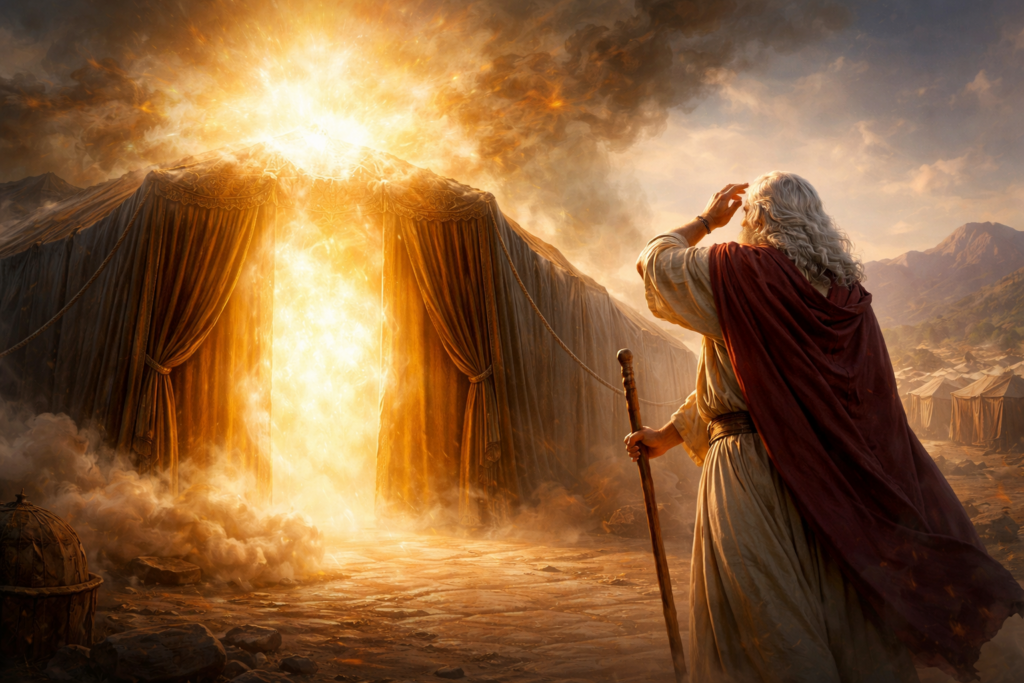
There in the middle of the darkness stands the fiery Presence of God leading His people toward new creation. The pillar is the visible manifestation of God’s Presence connecting heaven and earth in the midst of chaos. The Tabernacle itself becomes a living organism on the move through the wilderness. Carried by designated priests and filled with divine glory, it functions as a living mobile temple carrying the Presence of God through chaos toward promised rest.
Throughout Scripture, God repeatedly manifests Himself as fire. The burning bush burns without being consumed. Sinai is wrapped in fire and smoke. Fire descends upon Elijah’s altar. Ezekiel sees fiery throne imagery. Daniel describes the Ancient of Days with streams of fire flowing from His throne. At Pentecost, tongues of fire rest upon the gathered people.
This may even shed light on the strange Sabbath command not to kindle fire. Israel was surrounded by nations who fashioned gods in visible form. But at Sinai, Israel heard a voice and saw fire, yet saw no form. Deuteronomy emphasizes this connection immediately before warning against idolatry.
God cannot be reduced to an image.
In this sense, idols are frozen gods while Yahweh appears as living fire. Whether or not the Sabbath prohibition directly concerns image-making, the tension is striking. Human beings repeatedly attempt to manufacture divine presence while the God of Israel reveals Himself through heavenly fire descending from above.
The Tabernacle and later the Temple became earthly models of heaven itself. Ancient Jewish writers and historians understood this clearly. Josephus describes the Temple veil as embroidered with stars, constellations and cosmic imagery. The veil represented the heavens. The Holy of Holies symbolized the throne room of God. The ancients often understood heaven, mountain and temple as overlapping realities. Sinai, Zion and the heavenly sanctuary mirrored one another as sacred space where heaven and earth met.
Some Second Temple Jewish writings describe the heavenly sanctuary itself in fiery terms. In 1 Enoch, the heavenly Temple blazes with fire. Streams of flaming fire flow beneath the throne. Fiery cherubim surround the sanctuary. Some scholarly discussions even refer to the Holy of Holies as the “House of the Tongues of Fire.” Scholars have drawn attention to these traditions and their importance for understanding early Christianity.
The Holy of Holies Opens to the World
This background should shape how we read Pentecost.
Acts 2 is not simply the “birthday of the church” in the modern sense. It is Shavuot, the Feast of Weeks, celebrated seven weeks after Passover. Jewish tradition associated this feast with Sinai and the giving of Torah. Pilgrims came to Jerusalem bringing first fruits into the Temple. The feast already carried themes of covenant, revelation and divine Presence.
At Sinai, fire descends from heaven and God gives His oracles to the world. Torah is not merely “law” in the modern sense. It is divine wisdom ordering creation and forming covenant people. Sinai becomes a kind of cosmic Holy of Holies where heaven and earth overlap.
Luke intentionally fills the Pentecost/Shavuot story with Sinai and Temple imagery. There is heavenly sound, rushing wind, visible fire, divine Presence and the filling of sacred space. Scholar John D. Griffiths argues that Pentecost should be understood as a Temple inauguration theophany. In the Hebrew Scriptures, divine fire descends upon sanctuaries, altars and holy places to consecrate them. Fire falls at Sinai. Fire fills the Tabernacle. Fire consecrates Solomon’s Temple.
But in Acts 2 something unique happens.
The fire no longer rests upon a building. The fire divides. Tongues as of fire spread and rest upon people.
The movement is not humanity entering into the Holy of Holies and remaining there forever. The movement is God, manifested in fire, coming outward from the Holy of Holies into the world. The Presence once localized above the Ark, upon Sinai, within the Temple and ultimately within Yeshua Himself is now spread among the gathered covenant people. Heaven’s fire moves outward into the world through living human beings.
This may also explain the tearing of the Temple veil at Yeshua’s death. The veil that was torn appears to have been the great outer veil described by Josephus with its cosmic imagery representing the heavens. The tearing of the veil was not simply about human beings gaining permission to enter sacred space. It represented a rupture between heaven and earth. The barrier separating realms was being removed.
G. K. Beale describes this tearing as the chaos between one kingdom order and the emergence of another. N. T. Wright repeatedly argues that the Christian hope is not escaping earth for heaven, but heaven and earth reunited. Beale similarly argues that Eden itself was always intended to expand until all creation became sacred space. The Temple symbolized that expansion.
Pentecost becomes the next stage in that process. The fire leaves the confinement of the sanctuary and spreads outward like wildfire.
Pentecost reverses Babel. At Babel humanity attempted to ascend into heaven through technological achievement, kiln-fired bricks and centralized power. Humanity sought to make a name for itself by building upward.
At Pentecost heaven descends instead. Languages multiply redemptively rather than divisively. The Presence disperses rather than centralizes. Sacred fire spreads outward into the nations. The Kingdom advances not by escape from earth, but by the spread of God’s Presence into the world through proclamation. It spreads by the Word and Spirit of God.
Tongues of Fire and the Wisdom of God
This also reframes the controversy surrounding speaking in tongues in the Christian world. Much of the modern debate has reduced tongues to a private prayer language, ecstatic speech, emotional experience or arguments about whether miraculous gifts continue. Honestly, much of the discussion sounds closer to the oracles of Delphi than to Sinai.
The ancient world already knew ecstatic religious speech. At Delphi, the Pythia delivered inspired utterances believed to come from Apollo. Her speech was often obscure and required interpretation by priests. Such oracles could easily be manipulated for personal, political or imperial gain. Across the Greco-Roman world there were prophetic frenzies, mystery cults and ecstatic speech phenomena.
Acts 2 is presented very differently.
Luke places the event squarely within Sinai imagery, Temple imagery, covenant imagery and divine Presence imagery. Luke is intentionally portraying Pentecost as a new Sinai event. At Sinai, God descended in fire upon the mountain and spoke His wisdom into the world. At Pentecost, the tongues of fire no longer rest upon one mountain. The fire divides and rests upon people.
And the Word that follows is not meaningless chaos.
The nations hear “the mighty works of God.” The miracle is the spread of divine proclamation outward into the nations. The tongues of fire are connected to the dissemination of divine wisdom into the world.
Some Jewish traditions even imagined the voice at Sinai dividing into many languages so the nations could hear the revelation of God. Whether Luke consciously draws upon those traditions is debated, but the parallels are striking. Fire, divided speech, covenant revelation, divine wisdom and proclamation to the nations all converge at Pentecost/Shavuot. Divine fire now produces proclamation about the risen King whose victory over death is announced to the nations.
In this sense, tongues are not primarily about private mystical ascent into heaven. They are about heaven’s fire spreading outward through people carrying divine wisdom into the nations after the resurrection victory over death. The Presence that once dwelt in Eden, upon Sinai and within the Holy of Holies now spreads outward through people carrying the message that death itself has been defeated.
The fire can no longer be contained. The Presence is on the move, spreading into the world through people filled with the Spirit of God. The message carried by that fire is that the Kingdom of God is breaking into the earth. And the invitation remains open: “Whosoever shall call upon the name of the Lord shall be saved.” Saved from death itself. We are invited into this expanding work of new creation until the knowledge of the glory of the Lord fills the earth as the waters cover the sea.
Leave a Reply