

How Empire Distorts the Image of God—and How Yeshua Restores It
On the eastern shore of the Sea of Galilee, within the shadow of Rome’s power, Yeshua steps into a world shaped by empire. What follows is a revelation of what empire does to humanity—and how the kingdom of God restores it.
The Decapolis, a network of ten Greco-Roman cities, made Rome’s presence visible through military power and economic control. After calming the storm, Yeshua and His disciples step onto that shoreline. It is here, in this territory—among tombs and herds of swine—that Jesus confronts a man possessed by what calls itself “Legion.”
This episode is often read as an isolated exorcism. It is that—but it is far more. It is a public sign of new creation. In restoring one tormented man, Jesus demonstrates His authority to restore all God’s image-bearers. This story also reveals how empire distorts humanity and how the kingdom restores it.
The man lives among tombs. He is violent, self-harming, uncontrollable, and cut off from community. Chains cannot restrain him. In biblical thought, contact with the dead rendered a person ritually unclean—not immoral, but separated from God’s presence. Mark’s description portrays more than suffering; it reveals a fractured identity. When Jesus asks his name, the answer is telling: “My name is Legion, for we are many.”
A Roman legion was a defined military unit, often numbering several thousand soldiers—an imperial occupation force. Mark’s audience would not have missed the association. Roman campaigns in this region involved raids, land confiscation, and suppression of dissent. Entire communities experienced displacement and intimidation. In that context, a man living among the dead embodies what empire does to people over time.
Empire and the Distortion of Human Identity
The Bible begins with humanity created in God’s image, entrusted with meaningful work. Empire disrupts that calling by redefining identity around usefulness to the state. In the Exodus story, Israel’s service to God becomes forced labor for Pharaoh’s building projects. Work that once reflected divine purpose is redirected toward imperial expansion.
This pattern repeats across history. Empire reduces people to output and efficiency, detaches work from worship, and defines security through control maintained by fear. Compassion erodes, apathy takes hold, and communities eventually fracture. After all, divided societies are much easier to manage.
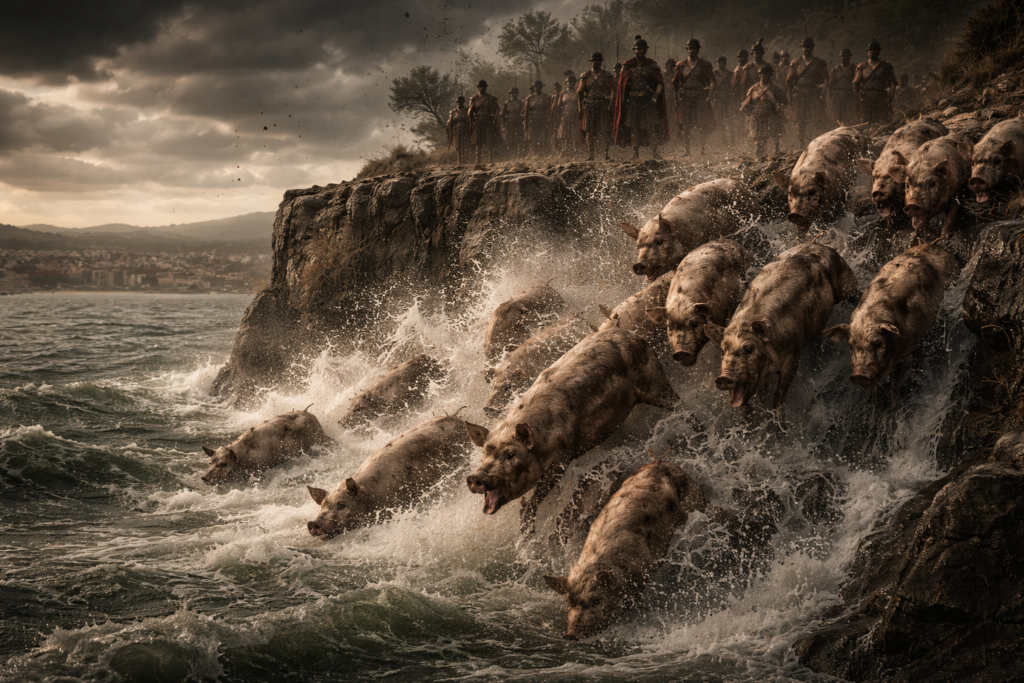
The Gerasene demoniac is a concentrated image of this distortion. He reflects a humanity disordered under imperial coercion. Even the language surrounding the herd carries military overtones. When the demons ask not to be sent out of the region, it resonates in a land familiar with Roman retaliation. Yeshua permits them to enter the pigs, and the herd rushes into the sea—an intentional echo of Exodus, where Pharaoh and his army are swallowed by the waters.
Yet the climax is not the destruction of the pigs, but the restoration of the man. He is found clothed and in his right mind—dignity restored, self-control regained, and reintegrated into community. The one who lived among the dead now sits at Jesus’ feet.
This is not simply relief from suffering. It is the restoration of a distorted human image. God does not free people merely to remove pain, but to restore them to their created purpose—to reflect His character in the world.
Then the story turns. The healed man asks to follow Jesus but is sent home: “Go to your people and tell them how much the Lord has done for you.” Restoration leads to responsibility. He becomes a witness in Gentile territory.
Empire is always close at hand. Across millennia, it has changed names and places, but its structure remains the same—a system that centralizes power, reshapes identity around production, and maintains control through fear and dependency. Work becomes detached from sacred purpose. Systems profit from dependency because it keeps populations manageable. Empire demands a loyalty that rightly belongs to God.
The Kingdom of God and the Restoration of the Image
Scripture presents a different vision. Human life is meant to be centered on God, with work and community flowing from that relationship. The drowning of the pigs echoes Pharaoh’s defeat. God confronts oppressive power, restores His people, and reorders worship around Himself. And the victory begins with one restored image-bearer. Empire weakens whenever people refuse to let their identity be shaped by it.
Yeshua gives us the pattern for confronting and overcoming empire. He exposes its limits and establishes a greater Kingdom through victory over chaos, death, and the powers that enslave.
Yeshua does not defeat people. He defeats chaos.
He confronts the forces that enslave rather than the individuals caught within them. Delivering the demoniac is an act of liberation. Jesus returns people to true worship and their created purpose, and in doing so undermines imperial power at its root.
At the Sea of Galilee—the edge of empire—Jesus rebukes the sea, casts out demons, and heals disease. These are not isolated miracles; they are acts of new creation. He establishes order where empire produces disorder. He restores individuals and, through them, entire communities.
Yet He does not seize power.
In the wilderness, He rejects the offer of the kingdoms of the world (Matt. 4). He refuses domination as a path. He redefines kingship—not by force, but by the Spirit. Empire says, “Control, secure, preserve power.” Jesus says, “Lose your life to find it.”
Yeshua is neither passive nor weak. He overturns the assumptions that govern the world. He exposes empire’s limits, reveals its overreach, and challenges its claim to ultimate authority.
He forms an alternative community—a people shaped not by empire, not by elite structures, not by status or wealth but by the presence of God. A people defined by shared identity, allegiance, and purpose. This is a counterculture rooted in divine presence rather than imperial power.
The same pattern appears in His teachings.
In the Sermon on the Mount, the context also includes Yeshua confronting Rome’s preferred method of control—public humiliation. This is a world where honor and rank equal dignity. He offers a different way—not passive submission and not retaliation, but a form of resistance that refuses both.
Turning the other cheek subverts public humiliation. Giving one’s cloak—more than is required—exposes Rome’s injustice. Going the extra mile reveals a shift from the powerful to the powerless. Each act disrupts expected responses within a system that depended on fear, retaliation, or submission. Jesus breaks that cycle when people refuse to live by empire’s rules.
What emerges is a different kind of kingdom—one built on self-giving. Yeshua teaches His followers to live in a way that exposes the emptiness of power rooted in violence and control. The empire seeks to shame and subdue, but He reveals a deeper truth: true dignity comes from God, and no system can take that away.
The story ends with a restored image-bearer sent back into the world as a witness. That is where empire loses its power—when lives are transformed. Wherever men and women refuse to let their identity be shaped by fear, control, or domination, the kingdom of God is already breaking through. True deliverance is refusing to let empire live within us.
We are in the world but not of this world. As I was reading your article I kept hearing echos of another teaching from a pastor of my younger days. He’s teaching was along the same truths. My take away is that we should never rely on our job to provide for us. God is our Provider. Work is just a means and we need to keep that perspective. Thank you for sharing your insights with us. I was thinking about my son while reading. Please pray for him; Nathaniel.
Thanks for sharing Janiece. I appreciate the feedback. Praying for Nathaniel.
Keenly and Spiritually insightful. Thank you for sharing.