

Leviticus: The Protocol of Holy Access
The book of Leviticus continues where Exodus leaves off.
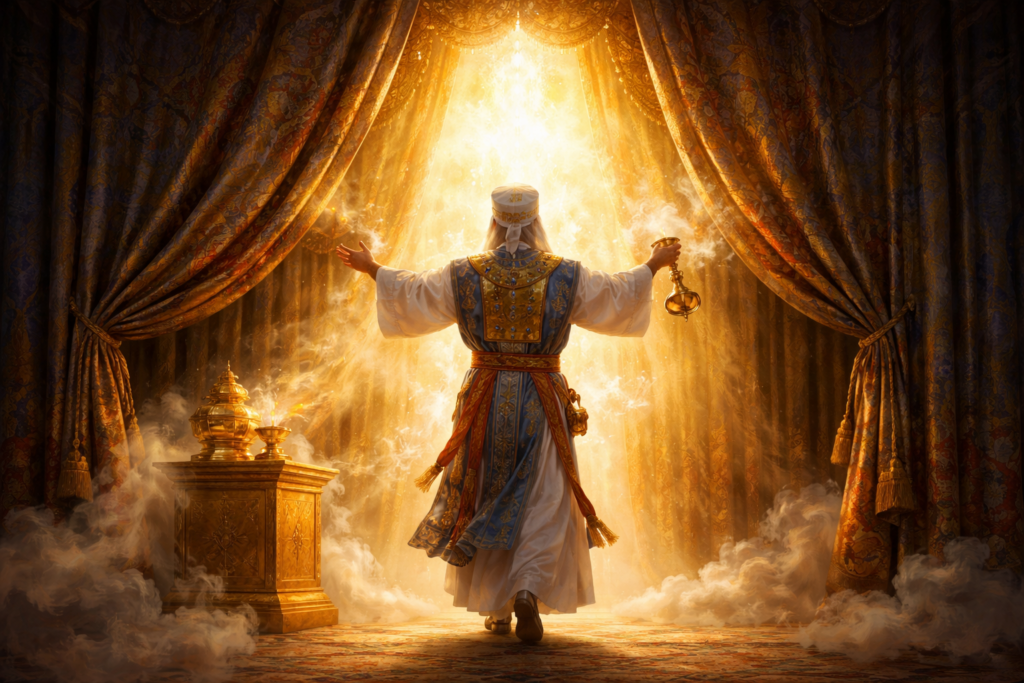
Exodus 40 ends with the Tabernacle fully constructed, erected, anointed, and filled. The cloud descends, and the glory of Adonai fills the Mishkan. The same glory that once covered Mount Sinai now fills this portable sanctuary in the midst of Israel’s camp. The text makes an intentional point: Moses was unable to enter the Tent of Meeting because the cloud rested upon it and the glory filled the Tabernacle. Access was denied—even to God’s mediator. The one who once entered the mountain cloud cannot enter this newly constructed sanctuary.
Leviticus: When Glory Descends but Access Is Denied
The final verses of Exodus form a hinge to Leviticus. The cloud remains over the Tabernacle by day and fire by night throughout Israel’s journeys. Immediately Leviticus opens: “Now Adonai called to Moses and spoke to him from the Tent of Meeting.” The voice comes from inside the sanctuary. God speaks outward from within His dwelling.
Just as in Genesis God spoke creation into ordered existence, here He speaks from within the Mishkan. Leviticus answers the question raised at the end of Exodus: If the glory has descended and even Moses cannot enter, who can approach? Who may ascend? Psalm 24 asks the same question and answers it: the one with clean hands and a pure heart.
Leviticus provides the protocol for approaching a holy God.
Genesis describes how God filled creation. Exodus describes how God filled the Tabernacle. Leviticus explains how humanity may approach that filling. It introduces mediation through a set-apart priesthood and establishes boundaries that regulate access.
Sacred Space, Boundaries, and the Danger of Approach
In Genesis 1–2, God speaks and order emerges. Humanity is placed within sacred space and given a vocation “to serve” (avad) and “to guard” (shamar). These same verbs later describe priestly responsibilities in Numbers. Adam’s placement in the garden included structured access. There was abundance, but there were also limits. Access to the tree of the knowledge of good and evil was restricted. Adam transgressed that boundary, and the result was exile. Sacred space was then guarded by cherubim.
Exodus mirrors this pattern. The Tabernacle becomes concentrated holy space in Israel’s midst. Holiness implies restriction. Moses cannot enter. It is deadly if approached incorrectly. Leviticus 10 confirms this when Nadab and Abihu offer unauthorized fire and die before Adonai. The issue seems to be the violation of divine boundaries.
Leviticus is fundamentally about boundaries. These boundaries are protective, not punitive. Greater proximity to holiness requires greater accountability. The central question becomes clear: How does one approach divine glory without dying?
The answer unfolds through sacrifice, blood, priesthood, and graduated holy space. Access is mediated.
Blood, Mediation, and the Restoration of Access
Leviticus 1 introduces the elevation offering, the korban olah. The term korban derives from karav, meaning “to draw near.” The offering is brought to “the entrance of the Tent of Meeting.” The altar stands at the boundary between common space and holy space. The animal is slaughtered before Adonai, and the priests apply the blood to the altar.
This must be understood in contrast to the broader Ancient Near Eastern world. In Mesopotamian religion, sacrifices were offered to feed the gods. In Israel, blood functions to cleanse sacred space. Leviticus 17 explains, “The life is in the blood… I have given it to you upon the altar to make atonement.” The Hebrew root kaphar means to purge or cleanse. Blood represents life given in place of life and serves as a ritual means of removing contamination from the sanctuary.
Since Genesis 3, death entered the human condition. A life had been forfeited. Blood symbolized life offered to restore covenant order so that the divine presence could remain among the people.
Leviticus is not about arbitrary restriction; it is about structured access. In Exodus 33, during the golden calf incident, Moses met God in a provisional tent outside the camp. By Exodus 40, reconciliation had occurred, and the permanent sanctuary replaced the provisional one. The Tent of Meeting and the Tabernacle are treated as one unified structure, but access is now carefully regulated.
Leviticus 10 demonstrates the danger of unauthorized approach. Leviticus 16 establishes the Day of Atonement, structuring the only annual entry into the Holy of Holies. The pattern remains consistent: unregulated access leads to death; ordered approach leads to life.
Every sacrifice represents regulated nearness. Israel does not return fully to Eden, but it moves toward the presence under defined conditions. Worship—the telos of creation—requires ordered access. Holiness requires limits. Sacred space is not common space.
Leviticus makes clear that life in the presence of a holy God depends upon approaching Him in the way He has prescribed.
The sacrificial system, however, also pointed beyond itself. The blood of bulls and goats cleansed sacred space ritually yet temporarily. In the fullness of time, Yeshua entered the story as the true mediator. His blood was offered once for all. His death addressed the root problem introduced in Genesis 3.
Through His shed blood, sacred space is cleansed at its deepest level. The barrier of restricted access is lifted. What Leviticus regulated through priesthood and sacrifice, Messiah fulfills through His own life given. He becomes both the offering and the High Priest. His work enables humanity to approach a holy God. The restrictions were never discarded; now they are satisfied. His blood opens the way.
He is the door of access.
Question; Yeshua came as a man, and The Word says- “No man dies for another man’s sins”? Please enlighten me? Sincerely, Linda
No man dies for another man’s sins reflects individual accountability in the civil justice system of Israel. Courts were forbidden to punish one person for another’s crime. This has to do guarding against injustice. At the same time God works through representative figures as I just wrote about. Adam as humanity, the high priest on the day of atonement for the nation, the servant in Isaiah bearing the iniquity of Israel. Jesus’ death as one dying for the many according to Caiphas. I think we have to understand this within a biblical framework. Yeshua’s work is not to absorb punishment by appeasing an angry God. Rather Yeshua represents the faithful Israelite, the covenant son, the high priest all at the same time. He embodies his people and offers himself in covenant solidarity. He is not dying for another man’s sin but is taking on the sin himself as if he were Israel,the high priest etc .
Very good reply and explanation to Linda’s question, thank you, Dinah!