Tag: Moses

Purim

How Purim Replays the Exodus Story

Though the book of Esther and the celebration of Purim is a captivating story about court intrigue and political reversal, it is also an Exodus story revisited. Different empire. Different tyrant. Different geography. Different circumstances. The message, however, is the same: the deliverance of God’s people in exile. The Exodus is the story through which Israel learns how God acts in history. And in Persia, once again under imperial shadow, that story unfolds.

How Esther Replays the Exodus Story

In the opening chapters of Exodus, Egypt is humming along with its building projects. Pharaoh’s power is consolidated. The machinery of his empire is functioning with precision. Then comes the threat: “The people of Israel are too many and too mighty for us.” Israel’s multiplication unsettles Pharaoh — this external challenge could create political instability for the empire.

In Esther, Persia stands equally secure under King Ahasuerus. The empire stretches across many provinces with bureaucratic efficiency. And again, a threat is perceived at Purim. Haman describes “a certain people scattered and dispersed… whose laws are different from those of every other people.” Their distinctiveness is intolerable, embodied most clearly in Esther’s Uncle, Mordecai. Their allegiance to another law exposes the limits of imperial control.

Pharaoh sees Israel as a resource to be exploited and restrained. Haman sees the Yehudi, those belonging to Judah, as politically subversive. In both narratives, the identity of the people of God collides with imperial fortunes. That collision ultimately provokes a genocidal decree. Empire cannot abide a people whose ultimate loyalty lies elsewhere.

The Decree of Death

So, the decrees are issued.

In Exodus, Pharaoh commands the death of Hebrew baby boys. In Esther, Haman seeks the annihilation of every Jew, men, women, and children, all across the empire. Both convert fear into public policy. Both attempt to legislate the erasure of God’s people.

Passover on the Calendar

Then the text of Esther and the story of Purim introduces a detail tied directly to Passover. “The king’s scribes were summoned on the thirteenth day of the first month” (Esther 3:12). The first month is Nisan. The thirteenth day is the eve of Passover. The decree of destruction goes out on the threshold of Israel’s feast of deliverance.

On Nisan 14, Israel remembers a night when earlier another genocidal decree hung over them in Egypt. A ruler had issued a death sentence. The covenant people were targeted. Deliverance came, and the turning point was Passover.

In Esther, the Persian ruler confirms a death sentence. Once again the covenant people are targeted. Deliverance will come — but through hidden providence at Purim And the threat begins at Passover time.

The author of Esther never names God. Never explicitly invokes Passover. Yet the narrative is framed against the calendar of redemption. It is as if another Pharaoh has arisen. The Exodus is being replayed, though without plagues or parted seas.

The connection deepens when we are told that Haman is an Agagite. Amalek was Israel’s first enemy after crossing the Reed Sea. The wilderness conflict in Exodus 17 reverberates through this genealogical detail. Amalek attacked the weary and the vulnerable. Now an Amalekite descendant rises again to threaten Israel’s existence. The ancient enemy has returned. The Exodus is not finished.

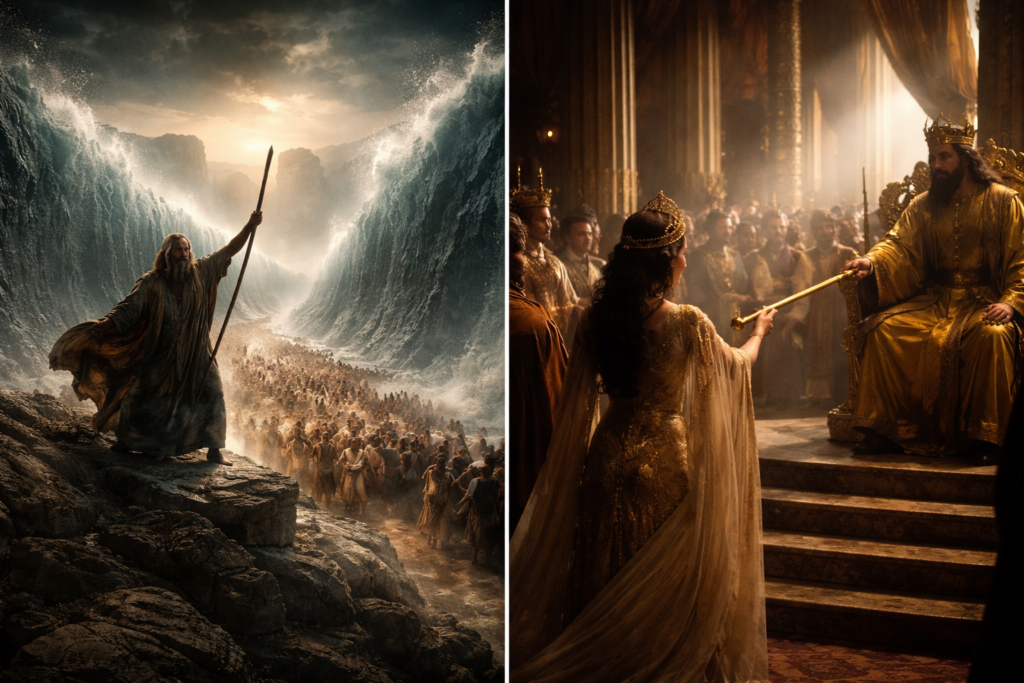
Even the deliverers mirror one another. Moses is raised in Pharaoh’s house, positioned inside the structure of empire. Esther — Hadassah — becomes queen in the Persian palace, embedded within imperial power. Both conceal their identities. Both are elevated not by political maneuvering but by providence. Both hesitate. Both must risk death for the sake of their people.

In Exodus, deliverance centers on redemption through the Passover lamb. Death passes over the homes marked by blood. Pharaoh’s army, pursuing Israel into the sea, is swallowed by the waters of the deep, waters that symbolized chaos. The Reed Sea turns back upon him, a reversal of a place that signified paradise in the Egyptian imagination. The empire’s instrument of control becomes its grave.

In Esther, reversal defines the climax. Haman constructs a towering wooden stake for Mordecai. That very structure becomes the site of his own execution. The weapon formed against God’s people collapses upon Haman. There is a pattern — chaos always turns back upon itself when Yahweh is in charge.

Passover on the Calendar

The story of Esther unfolds at a time when the Temple has already been rebuilt. In 515 BCE, under King Darius of the Achaemenid empire, the Second Temple stands in Jerusalem. Sacrifices have resumed. The presence of God dwells in the land in the Temple. And yet many of the Yehudi choose to remain in Persia. They are geographically separated from the central sanctuary.

If God’s presence is enthroned in Jerusalem, what does that mean for those still scattered in exile in Persia?

The book of Esther does not suggest relocating the Temple to Persia. Instead, it reveals something deeper about God’s dwelling. Though His name is absent from the book, His providence saturates His people wherever they settle. The hidden hand of divine presence is evident.

Temple imagery persists even in exile. Instead of sacrifice, there is fasting. Instead of priestly entry into the Holy of Holies, Esther approaches the king’s throne uninvited, risking death. The golden scepter is extended. Acceptance is granted. Like Moses, she stands as mediator between decree and people — a royal high priest in the Persian court.

And though the Temple stands in Jerusalem, God is not confined to Jerusalem.

Exodus culminates at Sinai in a covenant meal. The elders ascend, behold God, and eat in His presence. Deliverance leads to the indwelling presence of Yahweh. Salvation leads to communion. Esther, too, ends with a feast — Purim. Joy replaces mourning. Fear turns into celebration. The people institute an annual remembrance of a mighty reversal.

The date for Purim is set for destruction—Adar 13 becomes a day of Jewish triumph. In Exodus, destruction falls upon those without blood applied to their doorways. In Esther, destruction falls upon those who sought to erase God’s people. Reversal once again marks divine intervention.

The Pattern That Continues

Pharaoh or Haman. Egypt or Persia. Sea or gallows.

The question remains the same: Who has authority over life and death?

Purim answers the same way Passover answered. Certainly not empire.

The Exodus is not a closed chapter in Israel’s history. It is the interpretive lens through which history is understood. Esther and Purim continues the story. God delivers His people so He can dwell with them. In Egypt. At Sinai. In Jerusalem. In Persia.

And perhaps that is why the book of Esther feels so familiar. The names and locations have changed, but the story has not.
Purim
Moses

A Creative Look at the Birth of Moses

A simple birthing stool sat in the center of the mud-brick house. Despite wear and tear from generations of use, the brick stool was still sturdy enough. Many Hebrew babies had passed through it, but another birth was about to take place. Despite the modest surroundings, the birth of Moses would be far from ordinary.

Two Hebrew midwives attended Jochebed as she labored. Their steady hands would remain true to their calling, regardless of what happened next. With one final push, a loud cry filled the house. Exhaustion swept over Jochebed. The color returned to her hands as she slowly released her grip on the birthing stool. Joy and relief were palpable but followed quickly by pangs of fear. She’d given birth to a baby boy and named him Moses.

The midwives nodded in approval. Shiphrah, meaning “brightness like the stars,” placed a hand behind Jochebed’s head and stared knowingly into her eyes. Both women smiled softly at the challenge before them. Though Pharaoh had ordered the death of every Hebrew baby boy, the midwives had never considered obeying him. Their calling was to preserve life.

Puah, meaning “to glitter,” was the younger of the two midwives. She hummed a familiar Hebrew melody as she rubbed the baby Moses with dried myrtle leaf powder. She wrapped him in white swaddling cloth before handing him to his mother. According to the Hebrew sages, it was Adar 7 on the Hebrew calendar—a date that now speaks of the birth of Moses birth and his death.

Big sister Miriam beamed with delight. She watched intently as baby Moses began to nurse. Aharon, just a toddler at the time, cooed loudly to celebrate the arrival of a brother. Their father, Amram, a Levite, sang in hushed tones with priestly dedication: “Hear O Israel the Lord our God is One! Blessed be the Name of His Glorious Kingdom for all Eternity!” Amram sensed the presence of Yahweh in that moment, and his heart swelled with joy. A warm radiance filled their home, and Jochebed and Amram declared, “Glory to God in the highest, and shalom on the earth.” The proud parents saw that their baby Moses was “good”—a reflection of the light at creation, penetrating the chaos of slavery that oppressed their lives.

As the women focused their attention on mother and child, Amram stood watch. He heard the sound of heavy footsteps in the distance—Egyptian soldiers. He looked at his wife and lifted a finger to his lips. The family froze. Even baby Moses grew quiet.

Israelite slaves had built the Pharaoh’s expansive kingdom. Hard work calloused their hands and strengthened their bodies, and now Pharaoh feared an uprising of the enemies he’d created. He sent taskmasters to break their backs, but he could never truly subjugate their hearts. Even in slavery, the Israelites thrived. A population explosion in the Hebrew quarter caused Pharaoh great anxiety, and he convinced himself that his empire was in danger.

Based on their reading of the constellation Orion—the embodiment of their god Osiris—Egyptian astrologers predicted that a liberator would rise up from among the Hebrews. This sign in the heavens only furthered Pharaoh’s obsession. Every night in his private chambers, he stewed over reports of secret births. Realizing the midwives had defied his orders to quietly kill the male infants at birth, Pharaoh decreed all Hebrew baby boys be cast into the Nile—a judgment to be carried out in the name of Amon, the god of divine order. The cries of grieving mothers echoed through the narrow streets of Goshen as babies were drowned in unfathomable numbers. The wailing of her Israelite sisters tormented Jochebed throughout her pregnancy. The sorrow was immeasurable, and it left an indelible trauma that threatened the very social fabric of the Israelite community. Mothers and sisters who had once gathered to support each other found themselves turning away from pregnant neighbors, unable to bear the grief.

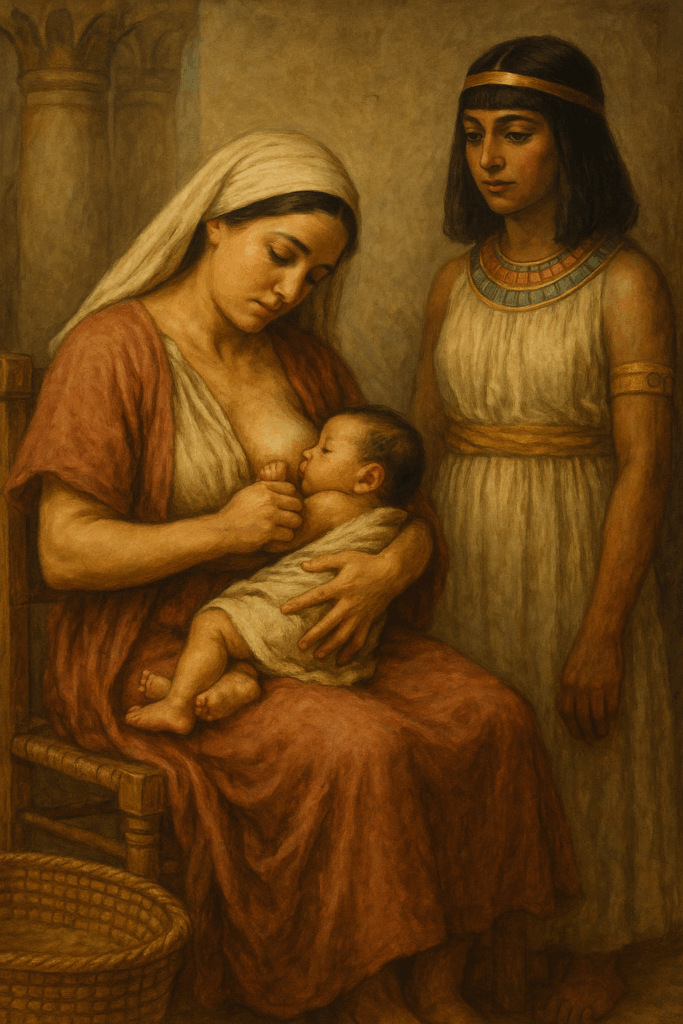
Yet, despite Pharaoh’s best efforts, Moses was born. And his life meant the restoration of Israel’s life. Amram’s skilled hands created a sanctuary for his son. For three months the family hid the growing infant behind a false brick wall covered in papyrus. Jochebed nursed her son Moses in the darkness, her hand readied to cover his mouth if his cries became too loud. Then, on Sivan 6, an auspicious day on the Hebrew calendar, Jochebed knew they could hide him no longer. The baby’s cries grew stronger, and visits to the land of Goshen by the Egyptian soldiers became more frequent.

Jochebed recalled her ancestor, Noah, who built a large floating vessel that carried God’s presence and preserved life. Inspired by this, her husband, Amram, and a few trusted elders constructed a miniature reed hut, sealing it with tar and pitch. They worked at night after long days of labor for Pharaoh.

Pharaoh’s palace dominated the eastern Nile Delta—the part of the land of Goshen where the Israelites had settled. The vast complex consisted of temples, halls, and elite villas centered around a grand ceremonial lake whose waters were connected to the Nile by a series of canals. The Temple of Amon, towering beside the river, welcomed pilgrims who arrived by boat to worship the god and to perform ritual acts of service. Beyond the temple lay Pharaoh’s private bathhouse. The sanctuary-like setting featured beauty treatments for spiritual purification. There, members of the royal household sought connection with the divine through water.

Among those who visited daily was the daughter of Pharaoh—a young woman highly educated in royal protocol. She often watched the reed barges floating downstream from temple to temple, carrying sacred images of Egypt’s gods—like the god Horus, of whom Pharaoh was the incarnation. These floating shrines, built from papyrus, symbolized divine protection and a renewed connection between Heaven and Earth. In observing these quiet morning rituals, the princess found freedom from her royal duties.

The princess’s bathing routine was common knowledge among the Hebrew slaves, whose eyes and ears missed nothing.

Jochebed and Miriam gently nestled Moses into the papyrus hut—the scent of the Nile’s damp reeds hung in the air.  A tearful Jochebed pressed her lips to his forehead uncertain if she would ever hold him again. They pushed the basket from the banks of the river, just within reach of the royal bathing site. The little ark blended well with the sacred barges sailing the Nile. Miriam hid nearby in the reeds, watching and waiting—her young shoulders bearing the weight of her brother’s fate.

The princess descended to the river to bathe when her eyes immediately spotted something unusual. As she and her attendants waded into the water, a small reed shrine caught her attention. It was unlike the grander floating oracles for the gods of Egypt that she knew so well—smaller, cruder, yet somehow compelling. She gestured to her maid servant who retrieved the shrine and pushed it to shore. Pharaoh’s daughter hesitated—her hand hovering over the small reed basket. She heard a baby’s cry, faint but unmistakable. As she lifted the lid, she knew at once that she was looking upon a Hebrew child. His dark features bore the marks of a people she had been taught from birth to despise.

The god Horus immediately flashed through her mind. Sky god and protector of Pharaoh, she knew he was the embodiment of kingship. His destiny was to defeat chaos and rule in justice. The parallels were too clear to ignore. Horus had also been hidden among the reeds of the Nile by his mother to save him from his evil Uncle Seth—who tried desperately to prevent Horus from claiming the throne. Isis drew her son out of water, nursed him in secret, and kept him hidden from danger. It was a story the princess had been told since childhood. So, was this infant like Horus under divine protection? Was this a sign from the gods?

Pharaoh’s daughter was highly knowledgeable in the organization of Egypt’s pantheon, but she also remembered the old stories told by senior servants in the royal court—stories of a man named Joseph, who had once risen to second in command under Pharaoh, and of Yahweh, the God whom Joseph worshiped. Staring down at the baby whose bright eyes pierced her soul, she sensed she was looking at a living image of that invisible God, Yahweh.

Miriam took a deep breath and stepped carefully from among the reeds, rehearsing word for word the message her mother had given her.

“I have a Hebrew wet nurse for the child?” she said as the princess caught her gaze.

The princess nodded softly, acknowledging the girl’s connection to the infant. She knew well there were many mothers in mourning from whom to choose—women whose arms ached for their lost babies. She understood this nurse must be tied to the child—perhaps being his own mother.

Before handing him over for a time, the princess named the baby Moses, meaning to draw out of water—an Egyptian name that would bridge two worlds.

Six women had played a role in the birth of Moses: First, of course, were the midwives, whose names spoke of Yahweh’s splendor and whose hands had preserved countless Hebrew sons; his own mother, whose name signified divine glory and whose faith would soon be tested; and his sister, Miriam, whose name meant rebel—a quality expressed through her own defiance of Pharaoh’s decree. Then was the Egyptian princess, the unlikely rescuer of the Hebrew infant. She was recognized in Egypt as the daughter of the hidden one—Amon, the god of Egypt’s creation. Her compassion would obscure the boundaries between oppressor and oppressed. And finally, there was the unnamed handmaiden of the princess. 

And so, Moses, the deliverer of Israel, was raised up in Pharaoh’s court—steeped in Egyptian wisdom but bound to Yahweh through an unbreakable bond of faith. During those precious nursing years, Jochebed instilled in her son a deep love for Yahweh and His people. She poured into Moses an innate ability to hear God’s voice amid the noise of the Egyptian gods, and she filled him with the knowledge of his destiny—deliverer and shepherd of his people. The seeds she planted would lie dormant for decades, but they would later take root and grow. They would bloom at the foot of a burning bush where the God of Israel would personally visit Moses.

It was for such a time that Moses, a child of two worlds, was born—saved by water to birth a nation through water.

Moses

––––––––––––––––––––––––––––––––––––––––––––––––––––––––––––––––––––––––

Authors Note:

The identity of the Pharaoh of the Exodus is uncertain. Some Egyptologists, such as David Rohl, argue that Pharaoh Ahmosis I was the most likely candidate. Ancient historian Josephus shared that belief. Josephus was likely influenced by the linguistic similarity between “Moses” and “Ahmosis,” both meaning “to draw out of water.” The Tempest Stele erected by Ahmosis I describes storms and cosmic disruptions reminiscent of the biblical plagues in Egypt. Ahmosis was said to be the incarnation of Horus, the god of kingship, whose birth bore a striking resemblance to that of Moses. I tend to lean toward the Ahmosis I theory, despite its speculative nature.

Pharaoh Ahmosis I (1539–1514 BCE) inaugurated the New Kingdom and 18th Dynasty, aligning perfectly with Exodus 1:8—”a new king over Egypt who did not know Joseph.” Other historical events strengthen this connection. Ahmosis expelled the Hyksos, a Semitic people who had ruled Lower Egypt, and who likely exacerbated tensions in the land. Were they the Hebrew slaves? The Hebrew word for Moses’s basket, “tevah,” is an Egyptian loanword. Rather than the small woven-reed basket we generally imagine, Egyptian tradition reveals that reed hut-like shrines regularly floated down the Nile carrying divine images.

Skip to content