Tag: Jordan

Hor

Mount Hor: The Mountain Above Petra That Most Never See—But I Did

Most visitors who come to Petra spend the day marveling at the Treasury, the towering sandstone cliffs, and the remarkable architecture carved into the rose-red rock. Few realize that high above the ancient city rises one of the most significant mountains in Israel’s wilderness journey—Mt Hor.

In 1999 my husband and I had the opportunity to visit Petra with a tour group. We expected to spend the day exploring the famous ruins. Then someone mentioned that it was possible to ride camels up to the traditional site of Aaron’s tomb on Mount Hor.

Anyone who knows me knows I never pass up an adventure.

Another couple from South Dakota joined us, and together we hired a Jordanian guide. Camels were brought, saddles secured, lunches packed, and before long we were climbing the mountain.

At least, that was the plan.

I was assigned the camel with the worst gait imaginable. Instead of the smooth rolling motion camels are famous for, mine bounced with every step. I felt as though I were inside a washing machine. After only a few minutes I knew I could never survive several hours on that animal.

My husband smiled and offered to trade. It was completely unselfish because he knew we still had six hours ahead of us. I happily accepted.

Slowly we climbed above Petra. Far in the distance we could already see the whitewashed shrine that crowned the summit.

Along the dusty trail we passed a large Bedouin family living in a cave. The floor was packed earth covered with prayer rugs. Their children, their clothing, even their faces carried the dust of the mountain. The women made colorful beaded bracelets for passing travelers, and we gladly purchased a few. One young mother sat quietly in the corner nursing her baby while life continued all around her.

It was another world. Only a day later we would be staying in a first-class hotel in Amman. The contrast could not have been greater.

We had not planned for this excursion. We were dressed for walking through Petra, not riding camels over rough mountain trails. The thick wool saddle reminded us of that decision with every mile.

Fortunately, we had plenty of water and food.

Up…and up…we climbed. After a while the awkward motion of the camel became routine and we settled into its rhythm as the white shrine slowly drew nearer.

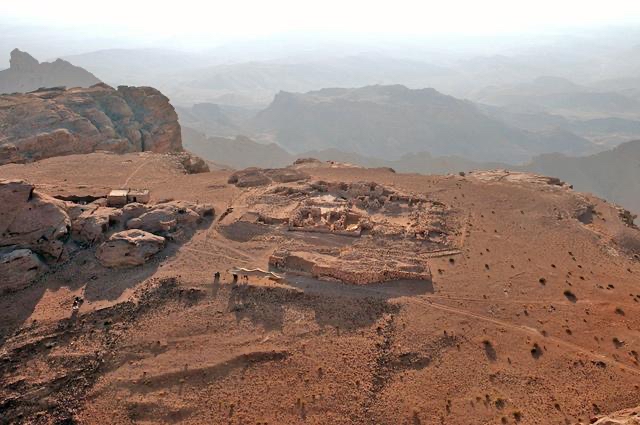
Nearly two hours later we reached a broad plateau just below the summit.

There we encountered a team of archaeologists from Finland and Sweden excavating a large complex spread across the mountainside. Our guide explained that the camels could go no farther. The final ascent was too steep and the summit too narrow. The archaeologists kindly allowed us to leave the camels with them while we climbed the last rocky stretch on foot.

At the time, we had no idea what they were uncovering. We simply assumed they were excavating another ancient ruin.

Only years later did I discover how remarkable that meeting had been. The excavation had begun only two years earlier under the direction of scholars from the University of Helsinki. We had arrived during one of the most exciting periods in the site’s modern history.

What they uncovered transformed our understanding of Mount Hor.

Jabal Harun—“Mountain of Aaron” stands about three miles southwest of Petra and rises more than 4,400 feet above sea level, making it the highest peak in the Petra region. Living at nearly 7,000 feet in New Mexico, the altitude never bothered us. The descent, perched high on those sure-footed camels, demanded far more courage than the climb.

At the summit stands the familiar whitewashed shrine dedicated to the prophet Harun—Aaron in Arabic. The present structure dates to a restoration completed in A.D. 1320 during the Mamluk period, although it rests upon the remains of a much earlier Byzantine sanctuary. Inside is a simple memorial chamber honoring Aaron.

No archaeological discovery has confirmed that Aaron himself was buried there. Yet for nearly two thousand years Jews, Christians, and Muslims have revered this mountain as the place where Israel’s first high priest died. That tradition reaches back at least to Josephus in the first century.

Some modern scholars question whether this mountain lies too far inside ancient Edomite territory to be the biblical Mount Hor.

Perhaps. But a tradition preserved for nearly two thousand years carries considerable weight with me. Standing on that summit, looking across the wilderness stretching toward the land of promise, I found it difficult to imagine a more fitting place.

The Finnish excavations revealed that this mountain had become one of the oldest pilgrimage destinations. Beginning in the fourth and fifth centuries, Christians climbed the mountain believing they were approaching the place where Aaron died.

Archaeologists uncovered a large basilica, chapels, monks’ quarters, storerooms, kitchens, courtyards, water systems, and buildings that probably served as hostels for weary pilgrims. The complex measured roughly sixty-two by forty-eight meters—far larger than anyone expected.

This was a thriving center of worship that welcomed generations of pilgrims making the difficult ascent. Among the discoveries were thousands of pottery fragments, Byzantine coins, Greek inscriptions, a baptismal font, and even traces of an earlier Nabataean sanctuary beneath the Christian structures.

The mountain had been regarded as sacred long before the monastery was built. One inscription referred to Aaron as “the Holy High Priest.” The monks built an entire pilgrimage center around the memory of his death.

That tells us how they understood Numbers 20 and 33. When we read the account of Aaron’s death, it is easy to focus only on the man. The biblical writers focus on something larger. Aaron ascends the mountain. His priestly garments are removed. They are placed upon Eleazar. Israel mourns for thirty days. Then their journey resumes. The mountain becomes the place where one servant lays down his calling, and another receives it.

Throughout the ancient Near East, kings often passed through ceremonies of humiliation before enthronement. Royal garments were stripped away before new garments were bestowed. Humbling preceded exaltation. Aaron’s priestly garments are stripped away on Mount Hor before they are placed upon Eleazar. The priesthood continues. Garments signify office, identity and calling.

Standing on that mountain twenty-six years ago, I could not have appreciated all of this. I simply remember the breathtaking view, the white shrine shining beneath the blue sky and the Jordanian sun, the archaeologists working below us, and the long camel ride from and to Petra.
Hor
worship

Worship and Wrestle: Finding God at Jabbok

The framework that once carried Christianity through American life is collapsing. In the decades following World War II, churches existed within a society that largely reinforced a Christian worldview. Schools, neighborhoods, civic institutions, entertainment, and public discourse all contributed to moral and ethical standards shaped largely by biblical ideas.

That world has disappeared before our eyes.

The challenge facing the church today is not primarily political, institutional, or technological. It is a question of worship. What captures our attention will ultimately shape our affections. Everyday millions of people are formed by the liturgies of distraction, comparison, outrage, self-promotion, and anxiety. The question confronting believers is not merely what we believe, but what has our attention, our loyalty, and ultimately our worship.

Yet this struggle is not new.

From the opening chapters of Scripture, humanity has faced the same fundamental choice. In the garden, the serpent’s temptation was not simply disobedience. It was an invitation to self-exaltation. Humanity was enticed to define good and evil on its own terms, to determine reality apart from God, and to become the source of its own wisdom and authority. The temptation was fundamentally about worship. Would humanity trust the Creator, or seek to take His place?

The same conflict appears in the wilderness. After forty days of fasting, Yeshua confronts haSatan—the adversary. Each temptation offers a shortcut to glory, authority, and power apart from obedience to the Father. Each temptation is a counterfeit form of worship. The wilderness becomes a battlefield where the question is: worship God or worship self.

The same choice confronts every generation. It confronts us now.

We often imagine that transformation happens through dramatic moments, but Scripture consistently portrays character as the result of countless decisions. Every day we choose what will shape us. Every day we choose whether to pursue righteousness or pursue ourselves. Every day we choose responsibility or resentment, trust or anxiety, obedience or self-determination. Over time, these choices become the path upon which we pattern our lives.

The story of Jacob speaks powerfully to our present moment.

Jacob is one of Scripture’s most recognizable portraits of humanity. He is flawed, ambitious, deceptive, manipulative, fearful, and yet remarkably successful. Again and again, he secures what he wants through strategy and persistence. He obtains the birthright. He deceives Isaac. He survives Laban. He accumulates wealth. He builds a household. By every visible measure, Jacob succeeds.

Yet prosperity and transformation are not the same thing.

God has blessed Jacob, but Jacob remains Jacob.

When God calls Jacob to return to the land, he is forced to confront the consequences of his past in the person of his brother Esau. The report from Jacob’s servants is alarming. Esau is approaching with four hundred men. Suddenly all of Jacob’s strategies seem inadequate. The text says he was greatly afraid and greatly distressed. The language evokes pressure and tribulation. Jacob finds himself in a place from which there appears to be no escape—no backup plan.

His first instinct is the same instinct that has governed his entire life. He calculates. He divides the camp. He develops contingency plans. If one group is attacked, perhaps another can survive. Even his prayer reflects the tension between faith and fear. He reminds God of the promises. He asks for deliverance (natzal) from Esau’s hand, using language that later echoes Israel’s deliverance from Egypt. Yet even while praying, Jacob continues arranging gifts and devising ways to appease his brother.

He is still trying to save himself.

Then night falls.

Jacob sends everyone across the river and remains alone. The isolation is key. Throughout Scripture, moments of transformation often occur when every support system and every backup plan has failed. No family. No servants. No flocks. No strategy left. Jacob is finally left with nothing but himself and God.

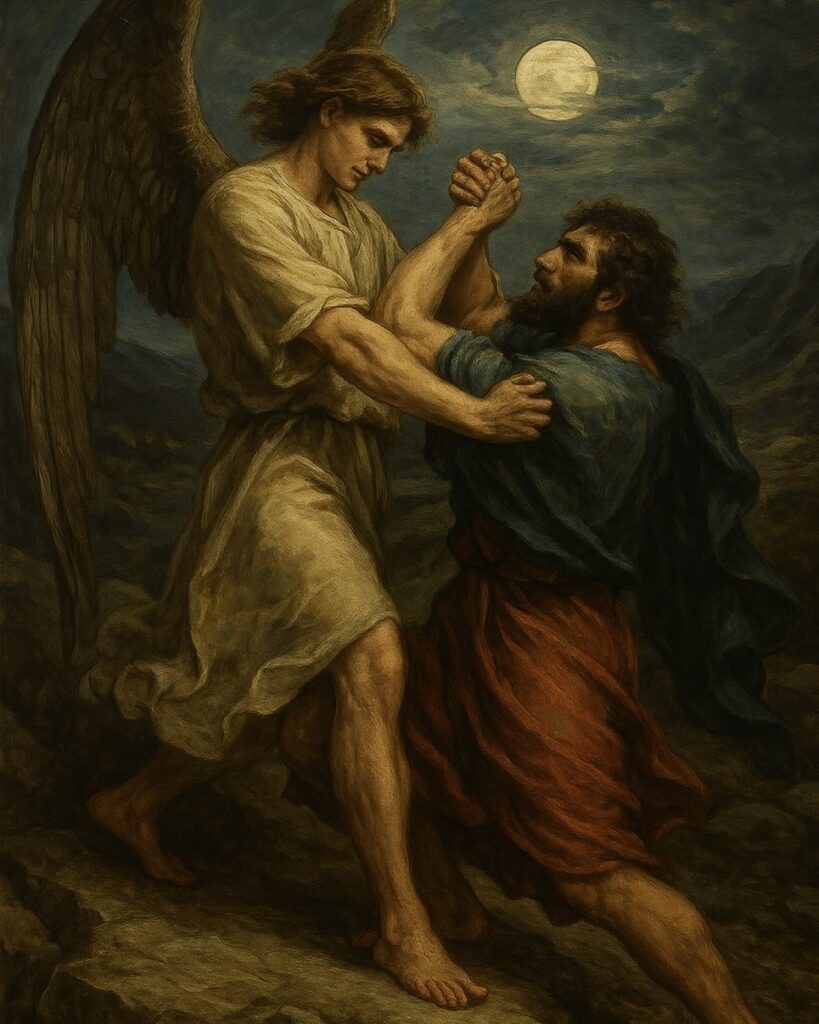
The encounter that follows is one of the most mysterious in all of Scripture. A “man” wrestles with him until the breaking of dawn. The Hebrew narrative is deliberately structured with a series of wordplays that intertwine Jacob’s identity with the place where the encounter occurs. Jacob, Ya’aqov, wrestles, ye’abeq, at the Jabbok River, Yabboq. The words echo one another in a way that simply can’t be accidental.

Many scholars have observed that the rare verb abaq likely carries the imagery of dust being stirred into the air. The scene depicts a violent struggle in the dirt beside the riverbank. Dust rises as these two figures grapple through the darkness.

Jacob has spent his entire life wrestling. He wrestled with Esau in the womb. He grasped his brother’s heel at birth. He fought for inheritance, blessing, prosperity, and security. Every major chapter of his life has been marked by struggle. Now, beside the Jabbok, all those struggles converge into one final encounter.

Many commentators suggest that Jacob is not only wrestling a mysterious divine opponent. He is wrestling his own past, his fears, his identity, and the person he has spent a lifetime becoming.

Dust is significant in Scripture. Humanity was formed from the dust of the earth. Dust reminds us of mortality, limitation, and dependence upon God. Jacob’s struggle unfolds in the very substance that testifies to human weakness. Everything he has trusted in himself is being exposed. His cleverness cannot secure the future. His plans cannot guarantee blessing. His manipulations cannot produce reconciliation.

What Jacob requires cannot come from Jacob. Wrestling is Required

The encounter also bears a striking resemblance to the combat scenes familiar throughout the ancient world. Heroes meet divine beings at rivers, mountains, and wilderness boundaries. The setting is liminal, standing between one reality and another. Darkness, struggle, blessing, and transformation all belong to this pattern. Jacob crosses the Jabbok as one man and emerges as another.

The irony of the story is that Jacob prevails not because he overpowers God, but because he refuses to let go. As dawn begins to rise, he clings to the One who has wounded him. The struggle leaves him limping, yet the limp itself becomes a sign of transformation. The wound ensures that he will never again confuse God’s blessing with his own strength.

When the encounter ends, Jacob receives a new name. The deceiver becomes Israel. The manipulator becomes one who has striven with God and endured. The dust settles. The old identity gives way to something new.

Perhaps this is where the faith community finds itself today.

The collapse of cultural Christianity has brought us to our own Jabbok. The structures and institutions that once reinforced faith are fading. The strategies that once seemed effective are proving insufficient. Like Jacob, we find ourselves standing between an old world that likely cannot be recovered and a future we can’t yet see clearly.

Yet it is often in such places that God does His deepest work.

The questions before us are not ultimately about political and institutional survival. They are questions about worship. Who is God? What is He doing in the world? What is His character? How does He transform human beings? How do we learn to trust Him when the familiar disappears?

Those questions are answered in the presence of God. They are answered through worship. They are answered through the long and often painful struggle of learning to trust Him more than we trust ourselves.

The cultural canopy that once carried Christianity is unlikely to return. But perhaps that is precisely the point. God has often done His most transformative work when His people could no longer rely upon the systems supporting them.

Like Jacob, we will discover that the path forward is found in surrendering our strengths. We will discover that blessing comes after the wrestling. We will discover that reconciliation with others begins with an encounter with God. And we may well discover that the collapse we so feared was actually the place where transformation began.

The choice remains what it has always been: worship God or worship self. Every day that choice stands before us. Every day we decide what will shape our hearts. Every day we choose whether we will cling to our own wisdom or hold fast to the God who meets us in the darkness and carries us into the dawn.

worship
Skip to content