Tag: Jacob

Joseph

When the Sun, Moon, and Stars Bowed

Joseph’s Dream and the Pattern of the Beloved Son

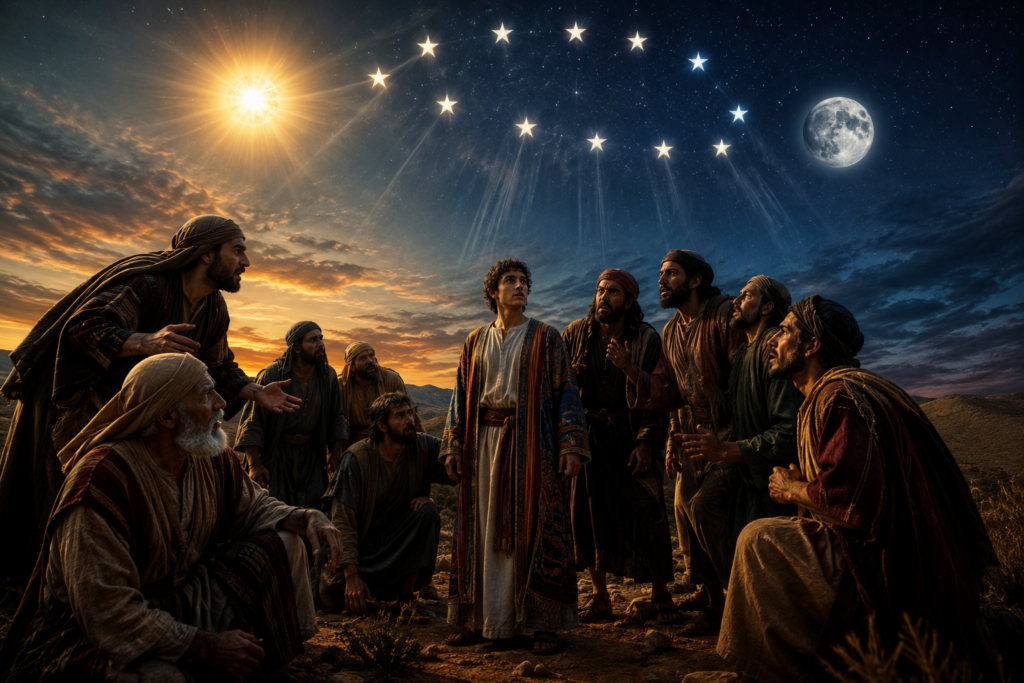
Joseph’s dream has long been read as a story of family rivalry. The sun, moon, and eleven stars bow before him, provoking jealousy and anger among his brothers. Jacob himself questions whether Joseph expects his father and mother to bow before him. Yet the dream announces something far greater than family authority. It introduces one of Scripture’s most enduring patterns: the beloved son who descends into suffering before being exalted to rule.

It begins with Isaac, the beloved son through whom the covenant continues. It is developed in Joseph, echoed in Moses and Joshua, and reaches its fulfillment in Yeshua. Throughout Scripture, God repeatedly chooses a royal heir whose path to authority leads first through rejection, humiliation, and apparent defeat.

Modern readers often miss another dimension of Joseph’s dream because we no longer live in the world of the ancient Near East. In Egypt, Mesopotamia, and later Rome, the sun, moon, and stars were not merely heavenly bodies. They formed the political language of empire. Kings associated themselves with the sun. Queens and royal households were linked with the moon. The stars represented princes, rulers, and members of the royal court. Joseph’s dream unfolds within that symbolic world.

When God commands Abraham, “Take your son, your only son, whom you love—Isaac,” most readers hear only the language of parental affection. Ancient audiences heard something more. Throughout Egypt and Mesopotamia, kings described the heir to their throne as the “beloved son,” the one chosen to inherit the dynasty and continue the royal line.

Genesis draws upon that same royal language

Isaac is not simply Abraham’s cherished child; he is the covenant heir through whom God’s kingdom purposes will continue.

The same pattern appears when Joseph is introduced. Genesis opens the story with, “These are the generations (toldot) of Jacob,” yet the narrative immediately turns to Joseph. Although Jacob has twelve sons, Joseph becomes the focus through whom the covenant story moves forward. In Genesis, the toldot formula consistently signals how God’s redemptive purposes advance. Joseph is presented as the beloved son, clothed with the ketonet passim, the long sleeved robe—a distinctive garment that marks his unique status within the family.

Then comes the dream.

Joseph dreams that the sun, moon, and eleven stars bow before him. Traditionally, the symbols are identified with Jacob, Rachel, and Joseph’s brothers. That interpretation is certainly correct, but it is not complete.

In the world of Egypt and Mesopotamia, the same heavenly bodies carried royal meaning. The sun symbolized supreme authority. The moon represented the royal household and its stability. The stars portrayed princes and rulers who surrounded the throne. Joseph’s dream therefore speaks the symbolic language of kingship.

His brothers immediately understand its implications. Their response is not simply wounded pride but more likely political outrage.

“Are you indeed going to reign over us?”

They recognize the dream as a claim to royal authority.

And they are right.

God is revealing the destiny of the beloved son. Joseph will one day stand at the right hand of Pharaoh himself, exercising authority that preserves the covenant family during famine. The dream announces not personal ambition but divine appointment.

Yet Joseph does not move from dream to throne in a single step. Before the beloved son is exalted, he must first descend.

Ancient Near Eastern royal ideology often reflected this same pattern. Before a king received the symbols of authority, he first passed through ritual humiliation. Royal garments were removed, insignia stripped away, and only afterward was he clothed anew and invested with the signs of kingship. Humiliation preceded exaltation.

Joseph’s life embodies that royal pattern. His distinctive robe is stripped from him. He is cast into a pit, sold into slavery, carried into Egypt, falsely accused, and confined to prison. Only after this long descent is he summoned before Pharaoh, clothed in fine linen, given the royal signet ring, and elevated to rule over the land.

Joseph’s dream was never merely about one young man rising to power in Egypt. From the beginning, it pointed beyond Joseph himself. The beloved son would be rejected before he was exalted. He would descend before he ascended. Through his suffering, God would preserve His people and advance His kingdom.

That pattern reaches its fulfillment in Yeshua.

The pit gives way to the tomb, the prison to the grave, and the throne of Pharaoh to the throne of heaven itself. What began with eleven stars bowing before Joseph ends with every ruler, every authority, and every power acknowledging the Beloved Son.

Joseph saw the pattern in a dream. The Beloved Son now reigns from the throne of heaven, and one day every ruler, every kingdom, and every power will bow before Him.

The Beloved Son is not simply a pattern we should find fascinating; He is the King we are called to follow. From Joseph to Yeshua, Scripture tells the same story. The pit gives way to the palace. The prison gives way to the throne. God brings His purposes to completion in His own time, and no earthly power can prevent what He has determined to accomplish.
Joseph
worship

Worship and Wrestle: Finding God at Jabbok

The framework that once carried Christianity through American life is collapsing. In the decades following World War II, churches existed within a society that largely reinforced a Christian worldview. Schools, neighborhoods, civic institutions, entertainment, and public discourse all contributed to moral and ethical standards shaped largely by biblical ideas.

That world has disappeared before our eyes.

The challenge facing the church today is not primarily political, institutional, or technological. It is a question of worship. What captures our attention will ultimately shape our affections. Everyday millions of people are formed by the liturgies of distraction, comparison, outrage, self-promotion, and anxiety. The question confronting believers is not merely what we believe, but what has our attention, our loyalty, and ultimately our worship.

Yet this struggle is not new.

From the opening chapters of Scripture, humanity has faced the same fundamental choice. In the garden, the serpent’s temptation was not simply disobedience. It was an invitation to self-exaltation. Humanity was enticed to define good and evil on its own terms, to determine reality apart from God, and to become the source of its own wisdom and authority. The temptation was fundamentally about worship. Would humanity trust the Creator, or seek to take His place?

The same conflict appears in the wilderness. After forty days of fasting, Yeshua confronts haSatan—the adversary. Each temptation offers a shortcut to glory, authority, and power apart from obedience to the Father. Each temptation is a counterfeit form of worship. The wilderness becomes a battlefield where the question is: worship God or worship self.

The same choice confronts every generation. It confronts us now.

We often imagine that transformation happens through dramatic moments, but Scripture consistently portrays character as the result of countless decisions. Every day we choose what will shape us. Every day we choose whether to pursue righteousness or pursue ourselves. Every day we choose responsibility or resentment, trust or anxiety, obedience or self-determination. Over time, these choices become the path upon which we pattern our lives.

The story of Jacob speaks powerfully to our present moment.

Jacob is one of Scripture’s most recognizable portraits of humanity. He is flawed, ambitious, deceptive, manipulative, fearful, and yet remarkably successful. Again and again, he secures what he wants through strategy and persistence. He obtains the birthright. He deceives Isaac. He survives Laban. He accumulates wealth. He builds a household. By every visible measure, Jacob succeeds.

Yet prosperity and transformation are not the same thing.

God has blessed Jacob, but Jacob remains Jacob.

When God calls Jacob to return to the land, he is forced to confront the consequences of his past in the person of his brother Esau. The report from Jacob’s servants is alarming. Esau is approaching with four hundred men. Suddenly all of Jacob’s strategies seem inadequate. The text says he was greatly afraid and greatly distressed. The language evokes pressure and tribulation. Jacob finds himself in a place from which there appears to be no escape—no backup plan.

His first instinct is the same instinct that has governed his entire life. He calculates. He divides the camp. He develops contingency plans. If one group is attacked, perhaps another can survive. Even his prayer reflects the tension between faith and fear. He reminds God of the promises. He asks for deliverance (natzal) from Esau’s hand, using language that later echoes Israel’s deliverance from Egypt. Yet even while praying, Jacob continues arranging gifts and devising ways to appease his brother.

He is still trying to save himself.

Then night falls.

Jacob sends everyone across the river and remains alone. The isolation is key. Throughout Scripture, moments of transformation often occur when every support system and every backup plan has failed. No family. No servants. No flocks. No strategy left. Jacob is finally left with nothing but himself and God.

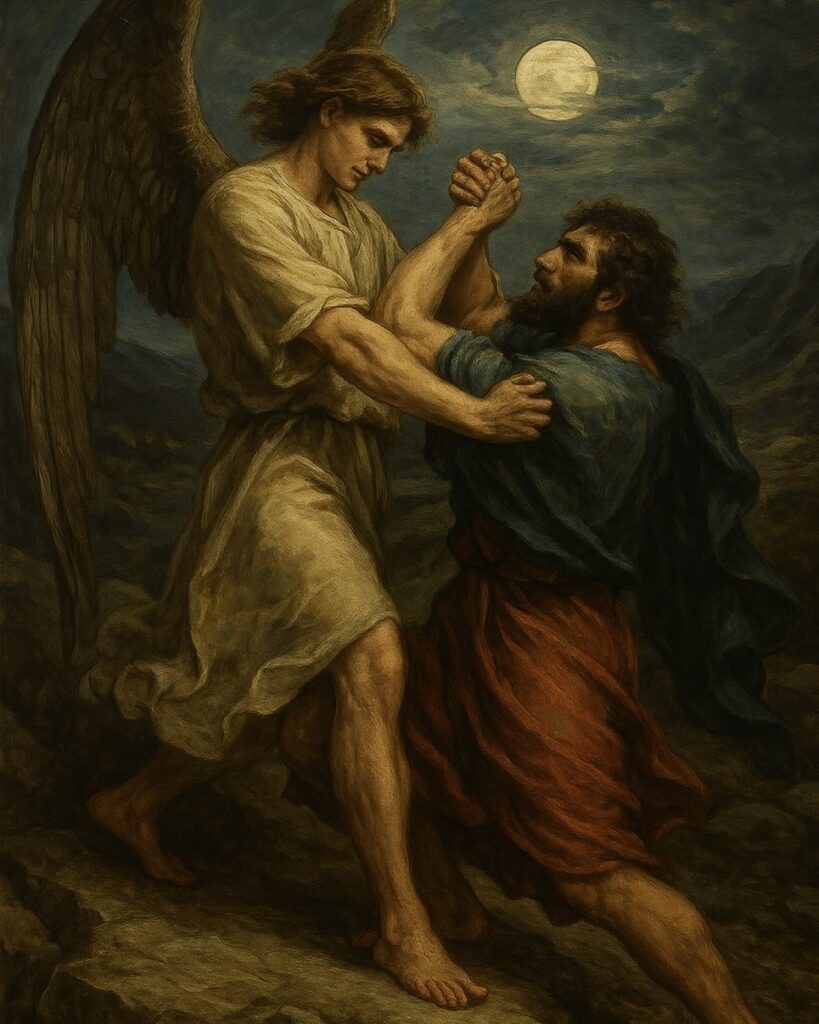
The encounter that follows is one of the most mysterious in all of Scripture. A “man” wrestles with him until the breaking of dawn. The Hebrew narrative is deliberately structured with a series of wordplays that intertwine Jacob’s identity with the place where the encounter occurs. Jacob, Ya’aqov, wrestles, ye’abeq, at the Jabbok River, Yabboq. The words echo one another in a way that simply can’t be accidental.

Many scholars have observed that the rare verb abaq likely carries the imagery of dust being stirred into the air. The scene depicts a violent struggle in the dirt beside the riverbank. Dust rises as these two figures grapple through the darkness.

Jacob has spent his entire life wrestling. He wrestled with Esau in the womb. He grasped his brother’s heel at birth. He fought for inheritance, blessing, prosperity, and security. Every major chapter of his life has been marked by struggle. Now, beside the Jabbok, all those struggles converge into one final encounter.

Many commentators suggest that Jacob is not only wrestling a mysterious divine opponent. He is wrestling his own past, his fears, his identity, and the person he has spent a lifetime becoming.

Dust is significant in Scripture. Humanity was formed from the dust of the earth. Dust reminds us of mortality, limitation, and dependence upon God. Jacob’s struggle unfolds in the very substance that testifies to human weakness. Everything he has trusted in himself is being exposed. His cleverness cannot secure the future. His plans cannot guarantee blessing. His manipulations cannot produce reconciliation.

What Jacob requires cannot come from Jacob. Wrestling is Required

The encounter also bears a striking resemblance to the combat scenes familiar throughout the ancient world. Heroes meet divine beings at rivers, mountains, and wilderness boundaries. The setting is liminal, standing between one reality and another. Darkness, struggle, blessing, and transformation all belong to this pattern. Jacob crosses the Jabbok as one man and emerges as another.

The irony of the story is that Jacob prevails not because he overpowers God, but because he refuses to let go. As dawn begins to rise, he clings to the One who has wounded him. The struggle leaves him limping, yet the limp itself becomes a sign of transformation. The wound ensures that he will never again confuse God’s blessing with his own strength.

When the encounter ends, Jacob receives a new name. The deceiver becomes Israel. The manipulator becomes one who has striven with God and endured. The dust settles. The old identity gives way to something new.

Perhaps this is where the faith community finds itself today.

The collapse of cultural Christianity has brought us to our own Jabbok. The structures and institutions that once reinforced faith are fading. The strategies that once seemed effective are proving insufficient. Like Jacob, we find ourselves standing between an old world that likely cannot be recovered and a future we can’t yet see clearly.

Yet it is often in such places that God does His deepest work.

The questions before us are not ultimately about political and institutional survival. They are questions about worship. Who is God? What is He doing in the world? What is His character? How does He transform human beings? How do we learn to trust Him when the familiar disappears?

Those questions are answered in the presence of God. They are answered through worship. They are answered through the long and often painful struggle of learning to trust Him more than we trust ourselves.

The cultural canopy that once carried Christianity is unlikely to return. But perhaps that is precisely the point. God has often done His most transformative work when His people could no longer rely upon the systems supporting them.

Like Jacob, we will discover that the path forward is found in surrendering our strengths. We will discover that blessing comes after the wrestling. We will discover that reconciliation with others begins with an encounter with God. And we may well discover that the collapse we so feared was actually the place where transformation began.

The choice remains what it has always been: worship God or worship self. Every day that choice stands before us. Every day we decide what will shape our hearts. Every day we choose whether we will cling to our own wisdom or hold fast to the God who meets us in the darkness and carries us into the dawn.

worship
Jacob's ladder

Jacob’s Ladder at Bethel: The Stones That Formed a Temple and Pointed to Messiah

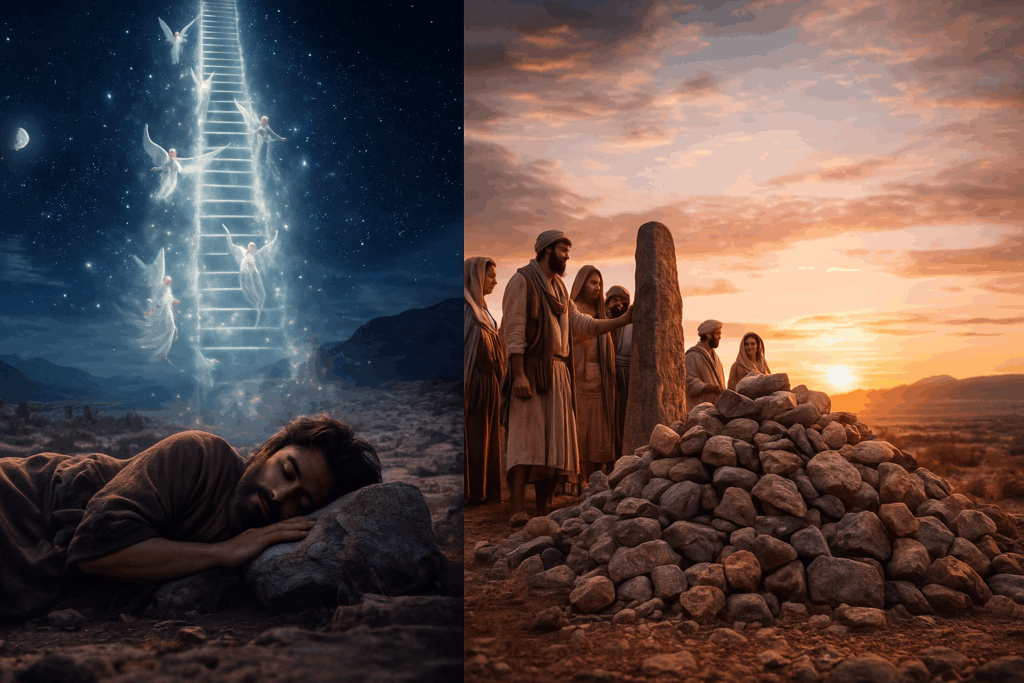
Most of us know Jacob’s ladder as a childhood Bible image—angels climbing a stairway to heaven while Jacob sleeps under the stars by a stone. The old spiritual sings, “We are climbing Jacob’s ladder… soldiers of the cross.” But in the Torah portion V’yetze (and he left), Jacob’s ladder is far more than a dream. It is the moment when heaven and earth meet at a single stone. The ladder or “sulam” really a ramp or stair—reveals Jacob himself becoming a living temple, a human Bethel or House of God. The four different stones he encounters at his head, at the pillar, at the well, and at the border reveal a pattern of creation, covenant, and new life.

In the ancient Near Eastern world, such stones were temple markers, miniature cosmic mountains, royal monuments, and legal witnesses. In Genesis, they show Yahweh breaking chaos and building His house through Jacob. The trajectory of Jacob’s ladder leads directly to Yeshua in John 1—the One who declares Himself the true Bethel, the Temple in flesh.

Bethel: Jacob’s Ladder and the Birth of a Living Temple

Jacob flees eastward from Beersheba just as Adam once fled east from Eden. His story is framed by four stone encounters—each a boundary marker steeped in ancient Near Eastern symbolism. Stones in that world were memorials, legal witnesses, temple foundations, and royal inscriptions—miniature mountains where heaven touched earth.

Jacob’s first night sets the pattern. Exhausted, he lays his head on a stone. That stone becomes the foundation for the most important vision of his life: a ramp rising from earth to heaven, with angels ascending and descending. Jacob wakes trembling, declaring, “This is none other than the House of God, and this is the gate of heaven.” He sets the stone upright, anoints it with oil, and consecrates it as a pillar, echoing ancient temple-dedication rites. A replication of Jacob’s ladder.

Bethel becomes the site of Jacob’s commissioning, the moment he becomes a living temple—a carrier of divine presence, a mobile sanctuary in the same pattern as the future tabernacle. The House of God is no longer fixed to a locale. It is attached to a man whom God has chosen.

From Bethel to Bethuel: The Cosmic House Meets the Human Household

Immediately after encountering the heavenly house, Jacob journeys to Bethuel, the household of Rebekah’s father. The names Bethel (House of God) and Bethuel (man of God, God dwells in him) echo one another. Bethel marks God’s cosmic dwelling; Bethuel marks the earthly family through whom His covenant will continue. Jacob’s journey from Bethel to Bethuel becomes a symbolic descent from the divine realm into the human realm.

The image of Jacob’s ladder is mirrored in John 1. Yeshua tells Nathanael that he will see “heaven opened and the angels of God ascending and descending upon the Son of Man.” Yeshua identifies Himself as the new Jacob’s ladder, the new Bethel—the living Temple where heaven and earth meet. And as Jacob enters Bethuel to form a covenant family, Yeshua gathers around Himself a renewed household of God.

The Stone at the Well: Life Released and Chaos Overturned

The stone theme continues in Haran. Jacob approaches a well that is covered with a massive stone. Wells symbolize life, fertility, covenant, and marriage. A stone that seals up a well symbolizes barrenness or the blockage of life.

Normally several shepherds were required to move the stone. Yet when Jacob sees Rachel, he rolls it away alone. This is not simply strength; it is also symbolism. Jacob removes the obstacle to life, opening the way for new creation. Like the opening of the Red Sea the sealed well becomes a life giving spring.

This foreshadows the stone rolled away at Yeshua’s tomb—the final overturning of chaos, barrenness, and death. Jacob’s act at the well signals that he is becoming a life-bringer, a patriarch through whom the twelve tribes, the living house of Israel will emerge.

The Covenant Boundary Stones: Jacob’s Exodus and Return

The final stone appears in Genesis 31. After twenty years, God commands Jacob to return, saying, “I am the God of Bethel, where you anointed the pillar and made a vow to Me.” Jacob’s story circles back to the first stone; the temple moment at Bethel anchors everything that follows.

Jacob sets up another pillar, and the whole family gathers stones to make a heap. This heap, or gal meaning to roll away, becomes the site of a covenant meal, a peace treaty, and a boundary line marking Jacob’s liberation from Laban’s oppression. It is Jacob’s exodus moment, the turning from exile toward home.

In the ancient world, stone pillars (stelae) marked victories, treaties, territories, and divine appearances. Jacob’s heap stands as a legal witness that God has delivered him, restored him, and established him in the land—just as the twelve stones of Sinai and the twelve stones of the Jordan stand as national covenant markers.

Jacob the Temple, Yeshua the Final Temple

Across these four stone encounters—the head-stone, the pillar, the well-stone, and the boundary-stone—Jacob is gradually transformed into a living temple. At the stone of Bethel he becomes the place where heaven and earth meet; at the anointed pillar he is consecrated as God’s chosen heir; at the well he becomes a giver of life, rolling away the obstruction that symbolizes chaos and releasing the waters of new creation; and at the boundary-stone he emerges as the liberated patriarch returning from exile to the land of promise.

Jacob’s ladder follows the biblical arc of creation, covenant, exile, return, and new creation. Yet the pattern reaches its fullness only in Yeshua, who becomes the true ladder or ramp joining heaven and earth in John 1 where angels are ascending and descending, the cornerstone of God’s living temple in Psalm 118 and Ephesians 2, the One who rolls away the stone of death in Mark 16, and the giver of living water in John 4. The stones ultimately point beyond Jacob to the Temple made flesh, the true Bethel through whom all nations are blessed.

Jacob's ladder

Skip to content