Tag: heaven and earth

veil

The Torn Veil and the Return of God’s Presence

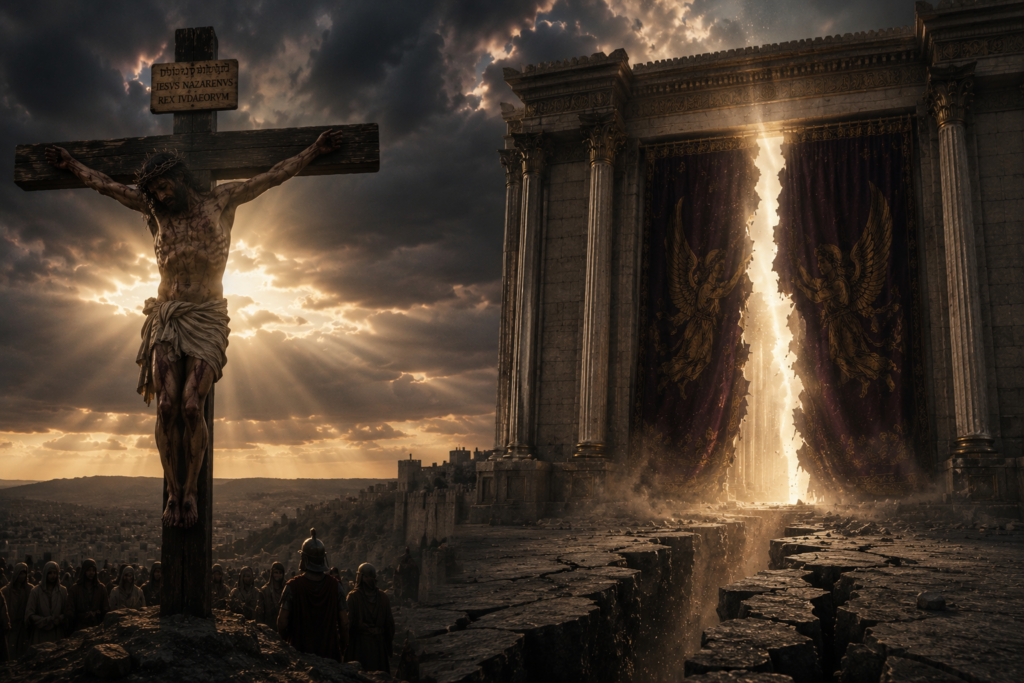
The first article in this series (Splitting, Tearing, and New Creation: A Matthew 27 Study.) explored the biblical pattern based on the Hebrew word bakah—splitting. From the dividing of the waters in Genesis, to the splitting of the sea in Exodus, and even the splitting of the Mount of Olives, Scripture repeatedly uses the language of rupture to describe moments when God intervenes in history. One order collapses and another emerges. Matthew’s account of the crucifixion brings that pattern to its climax. At the moment of Jesus’s death, the veil of the Temple is torn in two, the earth quakes, and the rocks split.

Why does the veil tear at that precise moment?

Many interpretations focus on humanity gaining access to God. While that is certainly part of the story, there may be something even larger. The torn veil is the announcement that God has begun to restore what was lost in Eden.

Eden was sacred space, the place where heaven and earth overlapped and where God dwelt with His creatures. Adam and Eve did not ascend into God’s heavenly realm. God placed them in the garden to dwell with Him. The human tragedy of the garden episode is not simply disobedience. It is exile from the presence of God.

Humanity is driven eastward from the garden. The way back is closed. Cherubim stand guard at the entrance, marking the boundary between God’s realm and the world beyond. From that moment forward, the biblical story becomes a story of exile and return—the return of God’s Presence to humanity and humanity’s return to sacred space.

This theme appears again and again throughout Scripture. Adam is exiled from Eden. Israel is exiled from the land. Ezekiel sees the glory depart from the Temple. Humanity lives east of Eden, separated from the fullness of God’s Presence.

The Tabernacle and later the Temple preserved the memory of that separation.

Scholars debate which veil Matthew has in view when he records that “the veil of the Temple was torn in two.” Some identify it as the great outer curtain described by Josephus, while others point to the inner veil separating the Holy Place from the Holy of Holies. For our purposes, the focus is not on which veil Matthew meant, but on what the veil represented.

The veil was a boundary.

Woven into it were cherubim, recalling the cherubim stationed at Eden’s gate. Before there was a curtain in the Temple, there were cherubim guarding the way back into sacred space. The veil continued that same function. The barrier still stood. The exile remained unresolved.

Once each year, on the Day of Atonement, the high priest approached that barrier carrying blood and incense. He entered God’s Presence on behalf of the people, but he did not remain there. His ritual acts repaired sacred space, but they did not remove the separation. The blood addressed the breach, yet the veil remained.

Though the Temple mediated God’s Presence, it did not fully resolve the problem that began in Eden. This is why the longing of the prophets is so striking. Their hope was not that humanity might ascend into heaven. Their hope was that God would return.

Isaiah gives voice to that longing in one of the most dramatic prayers in Scripture: “Oh, that You would rend the heavens and come down” (Is. 64:1). Isaiah does not pray, Let us go up to heaven. He prays, Come down…that the mountains might “shake” at Your presence.

Throughout Scripture the movement is consistently one of divine descent. God comes to Adam in the garden. God comes down at Babel. He descends upon Sinai. He fills the Tabernacle with His glory. He fills Solomon’s Temple. The Word becomes flesh and dwells among us. Even the story’s final vision is not humanity escaping the earth but the New Jerusalem descending from heaven.

The goal has always been the same: God dwelling among His people—permanently.

Elsewhere Isaiah speaks of God stretching out the heavens like a curtain and spreading them out like a tent. The heavens themselves are portrayed as God’s dwelling place. When Isaiah cries out for God to rend the heavens and come down, he is asking God to tear open the barrier that separates realms and return to His people.

Isaiah 63–64 are filled with themes of exile, restoration, divine intervention, and the hope of a renewed creation. Isaiah longs for the day when God will once again act decisively in history, defeat His enemies, restore His people, and dwell among them. Matthew may be presenting the torn veil as the answer to that ancient prayer. The barrier is torn. God has acted. The long exile is reaching its turning point. What Isaiah anticipated, Matthew sees unfolding at the cross.

Against this background, the tearing of the veil becomes the defining moment in Matthew’s story. At the very moment Jesus dies, the veil of the Temple is torn from top to bottom.

The action begins from above.

The tearing of the veil is a declaration that the barrier has been breached. The long exile from God’s Presence is nearing its end.

It becomes even clearer when we remember how Matthew presents Jesus throughout his Gospel. He is Emmanuel—God with us. In John’s Gospel, Jesus speaks of His own body as the Temple. If Jesus is the true dwelling place of God among humanity, then His death becomes a Temple event.

There may be another dimension to Matthew’s account that is often overlooked. Throughout His ministry, Jesus repeatedly confronted the corruption of the Temple and its leadership. His cleansing of the Temple was not so much a protest against commercial activity, but spoke of the coming judgment against a system that had failed. In the first century, the Temple had become associated with corruption, uncleanness, and spiritual blindness.

Matthew’s account raises a fascinating question: Is he presenting the death of Yeshua as a Temple crisis?

Jesus is the true dwelling place of God among humanity. The true Temple is struck. The earthly Temple now responds to that action. At the moment Jesus enters death—the deepest point of exile—the veil of the Temple is torn.

Death itself represents the ultimate intrusion of corruption into creation and the deepest expression of separation from God. A corpse brings impurity. Death contaminates sacred space. The God of life does not dwell in death. When Yeshua cries, “My God, my God, why have You forsaken me?” His words echo the language of abandonment and exile that has marked, not only Israel, but the entire human condition since Eden. Yet in entering fully into humanity’s exile, impurity, corruption, and death, Jesus begins to reverse their power.

This is why the tearing of the veil is so significant.

The torn veil becomes the visible sign that God is reclaiming and expanding His creation and restoring sacred space once again. The goal of both the Tabernacle and the Temple was never to confine God. They existed because God desired to dwell among His people. The torn veil signals that the barrier separating God’s Presence from creation has been breached. This is why Matthew records that the earth quaked and the rocks split. These are not merely images of access. They are images of restoration.

The effects of the cross extend beyond worship and into creation itself. A cosmic victory has occurred. The visible tearing of the veil reveals an invisible reality. The torn veil reminds us that the story of Scripture is not about escaping the world. It is about God repossessing it.

Immediately after the veil tears, the earth shakes, the rocks split, and the graves open.

We might ask: Why does the healing of the cosmos extend into the realm of the dead? That question leads us to the next stage of Matthew’s narrative. Stay tuned!

veil
earth

When Earth Is Pushed Beyond Its Limits

What happens when the earth is forced to produce without rest—and why Scripture warns us this always leads to collapse.

The earth that was created to sustain life is now being forced into relentless production, driven for yield at any cost. This is poor stewardship and it is a violation of the created order. Scripture never envisioned a world where the land would be worked without rest or treated as a machine for profit. The land is not failing us. It is exposing what happens when we refuse to live within the order that was designed to sustain life.

The biblical story unfolds through the language of land, cultivation, and kingship. From the beginning, the earth is ordered, tended, and brought under the rule of a rightful King. In the ancient world, a king subdued a threat, defeated an enemy, secured the land, and by doing so established order. Only then did he take his seat on the throne—his rest—within a house prepared for his presence.

The Land as Sacred Space

Adonai speaks to Moses on Mount Sinai and introduces the command that the land itself must observe a Sabbath. In Leviticus 25, the instruction is clear. For six years the land is to be cultivated—planted, tended, and harvested—but in the seventh year it is to rest completely. There is to be no sowing, no pruning, no fertilizing, and no harvesting. Instead, whatever the land produces on its own is to be shared by all: the landowner, the servant, the hired worker, the outsider, and even the animals.

The land’s yield in that year is not the result of human control, but of divine provision.

This command reveals something fundamental about how Scripture understands the earth. The earth is not neutral ground. It is not simply a resource to be managed or exploited. It is sacred space. It belongs to God and functions within His larger cosmic order. Its purpose is to provide food, sustenance, beauty, and stability so that life can flourish.

In that sense, the land participates in the larger structure of creation, which Scripture presents as a kind of cosmic house—heaven, earth, and sea ordered together as a dwelling place. At the center of that structure is the garden, and at the center of the garden are the trees. This layered design reflects a temple pattern, where sacred space is concentrated and life radiates outward from it.

The rhythm of seven is woven throughout this structure, reinforcing the idea of completion and rest. Ancient Jewish tradition observed that “all sevens are beloved,” and Scripture itself is saturated with this pattern—seven days of creation, seven-day festivals, cycles of seven years, and recurring sevens in offerings, rituals, and prophetic imagery.

Rest, Kingship, and the Order of Creation

Shabbat is about the transition from one state of being to another. During the six years of cultivation, human beings engage in the work of ordering the earth through sowing, planting, pruning, and harvesting. In the seventh year they cease from that activity because the cycle is designed to reveal something greater. They do not cease from all activity; rather, they enter a different mode of living in which God’s provision becomes central.

Rest signifies that the rightful King is on the throne, that order has been established, and that the land can now produce under His sovereign rule. When a king rested, it meant that his enemies had been subdued and that peace governed the earth.

This understanding places agriculture within a much larger framework. In the ancient Near East, kings were closely associated with gardens, and royal gardens were often attached to temples. These gardens symbolized a well-ordered world under the king’s authority. In Ecclesiastes, Solomon describes his building projects, vineyards, and gardens in language that reflects this royal role.

Cultivating the land was not only an economic activity but a participation in maintaining cosmic order. Adam’s task in the garden reflects this same pattern. To tend and keep the garden is temple language, closely related to priestly service. In this framework, cultivation becomes an act of worship, and even eating becomes a form of participation in the life God provides.

When the Land Bears the Weight of Disorder

Scripture also makes clear that this relationship between humanity and the land is fragile. When humanity steps outside of God’s order through injustice, idolatry, and corruption, even the land itself begins to suffer.

The prophets describe this in vivid terms. In Jeremiah 12, the land mourns and the grass withers because of the evil of those who dwell in it. In Isaiah 24, the earth is described as polluted under its inhabitants, consumed by a curse. These passages present the land almost as if it were a participant in human suffering, burdened by disorder and exposed to its consequences.

This helps explain why exile was necessary in Israel’s history. When the people failed to observe the rhythms of rest and obedience, the land itself required relief. Exile allowed the land to rest from the contamination caused by human disobedience. The sabbatical years were built into the structure of creation as a means of preserving both the land and the people.

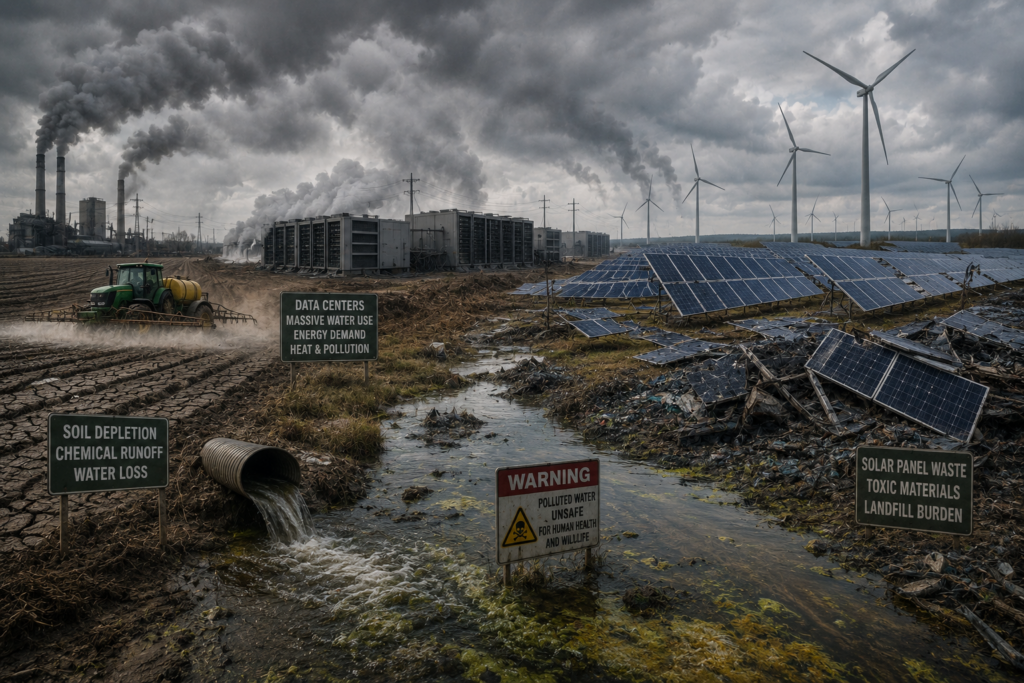
In our modern context, this pattern has been deeply disrupted. The earth is no longer simply neglected; in many cases, it is forced into relentless production. Large agricultural systems prioritize efficiency and profit, leading to soil depletion, chemical contamination, and declining food quality. The land is treated less like sacred space and more like a mechanism for extraction.

We are now seeing the land further strained by massive data centers and sprawling solar and wind installations that consume enormous amounts of water and resources, while creating long-term environmental problems through waste and storage once these systems fail.

earth

The language of Scripture—of the land being burdened or oppressed—feels increasingly relevant as the earth is pushed beyond its natural limits.

At the same time, an opposing response from modern environmental movements elevate nature to the ultimate authority. Humanity is viewed as the primary problem, something that must be restricted or removed in order for the earth to recover. These approaches reject the biblical vision in which humanity plays a necessary and restorative role. Scripture does not present humanity as an intrusion into creation but as its caretaker, called to cultivate and guard the earth in alignment with God’s purposes.

This leaves us in a place of tension. On one hand, we see the consequences of exploitation in degraded land and compromised food systems—the growing dominance of “big agri.” On the other, we encounter solutions that remove humanity from its intended role. The biblical answer calls for a return to the original pattern, where humanity participates in God’s order through responsible cultivation and trust in His provision.

This return begins with a shift in perspective. The sabbatical command in Leviticus ultimately asks whether we trust God enough to release control. It challenges the assumption that constant, forced production is necessary for survival and invites us to consider a different model, one in which provision is not solely dependent on human effort.

While few today can practice a literal sabbatical year, the principle remains deeply relevant. It calls us to reconsider how we relate to food, the land, and the systems that sustain us.

Practically, this means supporting local farmers who practice responsible cultivation, choosing food sources that prioritize quality over convenience, and recognizing that farming is not merely an economic activity but a participation in creation. Technology has its place, but it cannot replace the human role in tending the land. Agriculture is not simply about output; it is about relationship—between people, the soil, and their Creator.

Ultimately, the biblical vision is not one of despair but of restoration. The same God who brought order out of the waters continues to sustain and renew creation.

The land was never meant to be treated like a slave, and humanity was never meant to abandon its responsibility to it. When we return to God’s order, the land responds—provision stabilizes, life recovers, and what has been pushed to its limits begins to flourish again. The question is whether we will trust that pattern and the God who still sustains it.

Restoration begins the moment we step back into the pattern God has already established.

earth
OLYMPUS DIGITAL CAMERA

Toledot

Toledot is the Birth and Geneaology of Heaven and Earth

Toledot, this week’s Torah portion, is the story of birthings—movements from disorder into new creation. While often translated as genealogy, history, or account, the word goes much deeper: it means to bring forth children, to beget, to travail. It is the language of covenant and creation, of life produced when two realities meant to be one finally join together.

The first toledot in Scripture is not human at all. It is cosmic: “These are the toledot of the heavens and the earth…” (Gen. 2:4). At first glance this seems odd. How can heaven and earth give birth? But the text is hinting at a profound unity—almost a marriage—between God’s realm and humanity’s realm. What their union produces is creation itself.

Heaven, God’s domain, and earth, humanity’s domain, are meant to function as one integrated space. That has always been the goal of the biblical story: heaven and earth reunited so that the “sons of God” can be birthed—the ones who inherit and steward creation toward its intended flourishing. Two spaces brought together in unity, producing a people who bear God’s image and bear His authority.

Sacred Marriage

Creation is presented as a marriage, a sacred joining, where God’s space touches ours and life emerges in harmony. And Scripture keeps telling this story over and over again: heaven and earth were designed to be partners, destined for full union, destined to dwell together as they once did in Eden.

Revelation completes the loop with the same theme: a new heaven and a new earth, no longer two realms, but one restored marriage. What began in Genesis as creation ends in Revelation as new creation—the full maturity of God’s project. And between these two bookends lies the struggle: a fractured world, a divided cosmos, two kingdoms at war—Yahweh and the serpent, order and chaos, covenant and anti-covenant. Nowhere is this conflict more clearly seen than in the Torah portion Toledot, with the tension between Esav and Jacob.

Isaac and Rebekah

This is where Isaac and Rebekah enter the story. We expect toledot to begin with Isaac and a list of his children, but the text surprises us: “Abraham begot (yalad) Isaac.” Isaac is sixty when Rebekah bears the twins, and forty when he marries her. The sequence reminds us that Isaac can bring forth life only because Abraham first brought forth him. Covenant flows forward through sons; the story continues because someone was born.

But Rebekah, like the matriarchs before and after her, is barren. Barrenness in Scripture is never just biological. It is symbolic of primordial chaos—the unformed, unproductive void before God speaks in Genesis 1. A barren woman embodies the de-created world. So when God opens her womb, He is not simply providing a child; He is enacting new creation. This is why the births of Isaac, Jacob, Joseph, Samson, Samuel, and John the Immerser all come through barren women. Every one is a living signpost pointing toward the ultimate new creation: the birth of the Son of God, the true heir, the new Adam.

Rebekah conceives, but the struggle is far from over. In fact, it is just beginning. The Hebrew word used for the twins “struggling” means to crush, be crushed, or oppress. What is happening inside her womb mirrors the cosmic conflict outside it.

Two Kingdoms in Conflict

Two nations. Two kingdoms. Two destinies locked in prenatal combat. “Two goyim are in your womb…” Not merely sons but nations, peoples, worlds, futures. “Two peoples shall be separated…” The word means to divide by breaking apart.

Then the great reversal: “The many, the great, will serve the little, the small, the insignificant.” The unlikely heir becomes the true ruler. The younger becomes the leader.

This is the kingdom pattern from beginning to end—Micah’s ruler born in tiny and insignificant Bethlehem, Isaiah’s “least becoming a thousand,” Yeshua choosing fishermen instead of princes. This is the toledot pattern: God bringing forth what the world does not expect. “But you, Bethlehem Ephrathah, though you are little among the thousands of Judah, from you shall come forth the Ruler…”

Israel, the small nation, prevails and continues to prevail despite the vastness of empires around her. Logic says she should not exist. Scripture says she exists because God brings forth life from unlikely places.

Genealogies and New Creation

The Bible’s story is held together by these birthings—the toledot of the heavens and the earth, the toledot of Adam, the toledot of Noah, the toledot of Abraham, the toledot of Isaac, the toledot of Jacob, and finally the toledot of Yeshua the Messiah. Matthew opens with this line: “The book of the genesis (toledot) of Jesus Christ, the son of David, the son of Abraham.” The story loops back to Abraham, then forward to the new humanity.

And the birthings are not over. Toledot is still happening. We are living in the long stretch between creation and new creation—between promise and fulfillment. And the rhythm remains unchanged: new life out of barrenness, order out of chaos, kingdom rising through the unlikely. God is still bringing forth children, still writing toledot, still moving heaven and earth toward unity—one new birth at a time.

Toledot
heaven

Did Heaven and Earth Marry?

John picks up where Genesis left off, completing the seven-day pattern. Genesis opens with God creating the world through Word and Breath; John begins with the Word made flesh—the Light Himself stepping into human history. Both Genesis 1 and John 1 unfold through seven days, a week of forming and filling Word and Spirit working together until creation reaches its goal: the union of heaven and earth.

In the ancient world, a king’s enthronement brought order to the chaos, and it was said that these two spheres earth became one—shalom restored.

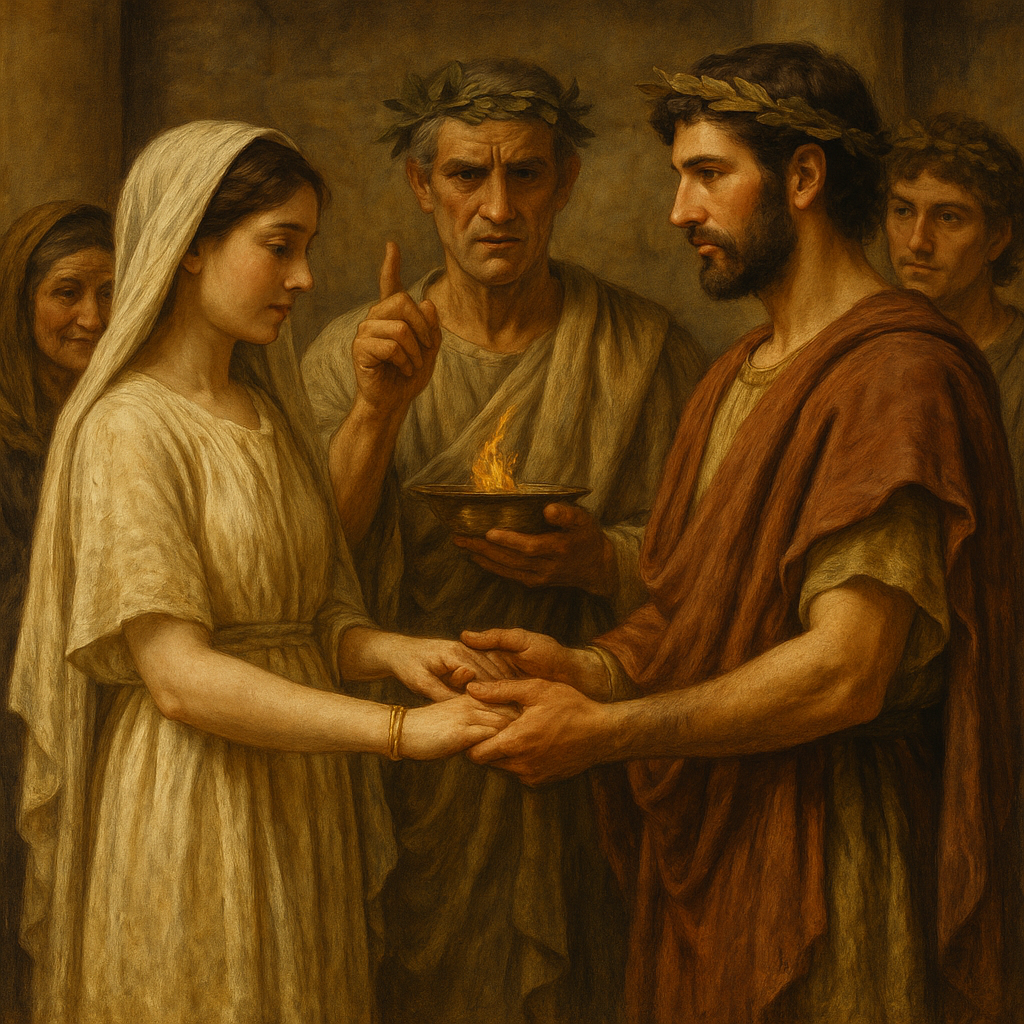
In Genesis, the seventh day crowns the work: The heavens and the earth were completed (Gen 2:1). The Hebrew kallah “completed” can also mean bride, the one who completes her husband. Creation week ends with a marriage: heaven and earth joined as one.

John’s Creation Week

John’s Gospel follows the same rhythm:

Day 1: John bears witness to the Light, the source of order.

Day 2: The Lamb of God who will remove human rebellion.

Day 3: Disciples rise up to follow their King.

Day 4: Nathanael beholds heaven opened with angels ascending and descending on the Son of Man, the bridge uniting heaven and earth.

Day 7: “On the third day,” a wedding in Cana becomes the climax of new creation.

Cana (Kanah) means nest, a place of new life.The Spirit who once hovered over the waters like a mother bird over her nest, an ancient idiom for the Temple, now rests upon Yeshua, the true Temple who will be raised up. And water becomes wine—the lifeblood of new creation.

The realms unite once more, not in a building but in a Person. Through Yeshua, the presence of God now fills humanity itself. And we are called to live as dwelling places of His Presence, bringing heaven’s order into earth’s chaos.

“Our Father who art in heaven, hallowed be Thy Name.

Thy kingdom come, Thy will be done, on earth as it is in heaven.”

heaven
Skip to content