Tag: exile

tombs

The Opened Tombs and the End of Exile

The third article in this series (Splitting, Tearing, and New Creation: A Matthew 27 Study.) 

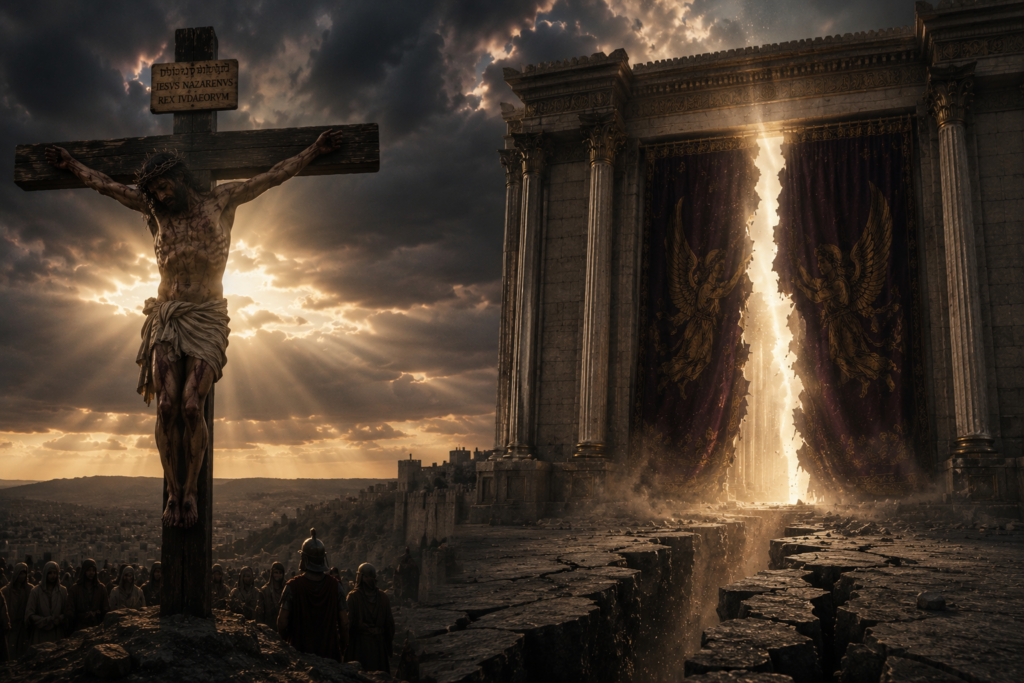
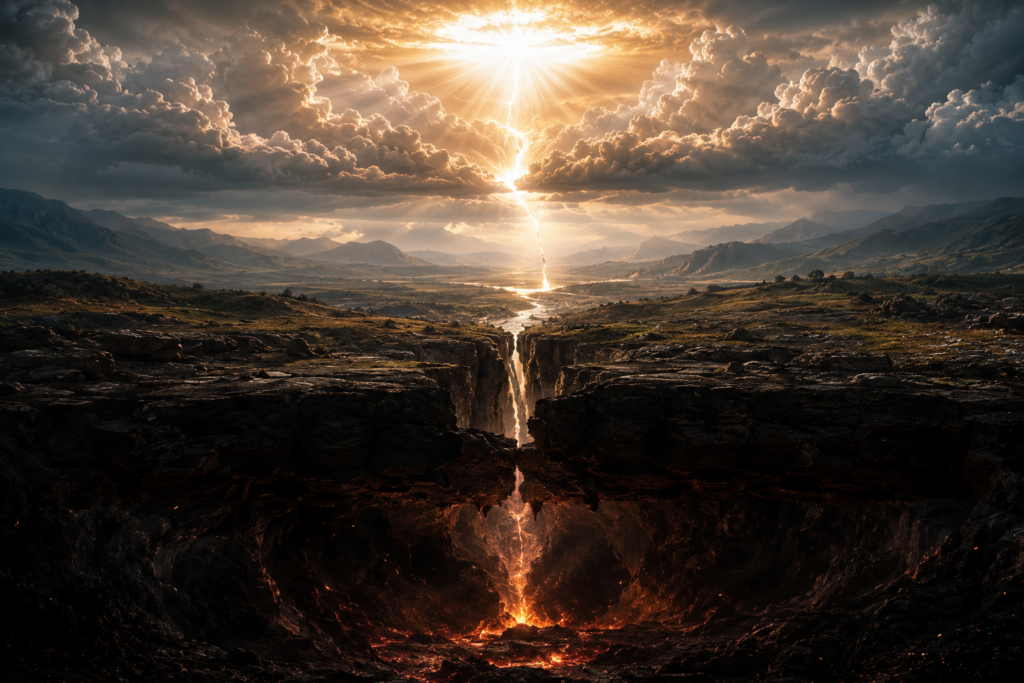
In the previous essays, we examined Matthew’s description of the moment Jesus died. The veil of the Temple was torn from top to bottom. The earth shook. The rocks split. The tombs opened. These dramatic signs accompany the Messiah’s death and prepare the reader for what comes next.

Immediately after describing the torn veil and the earthquake, Matthew adds a detail found only in his Gospel: “The tombs also were opened” (Matthew 27:52). Why does he move directly from the torn veil and the earthquake to the opening of tombs? The answer lies in the larger story Scripture has been telling from the beginning.

The signs surrounding Jesus’s death unfold in a deliberate progression. What begins with the torn veil continues through the earthquake and splitting rocks before reaching the opened tombs. Matthew is not describing isolated miracles but a victory advancing through successive barriers. To understand why the opening of tombs matters, we must place it within the larger story that begins in Eden.

The biblical story unfolds as a story of exile and restoration. When Adam and Eve were expelled from Eden, they were driven from God’s Presence and barred from the Tree of Life. Their exile was separation from the source of life itself. Death entered the human story, and from that moment exile and death became inseparable.

Israel’s story repeatedly mirrors Adam’s. Humanity is driven from Eden; Israel is driven from the land. Humanity loses access to the Tree of Life; Israel loses access to sacred space. Again and again, God’s people experience separation from the blessings of covenant life. Yet even when restoration comes, the deeper problem remains. Israel returns to the land, but death still reigns. The Temple is rebuilt, but graves continue to fill.

For this reason, the prophets look beyond national restoration to a greater redemption. Isaiah foresees the day when God will swallow up death forever and remove the reproach of His people. Daniel speaks of those who sleep in the dust awakening to new life. Throughout the Psalms, death is portrayed as a realm of darkness, confinement, and separation. The biblical hope is not simply that Israel will return home, but that death itself will finally be overcome.

If death is the deepest form of exile, then resurrection is the ultimate restoration.

The hope of Israel is not merely the recovery of land, city, or Temple. It is the return of life itself.

This larger context helps explain why the opening of tombs matters. If the torn veil signals the reversal of humanity’s separation from God, the opened tombs signal that the final barrier is beginning to give way.

To make sense of Matthew’s imagery, we must understand what first-century tombs looked like. Modern readers often picture individual graves in the ground, but that was not Matthew’s world. In Judea, many families used rock-hewn tombs carved into the limestone hills surrounding cities and villages. These were family burial chambers designed to hold multiple generations.

Inside were narrow burial niches called kokhim, where bodies were initially placed. After decomposition, the bones were gathered into stone boxes known as ossuaries, making room for future burials. A single tomb could therefore contain the remains of several generations.

The entrance was typically sealed with a large stone, either fitted into the doorway or rolled across the opening. The stone marked the separation between the living and the dead. When Matthew says the tombs were opened, he is not describing people emerging from holes in the ground. He is describing family burial chambers standing open, their stone barriers removed.

The significance of these tombs becomes clearer when viewed against Scripture’s portrayal of the realm of the dead. The Hebrew Bible describes Sheol as a place of gates, bars, depths, and darkness. Jonah speaks of the bars of the earth closing behind him, while the Psalms depict those who await deliverance from the shadow of death. Death is portrayed as a prison from which only God can rescue His people. In this light, the tomb was more than a burial place. It marked the entrance to that captivity.

Against this backdrop, Matthew’s description takes on greater significance. The tombs are not merely shaken by the earthquake; they are opened. Matthew presents Yeshua’s death within that pattern. He is not recording a series of events surrounding the crucifixion but a single victory unfolding across creation.

The veil is torn. The earth shakes. The rocks split. The tombs are opened.

Each sign extends the scope of the last. The veil marks the divide between God’s Presence and humanity. The earthquake and splitting rocks show creation responding to the death of its King. The opened tombs reach death itself. One by one, the barriers yield before the Messiah’s victory.

The sequence recalls key moments in Israel’s story. Just as God split the sea at the Exodus, He now tears the veil. Just as Sinai shook at His Presence, the earth trembles at the death of His Son. Just as God opened a path through the waters, He now opens the tombs. Matthew gathers these images into a single moment, presenting the crucifixion not as a defeat but as God’s victory over humanity’s deepest enemy.

Since Eden, death has remained the final consequence of humanity’s exile from God. As long as death reigns, exile remains unfinished. Only when death is overcome can restoration be complete.

The opening of the tombs signals that this final obstacle is beginning to give way.

This is where Jesus’s death differs from every exile that came before it. Adam was driven from Eden. Israel was driven from the land. Both experienced the consequences of disobedience. Yeshua enters the realm of death willingly. He embraces the deepest expression of exile in order to overcome it. What Adam lost and Israel could not restore, the Messiah now confronts directly.

Matthew places the opened tombs after the torn veil because the signs belong together. The torn veil reaches into the heavenly realm represented by the Temple. The earthquake and splitting rocks shake the world of the living. The opening of the tombs penetrates the realm of death itself. Together they reveal the full scope of the Messiah’s victory. Its effects do not stop at the sanctuary but extend through the whole structure of creation, reaching even the deepest consequence of humanity’s exile.

Seen in this light, this is not an isolated miracle. It declares that the victory accomplished at Golgotha reaches beyond sin to the deeper captivity that has shadowed humanity since Eden. Here the Messiah confronts death itself and challenges its claim on humanity.

Before Matthew tells us who emerged from these tombs, he first directs our attention to the tombs themselves. The emphasis falls on the breach. A barrier that had stood since Eden has given way. The consequences will soon become visible, but Matthew first invites his readers to consider what that opening means.
 

tombs


veil

The Torn Veil and the Return of God’s Presence

The first article in this series (Splitting, Tearing, and New Creation: A Matthew 27 Study.) explored the biblical pattern based on the Hebrew word bakah—splitting. From the dividing of the waters in Genesis, to the splitting of the sea in Exodus, and even the splitting of the Mount of Olives, Scripture repeatedly uses the language of rupture to describe moments when God intervenes in history. One order collapses and another emerges. Matthew’s account of the crucifixion brings that pattern to its climax. At the moment of Jesus’s death, the veil of the Temple is torn in two, the earth quakes, and the rocks split.

Why does the veil tear at that precise moment?

Many interpretations focus on humanity gaining access to God. While that is certainly part of the story, there may be something even larger. The torn veil is the announcement that God has begun to restore what was lost in Eden.

Eden was sacred space, the place where heaven and earth overlapped and where God dwelt with His creatures. Adam and Eve did not ascend into God’s heavenly realm. God placed them in the garden to dwell with Him. The human tragedy of the garden episode is not simply disobedience. It is exile from the presence of God.

Humanity is driven eastward from the garden. The way back is closed. Cherubim stand guard at the entrance, marking the boundary between God’s realm and the world beyond. From that moment forward, the biblical story becomes a story of exile and return—the return of God’s Presence to humanity and humanity’s return to sacred space.

This theme appears again and again throughout Scripture. Adam is exiled from Eden. Israel is exiled from the land. Ezekiel sees the glory depart from the Temple. Humanity lives east of Eden, separated from the fullness of God’s Presence.

The Tabernacle and later the Temple preserved the memory of that separation.

Scholars debate which veil Matthew has in view when he records that “the veil of the Temple was torn in two.” Some identify it as the great outer curtain described by Josephus, while others point to the inner veil separating the Holy Place from the Holy of Holies. For our purposes, the focus is not on which veil Matthew meant, but on what the veil represented.

The veil was a boundary.

Woven into it were cherubim, recalling the cherubim stationed at Eden’s gate. Before there was a curtain in the Temple, there were cherubim guarding the way back into sacred space. The veil continued that same function. The barrier still stood. The exile remained unresolved.

Once each year, on the Day of Atonement, the high priest approached that barrier carrying blood and incense. He entered God’s Presence on behalf of the people, but he did not remain there. His ritual acts repaired sacred space, but they did not remove the separation. The blood addressed the breach, yet the veil remained.

Though the Temple mediated God’s Presence, it did not fully resolve the problem that began in Eden. This is why the longing of the prophets is so striking. Their hope was not that humanity might ascend into heaven. Their hope was that God would return.

Isaiah gives voice to that longing in one of the most dramatic prayers in Scripture: “Oh, that You would rend the heavens and come down” (Is. 64:1). Isaiah does not pray, Let us go up to heaven. He prays, Come down…that the mountains might “shake” at Your presence.

Throughout Scripture the movement is consistently one of divine descent. God comes to Adam in the garden. God comes down at Babel. He descends upon Sinai. He fills the Tabernacle with His glory. He fills Solomon’s Temple. The Word becomes flesh and dwells among us. Even the story’s final vision is not humanity escaping the earth but the New Jerusalem descending from heaven.

The goal has always been the same: God dwelling among His people—permanently.

Elsewhere Isaiah speaks of God stretching out the heavens like a curtain and spreading them out like a tent. The heavens themselves are portrayed as God’s dwelling place. When Isaiah cries out for God to rend the heavens and come down, he is asking God to tear open the barrier that separates realms and return to His people.

Isaiah 63–64 are filled with themes of exile, restoration, divine intervention, and the hope of a renewed creation. Isaiah longs for the day when God will once again act decisively in history, defeat His enemies, restore His people, and dwell among them. Matthew may be presenting the torn veil as the answer to that ancient prayer. The barrier is torn. God has acted. The long exile is reaching its turning point. What Isaiah anticipated, Matthew sees unfolding at the cross.

Against this background, the tearing of the veil becomes the defining moment in Matthew’s story. At the very moment Jesus dies, the veil of the Temple is torn from top to bottom.

The action begins from above.

The tearing of the veil is a declaration that the barrier has been breached. The long exile from God’s Presence is nearing its end.

It becomes even clearer when we remember how Matthew presents Jesus throughout his Gospel. He is Emmanuel—God with us. In John’s Gospel, Jesus speaks of His own body as the Temple. If Jesus is the true dwelling place of God among humanity, then His death becomes a Temple event.

There may be another dimension to Matthew’s account that is often overlooked. Throughout His ministry, Jesus repeatedly confronted the corruption of the Temple and its leadership. His cleansing of the Temple was not so much a protest against commercial activity, but spoke of the coming judgment against a system that had failed. In the first century, the Temple had become associated with corruption, uncleanness, and spiritual blindness.

Matthew’s account raises a fascinating question: Is he presenting the death of Yeshua as a Temple crisis?

Jesus is the true dwelling place of God among humanity. The true Temple is struck. The earthly Temple now responds to that action. At the moment Jesus enters death—the deepest point of exile—the veil of the Temple is torn.

Death itself represents the ultimate intrusion of corruption into creation and the deepest expression of separation from God. A corpse brings impurity. Death contaminates sacred space. The God of life does not dwell in death. When Yeshua cries, “My God, my God, why have You forsaken me?” His words echo the language of abandonment and exile that has marked, not only Israel, but the entire human condition since Eden. Yet in entering fully into humanity’s exile, impurity, corruption, and death, Jesus begins to reverse their power.

This is why the tearing of the veil is so significant.

The torn veil becomes the visible sign that God is reclaiming and expanding His creation and restoring sacred space once again. The goal of both the Tabernacle and the Temple was never to confine God. They existed because God desired to dwell among His people. The torn veil signals that the barrier separating God’s Presence from creation has been breached. This is why Matthew records that the earth quaked and the rocks split. These are not merely images of access. They are images of restoration.

The effects of the cross extend beyond worship and into creation itself. A cosmic victory has occurred. The visible tearing of the veil reveals an invisible reality. The torn veil reminds us that the story of Scripture is not about escaping the world. It is about God repossessing it.

Immediately after the veil tears, the earth shakes, the rocks split, and the graves open.

We might ask: Why does the healing of the cosmos extend into the realm of the dead? That question leads us to the next stage of Matthew’s narrative. Stay tuned!


veil
Skip to content