Tag: Eden

compromise

The Seduction Before the Crossing: How Spiritual Compromise Nearly Cost Israel the Promised Land

Few episodes in Israel’s wilderness journey have troubled modern readers more than the war against Midian. It is an event marked by the violence of the ancient world. Israel marches against Midian with twelve thousand soldiers, one thousand from each tribe. Cities are reduced to ashes. Five Midianite kings fall. Balaam, whose schemes had nearly brought Israel to ruin, dies by the sword. Livestock, precious metals, and every kind of spoil are gathered and brought back to Israel’s camp on the plains of Moab. Moses is outraged when he learns that the women who had led Israel into compromise and the worship of Baal-Peor have been spared, and he orders them put to death.

What follows the battle is just as important as the battle itself. Throughout the Torah, death is the great intruder into God’s creation, the visible mark of humanity’s exile from Eden. Even a war commanded by God leaves His people surrounded by its contamination. Before anyone may again dwell where God’s presence resides, everything and everyone touched by the battlefield must be cleansed. Nothing returns to the camp until it has been purified. The soldiers remain outside the camp for seven days. Their bodies, clothing, weapons, and even the gold and silver taken in battle must all be purified before they may return.

Only a short time earlier, Balak, king of Moab, had hired Balaam to curse Israel. Yet every attempt failed. Instead of curses, blessings poured from the prophet’s mouth because Israel stood under the covenant faithfulness of God. What no king and no prophet could accomplish through battle was nearly achieved by another means.

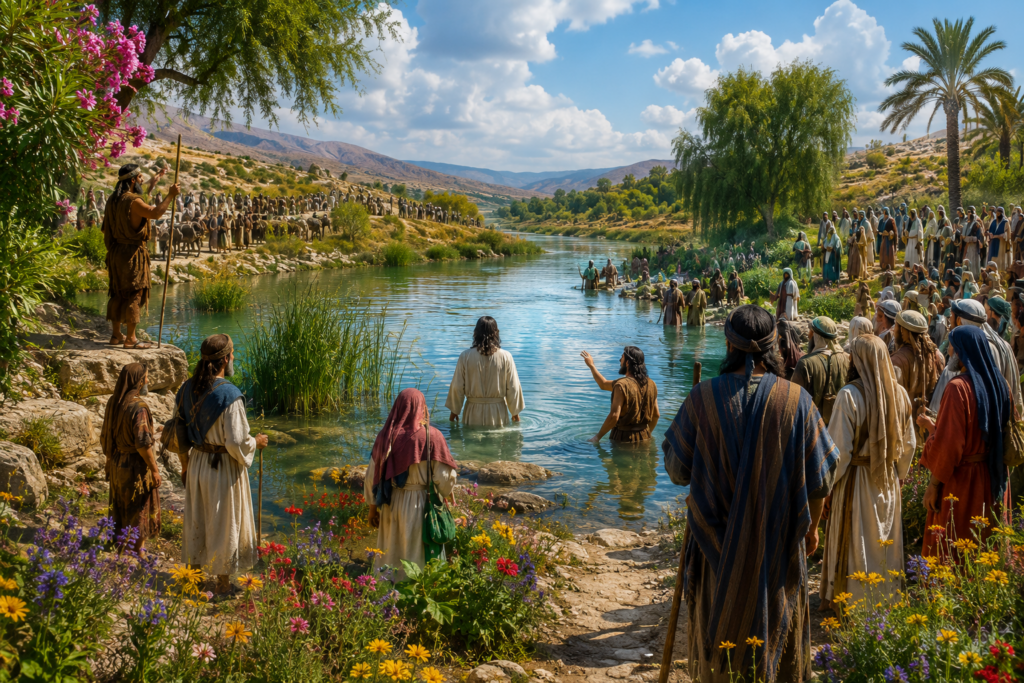
So, rather than confronting Israel on the battlefield, Midian and Moab attacked the covenant itself. At Baal-Peor, Israelite men joined sacrificial meals, embraced the fertility rites of the surrounding nations, and gave their allegiance to gods who promised prosperity, rain, and abundance. The consequences were devastating. Twenty-four thousand Israelites perished because Israel had begun to imitate the nations.

Crisis at Ba’al Peor

The campaign against Midian is therefore more than a military victory. It brings the crisis at Baal-Peor to its conclusion. Balaam could not separate Israel from God by cursing them, so he pursued a far more effective strategy: he enticed them to compromise. Military force had failed, but spiritual corruption nearly destroyed the covenant community.

Scripture often returns to this pattern. Egypt sought to shape Israel through slavery, Canaan through idolatry, Babylon through assimilation, and Rome through demands for ultimate allegiance. The greatest threat was never simply an invading army, but the pressure to adopt the worship and values of the surrounding world.

That is why this battle takes place where it does. Israel stands on the plains of Moab opposite Jericho with the Jordan before them and the Promised Land within sight. Before they cross into their inheritance, the influence that had nearly destroyed the covenant must be removed. God is preparing a people who will live under His rule in the land He has promised them.

The repeated instructions for purification now make sense. Contact with death rendered a person ceremonially unclean, so those who had fought remained outside the camp for seven days. War had touched everything, and nothing from the battlefield could simply be carried into the presence of God.

How to Deal with Contamination

Here the Torah teaches an important truth. Even if the battle is just, death leaves its mark. Victory does not remove its contamination. Before Israel could once again gather around the Tabernacle where God dwelt among His people, the effects of death had to be removed.

The Jordan River crossing was a liminal boundary. It was more than a river—it marked the place where one chapter of God’s purposes ended and another began. Israel could not cross into the Promised Land carrying the influence that had nearly destroyed the covenant at Peor.

The temptation at Peor was not simply immorality or idolatry. It was the invitation to seek blessing, security, and life from other gods rather than from Yahweh Himself—the one who had redeemed Israel. Balaam could not curse God’s people, so he chose a far more effective strategy. He persuaded them to compromise.

That strategy continues to this day. The names of the idols may change, but the temptation remains. God’s people are always being invited to measure success and security by the values of the culture around them rather than by the God who calls them into covenant. External opposition is not necessarily the enemy’s only weapon. More often, it is compromise that slowly reshapes God’s people until they no longer look any different from the world around them.

Israel stood on the edge of the Promised Land with the Jordan before them and their inheritance within reach. Yet before they could cross, one final enemy had to be confronted—not simply Midian’s army, but Midian’s influence. They could not inherit the covenant land while embracing the worship and values of the nations. That was Israel’s struggle on the plains of Moab, and it remains the challenge facing every generation that seeks to walk faithfully with the God who still calls His people to be set apart.
compromise
Sarah

The Life of Sarah: Doubles & Echoes of Eden

The Torah opens Chayyei Sarah with an unusual phrase: vayihyu chayyei Sarah, “and the lives of Sarah were…” Her life is spoken of in the plural, hinting that her story is one of layers, repetitions, and echoes. The grammar suggests that Sarah’s life unfolds in cycles, that her story needs to be read more than once to be fully understood.

Sarah seems a kind of second or restored Eve reimagining Eve’s purpose as mother of the living.  If Eve’s story begins in the garden and moves outward into exile, Sarah’s story begins in barrenness and moves toward a restored garden—the matriarch through whom Eden’s promise begins to be replanted in the land.

The theme of doubling is present even in the geography. Sarah dies in Kiryat Arba, “the city of four,”recalling the four rivers that flowed from Eden. She is buried in Hebron, whose name carries the meaning of joining, coupling, or binding. This is followed by Machpelah, the “doubled cave,” from kafal, meaning to fold or duplicate. According to rabbinic tradition, Machpelah had two chambers and was itself a doubled space.

The text describes Abraham’s purchase of the cave, the field, and all the trees within its boundaries in Edenic detail. The rabbis saw Machpelah as nothing less than the entrance to the Garden of Eden. Abraham, they said, caught the fragrance of Eden there—the lingering scent of a world before exile.

The purchase of Machpelah is a legal transaction. Abraham negotiates with Ephron the Hittite in the public gate where witnesses gather. The Hittites address Abraham as a nasi elohim, a prince of God, acknowledging his authority and sacred standing.

When the land is transferred to Abraham, it becomes the very first piece of the promised land legally possessed. The field, the cave, and the trees create a kind of micro-Eden—an earthly sanctuary awaiting the resurrection. Abraham is anchoring Israel’s future in holy ground.

Mamre: A Replanted Garden of Encounter

Machpelah lies beside Mamre, a place already steeped in divine encounters. Mamre means “fatness,” a symbol of abundance and divine favor, calling to mind the goodness of Eden. The terebinth and oak groves of the region were ancient symbols of sacred space and divine presence—natural sanctuaries in the world of the ancient Near East.

Here Abraham built an altar. Here God appeared to him. Here the three mysterious visitors shared a covenantal meal under the shade of ancient trees. Mamre becomes a restored meeting place between God and humanity, a garden moment where God’s divine presence rests among the trees.

The setting is saturated with Edenic imagery: shade, fellowship, blessing, abundance. Mamre is not Eden, but it resonates with Eden’s symbology, becoming a place where promise and presence converge.

Mamre sits on the Judean ridge near Hebron, one of the highest elevations in the region. Ancient tradition viewed mountains as cosmic pillars linking heaven and earth. Eden, too, was imagined as a mountain from which the rivers flowed downward into the world. Mamre thus becomes a proto-mountain sanctuary, The geography reinforces this theology: God meets Abraham in a place elevated above ordinary life, surrounded by trees, overlooking the land of promise. Mamre is a mountain-garden where heaven once more touches earth.

The Search for a Wife

The next event shifts to Abraham’s servant seeking a wife for Isaac. The story unfolds with emphasizing the ongoing theme of doubling. At the well, Eliezer prays for a sign. Rebekah appears and enacts the sign precisely, offering water to him and to the camels. Wells in Scripture represent life, abundance, and covenant blessing. Many biblical betrothals occur at wells, making them symbolic thresholds.

Rebekah becomes a renewed echo of Sarah, who herself was a renewed echo of Eve. When Isaac brings her into Sarah’s tent, he is comforted—an indication that Sarah’s legacy continues through Rebekah, and the matriarchal mantle passes from one Eve-figure to the next.

Isaac in the Field: The Return to Eden’s Prayer

Later, we find Isaac “meditating in the field” at the moment Rebekah arrives. The rabbis linked this to the same phrase, si’ach sadeh, in Genesis 2:5, a phrase connected with the shrubs of the field before the creation of man. They saw in it an early hint of prayer, contemplation, and divine presence.

Isaac’s field would become an idiom for the Temple—a sacred space where God and humanity meet. The sages also used “the King in the field” to describe the nearness of God during the month of Elul, awaiting His bride. Rebekah’s arrival in this moment becomes a restored Eden encounter, a reunion at the threshold between earth and heaven.

Abraham’s Death and Another Double Reunion

Abraham’s death at 175 is described using a wordplay to suggest completeness and satisfaction. His sons Isaac and Ishmael bury him together, another doubled scene of reconciliation and restoration.

Brothers once divided are now reunited at the entrance to Eden’s gate. The pattern is complete: the mother of covenant is first buried in a doubled cave, now the father of covenant is buried in the same place and the sons stand side by side in unity for the first time in years. The cycle of doubles concludes with reconciliation and peace.

A Replanted Eden at the Heart of the Promise

When all these threads are gathered together, Chayyei Sarah becomes more than a narrative of death or burial. It becomes a renewed story of Eden. The garden imagery: trees, mountains, wells, groves, altars, covenants flows through the text.

Machpelah is the seed for future resurrection. Mamre a meeting place for divine presence. Rebekah becomes the living continuation of Sarah’s promise. Isaac meditates in a field that is both Temple and Garden. Abraham secures a foothold in the land that will one day blossom with the fullness of Eden.

In this way, Chayyei Sarah is not the story of a life ending. It is the story of life doubling back, echoing forward, and rooting itself once again in the soil where God will walk again with His people in perfect intimacy. It is Eden in seed form, waiting for its resurrection.

In this Torah portion, the deaths of Sarah and Abraham become like bookends—two pillars framing a story of companionship, covenant, and restoration. Their lives were bound together, and their deaths are bound together as well. Between these bookends unfolds the betrothal of Isaac and Rebekah, a union that itself echoes Eden: the joining of man and woman, the renewal of life, the covenantal blessing that multiplies into generations. The rhythm of doubles—two lives, two deaths, two sons reunited, two wells, two matriarchs—and through them, the companionship that is meant to heal the fractures of exile.

This theme of pairing and union reaches back to the very first marriage in Genesis: “A man shall leave his father and mother and be joined to his wife, and the two shall become one flesh.” Eden’s joy is located not only in its trees and rivers but in covenantal union—fruitfulness, fellowship, life shared. This is why Yeshua speaks of Himself as the Bridegroom and His people as the Bride.

And yet the echoes of Eden do not erase the world we actually live in. This is in no way a judgment upon the divorced, the widowed, or the single. The Torah’s Edenic imagery is not restricted to biological unions; it is a picture of divine companionship. For those whose stories include loss, grief, or unexpected paths, Scripture offers a deeper truth: “Your Maker is your Husband.” The God who walked with Adam and Chavah in the garden walks with every soul who trusts Him. The richness, blessing, and fruitfulness of Eden are not limited to marriage but are gifts God gives to all who dwell with Him.

Sarah
Skip to content