
From Egypt to Immanuel: The Forty-Two Pattern in Numbers
Hidden within the book of Numbers is a remarkable pattern: Israel’s forty-two wilderness encampments not only trace the journey from Egypt to the Promised Land but also foreshadow the forty-two generations leading up to the birth of Jesus in the Gospel of Matthew.
At first glance, the list of camps in Numbers appears more like an ancient geographical map —a sequence of unfamiliar places and unpronounceable names scattered across the desert. Yet the journey is far more than a travel log—the forty-two encampments form a map of transformation. They tell the story of a people being led from slavery to inheritance, from chaos to covenant, and ultimately toward a model of new creation.
This pattern reappears intentionally in the opening chapter of Matthew’s Gospel. Matthew structures the genealogy of Jesus into three sets of fourteen generations, creating a total of forty-two generations. Matthew is deliberately echoing Israel’s forty-two wilderness encampments because he wants his readers to understand that the story of Israel has always been moving toward the Messiah. These are not two disconnected stories. They are one unfolding journey woven together by God.
The Wilderness in Numbers as a Spiritual Classroom
The sages counted forty-two distinct encampments. Every stop was directed by God. Each resting place part of Israel’s formation as a covenant people. Though the wilderness was a de-creation environment filled with life threatening dangers, it also functioned as a spiritual classroom where God stripped away the mentality of slavery and taught His people dependence upon Him.
The Numbers stations themselves tell the story. Israel moves from the bondage of Egypt to the shelter of Sukkot. They pass through the bitter waters of Marah and arrive at the springs of Elim. They face hunger, thirst, rebellion, serpents, enemies, and the desolation of the desert. Every encampment exposes something within them. Every crisis reveals whether they will trust the God who delivered them through the sea.
God was dismantling Egypt inside His people. He was breaking the grip of fear, idolatry, and self-reliance. He taught them contentment. Manna fell from heaven. Water came from the rock. Their clothing endured. Their survival depended entirely upon His provision. The forty-two encampments in Numbers show how God transformed Israel from a fearful people shaped by slavery into a people learning to live in His Divine Presence.
The journey in Numbers even echoes creation itself. In Genesis, God speaks life into a world that is formless and void. In the wilderness, He shapes a new people out of a disordered multitude rescued from Egypt. The wilderness becomes a place where God brings order out of chaos.
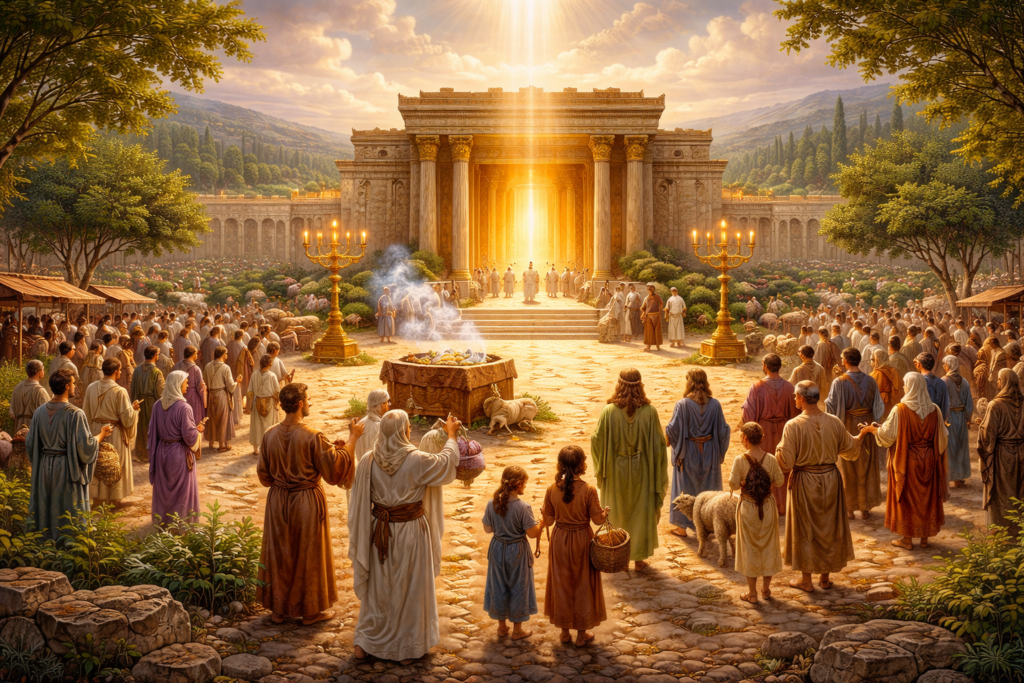
At the center of Israel’s wilderness journey in Numbers stood the Tabernacle—the dwelling place of God moving in the midst of His people. They carried the Presence of God with them. The cloud by day and the fire by night rested over the Tabernacle, guiding every stage of the journey. When the cloud lifted, Israel moved. When it rested, Israel encamped. The wilderness was therefore not merely a journey toward a destination; it was a journey in which they carried the Presence of God in a mobile sanctuary.
Even the length of the journey in Numbers carries birthing imagery. Israel wandered for forty years in the wilderness, mirroring the forty weeks of human gestation. The wilderness functioned like a womb where God formed and shaped His covenant people before bringing them into the land. What emerged on the other side of the Jordan was a people born anew under the Presence of God.
Matthew’s Genealogy and Israel’s Journey
Matthew opens his Gospel with the same pattern. His genealogy unfolds in forty-two generations: from Abraham to David, from David to the exile, and from the exile to the Messiah. Abraham represents promise. David represents kingship. The exile represents the collapse of human self-rule and the consequences of covenant unfaithfulness. And Jesus represents fulfillment—the One who completes Israel and her journey, and brings the story home.
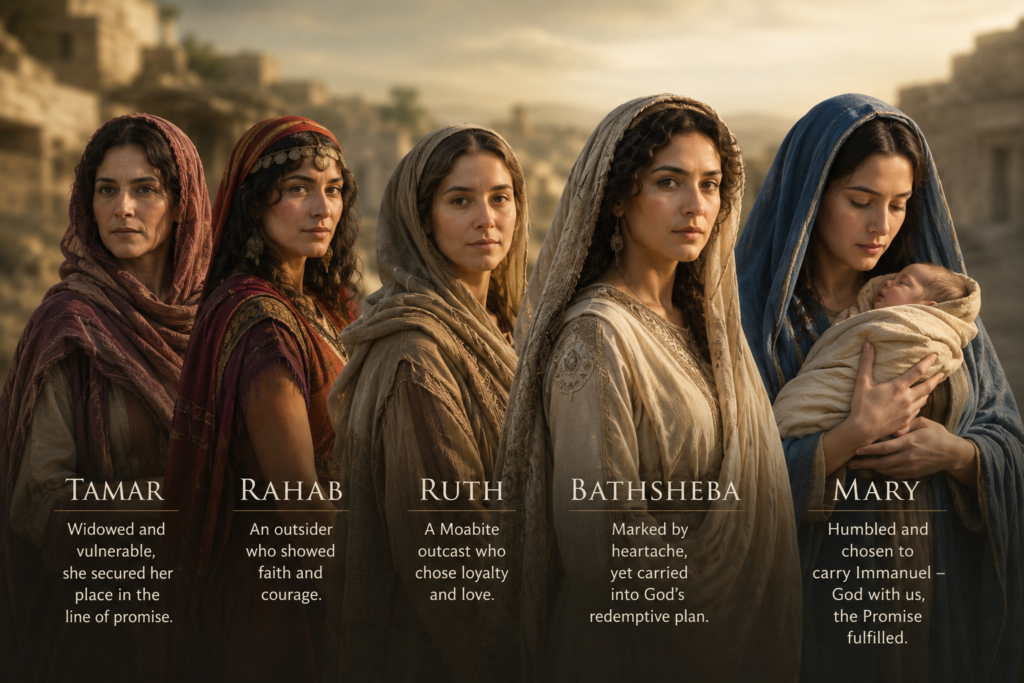
Matthew echoes the wilderness pattern through the women he highlights in the genealogy. Unusual for the ancient world. Tamar, Rahab, Ruth, Bathsheba, and ultimately Mary each carry the promise forward through seasons of uncertainty, danger, shame, and exile. These women are wilderness figures in their own right. Tamar was widowed and vulnerable. Rahab was a Canaanite prostitute. Ruth was a Moabite outsider. Bathsheba endured exploitation and tragedy. Mary faced public shame and misunderstanding. Yet God placed them into the redemptive story leading to Messiah.
The story culminates in Mary carrying within her womb the Presence of God. The wilderness journey of Israel reaches its fulfillment in the birth of Immanuel—“God with us.” What the Tabernacle foreshadowed in the wilderness now becomes flesh and blood in Jesus. He is the living Tabernacle moving among His people, the embodiment of the divine Presence once carried through the desert beneath the cloud and fire. The God who dwelt in the midst of Israel now walks among humanity in the person of the Messiah.
Matthew immediately presents Jesus as the fulfillment of Israel’s story. Like Israel, He passes through the waters at the Jordan. His immersion mirrors Israel crossing the sea. Then He is driven into the wilderness for forty days where He confronts haSatan—the serpent, the accuser, the embodiment of the chaos Israel repeatedly failed to overcome. Where Israel grumbled and rebelled in the wilderness, Jesus remains faithful. He defeats the counterfeit powers not through military force, but by the Word of God.
Then He ascends the mountain. Like Moses ascending Sinai, Jesus climbs a mountain in Galilee and delivers the Torah anew in the Sermon on the Mount. Matthew is presenting Him as far more than a teacher. He is the living Torah, the divine Lawgiver, the One through whom heaven and earth are being reordered.
Matthew is showing us from the very beginning that God’s kingdom gathers the outcasts, restores the broken, and brings life out of situations that appear hopeless.
From Chaos to New Creation
The wilderness journey is not simply Israel’s story. It is humanity’s story. And it is still our story today.
We also live between Egypt and promise. We pass through wilderness seasons where our illusions are stripped away and our hearts exposed. Wilderness storms reveal who we truly are. They force us to decide whether we will trust God or surrender to fear.
The Bible is filled with such moments. Abraham faced famine and displacement. David endured betrayal from his own son. Ruth lost her husband and entered exile alongside Naomi. Abraham lied out of fear. David fell into adultery and murder. Ruth came from a people Israel despised. Yet God worked through them because they trusted Him in the midst of their storms.
The forty-two encampments in Numbers and the forty-two generations in Matthew remind us that every stage of the journey matters. Every trial, every wilderness season, every storm, and every victory becomes part of God’s redemptive work in forming His people.
The wilderness still teaches us today. It teaches dependence instead of self-sufficiency. It teaches contentment in a culture of excess. It teaches us that survival itself is sustained by the hand of God. Most importantly, it teaches us that the wilderness is never the final destination.
That is the deeper question of the Numbers wilderness. Not whether storms come—they always do. The real question is how we respond when they arrive. Will chaos define us? Or will we allow God to shape us through it?