Tag: Arnon

wilderness

The Wilderness That Remembered

The book of Deuteronomy opens with Moses looking back over Israel’s forty years in the wilderness. Before he gives Israel new instruction, he reminds them where they’ve been.

Years ago, I had the privilege of following much of that same route through modern Jordan on a rugged jeep tour. Fortunately, it didn’t take me forty years, or I’d probably still be trying to cross back into Israel!

“It is eleven days’ journey from Horeb by way of Mount Seir to Kadesh-barnea… In the fortieth year… Moses began to explain this Torah.” (Deut. 1:2–5)

Most of us begin reading Deuteronomy and quickly stumble over an unfamiliar list of names. Horeb. Kadesh-Barnea. Mount Seir. The Arabah. Wadi Zered. The Arnon. Moab.

They seem like little more than ancient geography, the sort of details we skim on our way to the “important” parts of Moses’ final speech. But Moses wasn’t giving Israel a geography lesson. He was telling a story—a story of their history.

Our journey through Jordan traced much of Israel’s final wilderness route. We traveled through the Arabah, explored Petra, crossed the Zered Valley, descended into the magnificent Arnon Gorge, climbed Mount Nebo, and eventually stood overlooking the Jordan Valley. Suddenly those names in Deuteronomy were no longer dots on an ancient map. They were no longer just names on the pages of my Bible. They had become real places I had seen with my own eyes.

The first thing that struck me was the Arabah itself. It is difficult to describe just how barren this landscape is. Stretching south toward the Gulf of Aqaba, it is one of the driest regions in the Near East, receiving little more than half an inch of rain each year. I remember looking across miles and miles of desert and seeing almost nothing alive. A few scattered acacia trees struggled against the relentless heat. Rocks stretched to the horizon. The silence was almost overwhelming. It was a thirsty, parched land.

Yet it is precisely this landscape that Isaiah speaks of regarding God’s promises:

“The desert and the dry land shall be glad; the Arabah shall rejoice and blossom like the crocus… For waters shall break forth in the wilderness, and streams in the desert.” (Isaiah 35:1, 6)

The place of desolation will become the place of restoration.

Continuing north, we crossed Wadi Zered, the valley Moses mentions in Deuteronomy 2. In biblical times it formed the boundary between Edom and Moab. Moses reminds the people that by the time they crossed the Zered, the generation that had refused to trust God at Kadesh-Barnea had passed away. The crossing marked the end of one chapter in Israel’s history and the beginning of another.

Not long afterward we descended into the spectacular Arnon Gorge. The Arnon is far more than a river. It cuts through the plateau of Moab in a canyon nearly 1,700 feet deep in places. Standing there, the biblical description of a “rushing torrent” suddenly made perfect sense. A canopy of rock hovered above us. As our convoy of white jeeps slowly wound its way through the valley, I understood why this place remained etched in Israel’s memory. Beyond it lay new enemies, new victories, and the first steps toward the Promised Land.

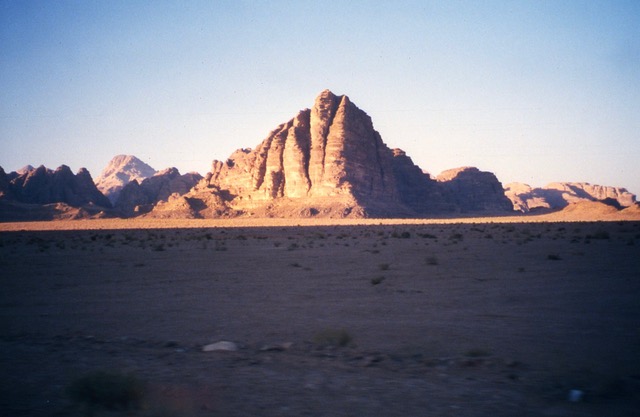
Not every location mentioned in Deuteronomy can be identified with certainty. Wadi Rum, for example, has been suggested by some scholars as a possible location for Kadesh-Barnea because of its immense size and natural water reservoirs hidden beneath its sandstone formations. It resembles a vast sand ocean. Whether that ultimately proves correct or not, standing in that vast wilderness helps one appreciate the scale of Israel’s encampment.

Wadi Rum is also forever linked with one of history’s most famous adventurers, T. E. Lawrence—better known as Lawrence of Arabia. During the Arab Revolt of 1917–1918, Lawrence crossed these deserts while helping lead Arab forces against the Ottoman Empire.

One of Wadi Rum’s towering sandstone formations now bears the name The Seven Pillars of Wisdom which inspired the title of Lawrence’s famous memoir. It is easy to understand why filmmakers have repeatedly chosen Wadi Rum to portray the moon, Mars, and otherworldly landscapes. This is a place of dramatic beauty—a wilderness that formed part of the landscape through which God prepared His covenant people to enter the Promised Land.

That may be the greatest lesson of Deuteronomy.

Moses also reminds Israel of the formidable peoples they encountered along the way—the Emim, the Anakim, the Rephaim, and Og king of Bashan. These “giants” had once filled Israel with fear. Forty years earlier the spies looked upon the Anakim and confessed, “We seemed like grasshoppers in our own eyes.”

Yet by the time Moses spoke these words, many of those once-feared enemies had already fallen. Their size had not determined the outcome. God’s faithfulness had. Every giant Israel dreaded became another testimony that nothing standing in the way of God’s covenant purposes was beyond His power to overcome.

That is why Deuteronomy begins with geography before it gives commands. Before Israel receives instruction, Moses reminds them of the road they have traveled with God. Yes, the wilderness was about reaching Canaan but perhaps more importantly it was about forming a people.

Standing among those valleys and mountains years later, I realized the landscape itself was part of Israel’s testimony.

Our own lives are not so different.

Like Israel, we are often tempted to measure the size of the obstacle instead of the greatness of the God who goes before us. Deuteronomy reminds us that every wilderness contains giants, but it also reminds us that God has never abandoned His people along the journey.

We all have our Horebs and Kadesh-Barneas, our Zereds and Arnons—places where God met us, corrected us, carried us, and prepared us for what lay ahead.
wilderness
Hor

Mount Hor: The Mountain Above Petra That Most Never See—But I Did

Most visitors who come to Petra spend the day marveling at the Treasury, the towering sandstone cliffs, and the remarkable architecture carved into the rose-red rock. Few realize that high above the ancient city rises one of the most significant mountains in Israel’s wilderness journey—Mt Hor.

In 1999 my husband and I had the opportunity to visit Petra with a tour group. We expected to spend the day exploring the famous ruins. Then someone mentioned that it was possible to ride camels up to the traditional site of Aaron’s tomb on Mount Hor.

Anyone who knows me knows I never pass up an adventure.

Another couple from South Dakota joined us, and together we hired a Jordanian guide. Camels were brought, saddles secured, lunches packed, and before long we were climbing the mountain.

At least, that was the plan.

I was assigned the camel with the worst gait imaginable. Instead of the smooth rolling motion camels are famous for, mine bounced with every step. I felt as though I were inside a washing machine. After only a few minutes I knew I could never survive several hours on that animal.

My husband smiled and offered to trade. It was completely unselfish because he knew we still had six hours ahead of us. I happily accepted.

Slowly we climbed above Petra. Far in the distance we could already see the whitewashed shrine that crowned the summit.

Along the dusty trail we passed a large Bedouin family living in a cave. The floor was packed earth covered with prayer rugs. Their children, their clothing, even their faces carried the dust of the mountain. The women made colorful beaded bracelets for passing travelers, and we gladly purchased a few. One young mother sat quietly in the corner nursing her baby while life continued all around her.

It was another world. Only a day later we would be staying in a first-class hotel in Amman. The contrast could not have been greater.

We had not planned for this excursion. We were dressed for walking through Petra, not riding camels over rough mountain trails. The thick wool saddle reminded us of that decision with every mile.

Fortunately, we had plenty of water and food.

Up…and up…we climbed. After a while the awkward motion of the camel became routine and we settled into its rhythm as the white shrine slowly drew nearer.

Nearly two hours later we reached a broad plateau just below the summit.

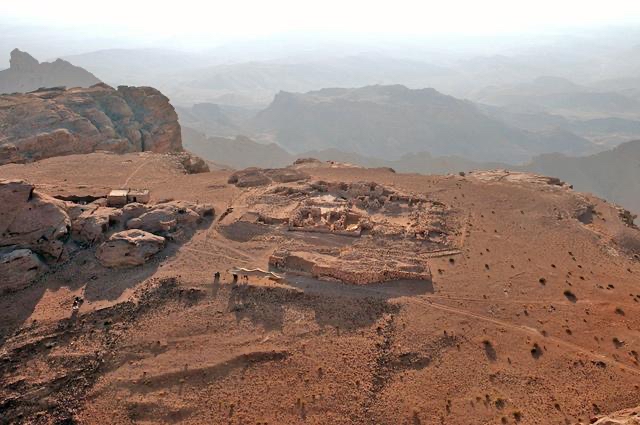
There we encountered a team of archaeologists from Finland and Sweden excavating a large complex spread across the mountainside. Our guide explained that the camels could go no farther. The final ascent was too steep and the summit too narrow. The archaeologists kindly allowed us to leave the camels with them while we climbed the last rocky stretch on foot.

At the time, we had no idea what they were uncovering. We simply assumed they were excavating another ancient ruin.

Only years later did I discover how remarkable that meeting had been. The excavation had begun only two years earlier under the direction of scholars from the University of Helsinki. We had arrived during one of the most exciting periods in the site’s modern history.

What they uncovered transformed our understanding of Mount Hor.

Jabal Harun—“Mountain of Aaron” stands about three miles southwest of Petra and rises more than 4,400 feet above sea level, making it the highest peak in the Petra region. Living at nearly 7,000 feet in New Mexico, the altitude never bothered us. The descent, perched high on those sure-footed camels, demanded far more courage than the climb.

At the summit stands the familiar whitewashed shrine dedicated to the prophet Harun—Aaron in Arabic. The present structure dates to a restoration completed in A.D. 1320 during the Mamluk period, although it rests upon the remains of a much earlier Byzantine sanctuary. Inside is a simple memorial chamber honoring Aaron.

No archaeological discovery has confirmed that Aaron himself was buried there. Yet for nearly two thousand years Jews, Christians, and Muslims have revered this mountain as the place where Israel’s first high priest died. That tradition reaches back at least to Josephus in the first century.

Some modern scholars question whether this mountain lies too far inside ancient Edomite territory to be the biblical Mount Hor.

Perhaps. But a tradition preserved for nearly two thousand years carries considerable weight with me. Standing on that summit, looking across the wilderness stretching toward the land of promise, I found it difficult to imagine a more fitting place.

The Finnish excavations revealed that this mountain had become one of the oldest pilgrimage destinations. Beginning in the fourth and fifth centuries, Christians climbed the mountain believing they were approaching the place where Aaron died.

Archaeologists uncovered a large basilica, chapels, monks’ quarters, storerooms, kitchens, courtyards, water systems, and buildings that probably served as hostels for weary pilgrims. The complex measured roughly sixty-two by forty-eight meters—far larger than anyone expected.

This was a thriving center of worship that welcomed generations of pilgrims making the difficult ascent. Among the discoveries were thousands of pottery fragments, Byzantine coins, Greek inscriptions, a baptismal font, and even traces of an earlier Nabataean sanctuary beneath the Christian structures.

The mountain had been regarded as sacred long before the monastery was built. One inscription referred to Aaron as “the Holy High Priest.” The monks built an entire pilgrimage center around the memory of his death.

That tells us how they understood Numbers 20 and 33. When we read the account of Aaron’s death, it is easy to focus only on the man. The biblical writers focus on something larger. Aaron ascends the mountain. His priestly garments are removed. They are placed upon Eleazar. Israel mourns for thirty days. Then their journey resumes. The mountain becomes the place where one servant lays down his calling, and another receives it.

Throughout the ancient Near East, kings often passed through ceremonies of humiliation before enthronement. Royal garments were stripped away before new garments were bestowed. Humbling preceded exaltation. Aaron’s priestly garments are stripped away on Mount Hor before they are placed upon Eleazar. The priesthood continues. Garments signify office, identity and calling.

Standing on that mountain twenty-six years ago, I could not have appreciated all of this. I simply remember the breathtaking view, the white shrine shining beneath the blue sky and the Jordanian sun, the archaeologists working below us, and the long camel ride from and to Petra.

Hor
Skip to content