

How Do You Measure Up?
A measuring line stretched across the earth. Foundations laid and a cornerstone set in place. Who determined the earth’s dimensions? God’s questions to Job picture creation taking shape through the work of a builder. He asks whether Job understands the earth’s vastness, the ordinances of heaven, or the source of wisdom itself (Job 38). Psalm 104 adds to the imagery: God stretches out the heavens like a tent, lays beams over the waters, and sets a boundary for the sea. Creation is described in the language of construction!
God is preparing a dwelling place for His Presence where life can flourish. Its dimensions and boundaries express His care for what He has made. Wisdom guides His work. “In wisdom you have made them all,” the psalmist declares (Ps. 104:24).
We find that same wisdom in the people God chooses to build His sanctuaries. Proverbs names three attributes behind God’s creative work: “The Lord by wisdom has founded the earth; by understanding has He established the heavens. By His knowledge the depths are broken up, and the clouds drop down the dew” (Prov. 3:19–20). Through His Spirit, God gives Bezalel and Oholiav and even Hiram those same attributes, equipping them for the craftsmanship needed to build the Tabernacle.
Some scholars understand the Tabernacle as a miniature expression of the ordered creation, an Eden-like sanctuary where God dwells among His people. Its boundaries, cherubim, and furnishings contribute to that picture.
The language carries into ordinary life. Through wisdom a house is built, through understanding it is established, and through knowledge its rooms are filled (Prov. 24:3–4). The divine Builder, the Master Craftsman of the universe, shares His wisdom and skill with His human image bearers.
God’s design and human hands
The Bible’s building accounts bring together measuring, divine instruction and human work.
Noah receives instructions and dimensions for the ark. Moses receives the pattern for the Tabernacle on Sinai. David passes the temple plans to Solomon, explaining that the Lord enabled him to understand them.
God entrusts His people with carrying out the work. Timber must be cut, curtains woven, stones prepared, and metal shaped. The dwelling takes form through their skill, cooperation, and obedience.
God’s choice to work through skilled hands tells us something about the value He places on craftsmanship. Patience, attention, and sound judgment are all expressions of wisdom. Careful work honors the One who gave us our abilities, and accurate measuring is part of that responsibility.
Measuring the right dimensions
Anyone who has attempted a building project knows the need for correct dimensions. A beam must suit the span and load it carries. Supports must be properly placed, and adjoining pieces must connect securely. A structure may look impressive, yet wind, rain, movement, and weight can expose its weaknesses. Accurate measuring, sound materials, a suitable foundation, and good craftsmanship help the building stand.
The Hebrew noun middah for measuring first appears in Exodus 26:2, where God specifies the dimensions of the Tabernacle’s curtains. Each has the same length and width. The instructions then describe how they connect: loops correspond, clasps join the sections, and separate pieces become “one tabernacle” (Exodus 26:6).
Each piece must fit securely with the others to form the dwelling. This capacity for measuring is a gift to humanity. It allows us to put a design into practice, joining separate parts into something stable and useful.
Discovering the works of His hands
Psalm 8 describes the heavens as the work of God’s fingers, then marvels that He entrusts humanity with responsibility for the works of His hands. Among them are creatures traveling through the “paths of the seas.”
According to an account of the life of Matthew Maury (1806–1873), those words sparked his curiosity about ocean currents. He also reflected on Ecclesiastes 1:6, which describes the wind blowing south, turning north, and continually returning to its circuits.
A naval officer whose leg injury prevented his return to sea duty, Maury gathered sailors’ observations of winds, currents, and voyage times. His charts helped navigators choose more efficient routes across the oceans.
The paths already existed within creation. Discovering their patterns required observation, measuring, and judgment. Distances and seasonal conditions became practical knowledge that helped sailors reach their destinations. Maury’s work offers an example of God-given abilities becoming wisdom put to use.
The promise of a restored home
For Israel, a broken covenant led to the loss of Jerusalem, the sanctuary, and life in the land. In Lamentations 2:8–10, God stretches out a measuring line for the city’s destruction. Walls collapse, gates sink into the ground, and elders sit in silence. Exile separates the people from the place where God had established His dwelling. Before they can rebuild, they must return.
The later promise of a line stretched over Jerusalem therefore carries hope. Jeremiah 31 places the rebuilding of the city alongside a renewed covenant. In Zechariah 1:16, God returns in mercy, His house will be built, and Jerusalem will again experience measuring. The next chapter describes a growing city with God’s glory in its midst.
Ezekiel’s temple vision belongs within this promise of deliverance from Babylonian exile. Given fourteen years after Jerusalem’s destruction, it follows God’s pledge to gather His people, cleanse them, and give them a new heart and Spirit. The desolate land will become like Eden (Ezekiel 36:24–35).
The sanctuary chapters 40–48 function within that setting: the end of exile, rather than the end of the world. God’s glory returns, and water flows from His dwelling, nourishing the land and its fruitful trees. The measured temple offers displaced people the promise of a restored home. Rebuilding expresses deliverance, renewed life in the land, and a return to God’s Presence.
A measured community
Ezekiel’s vision offered hope to people exiled in Babylon. Revelation addresses communities living under Rome. The ongoing story of captivity and deliverance provides language for their own experience of oppression and longing for restoration.
In Revelation 11, John is told to measure the temple, altar, and worshippers. Including the worshippers, brings the community into the sanctuary picture. G. K. Beale connects this act with the establishment and protection of God’s temple community. Though they still suffer under empire, God has claimed them as His dwelling.
This most likely connects with Ezekiel’s end-of-exile vision. The measured sanctuary assures displaced people that God will dwell among them again. Revelation develops that promise through the slain and risen Messiah. His people already belong to His Kingdom, even as they await their full deliverance.
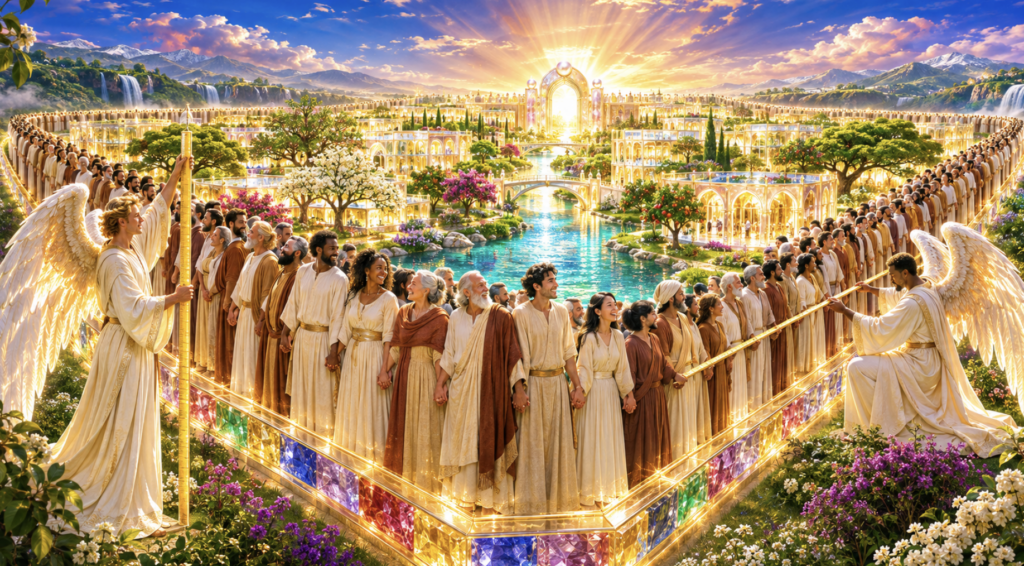
In Revelation 21, an angel measures New Jerusalem, its gates, and its wall. The city’s equal length, width, and height recall the Holy of Holies in Solomon’s temple. Yet there is no separate sanctuary within it. God and the Lamb are its temple, and the river of life flows from their throne.
The promise now reaches beyond deliverance from Babylon or Rome. Death itself, the greatest exile, will end. God will dwell with His people, wipe away their tears, and remove death from their midst (Revelation 21:3–4). Read alongside Ezekiel, this is the restoration of home in its fullest sense: a renewed creation where neither empire nor death can separate God’s people from His Presence. “Behold the dwelling of God is among men, and He shall tabernacle among them.”
Fitly joined together
Ephesians brings the building imagery into our relationships. In Messiah, the whole building is fitted together and grows into a holy temple. We are being built together into God’s dwelling place through the Spirit (Ephesians 2:21–22). His gifts equip us for service, and the body grows as each member contributes. The measure of its maturity is the fullness of Messiah.
We must ask: How do our abilities serve the whole? Are our connections sound? Does our contribution strengthen those around us?
Torah places honest measures alongside impartial judgment and love of neighbor (Leviticus 19). Yeshua brings the measure into our treatment of others: the measure we use will be measured back to us (Matthew 7:2). He concludes the Sermon on the Mount with a house that withstands rain, floods, and wind. Its builder hears His words and practices them.
We may bring considerable knowledge and ability to a community and still have much to learn about patience, honesty, forgiveness, and mercy. We practice these in ordinary encounters: keeping a promise, receiving correction, carrying someone’s burden, or repairing a relationship we have damaged.
God has entrusted each of us with a part in His building work. Perhaps the measure of a person is how faithfully we use what He has given us to help strengthen the whole house.
Leave a Reply