

Brother Against Brother: Conflicts can only be Healed through reconciliation
One of the most enduring themes in Scripture is the conflict between brothers. The pattern is not incidental. From Genesis onward, the Bible tells its story through rivalry, jealousy, wounded honor and the struggle over inheritance and covenant identity. Cain and Abel. Isaac and Ishmael. Jacob and Esau. Joseph and his brothers. The sons of David. Adonijah and Solomon. And eventually the climactic example: Yeshua and His own brothers. Each of these stories is not merely a record of ancient tragedy but, rather, an echo of Eden replaying humanity’s marriage to the serpent’s nature. A nature which brought about the distortion of identity and the longing for dominion. But yet, deep down, it also brought a hope for reconciliation.
Conflict, Covenant, and Resurrection Patterns
The serpent’s strike against the human family in Eden continued on through fratricide, rivalry, and the pursuit of honor at all costs. Scripture portrays the brother-conflict as one of the primary ways chaos enters the human community. Whenever blessing is given to one, the other feels robbed. Whenever a calling is granted to one son, another seeks to seize it by manipulation or force. Favoritism breeds resentment. Resentment leads to anger. Rage leads to murder. Humiliation wounds human dignity. And the temptation to seize power is where the serpent continually whispers: “Take what should be rightfully yours.”
Cain murders Abel when God favors Abel’s offering. Isaac and Ishmael clash over covenant identity and inheritance. Jacob and Esau battle over birthright, paternal blessing, and their father’s favor. Joseph’s ascension provokes his brothers to conspiracy, cruelty and even death. Abimelech slaughters seventy half-brothers to secure a throne. Absalom kills his brother and revolts against his father. Solomon executes Adonijah after Adonijah tries to seize royal authority. Beneath all of it stands the same question: Which brother will be king? Who will carry covenant blessing? Who will represent God in the world? Who will bring reconciliation?
These narratives also reveal the human fear that another’s calling will somehow diminish our own. They expose our inability to trust God’s personal or communal assignment. And they reveal how easily family dysfunction becomes the battleground for identity, destiny, and divine purpose.
It’s the drama that keeps on giving. The “rejected” brother emerges as the chaos agent. The “chosen” brother becomes the vessel of blessing and restoration. God continually elevates these biblical stories—the resolution is always reconciliation, transformation, and return.
And nowhere is this more illustrated than in the story of Jacob and Esau — a narrative in Genesis that could only be resolved through reconciliation.
Jacob’s story begins under the shadow of brother rivalry. He and Esau wrestle in the womb for the firstborn position. Esau emerges first, but Jacob grasps the heel — like a man hungry for power. The struggle continues into adulthood: birthright, deception, conflict over the paternal blessing. With a threat looming, Jacob flees his home under the pretense of finding a wife among the family clan. His exile begins with a stone beneath his head at Bethel, where God meets him in a dream. A ramp, a ladder, touches earth and reaches heaven. Angels ascend and descend. The Covenant promise unfolds here — land, offspring, and blessing to the nations. Jacob sets up the stone, anoints it, and vows allegiance to God who has claimed him as His own.
Jacob, however, leaves Bethel still as Jacob — the cunning brother, exiled to Padan Aram. Years pass. He marries, works, multiplies, becomes exceedingly fruitful. His household grows: wives, maidservants, eleven sons, flocks, wealth. But in time God’s command finally comes: return. And return means one unavoidable reality — he will have to make with reconciliation with Esau. Jacob cannot simply pass through Edom (Esav’s territory) and cross over into the land until the fracture with his brother is healed. No covenant renewal until the wound between brothers is addressed and reconciliation is achieved.
Jacob is terrified. Esau approaches with four hundred men. Jacob divides his camp — two companies — hoping that if Esau strikes one, the other may escape. This is the old Jacob, still ruled by fear, strategy, and survival. But Jacob is left alone at night and wrestles with a mysterious figure until daybreak. His name is changed. Jacob becomes Israel — the one who contends with God and prevails. Limping, marked, renamed, he crosses over as a new man into the land of God’s promise.
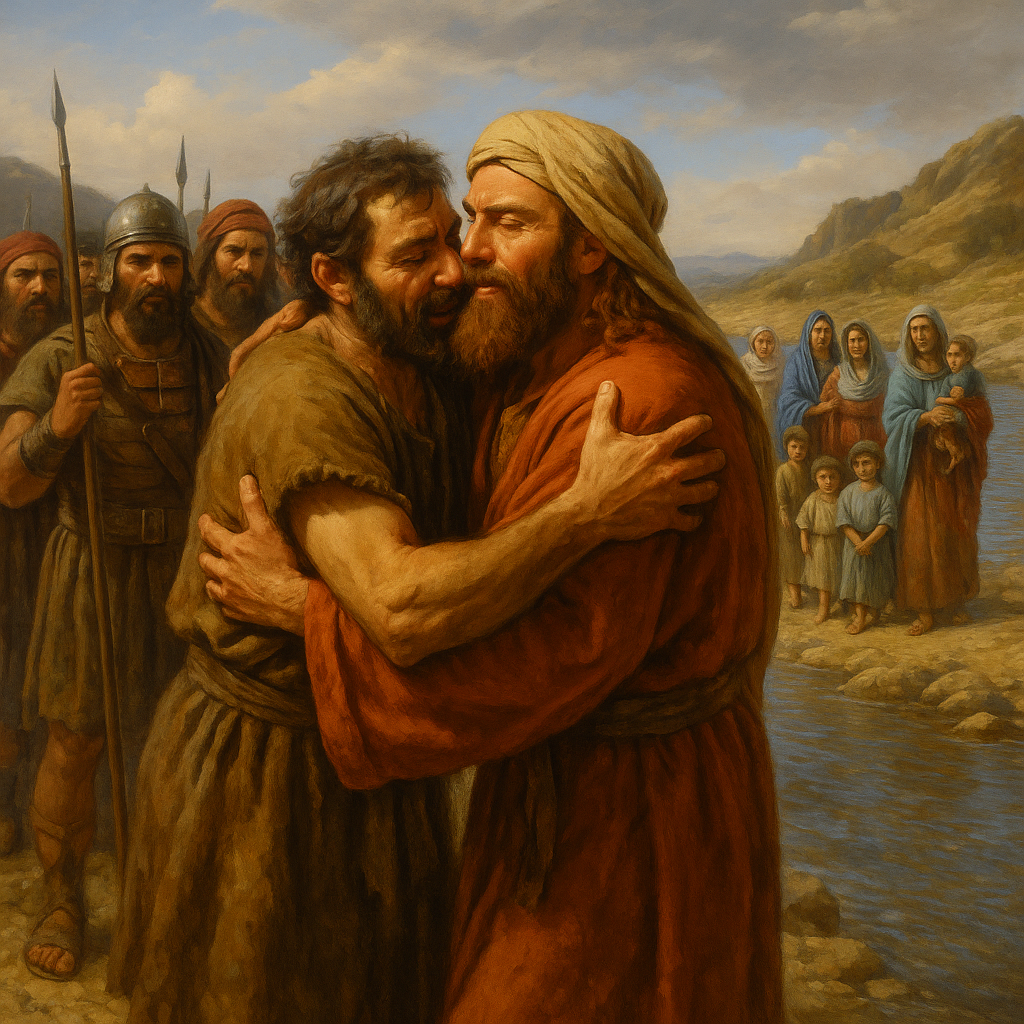
When Jacob meets Esau, he bows seven times to the ground. He honors the brother he once sought to surpass. And he receives not vengeance but embrace. Esau runs, falls on his neck, and weeps. Jacob says to him, “To see your face is like seeing the face of God, and you have accepted me.” It is the single greatest key to the path of reconciliation: to behold something divine in the face of the one you once feared. Reconciliation now reveals God’s presence where rivalry once ruled.
But the narrative does not end there. God’s call is for Jacob to return to Bethel where it all started. A chiasm emerges between the two Bethels (Gen. 28). Between the stone raised up and the altar rebuilt upon return.
The Wrestling at Jabbok: The Center of the Bethel Chiasm
Jacob’s wrestling at the Jabbok (Gen. 32:24–32) sits at the structural and theological center of the entire Bethel arc. It is the hinge on which everything turns—the moment Jacob becomes Israel, when the rivalry pattern that runs through Scripture finally breaks, and reconciliation becomes possible. Structurally, the wrestling stands at the midpoint of the Bethel narrative.
The story opens at Bethel in Genesis 28: a stone under Jacob’s head, a ladder bridging heaven and earth, divine promises of land, offspring, covenant, and blessing. But all of this will unfold in exile. Jacob leaves the land, marries and becomes fruitful in Padan-Aram. His household and flocks multiply under Laban’s hand until Yahweh issues the command: “Return to your land and kin.”
Yet Jacob cannot fully return to Bethel as he is. Before he crosses back into the land, he must face the brother he deceived, the inheritance he seized, and the unresolved rivalry that drove him into exile. And before he can face Esau, he must face God. He must make reconciliation with Esav. So, on the night before meeting his brother, he is left alone—and he wrestles.
The center of the narrative: The Gift of Reconciliation
Jacob grapples until dawn, refusing to release his mysterious opponent until he receives blessing. Nothing in the story changes until Jacob is changed.
Before Jabbok, Jacob moves through the narrative with the old instincts: plotting, maneuvering, dividing his camps, working angles, bracing for attack, leaning on human strategy and old patterns of deception. After wrestling, everything shifts. He limps, bearing the mark of broken human strength. He receives a new name—Israel. He sees the face of God in Esau. He bows, yields, submits, and reconciles. The interior change preceded his external restoration.
This is why the wrestling is the true center of the chiasm. It is the spiritual core—Jacob must become Israel before he can return to Bethel.
Every brother-conflict in Scripture revolves around the same themes Jacob carries into that night: identity, inheritance, blessing, and kingship. When God later reaffirms Jacob’s name at Bethel, He declares: “From your loins kings will come.” It is the climactic moment when the brother-rivalry pattern is shattered, and a new identity is forged. In that struggle, Israel is born.
Covenant reaffirmed: Fruitfulness, land, and kingship
Only after the wrestling can Jacob step back onto sacred soil. He faces Esau not as a rival, but as a reconciled brother. He crosses the Jordan not as an exile, but as a restored man. He purges his household of foreign gods, calls them to wash and change their garments, and leads them back to Bethel. There, he stands no longer as Jacob the deceiver, but as Israel, the covenant heir. He erects his stone pillar, builds his altar, and hears God reaffirm the promises spoken at the beginning: blessing, fruitfulness, nations, kings.
Jacob leaves Bethel as Jacob. He returns to Bethel as Israel.
In Genesis 35, God commands Jacob: “Go up to Bethel and dwell there. Build an altar.” Jacob instructs his household to remove foreign gods, purify themselves, and change their garments—signifying a new identity. Jacob hides the family idols beneath the oak tree — a burial for the gods that once governed their loyalties and polluted their worship. When they arrive at Bethel, Jacob builds an altar to the God who had first revealed Himself there. This time the stone does not first rest under his head. It stands upright as a pillar. It is an anointed witness to covenant renewal. God appears again, confirms the name Israel, commands fruitfulness, promises kings, and reaffirms the land.
Jacob fled the land under threat from his brother; he returns having embraced him. He left Bethel as Jacob; he returns as Israel. He departed with fear; he returns under blessing. And from Bethel, he journeys to Hebron to bury his father together with his brother Esau — just as Isaac and Ishmael together buried Abraham in the cave of Machpelah in Hebron. These sons once rivals have become sons of honor, thus healing the fracture. Even here, the Bible shows that reconciliation is the only path forward.
The final cycle: Yeshua and His brothers.
At first, Jesus’ brothers reject Him. They question His mental state: “They thought He was out of His mind.” They refuse to believe in Him (John 7:5). They mock Him. They resist His calling, not because they were cruel but because they were too close. Familiarity often blinds us to our own patterns of behavior. They grew up with Him. They shared childhood dynamics, family expectations, and the ordinary experiences of life in Galilee. Like Joseph’s brothers, they could not see destiny standing before them. They could not behold Yeshua as a Davidic king. They saw a sibling. And so the pattern of brotherly hostility repeated.
But after the resurrection, everything changes. Yeshua appears personally to James (Jacob) in 1 Corinthians 15:7. Love will triumph over rivalry. James becomes a pillar of the Jerusalem church, head of the Acts 15 council, and author of the epistle that bears his name. Jude becomes a devoted disciple and writer of Scripture. The risen Messiah gathers with His brothers and mother in prayer (Acts 1:14). The Cain-like impulse has been dismantled. The fear of Esau removed. The resentment of Joseph’s brothers healed. The final brother story does not end in exile or monarchy, domination or murder. It ends in repentance, restoration, shared leadership, and kingdom mission.
Yeshua becomes the Greater Brother. He does not punish His brothers for their rejection. He does not humiliate them for disbelief. He wins them through love, truth, and resurrection power. And ultimately through Him, all humanity — Jew and Gentile — will become one household under God. Jacob’s return to Bethel sets the pattern by which Scripture teaches reconciliation, covenant renewal and resurrection.
From Bethel to Bethel, Genesis reveals the blueprint: exile, transformation, reconciliation, return. To return to Bethel is to return to Eden — to the sacred mountain, the covenant bond, the presence of God, and key to the healed brotherhood of man.
I wish the script was bolder, very hard on my eyes to read. Thank you Diana. Shalom
It’s on the darkest setting. No sure how to make it any bolder.