
When Life Seems to Take You Away from the Promise
Jacob’s journey to Haran begins with a reversal. His grandfather Abraham had been called out of Mesopotamia into the land of Canaan, where Adonai promised him an inheritance and descendants through whom all the families of the earth would be blessed. Now Jacob, the heir of that covenant, is traveling in the opposite direction. He is leaving Beersheba, in the land of promise, and returning toward the ancestral homeland from which Abraham had departed.
Jacob is fleeing the anger of his brother Esau, leaving behind his family, his security, and the inheritance he has just received through Isaac’s blessing. The covenant promises are his, yet his circumstances seem to be carrying him away from their fulfillment.
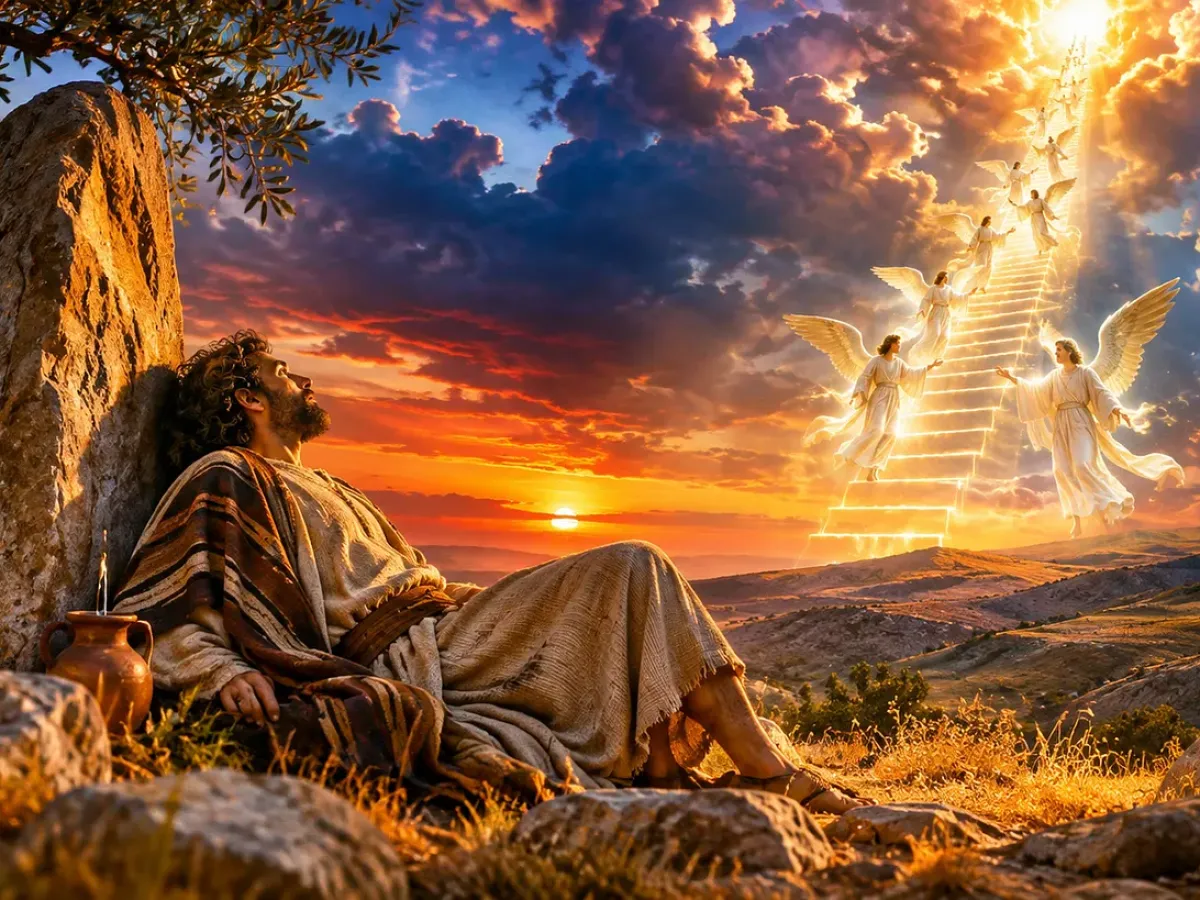
As the sun sets, Jacob stops for the night, having come upon ha-makom, “the place.” What appears to be an ordinary stopping off place becomes the setting for a divine encounter. The word makom appears six times (Genesis 28:11–19), three times before Jacob’s dream and three times afterward. This threefold pattern may recall the third day of creation where dry land emerges from the waters and becomes a place of transition and flourishing. At Bethel, the ground upon which Jacob sleeps is where heaven and earth meet. Nothing about the physical location has changed per se, but Jacob’s understanding of it has been transformed.
In later Jewish tradition, HaMakom became a designation for God Himself. Jacob had encountered more than a geographical location. He had encountered the God whose presence gives meaning to the place.
The Stone and the Heavenly Stairway
Jacob takes one of the stones and positions it at his head. Most translations describe the stone as a pillow, but the Hebrew says “at his head-place.” It does not necessarily meant underneath his head.
In his dream, Jacob sees a sullam standing upon the earth, its top reaching heaven, with angels of Elohim ascending and descending upon it. The word sullam occurs only here in the Hebrew Bible. Although traditionally translated “ladder,” it may actually describe a stairway or ramp. Scholars have compared it with the Akkadian simmiltu, a term associated with stairways, including those belonging to monumental religious structures. Throughout ancient Mesopotamia, temple towers known as ziggurats symbolized the relationship between heaven and earth. Their elevated sanctuaries and stairways expressed the sacred connection between the divine and human realms.
Jacob’s vision belongs to this ancient world of sacred architecture, but with an important difference. Jacob has constructed nothing. The heavenly connection is revealed to him by Adonai.
When Jacob awakens, he takes the stone that had been at his head and sets it upright as a standing pillar. Standing stones were familiar throughout the ancient Near East. They could mark sacred locations, commemorate ancestors, serve as witnesses to agreements, or symbolize divine presence. Jacob’s action belongs to this cultural setting, yet the biblical narrative gives it a distinctive meaning. He is not erecting an image of a foreign deity. He is consecrating a stone in response to the revelation of Adonai.
Jacob pours oil upon the pillar and names the location Bethel, Beit El, the House of God. He declares, “This is none other than the house of God, and this is the gate of heaven.”
The place where heaven and earth meet has become a sacred center.
From One Man to the Nation of Israel
The entire biblical story is, at its heart, the story of God restoring His dwelling presence among humanity, a presence lost through humanity’s expulsion from Eden. At Bethel, Jacob receives a glimpse of heaven and earth reunited; that presence will later dwell among Israel in the Tabernacle and Temple, before finding its fullest expression in Yeshua, the Word made flesh, who tabernacled among us and through whom God’s ultimate purpose of dwelling with humanity will be fulfilled.
At Bethel, Adonai reaffirms the covenant made with Abraham and Isaac. The land upon which Jacob lies will belong to him and his descendants. His seed, zerah, will become as numerous as the dust of the earth. “You shall spread abroad to the west and to the east and to the north and to the south” (Genesis 28:14).
The Hebrew verb paratz conveys breaking forth, bursting through, or spreading beyond boundaries. From this place of encounter, Jacob’s descendants will expand toward the four directions. And through his seed, all the families of the earth will be blessed.
Years later, Jacob will return from Haran, having endured exploitation, family conflict, and over twenty years of uncertainty. His name will be changed to Israel at Peniel and reaffirmed at Bethel. In Genesis 35:11, Adonai promises that a nation, a company of nations, and kings will come from him.
Jacob, the solitary traveler becomes Israel, the father of twelve tribes.
When those tribes leave Egypt and gather in the wilderness, their arrangement around the Tabernacle reflects something important. Three tribes camp on each of the four sides of the sanctuary: east, south, west, and north. At the center stands the Tabernacle, surrounded by the Levites, with the presence of Adonai dwelling among His people.
The four-direction arrangement recalls the promise made to Jacob at Bethel. What was spoken to one man becomes visible in the sacred organization of an entire nation. Israel is not organized around a palace or military headquarters. Its center is the dwelling of God. The sanctuary establishes an ordered community around the divine presence, drawing twelve distinct tribes into a shared covenant identity.
Yet the promise given at Bethel was never intended to end with Israel. Through Jacob’s seed, the blessing was destined to reach all the families of the earth.
The King Who Connects Heaven and Earth
The promise that kings would descend from Jacob introduces another dimension of the relationship between heaven and earth. In the ancient Near East, kingship carried significance. Egyptian pharaohs were understood as mediators between the gods and humanity, while Mesopotamian kings generally ruled as divinely appointed representatives. Their thrones expressed an authority understood to originate in heaven and it was thought that when they “sat” on the throne to rule heaven and earth became one. A sign that order had been restored.
Israel’s understanding of kingship was distinctive. The king was not a god but the anointed representative of Adonai. First Chronicles 29:23 declares that Solomon sat upon “the throne of Adonai.” Psalm 2 presents God’s king enthroned upon Zion, His holy mountain. Kingship, sacred geography, and divine presence belonged together.
These themes converge in John 1, where the imagery of Jacob’s vision returns. When Nathanael encounters Yeshua, he declares, “Rabbi, You are the Son of God! You are the King of Israel!” (John 1:49).
Immediately afterward, Yeshua tells him: “You will see heaven opened, and the angels of God ascending and descending upon the Son of Man.”
The reference to Jacob’s vision seems clear, but something has changed. At Bethel, the angels ascend and descend upon the sullam, the ramp. In John’s Gospel, they ascend and descend upon the Son of Man Himself. The meeting place between heaven and earth is now identified with Yeshua.
John has told us that the Word became flesh and dwelt, or tabernacled, among us. Later, in John, Yeshua identifies His own body as the Temple. The sacred center is no longer identified solely with a particular location and building. God’s dwelling presence is now revealed in the person of Israel’s Messiah, the promised King.
The King Lifted up Upon the Tree
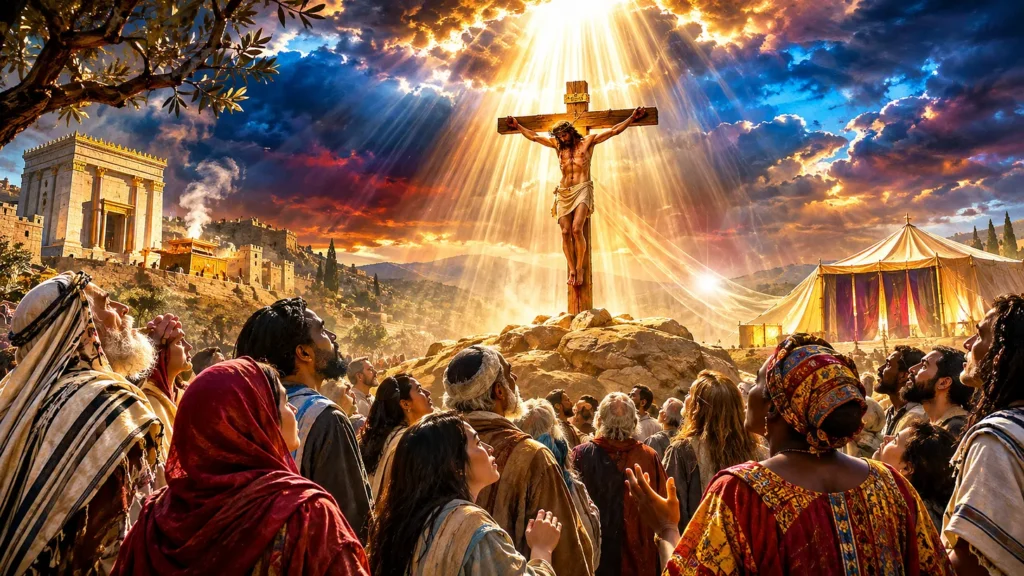
The connection between heaven and earth reaches its fullest expression when Yeshua is lifted up upon the Tree. At Golgotha, the King of Israel hangs between heaven and earth, crowned with thorns. Above His head is the inscription identifying Him as King of the Jews. What appears to be the humiliation of Israel’s Messiah becomes, in John’s Gospel, the revelation of His glory.
Yeshua had declared, “And I, when I am lifted up from the earth, will draw all people to Myself” (John 12:32). In the same chapter, He speaks of a grain of wheat falling into the earth and dying so that it may bear much fruit by spreading out.
Through the death and resurrection of Israel’s Messiah, the promise of the seed comes into focus. The blessing promised to Abraham, Isaac, and Jacob breaks forth toward the nations.
Yeshua is the living Tabernacle, the sacred center where heaven and earth meet. From Him, the life of God extends outward toward earth’s four corners, gathering Jew and Gentile into one household.
Israel has not been replaced. Through Israel’s King, the covenant blessing reaches the world for which it was always intended.
Surely Adonai is in This Place
Jacob’s life seemed to be moving in the wrong direction. He was leaving the inheritance behind, uncertain of his future and facing years of hardship he could not yet imagine.
Many people today understand that uncertainty. Financial pressures, medical concerns, family difficulties, and constant bad news can leave even faithful people demoralized and wondering what lies ahead.
Adonai did not promise Jacob an easy journey. He promised something more enduring: “I am with you … I will not leave you until I have done what I have promised you.”
When Jacob awoke, his circumstances had not changed. He was still far from home, with an uncertain road ahead. But his understanding had changed. “Surely Adonai is in this place, and I did not know it.”
The God who met Jacob at Bethel is not confined to sacred buildings or favorable circumstances. We may not know what tomorrow will bring, but Jacob’s journey reminds us that even when life appears to be carrying us away from everything familiar, we have not moved beyond the reach of God’s presence. The place of uncertainty may very well become the very place where we discover that He has been with us all along.
Leave a Reply