
Noah’s Ark: A Floating Temple in a World of Chaos
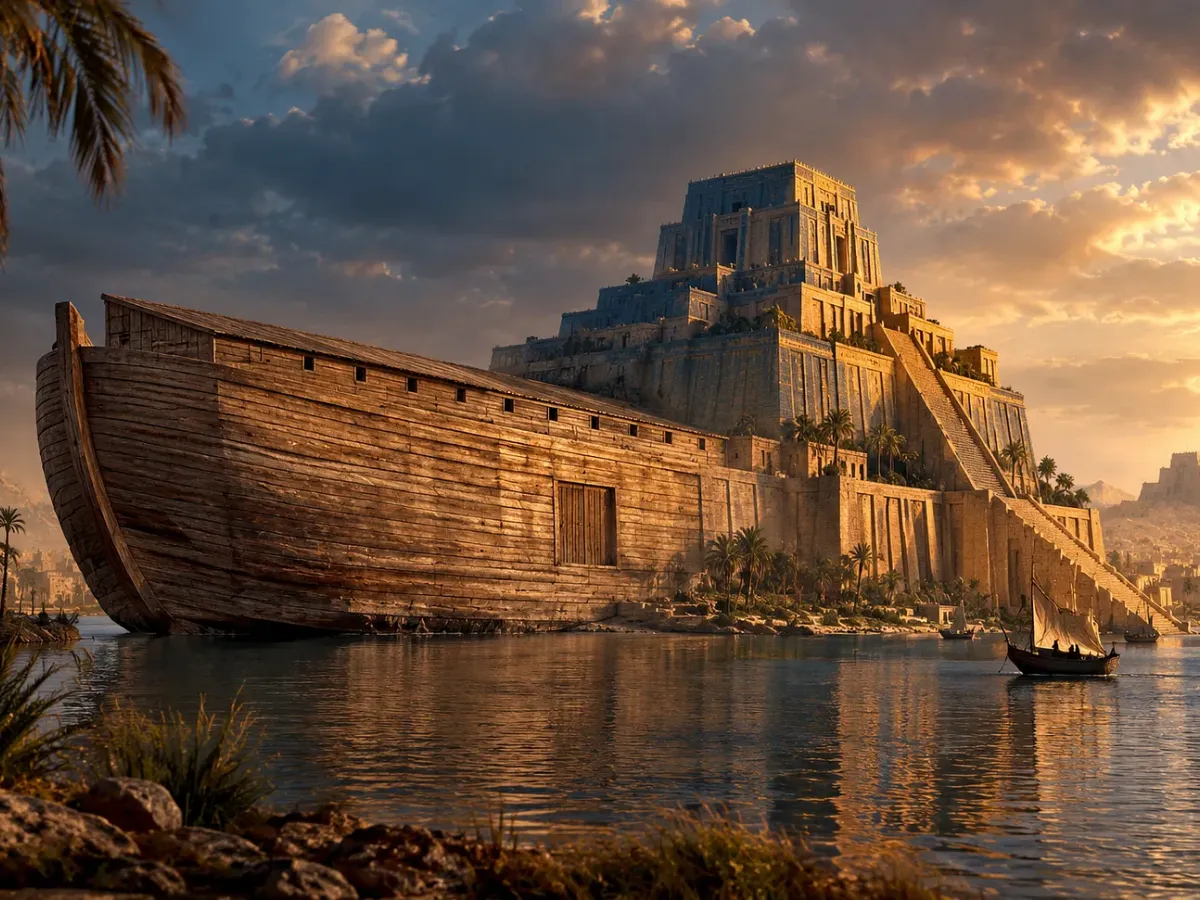
When we think about Noah’s ark, most of us picture an enormous wooden boat filled with animals, floating on a vast ocean while the world disappears beneath the floodwaters. We remember the forty days of rain, the dove returning with an olive leaf, and the bow in the sky that marked God’s covenant with Noah. Yet the biblical account contains an architectural dimension. Noah’s ark was much more than a vessel designed to survive a catastrophic flood. Its structure, dimensions, and purpose reflect an ancient understanding of sacred space, particularly the cosmic mountain, the Mesopotamian ziggurat, and the Tabernacle that Israel would later construct in the wilderness.
These connections provide an entirely different perspective on the flood narrative. The ark becomes a miniature representation of the created world, a sanctuary where life is preserved while the surrounding creation returns to chaos. It also anticipates the Tabernacle, where the Divine Presence would dwell among Israel as the nation journeyed through the wilderness. Both structures reveal something fundamental about God’s purposes: He preserves a people through judgment and disorder so that His creation can be restored.
The Ark and the Ancient Ziggurat
To understand the architectural imagery of Noah’s ark, we need to consider the world of the ancient Near East, where mountains and temples were closely associated with the dwelling places of the gods. Mesopotamian cities constructed enormous stepped temples called ziggurats, designed to represent sacred mountains rising from the earth toward heaven. These structures were understood as places where heaven and earth intersected, where the divine realm could encounter the human world.
The famous ziggurat of Babylon, Etemenanki, was constructed with equal dimensions in height, length, and width. Its architectural design reflected the ancient understanding of the cosmos, with the temple rising above the earthly realm toward the heavens. The ziggurat was not simply an impressive religious monument. It represented the ordered universe and the divine authority that sustained it.
In the ancient Mesopotamian flood narrative, the Epic of Gilgamesh, the hero Utnapishtim receives instructions to construct a vessel that will preserve life during a catastrophic deluge. His ark is described as a cube measuring 120 cubits in length, width, and height, divided into seven horizontal levels.
Scholars such as John Holloway and L. Michael Morales have argued that this vessel was conceived along the lines of a ziggurat. Its seven levels reflected the cosmic structure of the universe, while its equal dimensions recalled the sacred architecture of Babylon. Even the Akkadian word ekallu, used in the Gilgamesh account, ordinarily referred to a palace or temple rather than a seagoing vessel. The flood vessel was imagined as a floating sanctuary, a sacred mountain capable of preserving life while the world outside was overwhelmed by the waters of chaos.
Genesis presents Noah’s ark with a different architectural design, yet it shares important features with these ancient traditions. Rather than a seven-level cube, Noah constructs a rectangular structure measuring three hundred cubits long, fifty cubits wide, and thirty cubits high. It contains three levels, a door in its side, and compartments for the living creatures that will inhabit it.
What is significant is what the ark does not contain. There are no sails, rudders, oars, or navigational instruments. Noah is never instructed to steer the vessel toward a particular destination. The ark is designed to float, not to navigate. Its purpose is to preserve life within an enclosed and ordered environment while the waters rage outside.
From this perspective, the ark resembles a floating house or temple more than a conventional ship. Its architecture reflects the sacred structures of the ancient world, where the dwelling place of the divine was understood as a miniature representation of the cosmos.
The Ark as a Cosmic Mountain
The connection between Noah’s ark and the cosmic mountain becomes clearer when we examine its three levels. Ancient Near Eastern cosmology commonly understood the universe as consisting of three realms: heaven above, the earth where humanity dwelled, and the waters or underworld beneath.
The sacred mountain brought these three realms together. Its summit reached toward heaven, its middle slopes belonged to the earthly world, and its foundations extended into the primordial deep. The mountain therefore represented the intersection of heaven, earth, and the waters beneath creation.
Noah’s ark reflects this same threefold arrangement. Genesis 6:16 specifically instructs Noah to construct lower, second, and third levels. Scholars have suggested that this tripartite design represents the ordered cosmos, with the highest level symbolically associated with heaven and the lower levels corresponding to the earthly and watery realms.
This pattern appears repeatedly throughout Scripture. At Mount Sinai, Moses ascends into the cloud at the summit, the elders occupy an intermediate position, and the people remain near the mountain’s base. Later, the Tabernacle and Temple reflect similar distinctions between increasingly sacred spaces.
The mountain is particularly important because it represents the place where God’s Presence establishes order over the forces of chaos. In the biblical creation account, the waters are separated and boundaries established so that life can flourish. The world becomes an ordered dwelling place—a cosmic house prepared for its inhabitants.
The flood reverses that process.
The boundaries that restrained the waters are overwhelmed, and the ordered world returns to a condition resembling the primordial deep. The earth that God had prepared for habitation disappears beneath the floodwaters. Humanity, animals, and the established structures of civilization are swept away.
Yet within this destruction, the ark remains.
It becomes a miniature cosmos, preserving the life of the original creation within its walls. Noah, his family, and the animals inhabit a protected environment while the world outside undergoes a process of cleansing and renewal. The ark functions as a sacred mountain moving over the waters, maintaining an ordered space in the midst of universal disorder.
This imagery reaches its fulfillment when the ark comes to rest upon the mountains of Ararat. The floating mountain finds its resting place upon an actual mountain, and the process of restoring creation begins.
Noah’s Ark and the Wilderness Tabernacle
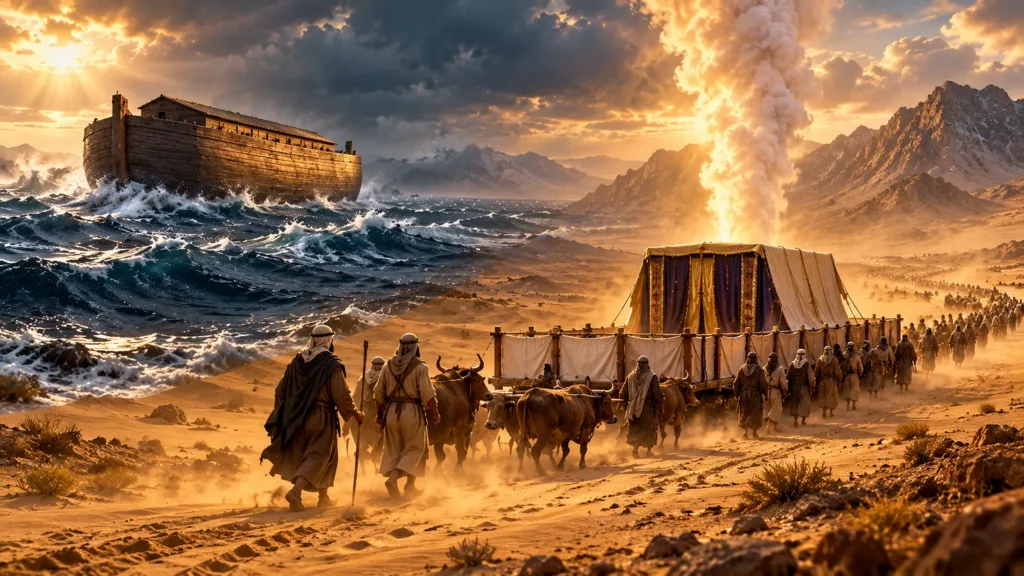
One of the most compelling aspects of the flood narrative is its relationship to the wilderness Tabernacle. Both structures were built according to divine instructions, both were designed to preserve God’s people within a threatening environment, and both functioned as mobile sanctuaries.
Genesis tells us that Noah did everything God commanded him concerning the construction of the ark. The same language appears in Exodus when Moses completes the Tabernacle according to the pattern revealed to him on Mount Sinai. In both accounts, God provides the architectural instructions, and the human builder faithfully carries them out.
And the similarities extend beyond the construction process.
The ark moves across the waters of chaos, while the Tabernacle moves through the wilderness. Both environments represent disorder and danger. The floodwaters threaten the existence of creation itself, while the wilderness threatens Israel’s survival following the Exodus from Egypt.
Yet God provides a sanctuary for each environment.
The ark becomes the protected dwelling place for Noah’s family and the animals, while the Tabernacle establishes the Divine Presence at the center of Israel’s encampment. Each structure creates an ordered world in which life can be preserved and God’s purposes carried forward.
The Tabernacle also functions as a portable Mount Sinai. The Divine Presence that descended upon the mountain in fire and cloud would later dwell within the sanctuary constructed by Moses. As Israel traveled through the wilderness, the sacred mountain effectively traveled with them.
Noah’s ark anticipates this extraordinary development. It represents a mobile mountain sanctuary, carrying the inhabitants of a future creation across the waters until they reach their appointed place of rest.
L. Michael Morales describes the movement of these sanctuaries in terms of their direction. The ark moves vertically over the waters toward the mountaintop, while the Tabernacle moves horizontally across the wilderness toward the Promised Land. Both journeys culminate in the restoration of an ordered dwelling place for God’s people.
Genesis 8:13 records that on the first day of the first month, Noah removed the covering of the ark and discovered that the waters had dried from the earth. Exodus 40:2 instructs Moses to erect the Tabernacle on the first day of the first month. These corresponding dates reinforce the relationship between the ark and the Tabernacle as structures associated with new beginnings. Noah emerges into a renewed world, while Israel establishes the sanctuary that will define its life as a redeemed nation.
Like Noah and the children of Israel, we live in a world where chaos continually threatens the order God intended for His creation. We experience uncertainty, upheaval, and circumstances beyond our control, yet the biblical pattern reminds us that God’s Presence is not confined to a particular mountain, building, or geographical location. The ark moved across the waters, and the Tabernacle traveled through the wilderness because God was establishing something far greater. He was forming a people who would carry His Presence into the world.
As the Body of Messiah, we are now called to become that living sanctuary, a community where God’s order, justice, wisdom, and compassion are made visible in the midst of a troubled world. Our calling is not to withdraw from a world overwhelmed by chaos, but to become a place where the life and Presence of God are preserved, nurtured, and extended to others.
Leave a Reply