

In the Beginning, Wisdom
A house needs more than walls, a roof, and a place to sleep. It needs someone who understands how to bring order to its daily life, nourish its members, and preserve its integrity. The Woman of Valor in Proverbs 31 does all of this. She provides, teaches, works, and watches over her household. Her strength is practical and spiritual, extending beyond her own needs to those of her family and community. We recognize her as a faithful wife and mother, but within the larger framework of Proverbs, she also invites us to consider Wisdom herself.
What might this woman teach us about the building of God’s house?
Proverbs introduces Wisdom as a woman who speaks, instructs, and calls people away from foolishness. She offers something more enduring than wealth and more valuable than precious stones. Those who embrace her find life. Wisdom is described as a Tree of Life, an image associated with the Torah. In Jewish tradition, the Torah is called Etz Chaim (עֵץ חַיִּים), a Tree of Life, reflecting Proverbs 3.18: “She is a tree of life to those who grasp her.” Even the wooden rollers of the Torah scroll are called atzei chaim, trees of life.
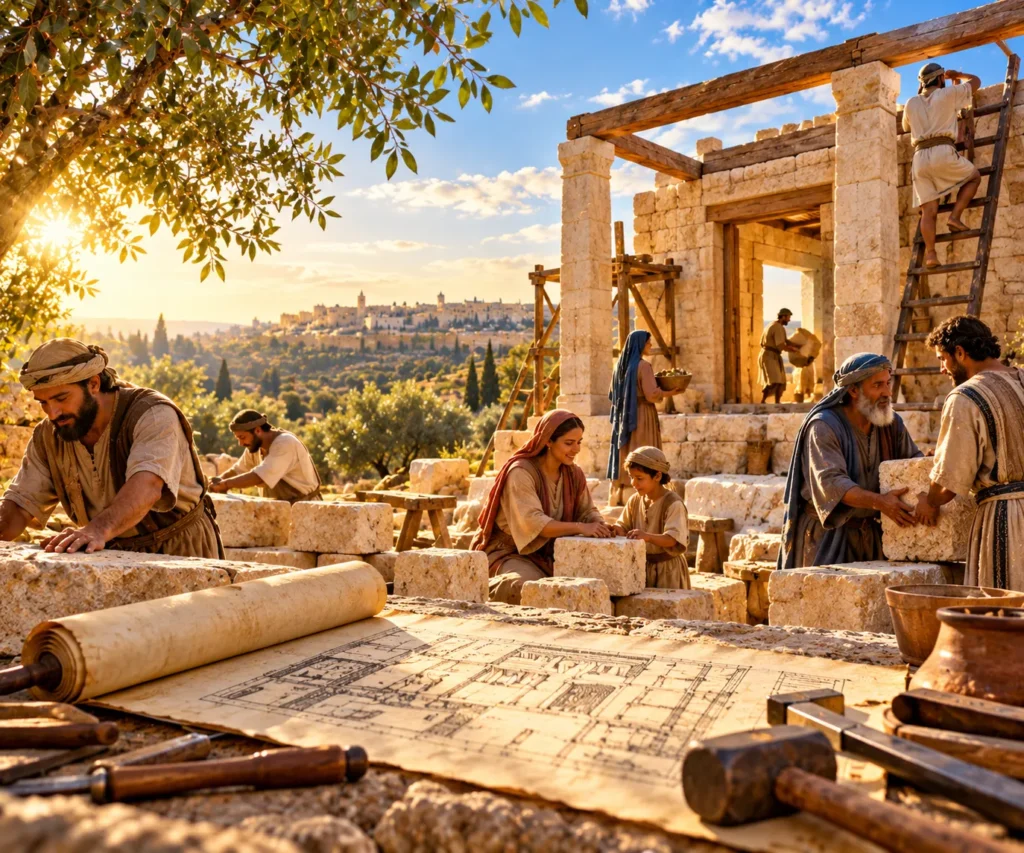
Wisdom is also a builder who prepares her house, carves its seven pillars, and sets a table for those willing to learn (Prov. 9.1–6). These images belong together. A tree sustains life, a table nourishes a family, and a house provides a place where life can flourish. Wisdom makes the household fruitful.
This building project begins long before the construction of Israel’s Tabernacle. Proverbs tells us that God founded the earth through wisdom and established the heavens through understanding (Prov. 3.19). In chapter 8, Wisdom speaks of being present before the mountains, springs, and boundaries of the sea. She witnesses the ordering of creation and delights in humanity. Creation is an expression of God’s wisdom. The world possesses structure, boundaries, and purpose. When we understand creation as a temple, we recognize the work of a wise builder preparing a dwelling place.
Later Jewish writings develop this portrait. The Wisdom of Solomon associates Wisdom with God’s works: righteousness, understanding, and good government. Sirach pictures Wisdom ministering in the holy dwelling and taking root among God’s people. Together, these traditions connect creation and sanctuary. Wisdom understands how the house should function.
Other Jewish traditions explored feminine imagery in relation to God’s presence. Philo spoke of God as the husband of Wisdom, while later Jewish mysticism described the Shekinah, God’s indwelling presence, through feminine and bridal imagery. The relationship between the heavenly King and Queen became a way of contemplating divine presence, Israel’s faithfulness, and restoration. Although these interpretations emerged in different historical settings, they do reflect a recurring theme:
How does God dwell among His people, and what happens when that relationship is broken?
This question also leads us into the difficult history of Asherah worship in ancient Israel. Scripture records the presence of objects associated with Asherah, sometimes even within the Jerusalem Temple. The reforms of Asa, Hezekiah, and Josiah involved removing these objects and confronting religious practices that had become embedded in Israel’s worship. Jeremiah likewise challenged those who offered sacrifices to the Queen of Heaven, believing she guaranteed their prosperity.
Archaeological discoveries added another dimension to this history. At Kuntillet Ajrud, an eighth-century BCE site in the northeastern Sinai, inscriptions discovered on large storage vessels invoke blessings associated with “Yahweh of Samaria” or “Yahweh of Teman” and “his Asherah.” Another inscription, discovered at Khirbet el-Qom, near Hebron in Judah, also associates Yahweh with Asherah in a blessing formula. These discoveries suggest some Israelites or their neighbors understood Asherah as having a relationship with Yahweh.
Scholars continue to debate whether these references identify a goddess regarded as Yahweh’s consort, a sacred wooden object, or another religious symbol. Raphael Patai and others explored the possibility that a divine feminine figure once occupied a place in popular Israelite religion. These findings reveal the complicated religious world behind the biblical text, although they do not establish that Scripture endorsed a divine wife. We simply cannot equate Asherah with biblical Wisdom or the Holy Spirit. Nevertheless, the evidence does invite us to consider how feminine imagery functioned within the religious imagination of ancient Israel.
The feminine imagery associated with the Holy Spirit deserves consideration. The Hebrew word ruach, meaning spirit, commonly takes feminine grammatical forms, as does the Aramaic ruha. Grammatical gender does not determine God’s nature, of course, but it provided a linguistic foundation for maternal imagery among some ancient interpreters. Certain Syriac Christian writings portray the Spirit as a mother who nurtures, sanctifies, and brings believers into new life. Other noncanonical Christian traditions preserve similar language.
At Yeshua’s immersion, the Spirit descends like a dove while a heavenly voice declares His beloved sonship. Early interpreters sometimes connected this scene with the Spirit hovering over the waters in Genesis. Water, hovering, and the emergence of new life provided a powerful pattern for understanding immersion and renewal. Although Matthew does not identify the heavenly voice as a Mother Spirit, these later interpretations reveal how some early believers understood the Spirit’s nurturing and life-giving activity.
The Queen of Sheba provides another intriguing example.
She visits Solomon, tests him with difficult questions, and examines his wisdom, wealth, servants, and ordered household (1 Kings 10). What impresses her is not simply Solomon’s intellectual ability but the visible results of his wisdom. She blesses the God who appointed him to administer justice and righteousness. We might see in her visit an earthly reflection of heavenly Wisdom examining the king and his kingdom. Does Solomon’s house reflect the wisdom by which God established creation?
Perhaps the clearest biblical connection between Wisdom and the Spirit appears in Bezalel’s commission. God fills him with His Spirit, giving him wisdom, understanding, knowledge, and craftsmanship to construct the Tabernacle (Ex. 31.1–5). The Spirit’s filling produces the ability to accomplish God’s purposes. Hiram’s craftsmanship in Solomon’s Temple reflects this same principle. Wisdom is not merely knowledge or spiritual insight. It equips people to build something that reflects God’s order.
Proverbs 24.3–4 brings these ideas together: wisdom builds a house, understanding establishes it, and knowledge fills its rooms. These architectural images extend beyond the physical sanctuary into ordinary life. Families require discernment, communities require justice, and God’s people require wisdom to live faithfully together. The Body of Messiah, described by Paul through Temple imagery, is likewise built through the gifts and responsibilities of its members.
Yeshua stands at the center of this restoration. Luke describes His growth in wisdom, while Paul declares that the treasures of wisdom and knowledge are hidden in Messiah (Luke 2.40, 52; Col. 2.3). His teachings reveal the character of God’s kingdom and the kind of people who belong within it. Walking in the Spirit should therefore transform our judgment, conduct, and relationships. James describes heavenly wisdom through purity, peace, gentleness, mercy, and good fruit (James 3.17). These qualities reveal whether the house we are building reflects its divine architect.
The maternal picture brings this work close to home. A good mother teaches, corrects, comforts, and prepares her children to live wisely. She preserves what is life-giving and confronts what threatens the household. Such imagery helps us contemplate the Spirit’s nurturing work without reducing God to human biology. It also challenges communities that diminish women’s capacity to teach, lead, and contribute wisdom. Genesis places both male and female within the divine image. A restored household requires the faithful participation of both.
Wisdom’s invitation ultimately asks for a response.
We may admire her house, appreciate her table, and discuss the mysteries of creation while neglecting the choices that determine the condition of our own lives. Ezekiel’s promise of a new heart and God’s indwelling Spirit connects restoration with obedience (Ezek. 36.26–27). God gives His people the wisdom and ability to live according to His ways.
The same Wisdom present in the ordering of creation continues to call God’s people into the work of restoration. She builds through those willing to receive instruction, exercise discernment, and bear good fruit. The question is whether we will allow that wisdom to rebuild our own house.
Leave a Reply