

When Chaos Rules the World
Why did the ancient world fill its temples and palaces with strange creatures unlike anything found in nature? Winged lions guarded palace gates. Serpents adorned temple walls. Human-headed bulls stood beside royal entrances, while other composite beings watched over places associated with kings and the divine. To modern eyes they may seem like little more than relics of ancient mythology. To those who carved them, however, they reflected a world in which order was never secure, and the forces of chaos were never far away.
That understanding grew out of everyday experience. A year’s harvest could disappear beneath floodwaters. Drought reduced fertile valleys to dust. Disease swept through villages, and invading armies left cities in ruins with families scattered in their wake. Kingdoms rose only to fall again, and every generation buried its dead. No matter how hard people worked to build a stable world, disorder eventually returned.
Chaos in the Ancient World
Every civilization searched for an explanation. Why did chaos always seem to return? Egypt, Babylon, Assyria, and Canaan answered that question in different ways, but they all shared one conviction: chaos was the great enemy of life. Egypt spoke of Apophis, the serpent of darkness. Babylon told of Tiamat, the chaotic waters. Canaan described Yam, the sea and Leviathan, the twisting sea monster that resisted rulership. The dragon, the serpent, the raging sea, and the monsters of the deep gave visible form to the unseen forces that threatened order. Even the cherubim guarding Eden belong to this larger world of ancient imagery.
It is into this world that the opening pages of Scripture speak. After centuries of stories describing gods struggling against rival deities, the Bible begins in an entirely unexpected way. “In the beginning God created the heavens and the earth.” There is no genealogy of competing gods, no cosmic struggle, and no uncertainty over who will prevail. Before a single creative act takes place, God already reigns.
The earth is tohu va-bohu—unformed and unfilled. Darkness covers the face of the deep, yet none of these things threaten the Creator’s sovereignty. God speaks, and creation responds. Light fills the darkness. Waters are given their boundaries. Dry land appears. Life begins to flourish. What is unformed becomes formed. What is empty becomes full. Step by step, the world is prepared as a place where God will dwell with humanity.
Yet the story immediately presents another question. If God created the world for life, fruitfulness, and His presence, why does chaos continue to dominate human experience? Here the Bible parts company with the stories of the surrounding nations. Chaos does not begin with a battle among the gods. It enters history through human rebellion.
The serpent’s appearance in Eden marks a decisive turning point in the biblical story. What follows is not a collection of unrelated stories but an unfolding pattern. Rebellion gives way to exile. Exile is followed by the murder of a brother. Violence spreads until it corrupts the whole earth. The Flood reverses creation as the waters once again cover the land. Babel fractures humanity into scattered nations. With each generation chaos extends its reach, moving from one couple to one family, from one family to all humanity.
The story continues throughout the Hebrew Scriptures. Pharaoh becomes another face of chaos as he enslaves Israel and orders the death of the baby boys. The sea once again stands as an obstacle to life. The wilderness becomes a place where hunger, serpents, hostile nations, and rebellion continually threaten God’s people. Yet each time the Lord acts, He is reclaiming His creation from everything that opposes His purposes and restoring a people through whom His presence will once again dwell in the midst of the earth.
Chaos in the Gospels
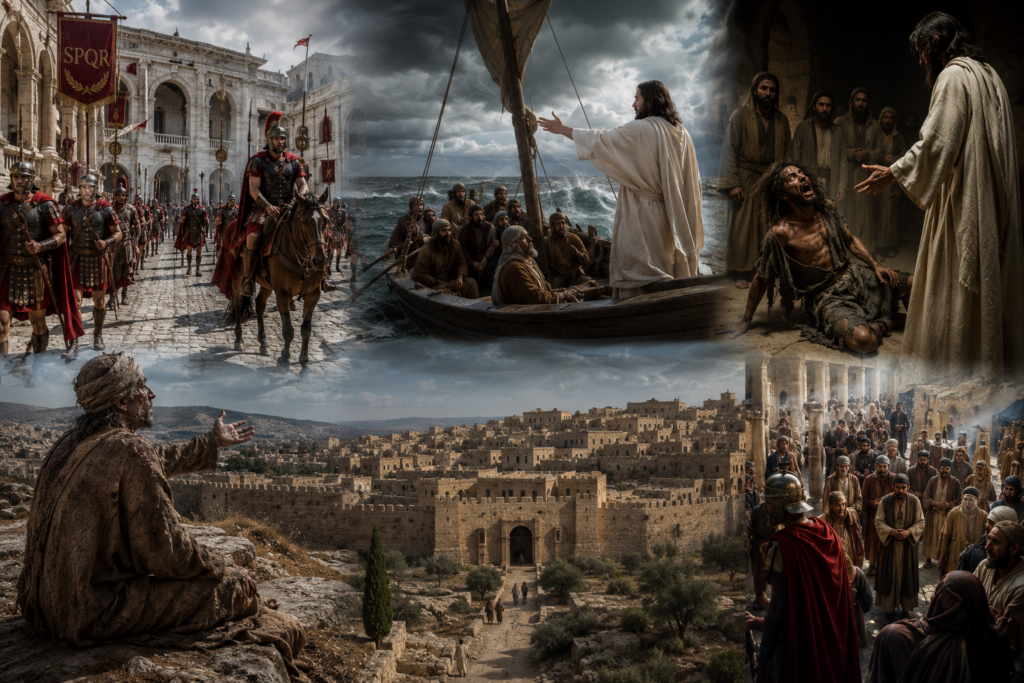
When the Gospels open, the symbols of chaos have become painfully recognizable. Israel lives beneath the weight of Roman occupation. The Temple itself has become entangled with corruption and political compromise. Blind men sit beside the roads. The lame wait outside the gates. Lepers remain isolated from their communities. Demonic powers torment men and women created in God’s image. Storms threaten the disciples on the Sea of Galilee, and death casts its shadow over villages Jesus enters. The biblical story has brought the problem of chaos into full view.
This is why the ministry of Jesus cannot be reduced to a collection of miracles or isolated acts of compassion. Every healing restores life where chaos has left its mark. Every exorcism drives back the powers that resist God’s kingdom. Every calming of the sea reveals His authority over the forces that threaten creation. Even His confrontation with death itself declares that the deepest consequence of humanity’s exile will not be the final word. The same story that began in Genesis continues to unfold as God moves toward the restoration of His creation.
The Bible ends where it began—with God’s dwelling once again among humanity. Death is abolished, mourning gives way to joy, and the exile that began in Eden finally comes to an end. Creation is restored, and the story that opened in a garden reaches its fulfillment in the presence of God.
Our own generation has not escaped the realities that confronted the ancient world. Floods still destroy homes. Wars continue their destructive path. Disease reminds us how fragile life remains. Violence, injustice, and broken relationships leave deep wounds that no generation has been able to avoid. Knowing that these experiences are ancient does not make them easier to bear, nor does it lessen the grief they bring into our lives.
Yet we are invited to see these realities within a much larger story. The chaos we experience today is not evidence that God has abandoned His creation. From Genesis to Revelation, the Bible tells one continuous story of a God who enters history, confronts everything that opposes life, and faithfully accomplishes His purposes. That promise sustained God’s people in the ancient world, and it continues to sustain ours as we await the day when death, sorrow, and exile will finally give way to life in the presence of God.
Leave a Reply