

Hyssop: The Little Plant in God’s Story of Redemption
Among the many plants mentioned in the Bible, none has generated more discussion than hyssop. For generations, botanists and biblical scholars have debated its identity. Was it the common hyssop known today, or the wild marjoram, Origanum syriacum, still called za’atar throughout Israel and Jordan? R. K. Harrison described hyssop as “one of the more problematical species of herbs,” observing that despite extensive study, its precise identification remains uncertain.
Most modern scholars associate the Hebrew ezov with a small aromatic plant that grows naturally throughout the hill country of Israel and Jordan. I remember seeing it growing from the rocks in Wadi Rum near Petra, where its ability to flourish in the harsh desert landscape brought Solomon’s description of “the hyssop that springs out of the wall” to life.
In the ancient world, hyssop was valued as both a culinary herb and a medicinal plant. Its leaves were dried for seasoning, while its aromatic oils were believed to possess cleansing properties. Ancient writers such as Pliny the Elder describe its use in treating skin disorders and digestive ailments, and later Jewish tradition likewise associated the plant with cleansing. Harrison also observes that its slender branches could easily be gathered into a bundle, making it well suited for use as a ritual sprinkler.
None of this, however, explains why hyssop occupies such an important place in Israel’s worship. Aromatic herbs and purification rituals were common throughout Egypt, Canaan, and Mesopotamia, where water, incense, fragrant plants, and sprinkling prepared temples for the presence of their gods. The Torah adopts none of the magical associations attached to such rituals. Instead, it gives hyssop a distinctive covenantal purpose.
Hyssop connected to sacred space
That realization shifted my attention away from identifying the plant and toward the role it plays throughout Scripture. Throughout the Torah, hyssop is consistently held in someone’s hand, conveying blood or water to a house, a sanctuary, or the people who belong within God’s dwelling. It appears whenever sacred space is being restored to covenant holiness.
The pattern begins on the night of the first Passover. Israel is instructed to take a bundle of hyssop, dip it into the blood of the Passover lamb, and apply the blood to the lintel and doorposts of every house. With a bundle of hyssop, covenant blood marks each household setting it apart from the judgment falling upon Egypt and preserving those within from death. The first place associated with hyssop is not the Tabernacle or the Temple, but an ordinary Israelite home that becomes sacred space as the Lord Himself passes over its threshold.
Here the Torah departs from the religious world around it. Egypt and Mesopotamia purified temples so their gods might dwell within them. Israel’s God does not summon His people into an earthly sanctuary here. He comes to their homes. Through blood applied with hyssop, an ordinary house becomes the first sacred space of the Exodus.
The pattern continues in Leviticus 14, where the object requiring purification is once again a house. A dwelling afflicted with ritual impurity undergoes an elaborate ceremony involving cedar wood, hyssop, scarlet yarn, the blood of a sacrificed bird, a living bird, and fresh running water. This is the first of several places where cedar, hyssop, and sheni tola’at appear together as part of Israel’s purification rites.
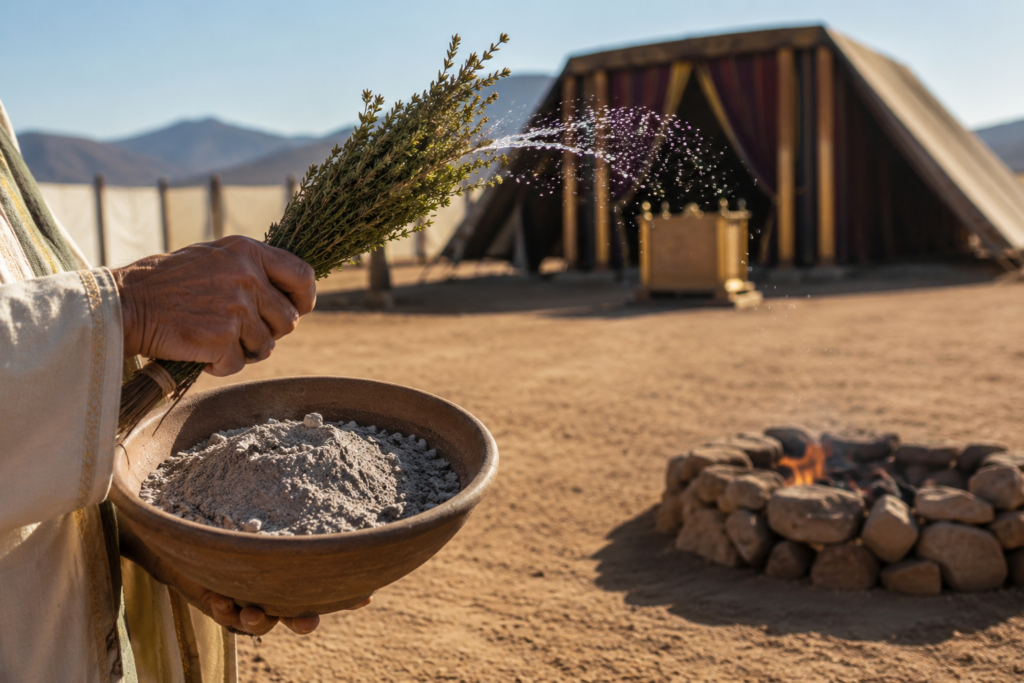
Numbers 19 expands the pattern. Here the issue is no longer disease but death itself. The ashes of the red heifer are combined with living water, and a clean person takes hyssop to sprinkle the tent, its vessels, and everyone defiled through contact with death. The same ritual elements appear again, but the concern now extends beyond individuals to everything associated with God’s dwelling. Death has interrupted covenant fellowship, and the ritual restores what death has defiled.
Every major occurrence of hyssop in the Torah is connected with sacred space—Israelite homes, houses restored after ritual impurity, and the Tabernacle with its furnishings and covenant community. The object of purification is not primarily the individual but the place where God’s presence dwells among His people.
David understands this when he cries, “Purge me with hyssop, and I shall be clean.” No priest stands over him with a bundle of hyssop. David speaks metaphorically, presenting himself as though he has become the sanctuary requiring purification. His deepest longing is not merely forgiveness but restored fellowship with the God whose presence had seemed so distant after his sin.
Hyssop for Consecration
The writer of Hebrews gathers these passages into a single image. Moses took blood, water, scarlet wool, and hyssop and sprinkled both the book of the covenant and all the people. The tabernacle and its vessels were likewise consecrated. The emphasis is not on the plant itself but on the consecration of God’s dwelling and His covenant people through blood and purification.
John alone tells us that the sponge filled with sour wine was lifted to Jesus on hyssop. Matthew and Mark mention only a reed, but John deliberately identifies the plant.
From the opening of his Gospel, John presents Jesus as both the Lamb of God who takes away the sin of the world and the place where God dwells among humanity. Throughout the Torah, hyssop served as the instrument by which covenant blood and the water of purification were applied to houses, sanctuaries, vessels, and God’s covenant people. Now, at the very moment the Lamb bears the sin of the world, that same instrument is lifted to Him. Throughout the Torah, hyssop accompanied the restoration of places where God chose to dwell. Now it is lifted to the One who bears the world’s defilement so that God may once again dwell among His people.
The same instrument that marked Israel’s houses at Passover, purified defiled dwellings, and restored the Tabernacle now appears at the cross. The pattern reaches its fulfillment in the Messiah. The One who bears the world’s sin accomplishes what every earlier act of purification anticipated: the restoration of God’s dwelling among humanity.
The little plant reminds us that God has always been restoring places where He chooses to dwell. The work that began in Israel’s homes reached its fulfillment in the Messiah and now continues in the lives of those who belong to Him. God’s purpose has never changed. He is still restoring His dwelling among His people.
Leave a Reply