

The Earth Gives Back Its Dead (Korah’s Rebellion)
As I was studying this week’s Torah portion, Korah, I expected to encounter the familiar themes of rebellion, priesthood, and judgment. What I did not expect was to find myself back in Matthew 27. Yet there it was again: the earth splitting open, the realm of death exposed, questions of holiness and priesthood, and a boundary between life and death laid bare.
Over the past several weeks, I have explored Matthew’s account of the torn veil, the earthquake, the splitting rocks, and the opened tombs. At first glance, Korah seems far removed from those events. Yet both passages revolve around the same mystery. In Numbers, the earth opens and the rebellious descend alive into Sheol. In Matthew, the earth shakes and holy ones emerge from their tombs alive. The same movement only reversed.
If you have not read the previous four essays in this series, I encourage you to do so. What began as an investigation into Matthew’s unusual resurrection account has opened into a much larger biblical theme: the boundary between life and death and the moments when God breaches it.
The heart of the Korah narrative is found in this statement. Moses declares, “If the Lord creates a new thing…” (Num. 16:30). The Hebrew word is bara, the same word used in Genesis 1 when God creates the heavens and the earth. The earth itself becomes the instrument through which God confirms His chosen priesthood.
The ground splits (bakah) beneath the rebels. The earth opens its mouth and swallows. They go down alive into Sheol. For a brief moment, the people see what lies beyond the boundary between life and death. The earth becomes a doorway into the realm of the dead.
The biblical story consistently portrays death as a descent. The grave receives its captives and closes over them. In the Korah rebellion, that hidden reality becomes visible. The earth opens, the rebels descend, and Israel witnesses the realm of death exposed before them.
This imagery appears throughout the Hebrew Scriptures. The psalmists speak of going down to the pit. Jonah describes the bars of the earth closing around him. Throughout the biblical story, death is portrayed as a realm that receives and holds its captives. The grave receives kings and servants, priests and prophets, the righteous and the wicked. Death remains the great destination of humanity’s exile from the presence of God. The Korah rebellion provides a glimpse into the larger human condition.
Now consider the direction of movement in Matthew’s account. At the death of Yeshua, the veil is torn, the earth shakes, the rocks split, and the tombs are opened. Though discussions generally focus on the identity of the holy ones who appear in Jerusalem, the direction of movement has changed.
In the Korah rebellion, the earth opens and people go down alive into Sheol. The grave receives them. Death claims its captives.
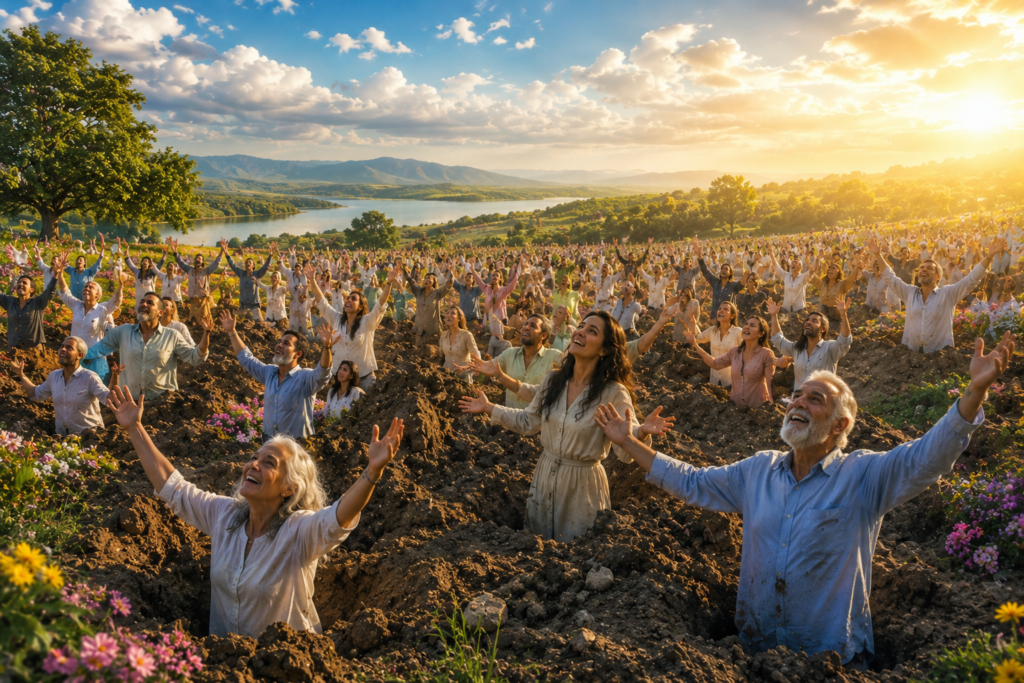
Matthew records something different. The tombs are opened and holy ones emerge. The movement has reversed. The grave that once received its captives now yields them. The earth that swallowed now releases.
From Adam onward, humanity entered the domain of death and remained there. At the death of Messiah, Matthew records the first signs that the pattern is changing.
The creation language of Numbers 16 points in the same direction. Moses declares that the Lord will create (bara) a new thing. The opening of the earth accompanies the confirmation of God’s appointed order. Matthew records another moment when creation itself responds to God’s work. The tombs are opened, and the grave begins to surrender what it holds. The movement that carried Korah and his followers down into Sheol is now reversed.
The Korah narrative is ultimately a dispute over priesthood. Korah challenges Aaron’s right to approach God’s presence, arguing that the entire congregation is holy. The opening of the earth settles the question. God’s chosen priesthood is confirmed.
When a plague breaks out among the people, Aaron takes a censer filled with incense and runs into the midst of the congregation. He stands between the dead and the living and makes atonement for the people. The plague stops.
Matthew presents a greater priestly reality. The opened tombs appear in the context of Messiah’s death. He enters the realm of death itself. Aaron’s ministry preserved life for a time. Jesus confronts the enemy that has held humanity captive since Eden.
The swallowing of Korah and his company and Matthew’s opened tombs stand on opposite sides of the same biblical pattern. In Numbers, the earth opens and the rebellious descend into Sheol. In Matthew, the tombs open and holy ones emerge. This helps explain why the opened tombs occupy such an important place in Matthew’s account. The boundary that had held humanity since Eden has been breached.
The prophets anticipated such a day. Isaiah declares, “Your dead shall live; their bodies shall rise. You who dwell in the dust, awake and sing for joy” (Isa. 26:19). What appears briefly in Matthew’s account becomes a promise for God’s people.
The same theme appears at the end of the biblical story. Revelation declares that “Death and Hades gave up the dead who were in them” (Rev. 20:13). The realm that once received its captives releases them. The grave is compelled to surrender its dead.
The opened tombs of Matthew 27 stand between Korah and Revelation, between the earth swallowing its dead and the earth giving them back. The direction has changed. The realm of death still exists, but its final victory has been challenged. The earth that once opened to receive now opens to release.
This is the promise. What appears briefly at the death of Yeshua anticipates the day Isaiah foresaw and Revelation describes, when the dead are called forth and death relinquishes its claim. The boundary between life and death still stands, but Matthew records the moment it was breached.
Leave a Reply