

When Earth Is Pushed Beyond Its Limits
What happens when the earth is forced to produce without rest—and why Scripture warns us this always leads to collapse.
The earth that was created to sustain life is now being forced into relentless production, driven for yield at any cost. This is poor stewardship and it is a violation of the created order. Scripture never envisioned a world where the land would be worked without rest or treated as a machine for profit. The land is not failing us. It is exposing what happens when we refuse to live within the order that was designed to sustain life.
The biblical story unfolds through the language of land, cultivation, and kingship. From the beginning, the earth is ordered, tended, and brought under the rule of a rightful King. In the ancient world, a king subdued a threat, defeated an enemy, secured the land, and by doing so established order. Only then did he take his seat on the throne—his rest—within a house prepared for his presence.
The Land as Sacred Space
Adonai speaks to Moses on Mount Sinai and introduces the command that the land itself must observe a Sabbath. In Leviticus 25, the instruction is clear. For six years the land is to be cultivated—planted, tended, and harvested—but in the seventh year it is to rest completely. There is to be no sowing, no pruning, no fertilizing, and no harvesting. Instead, whatever the land produces on its own is to be shared by all: the landowner, the servant, the hired worker, the outsider, and even the animals.
The land’s yield in that year is not the result of human control, but of divine provision.
This command reveals something fundamental about how Scripture understands the earth. The earth is not neutral ground. It is not simply a resource to be managed or exploited. It is sacred space. It belongs to God and functions within His larger cosmic order. Its purpose is to provide food, sustenance, beauty, and stability so that life can flourish.
In that sense, the land participates in the larger structure of creation, which Scripture presents as a kind of cosmic house—heaven, earth, and sea ordered together as a dwelling place. At the center of that structure is the garden, and at the center of the garden are the trees. This layered design reflects a temple pattern, where sacred space is concentrated and life radiates outward from it.
The rhythm of seven is woven throughout this structure, reinforcing the idea of completion and rest. Ancient Jewish tradition observed that “all sevens are beloved,” and Scripture itself is saturated with this pattern—seven days of creation, seven-day festivals, cycles of seven years, and recurring sevens in offerings, rituals, and prophetic imagery.
Rest, Kingship, and the Order of Creation
Shabbat is about the transition from one state of being to another. During the six years of cultivation, human beings engage in the work of ordering the earth through sowing, planting, pruning, and harvesting. In the seventh year they cease from that activity because the cycle is designed to reveal something greater. They do not cease from all activity; rather, they enter a different mode of living in which God’s provision becomes central.
Rest signifies that the rightful King is on the throne, that order has been established, and that the land can now produce under His sovereign rule. When a king rested, it meant that his enemies had been subdued and that peace governed the earth.
This understanding places agriculture within a much larger framework. In the ancient Near East, kings were closely associated with gardens, and royal gardens were often attached to temples. These gardens symbolized a well-ordered world under the king’s authority. In Ecclesiastes, Solomon describes his building projects, vineyards, and gardens in language that reflects this royal role.
Cultivating the land was not only an economic activity but a participation in maintaining cosmic order. Adam’s task in the garden reflects this same pattern. To tend and keep the garden is temple language, closely related to priestly service. In this framework, cultivation becomes an act of worship, and even eating becomes a form of participation in the life God provides.
When the Land Bears the Weight of Disorder
Scripture also makes clear that this relationship between humanity and the land is fragile. When humanity steps outside of God’s order through injustice, idolatry, and corruption, even the land itself begins to suffer.
The prophets describe this in vivid terms. In Jeremiah 12, the land mourns and the grass withers because of the evil of those who dwell in it. In Isaiah 24, the earth is described as polluted under its inhabitants, consumed by a curse. These passages present the land almost as if it were a participant in human suffering, burdened by disorder and exposed to its consequences.
This helps explain why exile was necessary in Israel’s history. When the people failed to observe the rhythms of rest and obedience, the land itself required relief. Exile allowed the land to rest from the contamination caused by human disobedience. The sabbatical years were built into the structure of creation as a means of preserving both the land and the people.
In our modern context, this pattern has been deeply disrupted. The earth is no longer simply neglected; in many cases, it is forced into relentless production. Large agricultural systems prioritize efficiency and profit, leading to soil depletion, chemical contamination, and declining food quality. The land is treated less like sacred space and more like a mechanism for extraction.
We are now seeing the land further strained by massive data centers and sprawling solar and wind installations that consume enormous amounts of water and resources, while creating long-term environmental problems through waste and storage once these systems fail.
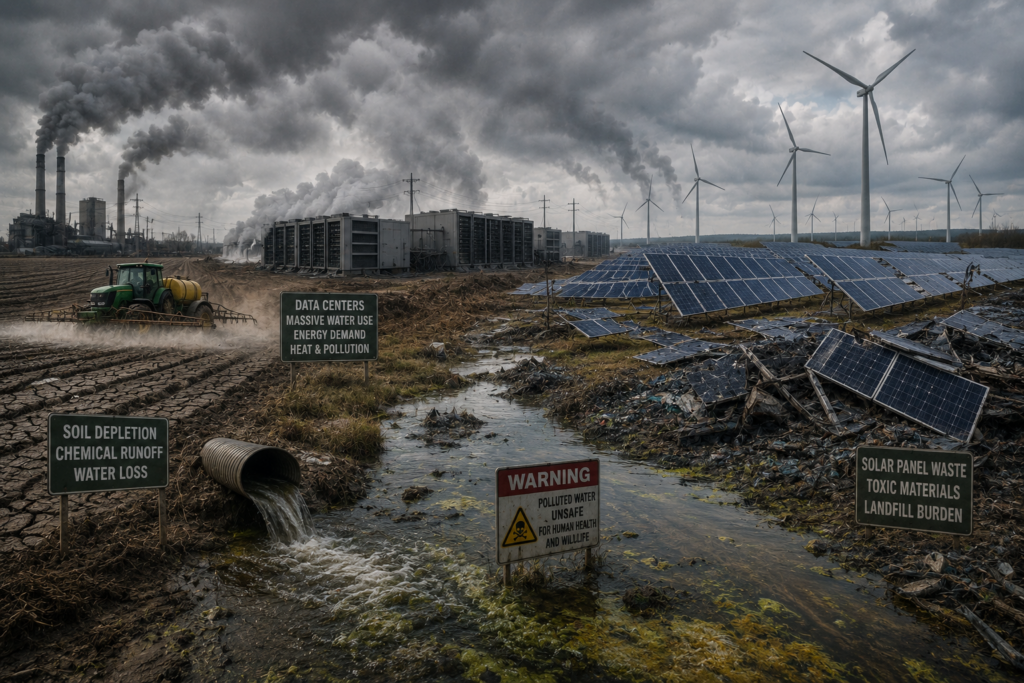
The language of Scripture—of the land being burdened or oppressed—feels increasingly relevant as the earth is pushed beyond its natural limits.
At the same time, an opposing response from modern environmental movements elevate nature to the ultimate authority. Humanity is viewed as the primary problem, something that must be restricted or removed in order for the earth to recover. These approaches reject the biblical vision in which humanity plays a necessary and restorative role. Scripture does not present humanity as an intrusion into creation but as its caretaker, called to cultivate and guard the earth in alignment with God’s purposes.
This leaves us in a place of tension. On one hand, we see the consequences of exploitation in degraded land and compromised food systems—the growing dominance of “big agri.” On the other, we encounter solutions that remove humanity from its intended role. The biblical answer calls for a return to the original pattern, where humanity participates in God’s order through responsible cultivation and trust in His provision.
This return begins with a shift in perspective. The sabbatical command in Leviticus ultimately asks whether we trust God enough to release control. It challenges the assumption that constant, forced production is necessary for survival and invites us to consider a different model, one in which provision is not solely dependent on human effort.
While few today can practice a literal sabbatical year, the principle remains deeply relevant. It calls us to reconsider how we relate to food, the land, and the systems that sustain us.
Practically, this means supporting local farmers who practice responsible cultivation, choosing food sources that prioritize quality over convenience, and recognizing that farming is not merely an economic activity but a participation in creation. Technology has its place, but it cannot replace the human role in tending the land. Agriculture is not simply about output; it is about relationship—between people, the soil, and their Creator.
Ultimately, the biblical vision is not one of despair but of restoration. The same God who brought order out of the waters continues to sustain and renew creation.
The land was never meant to be treated like a slave, and humanity was never meant to abandon its responsibility to it. When we return to God’s order, the land responds—provision stabilizes, life recovers, and what has been pushed to its limits begins to flourish again. The question is whether we will trust that pattern and the God who still sustains it.
Restoration begins the moment we step back into the pattern God has already established.
Leave a Reply