

Creation by Conflict: Athena, the Gods, the Giants, and the World They Made
One of the highlights of my trip to Athens was a visit to the Acropolis, literally the “high city” and to the Acropolis Museum—a must-see before visiting the Parthenon, the Erechtheion, and the remains of the old Temple of Athena. The museum provides essential context, allowing the visitor to understand how the Athenians envisioned order, power, and the divine.
Athena, the Acropolis, and the Architecture of Order
The Parthenon was dedicated primarily to Athena Parthenos, Athena the Virgin. It housed a massive gold-and-ivory statue of the goddess and emphasized civic order and protection, military readiness and victory, and imperial identity and power. The Erechtheion, by contrast, was dedicated to Athena Polias, Athena of the city. This was the older and more sacred cult, tied to the earliest history and identity of Athens.
According to tradition, the Erechtheion marked the site of the contest between Athena and Poseidon for patronage of the city. Poseidon struck the rock and produced salt water, a symbol of raw power and domination. Athena offered an olive tree. The Athenians judged her gift superior, and she became Athena Polias, guardian of the city. The olive tree mattered because it represented a different kind of order. It provided food, oil, light, medicine, wood, and long-term stability.
The Erechtheion was built around this sacred tree, preserving it within the architectural heart of the Acropolis. Even when the Persians destroyed Athens in 480 BCE, the olive tree was said to have resprouted immediately, reinforcing its symbolism that life cannot be extinguished.
Gigantomachy: When Creation Is Secured Through Violence
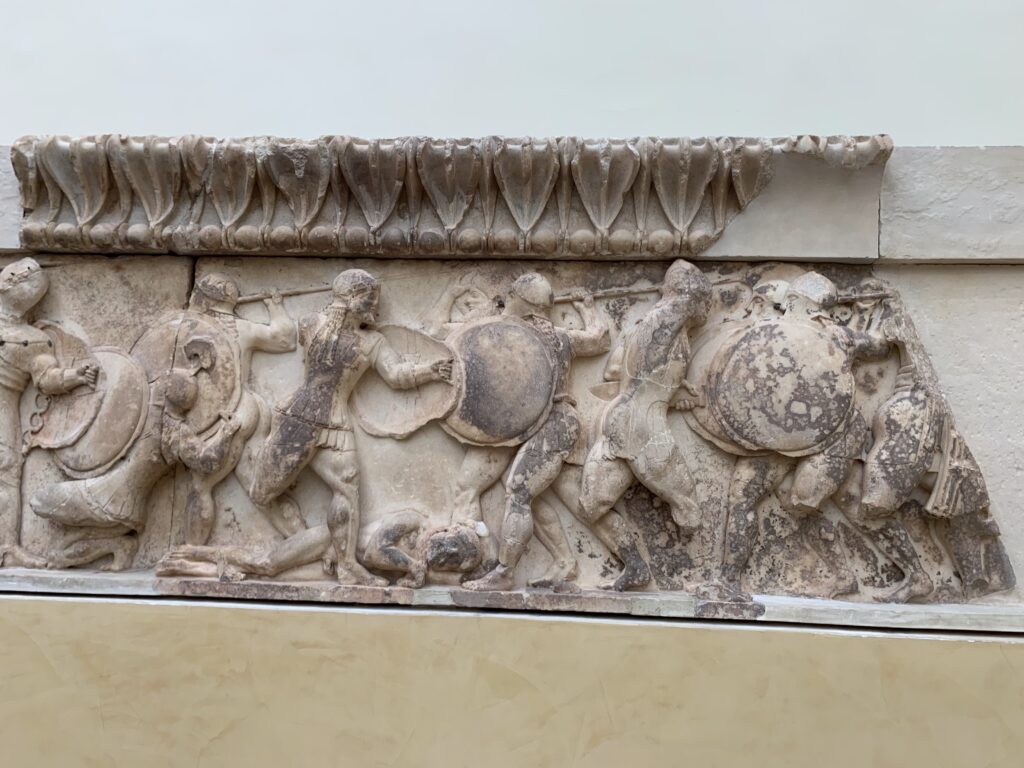
The museum also preserves the clearest visual expressions of how the ancient world understood creation, order, and power. Throughout its galleries, especially the Archaic Gallery and the Parthenon Gallery, Athena and the Olympian gods are repeatedly shown in violent conflict with the Giants. These scenes belong to a mythic cycle known as the Gigantomachy, a classic theme of divine struggle that shaped Greek religious imagination and civic identity.
The Gigantomachy depicts the battle between the Olympian gods and the Giants, a primordial race born from the earth itself. In Greek thought, the Giants were not merely large enemies; they embodied chaos, excess, and instability. They represented forces that threatened cosmic order and civic life. The defeat of the Giants was therefore necessary for the world to remain habitable.
Athena occupies a central role in these scenes. Marble reliefs in the Archaic Gallery, originating from the earlier Temple of Athena Polias, show Athena in the act of spearing a Giant. The east metopes (rectangular sculpted panels) of the Parthenon continue this theme in a more formalized and monumental style. Here, Athena appears in full battle gear alongside other gods, engaged in a long and violent struggle that culminates in the defeat of the Giants. One of the most striking examples is Athena’s combat with a Giant, one of the few clearly identifiable mythic combat scenes in which her warrior role is unmistakable.
These images communicated a worldview. In the ancient imagination, creation and stability emerged through violence. Order was born from conflict, and civilization endured only because the gods had crushed rival divine or semi-divine forces. The Gigantomachy captures this assumption with remarkable clarity. Chaos does not recede voluntarily; it must be subdued. The Giants are remnants of primordial disorder, and their destruction secures the cosmos.
Athena herself embodies a particular version of this logic. She is one of the most complex figures in Greek mythology, representing wisdom, strategic warfare, craft, and civic order. Unlike gods associated with uncontrolled violence, Athena represents measured power: intelligence applied to conflict, restraint guiding force. Her mythic birth reinforces this identity. According to Greek tradition, Athena is born fully armed from the head of Zeus, not from a womb. Order, in this account, emerges from divine intellect rather than generative process. She is Zeus’s ally, not his rival, and her authority reinforces the stability of the pantheon rather than threatening it.
As Athena Polias, guardian of Athens, she presides over law, political life, architecture, weaving, and education. The Parthenon stands as a civic and religious monument to her role as the one who secures the city’s order. When Athena battles Giants in temple sculpture, the message is clear: the city remains stable because chaos has been defeated. Divine violence underwrites civic peace.
This pattern reflects a widespread ancient assumption. Creation is not sustained through speech or covenant, but through the ongoing suppression of rival powers. Violence is not a tragic necessity; it is the engine of order. The world exists because someone stronger won.
God Speaks: The Bible’s Alternative Vision of Creation
Contrast this with the biblical worldview. Although the Bible speaks into this same symbolic world, it tells a strikingly different story. While it acknowledges chaos and opposition, often personified through sea monsters, hostile powers, and giants, it does not ground creation in divine warfare among equals. In Genesis, God does not fight other gods to create. He speaks. He separates. He orders. Light, land, and life emerge not from violence, imperial power, or bloodshed, but from divine command.
Even when biblical texts employ combat imagery, the emphasis differs sharply from the ancient mythic pattern. God’s authority is never in question. He will prevail. Chaos is real, but in the biblical story it is not ultimate. It does not rival God’s creative power; rather, it resists it.
This distinction becomes clear when considering giants in the biblical tradition. Like their ancient Near Eastern counterparts, biblical giants symbolize disorder, violence, and corruption. Yet they are never portrayed as cosmic equals to God. They threaten human faithfulness, not divine sovereignty. The struggle, then, is not between gods, but within human nature—between trust and fear, obedience and moral corruption.
The biblical battle is fundamentally moral rather than mythic. Where ancient myths portray creation as the outcome of divine rivalry, the Bible presents creation as sustained through wisdom and covenant fidelity. Violence does appear in certain biblical narratives, but it is never the foundation of order or divine will.
Seen in this light, the Gigantomachy panels in the Acropolis Museum provide a visual theology of the ancient world, a worldview in which stability depends on continual domination and creation emerges from conflict. Against this backdrop, the biblical creation account stands apart. It offers a vision of order grounded in the Word of God, moral restraint, and faithful governance. Scripture insists that the world endures because God speaks and what He speaks holds it together.
Leave a Reply