

The Song Before the Garden: Jesus Sang Psalm 36 on the Way to Gethsemane!
Matthew records a small detail with enormous implications: “And when they had sung a hymn, they went out to the Mount of Olives” (Matt. 26:30). These were not later Christian hymns. This was not “the old rugged cross” or “I’ll fly away.” They were the Hallel Psalms, and very likely included Psalm 136—the Great Hallel. Psalm 136 is not simply a praise psalm; it is a structured retelling of the biblical story, moving deliberately from creation to Exodus to covenant inheritance, all anchored by the repeated refrain: “For His Chesed (mercy) endures forever.”
This is Israel’s faith acted out in liturgical form through Psalm 136
The psalm begins with creation: “To Him who made the heavens with wisdom… who spread out the earth above the waters… who made the great lights…” (vv. 5–7). Creation is presented as ordered, sustained, and governed by the word of God. It then moves directly to Exodus: “To Him who struck down the firstborn of Egypt… and brought Israel out… who divided the Red Sea…” (vv. 10–15). Creation and Exodus are not separate acts. Exodus is new creation. The God who ordered the waters in Genesis parts them again to bring forth a people. The psalm concludes with wilderness, inheritance, and provision: “who led His people through the wilderness… gave their land as a heritage… remembered us in our low estate… and gives food to all flesh” (vv. 16–25). The goal is not escape. It is a world rightly ordered under God’s presence.
The biblical pattern is creation, deliverance, indwelling, and ongoing provision.
The language of “spreading out the earth upon the waters” echoes Genesis 1, where the waters are gathered and boundaries are established so that dry land can appear. The Hebrew verb used in Psalm 136:6 (רָקַע — rāqaʿ, “to spread out” or “to hammer out”) is closely related conceptually—though not identical in form—to רָקִיעַ — rāqîaʿ (“firmament”) in Genesis 1. Both share the same root and describe the act of spreading, stretching, or forming a boundary that orders creation. The firmament separates the waters above from the waters below; the earth is spread out over the gathered waters. In both cases, God is establishing order over chaos.
It is on the third day of creation that the waters are gathered and the dry land appears (Gen. 1:9–13). It is the first moment where stable, inhabitable ground emerges from the deep. It is also the day when life begins to sprout—seed-bearing plants and fruit-bearing trees. The third day is not simply about land; it is about life emerging from the restraint of chaotic waters.
That pattern is foundational.
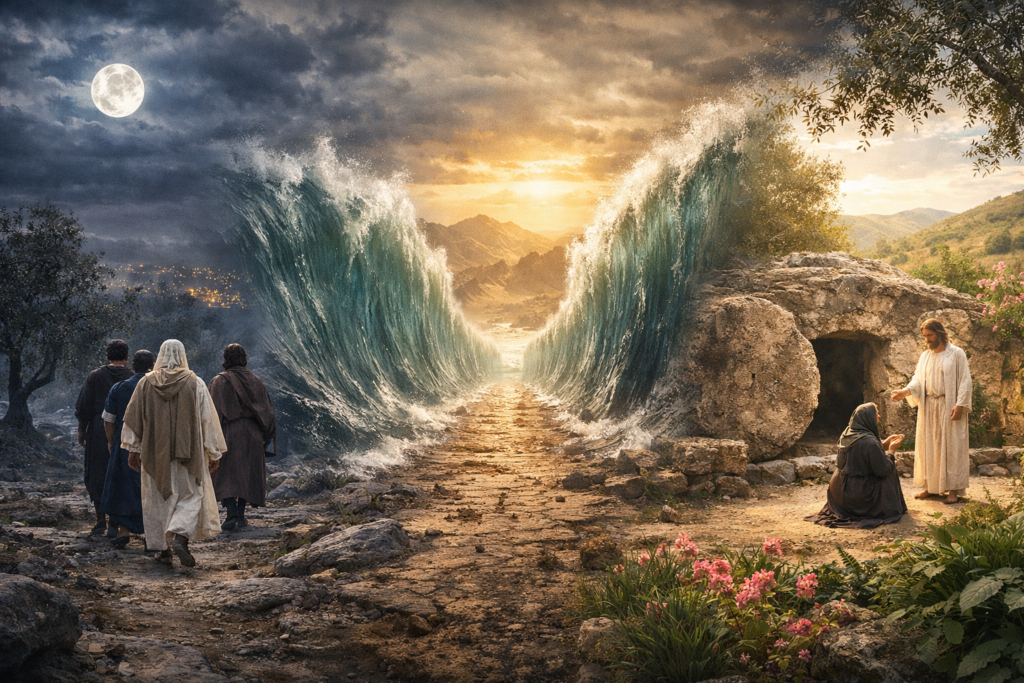
Psalm 136 then moves directly to Exodus: “to Him who divided the Red Sea in two… and made Israel pass through the midst of it…” (vv. 10–15). The connection is deliberate. The same God who gathered the waters in Genesis gathers them again in Exodus. The Reed Sea is a replay of creation itself.
Exodus is new creation.
The waters are divided. A path appears. Israel walks through on what is, in effect, newly revealed “dry land.” The enemy—the embodiment of chaos and oppression—is swallowed as the waters return. What Genesis establishes, Exodus then reenacts. The world is being ordered again through the formation of a people.
This is what Yeshua is singing.
On the night of Passover, He is stepping into this pattern fully aware that He is about to embody it. The movement from the table to the Mount of Olives is the continuation of the story He has just sung. He is singing of the God who creates, the God who restrains chaos, and the God who brings His people through the waters and into His presence—because He is about to enact that reality at its deepest level.
The next movement is the garden—Gethsemane, where He will be arrested.
This is not Eden restored yet. It is Eden in exile. It is a place of pressure, sorrow, and the approach of death. Adam was driven out of the garden and could not return. Humanity remained in exile, east of Eden, cut off from the Presence. Yeshua enters Gethsemane not as a restored Adam, but as representative humanity in exile. He steps into the place where the story has been held since Genesis 3.
From the garden, the movement continues toward the grave.
The grave becomes the greater sea. Psalm 136 declares that God divides the waters, defeats the enemy, and brings His people through. In the Gospel account, that pattern reaches its fullest expression. Darkness falls over the land (Matt. 27:45). The earth shakes. The tomb is sealed. Like the sea, it appears final. Death has closed over Him.
But the third-day pattern holds.
Just as in creation the waters are gathered and dry land appears, just as in Exodus the sea is divided and a people emerges, so now, on the third day, the grave is opened. The stone is rolled away (Matt. 28:2). What seemed to be the final boundary is undone. The place that held Him cannot contain Him.
The third day is the day of emergence.
What the Reed Sea was to Pharaoh, the tomb is to death itself. The enemy enters, but does not return. Death is not avoided. It is defeated.
And then, the garden appears again.
In John’s account, Yeshua is encountered in a garden and is even mistaken for a gardener (John 20:15). This is an important detail. In the ancient world, kings were gardeners—horticulturalists who took great pride in their gardens. The story has now come full circle. The One who entered the garden of exile now returns in resurrection life. What was lost in Eden is not merely recovered; it is reestablished on the other side of death itself.
This is new creation.
So, when Yeshua and His disciples sing Psalm 136, He is not recalling Israel’s past. He is declaring what is about to take place. The God who spread out the earth over the waters is about to bring forth life from the grave. The God who split the sea is about to divide life from death. The God who led His people through the wilderness is about to open the way to His Divine Presence.
Creation, Exodus, and resurrection are not separate acts. They are one continuous pattern. And all of it is grounded in the same refrain: “For His steadfast love endures forever.”
Leave a Reply