

Light Dawns in the Temple at Chanukkah
The story of Chanukkah, the Feast of Dedication—is usually told through the lens of revolt. Its traditional account comes from First and Second Maccabees, part of the Jewish apocryphal literature, and recounts Judah the Maccabee’s successful uprising against the tyranny of Antiochus IV Epiphanes. But beneath the military victory lies a far deeper story—one rooted in temple theology, Wisdom, light, and the restoration of God’s dwelling place on earth.
The date of Chanukkah, Kislev 25, was likely not chosen arbitrarily. It echoes temple prophecies in the book of Haggai, where the prophet confronted the returning exiles for neglecting the rebuilding of the Temple while tending to their own homes. Haggai’s words mark a turning point:
“Now set your heart (to consider), from this day and forward, from the twenty-fourth day of the ninth month, from the day the foundation of the Holy Place was laid; set your heart…” (Hag. 2:18)
The repetition of set your heart is striking. It signals more than a construction project. It announces the beginning of a new era, one marked by spiritual readiness, right intention, and renewed devotion. From that day forward, God’s blessing would return, but only if the foundation of His house was laid with the proper heart.
This same posture shaped Judah the Maccabee’s resolve centuries later. When he declared, “Let us go up to cleanse the Holy Place and rededicate it,” he was echoing Haggai’s call. Even his name tells the story. Maccabee is often understood as an acronym for Mi kamocha ba’elim Adonai?—Who is like You among the gods, O Lord? (Exod. 15:11). Judah and his followers knew they were not merely fighting a political enemy. They were reclaiming sacred space for the incomparable God whose presence alone brings light and life.
Dedication, Wisdom, and the Ordering of God’s House
The word Chanukkah itself comes from the Hebrew root chanach, meaning to dedicate. This same root appears in Proverbs 22:6, often translated, “Train up a child in the way he should go.” Yet, the Hebrew word chanoch more precisely means to dedicate. Proverbs belongs to Israel’s Wisdom tradition, and the Hebrew word for proverb, mashal also carries the sense of dominion or rule. Proverb’s sayings express kingdom principles for the proper ordering of God’s house.
Seen through this lens, Proverbs 22:6 may originally have referred not to general child-rearing, but to the dedication of young priests for lifelong service in the Temple. Those who ministered in God’s house, the kohanim were entrusted with sacred duties, chief among them the care of the menorah.
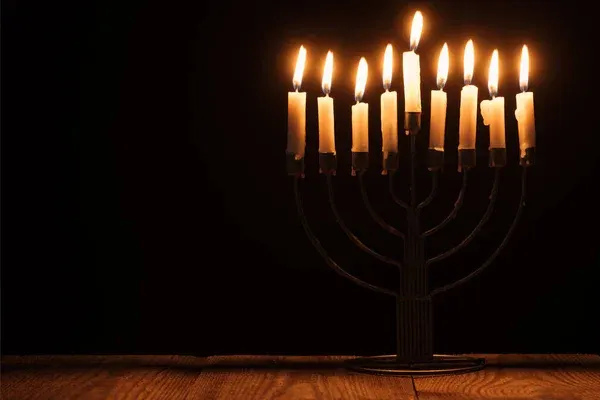
Every day, the priests filled the menorah’s bowls with pure olive oil. Each evening, they kindled its lamps so that its light would burn through the night. The seven-branched lampstand illuminated the Holy Place and symbolized both physical and spiritual light radiating from the presence of God. Jewish tradition called the Temple, and even Jerusalem itself, the light of the world (Genesis Rabbah 59). Josephus would later refer to Chanukkah as the Festival of Lights. And into this world of layered meaning, Yeshua declared, “I am the light of the world.”
Josephus explains why:
“They were so very glad at the revival of their customs…that they made it a law for their posterity that they should keep a festival on account of the restoration of their Temple worship for eight days…and from that time to this we celebrate this festival and call it Lights.”
(Antiquities 12.7.7)
Two Intertwined Stories: Chanukkah Victory and the Miracle of Oil
Chanukkah, then, carries two intertwined storylines. The first is the military struggle of the Maccabees against Antiochus Epiphanes. The roots of that conflict stretch back to Alexander the Great. After his death in 323 BCE, his empire fractured, eventually dividing between the Seleucids in Syria and the Ptolemies in Egypt. Antiochus, the Seleucid ruler, seized control of Judea and ruled with brutality. Observing Sabbath, circumcising sons, and living faithfully as Jews became capital crimes. The ultimate act of desecration came when Antiochus sacrificed a pig on the Temple’s altar.
Judah Maccabee and his followers resisted, defeated Antiochus, reclaimed the Temple Mount, and rededicated the sanctuary on Kislev 25.
The second storyline centers not on battlefields, but on the pure olive oil.
According to later tradition preserved in the Talmud (Shabbat 21b), when the Temple was reclaimed, the priests found only one sealed cruse of pure olive oil—enough for a single day. Yet that oil burned for eight days, allowing time to prepare more. This miracle of light, not the military victory, became the heart of Chanukkah.
“…They found only one cruse of oil sealed with the signet of the High Priest…sufficient for one day’s lighting; yet a miracle occurred and they lit the lamp for eight days.”
The Menorah, the Tree of Life, and the Light of the Messiah
Descriptions of the menorah in Exodus portray it as a living tree: branches, blossoms, petals, and almond-shaped cups flowing from a central shaft. Its seven lamps, often understood as seven eyes, were oriented to shine toward the space before the veil leading into the Holy of Holies. Philo identified the menorah as the tree of life planted in the garden sanctuary. He believed its central shaft represented the heavenly king, just as the High Priest embodied that reality on earth.
Across the Ancient Near East, the tree of life symbolized both god and king. Clement of Alexandria suggested that Yeshua Himself was the menorah—linked to the royal tree. Margaret Barker argued that the Temple lamp symbolized both the divine presence and the royal dynasty. In Revelation, the Son of Man stands among seven lampstands dressed as a priest, wearing the ketonet and a golden sash. His eyes blaze like fire. He is the Lamb with seven eyes. Enoch, too, saw a fiery golden tree in the garden sanctuary—the original tree of life.
This imagery sheds new light on familiar biblical scenes. At the burning bush, the Angel of the Lord appeared to Moses in a flame of fire from within a seneh, a thornbush burning yet not consumed. Moses was told to remove his sandals, for he was standing on holy ground. Priests, notably, served barefoot in the Temple precincts.
Likewise, Daniel’s companions walked unharmed in the fiery furnace, joined by one “like a son of God.” Ancient visions describe the heavenly sanctuary itself as ablaze with fire—floors, ceilings, and throne engulfed in glory.
Wisdom literature brings this full circle. Proverbs declares that Wisdom is a tree of life bestowing honor, healing, and sight. Her oil opens blind eyes. A Targum on Genesis links the Etz Chaim, the tree of life, with Torah itself. Yeshua, then, is the living Torah who descends from the heavenly sanctuary. He is the tree of life, the menorah, the anointed High Priest and king—Mashiach.
The Gospel of John provides the Bible’s only explicit reference to Chanukkah:
“Then came the Feast of Dedication in Jerusalem. It was winter, and Yeshua was walking in the Temple, in Solomon’s Colonnade.” (John 10:22–23)
Surrounded by festival lights, the shepherds of Israel were blind. Rejecting Yeshua the living Torah and embodied Wisdom, they proved themselves hired hands, thieves who could not see the light standing before them. Yet Chanukkah proclaims hope: light has returned to open blind eyes. A great light has dawned in the land overshadowed by death—the Temple Mount itself (Isa. 9:1).
To celebrate Chanukkah, then, is to remember that through Yeshua, light has indeed dawned. The glory of God has risen over His people. The menorah still burns—not merely in memory, but in the living presence of the One who is both King and Light.
Leave a Reply