

How Purim Replays the Exodus Story
Though the book of Esther and the celebration of Purim is a captivating story about court intrigue and political reversal, it is also an Exodus story revisited. Different empire. Different tyrant. Different geography. Different circumstances. The message, however, is the same: the deliverance of God’s people in exile. The Exodus is the story through which Israel learns how God acts in history. And in Persia, once again under imperial shadow, that story unfolds.
How Esther Replays the Exodus Story
In the opening chapters of Exodus, Egypt is humming along with its building projects. Pharaoh’s power is consolidated. The machinery of his empire is functioning with precision. Then comes the threat: “The people of Israel are too many and too mighty for us.” Israel’s multiplication unsettles Pharaoh — this external challenge could create political instability for the empire.
In Esther, Persia stands equally secure under King Ahasuerus. The empire stretches across many provinces with bureaucratic efficiency. And again, a threat is perceived at Purim. Haman describes “a certain people scattered and dispersed… whose laws are different from those of every other people.” Their distinctiveness is intolerable, embodied most clearly in Esther’s Uncle, Mordecai. Their allegiance to another law exposes the limits of imperial control.
Pharaoh sees Israel as a resource to be exploited and restrained. Haman sees the Yehudi, those belonging to Judah, as politically subversive. In both narratives, the identity of the people of God collides with imperial fortunes. That collision ultimately provokes a genocidal decree. Empire cannot abide a people whose ultimate loyalty lies elsewhere.
The Decree of Death
So, the decrees are issued.
In Exodus, Pharaoh commands the death of Hebrew baby boys. In Esther, Haman seeks the annihilation of every Jew, men, women, and children, all across the empire. Both convert fear into public policy. Both attempt to legislate the erasure of God’s people.
Passover on the Calendar
Then the text of Esther and the story of Purim introduces a detail tied directly to Passover. “The king’s scribes were summoned on the thirteenth day of the first month” (Esther 3:12). The first month is Nisan. The thirteenth day is the eve of Passover. The decree of destruction goes out on the threshold of Israel’s feast of deliverance.
On Nisan 14, Israel remembers a night when earlier another genocidal decree hung over them in Egypt. A ruler had issued a death sentence. The covenant people were targeted. Deliverance came, and the turning point was Passover.
In Esther, the Persian ruler confirms a death sentence. Once again the covenant people are targeted. Deliverance will come — but through hidden providence at Purim And the threat begins at Passover time.
The author of Esther never names God. Never explicitly invokes Passover. Yet the narrative is framed against the calendar of redemption. It is as if another Pharaoh has arisen. The Exodus is being replayed, though without plagues or parted seas.
The connection deepens when we are told that Haman is an Agagite. Amalek was Israel’s first enemy after crossing the Reed Sea. The wilderness conflict in Exodus 17 reverberates through this genealogical detail. Amalek attacked the weary and the vulnerable. Now an Amalekite descendant rises again to threaten Israel’s existence. The ancient enemy has returned. The Exodus is not finished.
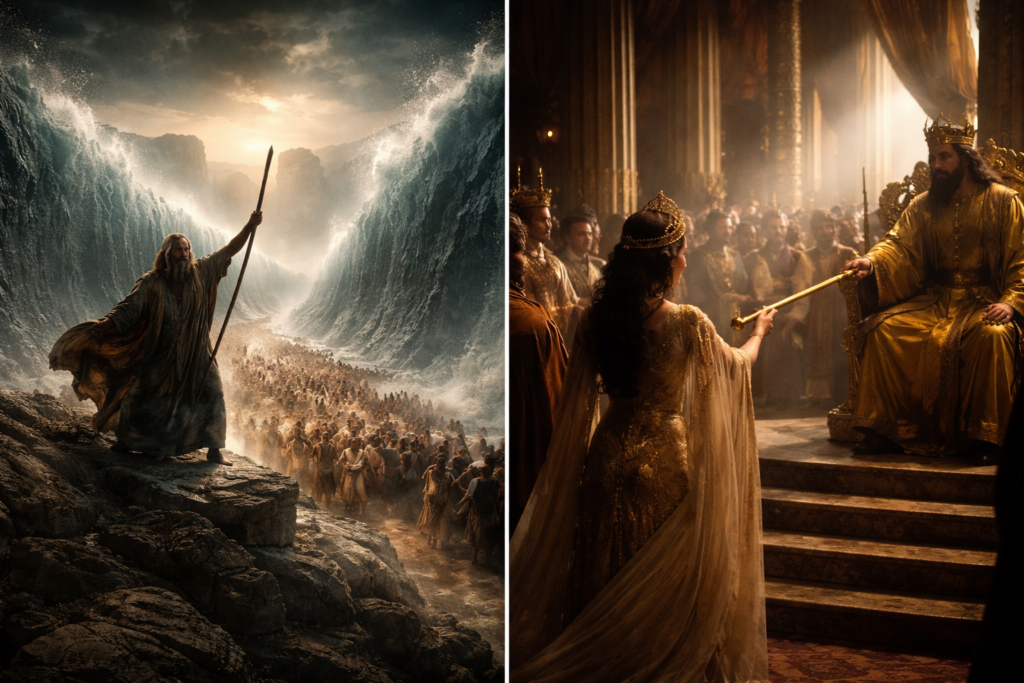
Even the deliverers mirror one another. Moses is raised in Pharaoh’s house, positioned inside the structure of empire. Esther — Hadassah — becomes queen in the Persian palace, embedded within imperial power. Both conceal their identities. Both are elevated not by political maneuvering but by providence. Both hesitate. Both must risk death for the sake of their people.
In Exodus, deliverance centers on redemption through the Passover lamb. Death passes over the homes marked by blood. Pharaoh’s army, pursuing Israel into the sea, is swallowed by the waters of the deep, waters that symbolized chaos. The Reed Sea turns back upon him, a reversal of a place that signified paradise in the Egyptian imagination. The empire’s instrument of control becomes its grave.
In Esther, reversal defines the climax. Haman constructs a towering wooden stake for Mordecai. That very structure becomes the site of his own execution. The weapon formed against God’s people collapses upon Haman. There is a pattern — chaos always turns back upon itself when Yahweh is in charge.
Passover on the Calendar
The story of Esther unfolds at a time when the Temple has already been rebuilt. In 515 BCE, under King Darius of the Achaemenid empire, the Second Temple stands in Jerusalem. Sacrifices have resumed. The presence of God dwells in the land in the Temple. And yet many of the Yehudi choose to remain in Persia. They are geographically separated from the central sanctuary.
If God’s presence is enthroned in Jerusalem, what does that mean for those still scattered in exile in Persia?
The book of Esther does not suggest relocating the Temple to Persia. Instead, it reveals something deeper about God’s dwelling. Though His name is absent from the book, His providence saturates His people wherever they settle. The hidden hand of divine presence is evident.
Temple imagery persists even in exile. Instead of sacrifice, there is fasting. Instead of priestly entry into the Holy of Holies, Esther approaches the king’s throne uninvited, risking death. The golden scepter is extended. Acceptance is granted. Like Moses, she stands as mediator between decree and people — a royal high priest in the Persian court.
And though the Temple stands in Jerusalem, God is not confined to Jerusalem.
Exodus culminates at Sinai in a covenant meal. The elders ascend, behold God, and eat in His presence. Deliverance leads to the indwelling presence of Yahweh. Salvation leads to communion. Esther, too, ends with a feast — Purim. Joy replaces mourning. Fear turns into celebration. The people institute an annual remembrance of a mighty reversal.
The date for Purim is set for destruction—Adar 13 becomes a day of Jewish triumph. In Exodus, destruction falls upon those without blood applied to their doorways. In Esther, destruction falls upon those who sought to erase God’s people. Reversal once again marks divine intervention.
The Pattern That Continues
Pharaoh or Haman. Egypt or Persia. Sea or gallows.
The question remains the same: Who has authority over life and death?
Purim answers the same way Passover answered. Certainly not empire.
The Exodus is not a closed chapter in Israel’s history. It is the interpretive lens through which history is understood. Esther and Purim continues the story. God delivers His people so He can dwell with them. In Egypt. At Sinai. In Jerusalem. In Persia.
And perhaps that is why the book of Esther feels so familiar. The names and locations have changed, but the story has not.
Leave a Reply