

Chanukkah as Exodus Retold: Israel’s Story Repeats, Deepens, and Points Forward
At first glance, the Exodus story and the Chanukkah story seem to belong to completely different worlds. One unfolds in the heat of Egypt and the wilderness of Sinai; the other in the hills of Judea under Greek rule. But when we look closer—through the lens of biblical patterns—the parallels emerge with clarity. Chanukkah is not an isolated historical moment. It is Exodus retold. It is Israel’s foundational salvation pattern replayed in a later generation, with new enemies, new symbols, and renewed covenant purpose.
Scripture repeatedly teaches that the biblical story is cyclical. What God does once, He does again—each time with deeper meaning. Chanukkah stands as one of the clearest re-performances of the Exodus pattern in Jewish history.
Oppression Under a Pagan Empire
Both stories begin the same way: a covenant people crushed beneath a pagan empire determined to erase their worship and identity.
Exodus places Israel in Egypt, living in a world saturated with idols. Pharaoh’s decrees aim to dismantle Israel’s future—enslaving the people, killing the sons, and refusing to allow worship of Yahweh. Pharaoh becomes the archetype of the anti-god ruler, the human face of spiritual chaos.
Chanukkah begins with the rise of Antiochus IV, who behaves like Pharaoh. He renames himself Epiphanes, “God manifest” and demands total allegiance. Circumcision, Sabbath, Torah reading, kosher laws—every covenant identity marker—becomes illegal. And the price of faithfulness—shame, torture, execution. Erasing Israel’s worship is the fastest way to erase Israel.
The Temple at the Center of the Battle
In both narratives, the conflict is political and theological and involves sacred space.
In Exodus, the plagues are not random punishments; they are targeted confrontations with Egypt’s gods. Pharaoh’s refusal to let Israel worship reveals the heart of the conflict: Who is King? Who rules the world? The climax of Exodus is not the Red Sea but the Tabernacle—God dwelling among His people as King.
In Chanukkah, Antiochus pollutes the altar by sacrificing swine, fills the Temple with pagan idols and images of himself to prevent Israel from drawing near to God. The Maccabean revolt is a nationalist uprising, and it is a priestly war to restore God’s dwelling place. Will Israel remain God’s kingdom of priests?
When the altar of the Temple is defiled, the world itself is disordered. When it is cleansed, creation is set right again.
Unexpected Deliverers from the Margins
Exodus and Chanukkah both feature deliverers who rise from unexpected places.
Moses, raised in Pharaoh’s household but living as a fugitive shepherd, becomes the unlikely liberator. No army. No weapons. Just a staff, a calling, and the presence of God going with him to meet the world’s most powerful tyrant.
The Maccabees are rural priests—hardly a military dynasty. Mattathias and his sons arise from a small village of Modi’in. No throne. No army. No political leverage. Yet God chooses them to stand against the powerful Syrian empire.
God consistently raises saviors from the margins so that the victory belongs to Him.
Impossible Odds, Divine Victory at Chanukkah
Both stories highlight the same truth: salvation, deliverance from the clutches of empire is something only God can accomplish.
Israel trapped between Pharaoh’s chariots and the Red Sea has no path forward. The victory at the sea is Yahweh’s alone: “stand still and see the salvation of the Lord.”
During Chanukkah, the Maccabees fight an empire with almost no chance of success. Jewish tradition remembers this not as a triumph of military power but of divine intervention: “Not by might, nor by power…”
When God replays the Exodus pattern, the impossible becomes the stage for His glory to be revealed.
Purification, Rededication, and Covenant Renewal
Both stories climax in the restoration and rededication of sacred space.
Exodus ends with Israel receiving the covenant, building the Tabernacle, consecrating priests, and establishing holy rituals. Creation is restored in microcosm as God fills His house with glory.
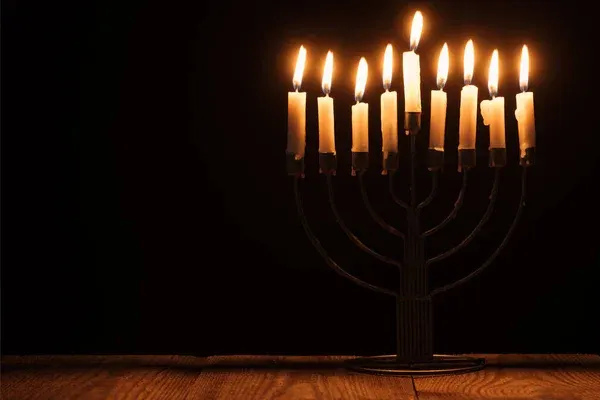
Chanukkah ends the same way. The altar is rebuilt. The Temple is purified. Worship is restored. “Chanukkah” means dedication—a return to holiness, identity, and covenant fidelity. The menorah will burn bright for eight days with freshly pressed olive oil to bring the eternal light into the Holy Temple.
In both cases, God restores His dwelling place and renews His kingdom among His people.
Divine Warrior Over Chaos
Exodus is the original Divine Warrior story: Yahweh confronts Pharaoh, splits the sea, shatters the oppressor, delivers His people from Egyptian slavery, and installs His kingship at Sinai.
Chanukkah is the same pattern. Antiochus behaves like a Leviathan—devouring and destroying. His empire brings chaos into God’s sanctuary. The Maccabean victory is God’s victory, pushing back the forces of disorder and re-establishing cosmic order from the Temple precincts.
Every time God defeats chaos and restores His Holy House, the Exodus is happening once again.
The Pattern That Leads to Messiah
By the first century, Chanukkah was widely understood as a second Exodus—another moment when God cleansed His people and restored His presence. This is the world in which Yeshua steps into the Temple during Chanukkah (John 10). He goes to the Temple to declare Himself the Greater Temple, the Good Shepherd, and the one who gives eternal light and everlasting life.
Chanukkah as the retold Exodus points to Yeshua and the final Exodus—the Deliverer who defeats the ultimate oppressor, death and cleanses the true Temple (humanity), and restores creation itself.
Chanukkah, the new exodus, is more than a historical memory. It is a prophecy in story form. A rehearsal for the day when the light of the world would step into the Temple and announce the arrival of the Greatest Exodus—the one that leads not just from empire to freedom, but from death to life, from corruption to new creation, from exile to home.
Yah gave me this little phrase as I struggled to make it through Pesach this year. It goes like this.
“Baseless hatred is overcome through spiritual formation.”
Thank you for expounding on it.
Glad to hear this gave you more insight. What a blessing!