

Six Days for Humanity, the Seventh for the King
The section of Exodus known as Mishpatim (Exodus 21–23) is often read as a collection of civil laws. The Hebrew word, however, carries more weight. Mishpatim refers to judgments and justice and the seventh. These are not just random case laws; they form a blueprint for how a covenant society is meant to function. They answer a foundational question: How do human beings live together in a way that protects the vulnerable, restrains power, and prevents the social decay that inevitably follows unchecked authority?
Mishpatim and the Architecture of Covenant Society
The answer is structured around a patter already established in creation itself: six and seven. The six-day seventh-day pattern, however, is not confined to Genesis 1. It becomes the organizing principle of Israel’s economic life, agricultural system, labor structure, and worship. It is civilizational.
For six days, humanity works. Work is not merely economic activity; it is cultivation. It includes sowing fields, managing households, adjudicating disputes, handling contracts, regulating servitude, and maintaining social order. The six-day principle is the arena of human responsibility toward one another.
Mishpatim makes this explicit. A Hebrew servant serves six years and goes free in the seventh without payment (Exodus 21:2). For six years the land is sown and harvested; in the seventh it rests so that the poor may eat (Exodus 23:10–11). Six days work is done, but on the seventh day even the ox, the donkey, the son of the handmaid, and the outsider must rest (Exodus 23:12). The verb used, naphash, carries the sense of catching one’s breath when weary. The Sabbath, the seventh, is not merely a ritual pause; it is an economic and social interruption.
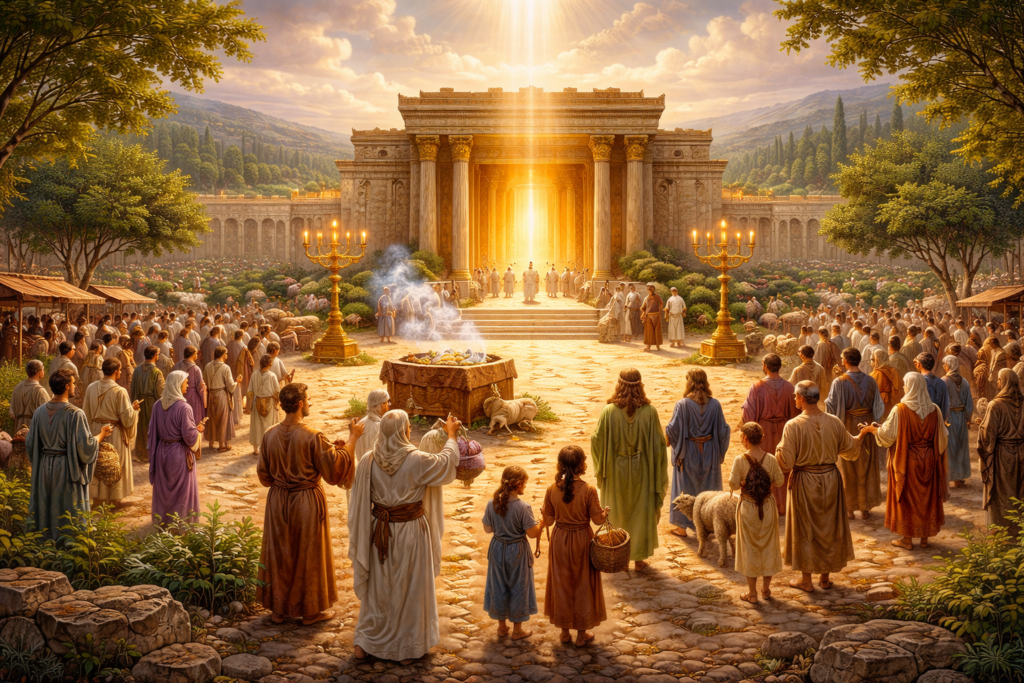
Six days are oriented toward sustaining human life and building a just society. The seventh reorients that society toward its true sovereign. There is a distinction. The seventh day is not simply the absence of work; it is a different kind of work. It is the work of approach. It is ritual service, worship, priestly mediation, drawing near into the dwelling place of the divine ruler.
Creation itself establishes this movement. Six days of forming and filling culminate in divine rest. That rest is not inactivity; it is enthronement. God takes His seat within an ordered cosmos. The seventh day marks the establishment of divine kingship over creation.
The Seventh Day as Royal Encounter
The same structure appears at Sinai. Exodus 24 describes the glory of the Lord settling/tabernacling—shakan upon the mountain. The cloud covers it for six days. On the seventh day, God calls to Moses from within the cloud. Six days of concealment; on the seventh, access. The seventh is the day of face to face encounter.
Moses enters the thick darkness (Exodus 20:21) to receive Torah and further instruction. Later, he ascends again to intercede and renew covenant (Exodus 34), descending with his face shining from the reflected glory of God. Kingship is publicly declared: “I am the Lord your God.”
The Psalms preserve this liturgical memory. Psalm 47 announces, “God reigns over the nations.” Psalm 24 imagines gates lifting to receive the King of Glory. Psalm 93 declares, “The Lord reigns; He is robed in majesty.” Psalms 96–99 repeatedly affirm, “The Lord reigns.” These enthronement psalms were likely sung during festivals such as Sukkot, when Yahweh’s kingship was publicly celebrated.
The Six-Day Framework of Human Responsibility
The Sabbath functions as a weekly reenactment of that enthronement.
Each seventh day interrupts the six-day cycle of human cultivation to acknowledge that provision ultimately comes from the divine ruler. Without the seventh, the six becomes self-referential. Productivity becomes what’s most important. Wealth accumulates without restraint. The vulnerable are forgotten.
Mishpatim prevents that collapse by embedding justice within the six-day framework and grounding it in the seventh. The release of the Hebrew servant in the seventh year, the resting of the land for the sake of the poor, the command that even animals and outsiders must rest—these are structural safeguards. They prevent society from becoming purely exploitative.
This pattern reappears in the Gospels. On a high mountain, Yeshua is transfigured before Peter, James, and John (Matthew 17:1–9). His face shines, recalling Moses’ radiance after Sinai. Moses and Elijah, both associated with mountain theophanies, appear beside Him. A bright cloud overshadows them, and a voice declares, “This is My beloved Son.” The enthronement formula of Psalm 2 is invoked.
From creation to Sinai to Tabernacle to Transfiguration, the six/seven structure holds. Six days orient human beings toward sustaining society by ensuring justice, compassion, and economic stability. The seventh orients society toward the divine ruler whose kingship makes justice possible.
A society that ignores the seventh will eventually distort the six. A society that neglects the six while emphasizing the seventh becomes detached from concrete justice.
Six days are given for humanity’s work on behalf of humanity. The seventh is given for humanity’s work toward God. In that rhythm, covenant life remains balanced, and the world does not collapse under its own ambition. When the seventh is forgotten, the six inevitably turn inward and justice erodes. The rhythm of six and seven anchor society in both responsibility and reverence, ensuring that human labor remains accountable to the divine King.
Leave a Reply