

Seven Pillars, Seven Women and the Architecture of Life
The Exodus narrative answers the question of how life is sustained in a world governed by death. Pharaoh represented an anti-creational power, enforcing order through control and destruction. God’s response to this system is not confrontation through force, but rather the preservation and multiplication of life through seven women. The story unfolds as a structured pattern in which creation, wisdom, and deliverance are bound together through a recurring sequence of seven.
Creation Resists Death Through Generative Order
Creation in Scripture is generative. In Genesis 2:4, the term commonly translated “account or geneaology” is toledot, derived from yalad, meaning “to give birth.” Genesis is not merely recounting origins; it is tracing generations. The heavens and the earth are portrayed as bringing forth life. Life comes into being through birthing imagery, often associated with water and the hovering Spirit. Creation is synonymous with building—whether a house, a temple, or a lineage.
This understanding of creation flows directly into the Exodus story. Pharaoh’s decrees aim to interrupt the generational process by targeting male offspring. His strategy is targeted. Hebrew daughters are permitted to live, while sons are condemned to death. Likely motivated by fear of a coming deliverer and by the practical desire to eliminate future resistance, Pharaoh assumes that daughters pose no threat. But he is wrong.
The first figures to resist Pharaoh’s policy are the Hebrew midwives, Shiphrah and Puah. Their role is creational at its core. The Hebrew word for midwife is built on the same root as yalad, “to give birth.” In a system designed to suppress life, they serve it instead. Exodus 1:20–21 states that God “made them houses.” A house in biblical thought is not merely a dwelling; it represents continuity, future, and stability. God builds houses through women whose purpose is to guard life.
Seven Women as Houses of Preservation in the Exodus Narrative
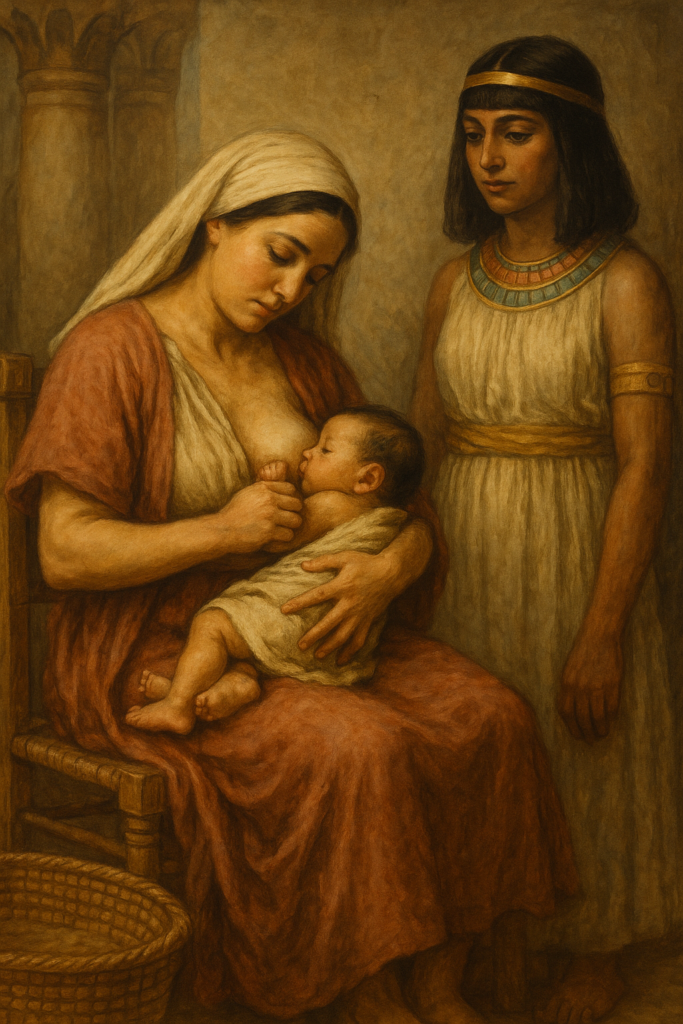
This sets the pattern for the birth narrative of Moses, which unfolds through a sequence of women. Six women intervene to protect him. These include the two midwives; Jochebed, his mother; Miriam, his sister; Pharaoh’s daughter; and her maidservant. Each plays a role in preserving the child who will later deliver Israel. These women function as “houses”—spaces of protection and continuity through which life is preserved in the face of imperial violence.
A seventh woman completes the pattern: Zipporah. She enters the story at a well, a recurring biblical setting associated with life, protection, and transition—places where futures are redirected and households are formed. At this well stand the seven women, daughters of Jethro, including Zipporah, Moses’s future wife. When they are driven away, Moses intervenes and protects them, reversing the earlier pattern in which women had protected him.
Zipporah’s appearance brings the sequence to completion. Together, these seven women form a coherent structure of resistance through preservation. Pharaoh’s campaign against life is undone by the acts of protection carried out by women he presumed posed no threat. It is the irony in the birth story.
This pattern of seven women aligns closely with Wisdom traditions in Scripture. In Proverbs, Wisdom is personified as a woman who calls publicly and prepares people to respond rightly. Proverbs 8 places Wisdom at creation itself. She stands alongside Yahweh as boundaries are set and order is established. Wisdom is embedded in the architecture of creation, participating in the shaping of a world ordered for life.
Proverbs 9 sharpens this image by describing Wisdom as a builder. She constructs her house and sets it upon seven pillars. Seven signifies completion and stability. In the ancient world, pillars represented permanence and public declaration. Wisdom’s house is a structure designed to sustain life.
Wisdom’s Seven Women Architecture from Exodus to Matthew
This Wisdom framework is reinforced by Isaiah 11:2, which describes the Spirit resting upon the Messiah through seven expressions: the Spirit of the Lord, wisdom, understanding, counsel, might, knowledge, and fear of the Lord. The sevenfold Spirit reflects completeness. Wisdom is an operative force equipping the Messiah to restore order where chaos prevails.
The women in the Exodus narrative function within this Wisdom pattern. As Tim Mackie notes, the biblical role of the woman as ezer is not subordinate but that of a deliverer-ally. God repeatedly calls upon women to rescue and protect for His purposes. In Exodus, women act as agents of Yahweh by preserving life at its most vulnerable point.
The pattern repeats when Moses encounters seven daughters of Jethro at a well. When shepherds drive them away, Moses intervenes and waters their flock. The one who was once delivered by seven women now becomes a deliverer himself. The symmetry is intentional. Wisdom builds through reversal and continuity. Protection received becomes protection extended.
This architectural pattern of seven continues into the opening chapters of Matthew. Matthew begins his Gospel with deliberate creation language: “This is the book of the genesis of Jesus Christ.” The term reflects the Hebrew toledot, signaling the unfolding of generations. Matthew presents the story of Jesus as a new creation account.
The genealogy is structured into three sets of fourteen generations, totaling forty-two. This structure echoes Israel’s forty-two wilderness encampments and suggests six cycles of seven, with the seventh now arriving. The genealogy is a theological statement about history reaching completion.
Women again occupy a central role. Matthew includes five women in the genealogy—each associated with irregular or socially precarious circumstances—yet each functions as a guardian of the promised seed. Elizabeth, though not named in the genealogy, shelters Mary during her pregnancy. Together, these six women form a protective line around the Messiah.
A seventh figure emerges symbolically in Rachel. Matthew invokes her voice through Jeremiah, portraying her as the mother of the nation weeping for her children. Her lament recalls earlier attempts to extinguish Israel’s future, including Pharaoh’s decree. Once again, empire seeks to destroy the seed. Once again, God preserves it.
The pattern is consistent. Seven women surround Moses. Seven pillars support Wisdom’s house. Seven expressions describe the Spirit’s work. Seven women frame the opening of Matthew’s Gospel. Each sequence points to the same divine strategy: life is preserved, multiplied, and carried forward through those who guard it.
From Genesis through Exodus into Matthew, the pattern of seven women reveals how God builds history. Creation is sustained through Wisdom, and Wisdom builds through women who protect life in the face of chaos. This is the architecture of redemption itself.
Leave a Reply