

From the Son of a Carpenter to Master Builder of New Creation
The Son of a Carpenter— and the Son of the Master Craftsman
We read that Yeshua was a carpenter, the son of a carpenter, and we move on. The Greek word tekton refers to a builder, a craftsman, a construction artisan someone trained to shape raw materials into a structure. His father, Joseph was such a man. But in the larger biblical narrative, Jesus is not only the son of Joseph the craftsman. He is the Son of the Master Craftsman, Yahweh.
Genesis presents God as the One who orders, separates, shapes, and forms creation. The world does not emerge chaotically but through structured building. Six days of intentional work, melachah, culminate in Sabbath rest. The Hebrew Scriptures use the same term to describe skilled construction — purposeful labor that produces structure. Creation itself is the first great act of divine melachah.
Spirit-Filled Craftsmanship in Exodus
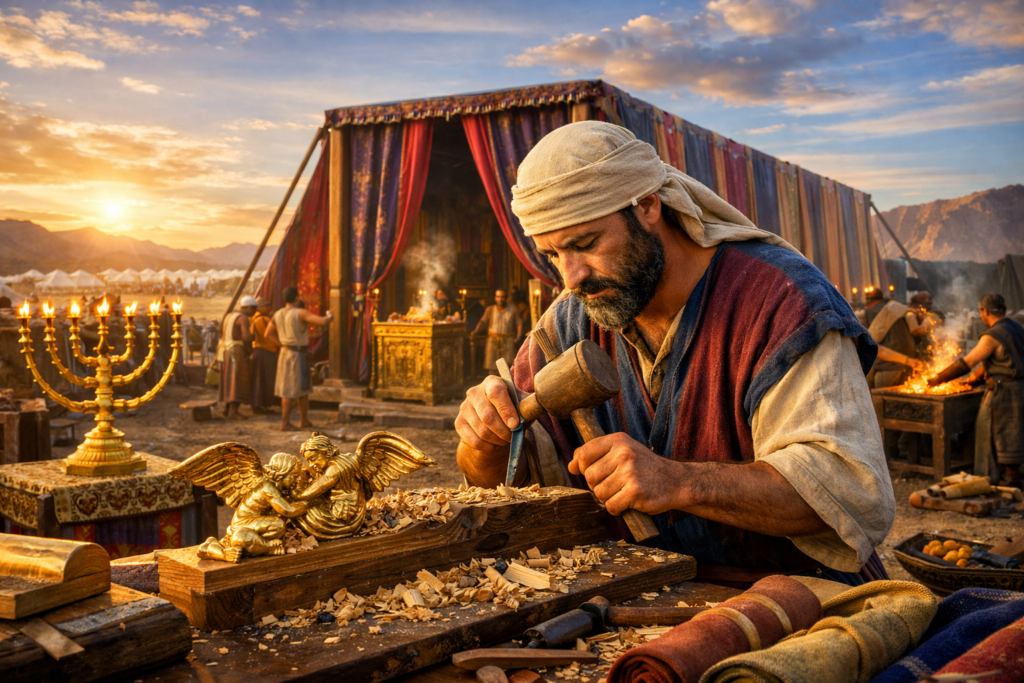
When Exodus introduces Bezalel and Oholiav, the language deliberately echoes Genesis. Bezalel, whose name means “in the shadow (or image) of El,” and Oholiav, “father’s tent,” are filled with the Spirit of God with wisdom (chokmah), understanding (tevunah), and knowledge (da’at) to perform melachah and build the Tabernacle. This is Spirit-empowered craftsmanship. They are master carpenters entrusted with a dwelling place where heaven and earth meet once again.
The placement of the Sabbath command in Exodus 35–40 reinforces the creation pattern. In both Genesis and Exodus, six days of construction precede rest. Completion precedes Yahweh’s indwelling glory.
The parshah Pekudei concludes the book of Exodus. Pekudei means “accounts” or “oversight” and refers to the administrative reckoning of the Tabernacle. The materials are numbered, inspected, and reviewed. The Hebrew root pāqad carries covenantal weight: to visit, to oversee, to reckon. The same word also describes God “visiting” Sarah to bring life and “visiting” Israel to bring deliverance. Divine visitation advances covenant purpose.
Yeshua the Tekton and the True Temple
In the New Testament, Yeshua is called a tekton — a builder, a craftsman, the son of a builder, and the Son of God, the One who ordered creation itself. Within the broader temple framework this identification is significant. Jesus presents Himself as the true Temple, the locus of divine presence. The Father is the Architect of creation, and the Son embodies that dwelling place.
Greater Works Than This…
Yet the story does not end with Messiah alone. In John 14:12, Jesus, the carpenter states, “He who believes in Me, the works that I do he will do also; and greater works than these he will do, because I go to My Father.” The Greek word for works, ergon, corresponds conceptually to the Hebrew idea of melachah — work accomplished, work that produces structure and result, work that includes worship and sacred action. Yeshua, as carpenter is speaking of the continuing work of New Creation. The ordering, restoring, building work continues.
Paul reinforces this in Ephesians 2:10: “For we are His workmanship, created in Christ Jesus for good works, which God prepared beforehand that we should walk in them.” We are His workmanship, crafted, intentionally formed in order to participate in His crafting work. The language recalls Genesis and Exodus. We were created to create.
Shavuot and the Expansion of Sacred Construction
The Spirit who hovered over the waters in Genesis, who filled Bezalel and Oholiav with wisdom, understanding, and knowledge, and who descended upon Messiah, is poured out at Shavuot upon a gathered people. In the Torah portion V’yakhel, Moses gathers the congregation and declares that work is to be done for six days and rest observed on the seventh. Sacred construction is communal. The skill set for building sacred space does not disappear; it expands.
Wisdom, understanding, and knowledge are the tools of the trade. They are the equipment necessary for sacred craftsmanship. Bezalel worked according to divine pattern. He measured, designed, calculated, and executed with skill. Scripture makes clear that he was Spirit-filled — but he was also disciplined and trained. Gifting requires development. Sacred craftsmanship demands apprenticeship.
Builders of the Greater Tabernacle
We often assume that such building belongs to a spiritual elite — leaders, clergy, scholars. Yet the Tabernacle was constructed in the midst of a gathered congregation. Sacred construction is communal. In the garden, humanity cultivated soil and tended life. In Messiah, that vocation expands. We cultivate communities, restore fractured relationships, construct ordered families, and build just systems. We are builders of the greater Tabernacle — the universal body of Messiah.
This body is structured and ordered. It requires wisdom, understanding, and knowledge. Yeshua’s promise of “greater works” signals expansion because He goes to the Father and the Spirit is poured out universally. The Temple becomes global.
The Ongoing Movement of the Greatest Exodus
Our faith is not passive belief or private spirituality. It is participation in divine melachah. The Father builds. The Son completes. The Spirit equips. The people construct. This is the biblical pattern from Genesis to Exodus to Messiah: God restores His dwelling place by restoring His image in humanity, and that restoration involves skilled, intentional work.
Sabbath marks order. Creation rested because it was complete. The Tabernacle rested because it was finished. Messiah rested in the tomb because His work was fulfilled. Now the work continues through a Spirit-filled people.
The question is not whether renewal is happening. Scripture affirms that it is. The question is whether we recognize ourselves as apprentices in the workshop of the Master Craftsman.
We were created to create. We were formed to build. The tools given to Bezalel and Oholiav — wisdom, understanding, and knowledge remain the equipment of the covenant community. The greater Tabernacle is being assembled. The task before us is faithful construction according to the pattern already given.
This is the ongoing movement of The Greatest Exodus, the rebuilding of humanity into a dwelling place for the presence of God.
Leave a Reply