

Cosmic Combat at the Sea: Yahweh as Divine Warrior
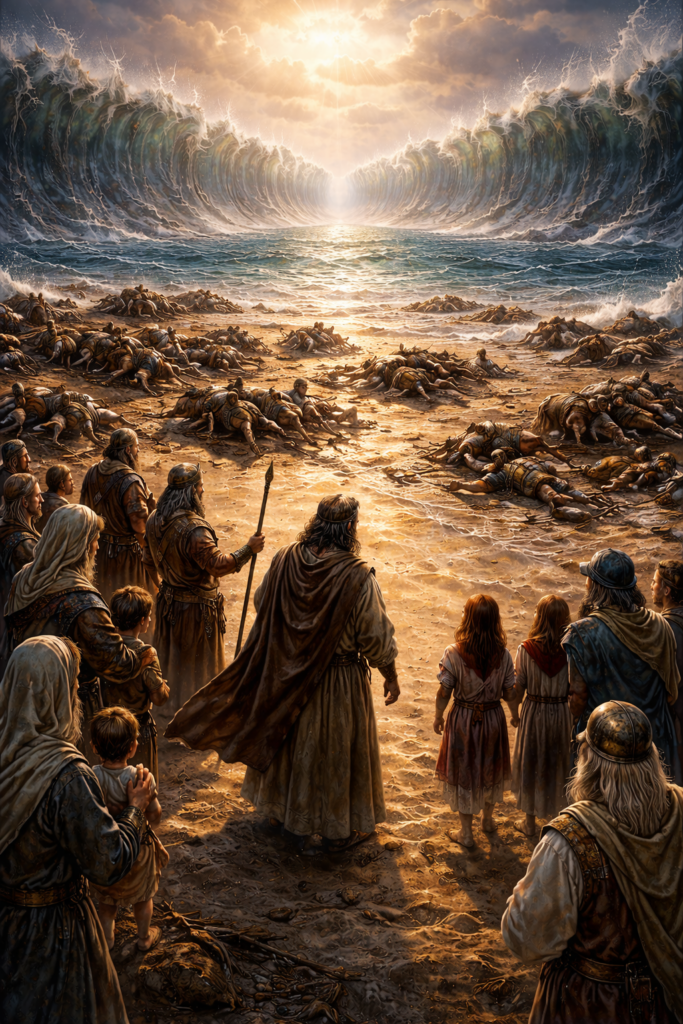
The crossing of the Sea of Reeds in Exodus 14–15 is far more than a dramatic escape from Egypt. It is the climactic battle scene in Yahweh’s war against Egypt and its gods, revealing Him unmistakably as the Divine Warrior. In the ancient world, divine authority was often demonstrated through combat with chaos and frequently personified by the sea. The sea represented untamed disorder, unpredictability, and death. Israel’s stand at the water’s edge places them squarely within this ancient cosmic drama.
Chaos Confronted: The Divine Warrior Battles at the Threshold of Creation
Israel finds herself trapped between two chaos forces: Pharaoh’s military power pressing from behind and the impassable sea blocking the way forward. In this liminal space, fear exposes the grip of Egypt’s worldview on Israel’s heart. The people later cry out that it would have been better to serve Egypt than to die in the wilderness. Though physically freed, they still wrestle with doubt, still uncertain whether Yahweh as Divine Warrior is truly stronger than the forces that once ruled them. Idolatry has not yet been fully uprooted.
Yahweh’s response is a command that initiates cosmic action: “Raise your staff; stretch out your hand.” When Moses obeys, it is Yahweh Himself who engages the battle. The Hebrew verb bakah—to split, tear, or break open describes the parting of the sea. This same verb appears in later messianic contexts linking it to a broader biblical pattern of divine intervention through rupture. In ancient combat myths, victory over chaos often involved cutting or splitting the chaos monster in two. Yahweh’s act fits this while redefining it.
With a blast of His breath, the Divine Warrior piles the waters into walls on either side, an imposing structure. In Torah scrolls the text is written in a brick-like pattern, visually reinforcing the order now imposed on chaos. Dry land emerges—a deliberate echo of Genesis 1, where God gathers the waters so that life can appear. Yahweh is not only rescuing Israel; He is reenacting creation itself.
The crossing is a sacred threshold. Just as blood on the doorposts during Passover marked a boundary between death and life, the parted sea becomes a doorway through which Israel passes from bondage into freedom. The pillar of cloud and fire stands as a divine barrier, casting darkness toward Egypt and light toward Israel—another echo of the creation account’s separation of light from darkness.
When the Egyptians pursue Israel into the sea, the Divine Warrior turns the battlefield against them. Chariot wheels are jammed, the army is thrown into confusion, and the waters are released to return to their place. What unfolds resembles a River Ordeal—a common ancient test of innocence or guilt. Egypt is judged by water and found guilty. The very force meant to assert Pharaoh’s dominance becomes the instrument of his defeat.
As the waters recede, Israel sees their enemies lifeless on the shore. This marks a covenantal threshold. The people now belong to Yahweh, protected by Him and separated from Egypt’s power. At last, they fear Yahweh, the Divine Warrior and believe. The hold of idolatry begins to loosen. Egypt’s gods, manifest in its military, economy, and religious system, have been decisively shattered.
The location of the crossing carries some theological weight. In Egyptian mythology, the Field of Reeds was a realm associated with the afterlife, resurrection, and Osiris, the god of the dead. For Pharaoh and his army to perish there is deeply ironic. They pursued immortality and instead encountered judgment. Yahweh overturns Egypt’s mythology using its own symbols, demonstrating His supremacy over life, death, and the cosmos.
From Victory to Kingship: The Divine Warrior at the Sea
Exodus 15 responds to this victory with the Song of the Sea, a triumph hymn that blends history, theology, and worship. The song proclaims the great victory. It begins with Yahweh’s identity as Warrior and concludes with His eternal reign as King. It announces the restoration of cosmic order. Though rhreats arise and chaos confronts God’s people, Yahweh triumphs, and creation is renewed.
This liturgical moment bridges deliverance and testing. It grounds Israel’s identity in Yahweh’s victory. The Divine Warrior has defeated the sea, overthrown Pharaoh, and opened the way for covenant, worship, and new creation. Yahweh reigns forever and ever.
Leave a Reply