

Who Is Your Enemy…Why Moses and Jesus Are Fighting the Same Battle!
Some of the most difficult passages in Scripture are those that seem to contradict God’s ways. As Israel stands on the plains of Moab preparing to enter the Promised Land, God commands the people to drive out the nations before them, show them no pity, burn their carved images, and leave nothing that might entice them into compromise. Yet in the Sermon on the Mount, Jesus tells His disciples, “Love your enemy and pray for those who persecute you.” At first glance, these commands appear impossible to reconcile. How can the God who commanded Israel to destroy its enemies later command His disciples to love theirs?
The tension begins to disappear once we recognize that the real conflict has never been merely about Israel’s opponents. It has always been about humanity’s greatest enemy.
When Moses speaks about the nations inhabiting Canaan, he is not describing random foreign peoples who happened to occupy the land. They represent a rival kingdom whose worship, values, and way of life threaten everything Israel has been called to become. If Israel embraces their gods, she will inevitably embrace their character, no longer reflecting the God in whose image she was created. The greatest danger is not military defeat but the loss of Israel’s identity as God’s covenant people.
Again and again, Moses warns that these nations will become a snare to Israel. The danger is not simply that they occupy the land but that they will capture Israel’s heart. The people redeemed to bear God’s image will gradually begin to reflect the image of the nations instead. That is the threat Moses sees before them.
This is why Moses commands Israel not to covet the silver and gold that adorn their idols or bring those abominations into their homes. Idolatry rarely begins with outright rebellion. It begins with fascination, grows into compromise, and ends in allegiance. God knew that the greatest victory of the Canaanites would not be won on the battlefield but in the hearts of His own people. The conquest would fail long before Israel lost a battle if Israel became Canaanite in heart.
By the time we reach the Gospels, the political landscape has changed. Rome now occupies the land, and Israel lives under foreign rule. Yet Jesus never commands His disciples to overthrow Rome by force or wage war against Caesar.
Instead, He says something that surprises us. “Love your enemies.”
Has God changed His mind? Not at all. The enemy still represents everything that opposes the Kingdom of God. What changes is the place where the battle is fought.
Under Joshua, Israel entered a physical land that had to be cleansed of idolatry. Under Messiah, God’s people become His dwelling place, and the battlefield moves into the human heart. The greatest threat is not so much the army outside the gates. It is the corruption that enters through the gates we abandoned.
We imagine an external enemy arriving with banners flying and swords drawn.
More often, he enters like a Trojan horse.
He comes disguised as compromise, envy, pride, greed, bitterness, or fear. He hides in the small habits we overlook and the subtle beliefs that slowly reshape both our understanding of God and our understanding of ourselves. Every idol begins by asking for just a little room before demanding the whole house.
Our greatest enemy is not the person standing across from us but the desires that rise within us. James writes that temptation begins when each person is drawn away by his own desires. Long before evil becomes visible in our actions, it has already taken root in the heart. Too often, we open the gates ourselves.
Hatred has a way of reproducing itself. Violence forms violent people. Bitterness reshapes the soul. When we answer evil with evil, we allow the kingdom we oppose to take root within us. The Apostle Paul captures this truth in a single sentence: “Do not be overcome by evil, but overcome evil with good.” The real victory is refusing to mirror and become the enemy.
The command to destroy the enemy is a call to remove everything that seeks to destroy the covenant life of God’s people. Israel was commanded to tear down idols because idols deform human beings. They replace the worship of the Creator with the worship of created things. They rob men and women of the dignity for which they were created.
So who is your enemy? It is not your irritating neighbor. It is not your political opponent. It is not the person who insults you on social media.
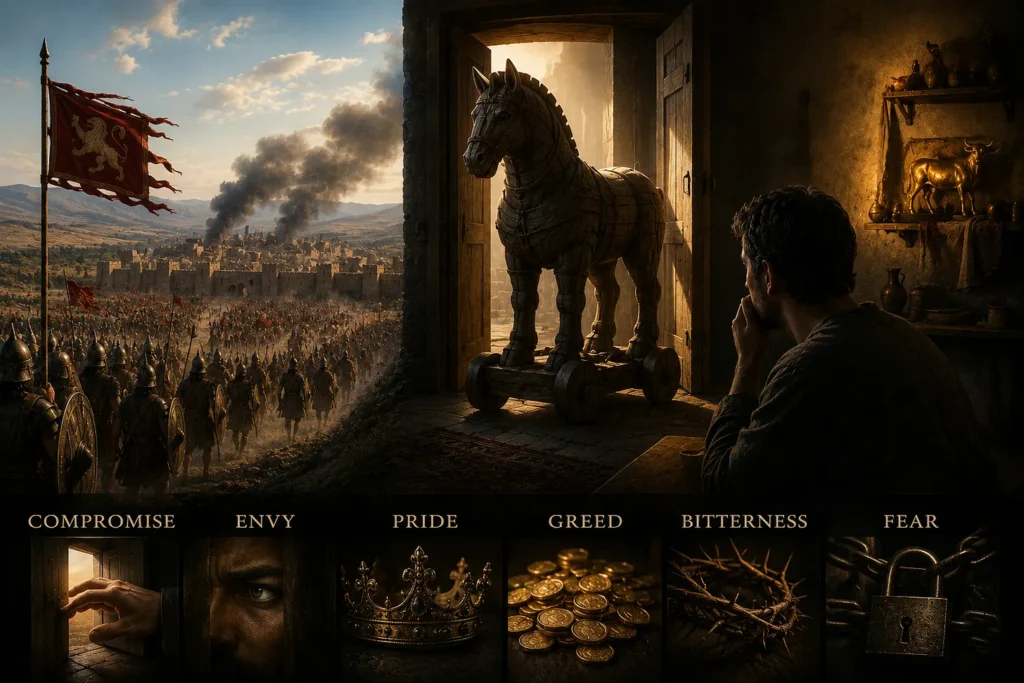
Your enemy is every force that seeks to distort the image of God within you—every thought that leads you from the truth, every desire that pulls you toward selfishness, every idol that demands your loyalty, every habit that weakens your walk, every lie that challenges God’s voice, and every fear that causes you to distrust His promises. Anything that diminishes the dignity and calling of an image-bearer is working against the Kingdom of God.
That is the enemy.
This is why Moses repeatedly tells Israel not to fear the nations. The battle belongs to the Lord. Israel’s calling was never to secure victory by its own strength but to remain faithful while God fought on its behalf. Throughout Deuteronomy, Moses returns to the same exhortation: listen, keep, and do.
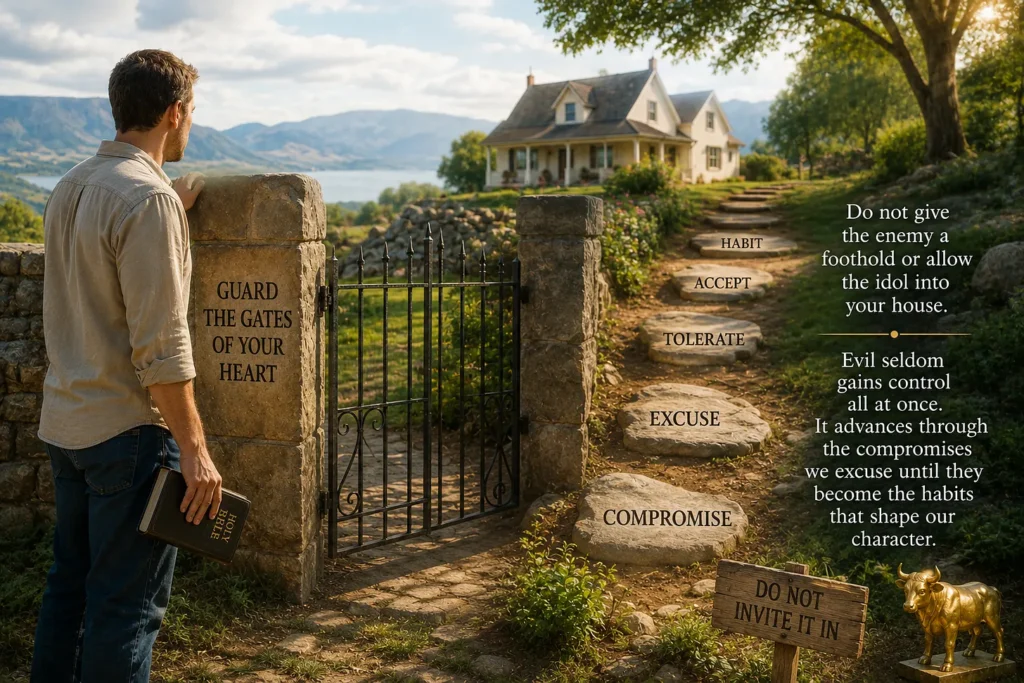
That same calling rests upon the disciple of Jesus. Guard the gates of your heart. Do not give the enemy a foothold or allow the idol into your house. Evil seldom gains control all at once. It advances through the compromises we excuse until they become the habits that shape our character.
The Lord who fought for Israel still fights for His people today. The enemy is whatever seeks to rob us of our calling as God’s image-bearers. Israel was commanded to remove whatever threatened the covenant community from within. Jesus calls His disciples to love those who oppose them while resisting the evil that seeks to deform God’s image in the human heart. Moses and Jesus are not speaking with different voices. They are calling God’s people to the same faithfulness against the same enemy—the one that would destroy God’s image in us.
Leave a Reply