

The Only Image God Ever Made
Why God Forbade Carved Images—and Created His Own
It was a beautiful September afternoon in 1978 beneath the Sangre de Cristo Mountains of northern New Mexico. The sky was an impossible shade of blue, the kind that only high desert air can produce. Prayer flags fluttered gently in the breeze while the aroma of Indian food mingled with incense, sage, and patchouli oil. Everywhere I looked, people wore colorful shawls, beads, and sandals. Hand drums, tablas, and tambourines blended into a hypnotic rhythm as the voices chanted together, “Ram… Ram… Sita Ram… Jai Hanuman…”
The gathering had been organized by Ram Dass, formerly Richard Alpert, one of the leading voices introducing Hindu spirituality to America. Following the death of his guru, Neem Karoli Baba, he had commissioned a massive marble statue or murti of Hanuman, the Hindu monkey god celebrated for devotion and service to Rama. Carved in Jaipur, India, the statue had crossed the ocean to San Francisco before making its way to northern New Mexico. According to those who organized the event, this would be the first public unveiling of the image in America.
As the afternoon wore on, everyone’s attention shifted toward a large wooden crate resting on a construction trailer. One by one the heavy wooden slats were removed, each board heightening the anticipation of those gathered around it. Finally, the front of the crate came away.
Standing before us was a towering white marble Hanuman draped in brilliant saffron robes, holding a golden mace. Against the deep blue New Mexico sky, the image was visually stunning.
An unexpected hush settled over the crowd. The chanting ceased. All conversation stopped. Almost instinctively people began falling to their knees before the newly unveiled image.
I remained standing.
In that moment—the one and only time in my life—I heard the audible voice of God.
“Thou shalt have no other gods before Me.”
The words carried an authority that left no room for doubt. While everyone around me bowed before the image, I stood frozen in place. In an instant I knew with absolute certainty that the God of Israel alone is God, and there is no other.
At the time, however, I understood almost nothing of what I had witnessed. I knew very little about the ancient world, the purpose of sacred images, or the biblical theology that lay behind the commandment I had just heard spoken so clearly. It would take years of studying Scripture before that afternoon beneath Taos Mountain began to make sense.
Reading Moses’ final address to Israel in Deuteronomy this week, I recalled this event many years ago.
Moses reminded Israel that when God descended upon Mount Horeb, they heard His voice from the midst of the fire. “You heard the sound of words, but saw no form… Therefore watch yourselves very carefully, since you saw no form on the day Adonai spoke to you at Horeb from the midst of the fire, lest you act corruptly by making for yourselves a carved image…” (Deuteronomy 4:12, 15–16)
In years past, I had assumed this was simply another warning against idolatry. But Moses was saying something much deeper. Israel was not merely forbidden to worship other gods. She was forbidden to create any visible representation of the God who had revealed Himself without one.
Why was this so important? The answer lies in the world Moses was confronting.
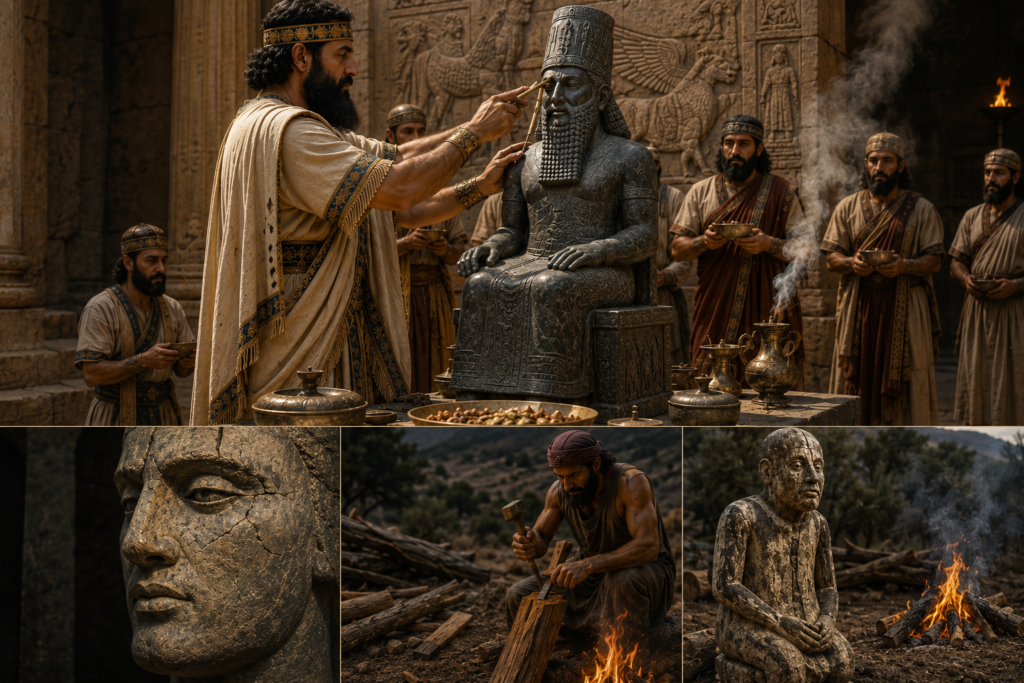
Throughout Egypt, Mesopotamia, Canaan, and the surrounding nations, the climax of building a temple was not completing the building itself. It was installing the image of the god. A temple without an image was considered empty because the image represented the deity’s presence and authority among the people.
Modern readers often imagine that ancient people believed a block of wood or carved stone literally was their god. That was rarely the case. Rather, after elaborate ceremonies, the deity was believed to dwell within the image or manifest his presence through it. The statue became the visible representative through which the unseen god ruled.
One of the most fascinating rituals was known in Mesopotamia as the Opening of the Mouth. After the image was carved, priests carefully washed it, clothed it, anointed it, and ceremonially touched its mouth, eyes, and ears. Only then was the image considered capable of seeing, hearing, receiving offerings, and serving as the earthly dwelling place of the deity.
Recall that Psalm 115 declares that idols have mouths but cannot speak, eyes but cannot see, ears but cannot hear. Isaiah mocks the craftsman who cuts down a tree, burns half of it for firewood, and fashions the other half into a god before which he bows.
These are direct attacks on the entire theology behind the mouth-opening ritual. Despite every ceremony performed by human hands, the images remained exactly what they had always been—lifeless stone and wood.
If God forbade Israel from making an image of Him, a question naturally follows.
Why? The usual answer is because idols are false. And that’s certainly true.
But Genesis suggests something deeper. God had already made His own image. God fashioned His own representative from the dust of the earth. Genesis tells us that He formed Adam and then breathed into his nostrils the breath of life. No priest stood beside Him. No ritual was required. No incantation was spoken.
God Himself breathed. The result was a living human being.
The contrast with the ancient world becomes obvious. Pagan priests attempted to prepare lifeless images for the indwelling of a deity. The Creator simply breathed, and His image opened its own eyes, heard His voice, spoke with Him, walked with Him, and received the commission to rule His world. The true image of God was never carved. It was created alive.
Genesis overturns the religious imagination of the ancient world. Every surrounding culture built temples, installed images, and invited the presence of the deity to dwell there. God followed a completely different pattern. He formed His cosmic temple, placed His own living image within it, and then walked with humanity in the Garden.
The prohibition against carved images is not merely a rejection of pagan religion. It is God’s declaration that His image already exists. He chose humanity.
Making another image implies that God’s own chosen representative is completely inadequate.
That is why idolatry is so serious. An idol is not simply a false object of worship. It is a counterfeit image. It replaces God’s living representative with something lifeless. It substitutes marble for flesh, wood for breath, stone for relationship.
Sin did not erase the image of God, but it distorted it. Humanity no longer reflected the Creator as it was intended to do. Instead of representing God, people began representing themselves. Eventually they manufactured gods fashioned after their own imagination.
Paul describes this exchange in Romans 1. Humanity traded the glory of the immortal God for images resembling mortal man, birds, animals, and creeping things. Those who had been created to be God’s living image began making images instead. Human beings who possessed eyes, ears, mouths, hands, and feet—the very capacities that enabled them to know and worship the Creator—began bowing before objects that possessed the same features but could neither speak nor hear nor see.
The counterfeit replaced the original.
This is why the New Testament presents Jesus as “the image of the invisible God.”
Jesus is not merely another image among many. He is the perfect Image—the One Adam was created to become but never fully was. In Him we finally see humanity reflecting the Father without distortion.
The first Adam received the breath of life but eventually returned to the dust from which he had been taken. Death marred the image God had created. The last Adam entered death willingly and emerged from the tomb alive forever. In His resurrection, the image of God is not merely restored. It becomes incorruptible.
Looking back after all these years, I understand that afternoon beneath Taos Mountain very differently. I do not question the sincerity of the people who knelt before the Hanuman murti. They were seeking the divine according to what they understood. But I now recognize that I was witnessing something that Moses had warned Israel about more than three thousand years earlier—a community gathered around a graven image believed to mediate the presence of the divine.
The God of Sinai chose another way. He revealed His voice, but no visible form. He entrusted His rule to living men and women, inviting them to reflect His character throughout creation.
The Bible begins with God placing His living image in His temple.
It ends with that image fully restored, dwelling forever in His presence.
Perhaps that is why the Second Commandment is much more than a prohibition against idols. It is a declaration of God’s confidence in His own creation. Every carved image says that God’s living representative is not enough. Every faithful life declares just the opposite.
Leave a Reply