

Splitting, Tearing, and the Threshold of a New World
There is a pattern in Scripture that appears again and again in moments of transition, deliverance, and new creation. It is the language of splitting or bursting open, and it tells us that we are standing at a threshold—the collapse of one order and the rise of another.
The Hebrew word is bakah, and it means to split, cleave, break open, divide, or burst forth. In Scripture it is used for splitting wood, dividing waters, breaking open rocks, and the earth splitting. It is a forceful, often sudden, and at times violent action. It appears in moments of divine intervention, crisis, or transition. Bakah marks the boundary between what is passing away and what is coming into being.
In the ancient Near Eastern world, this language would have been understood. Splitting was something a victorious warrior did to a defeated enemy. To split was to bring an end to one reality so that another could take its place. Chaos is confronted. Order is restored. In this context, splitting is the act that establishes a new reality. The gods split the seas. Warriors split their enemies and ordered their world.
Creation Begins with a Splitting
The pattern begins at creation itself. In Genesis, God separates the waters, dividing chaos and bringing order into existence. The firmament—the raqia—is stretched out, establishing a boundary between waters above and waters below. Creation is portrayed as the structuring of a world out of the deep.
Later, in Genesis 7:11, the flood is described using similar language: “on that day” the fountains of the deep burst forth. The waters are split—bakah. The imagery echoes birth. The waters break open like a womb. What once brought forth life now threatens to undo it. From the beginning, splitting stands at the boundary between chaos and life.
Exodus: The Splitting that Creates a People
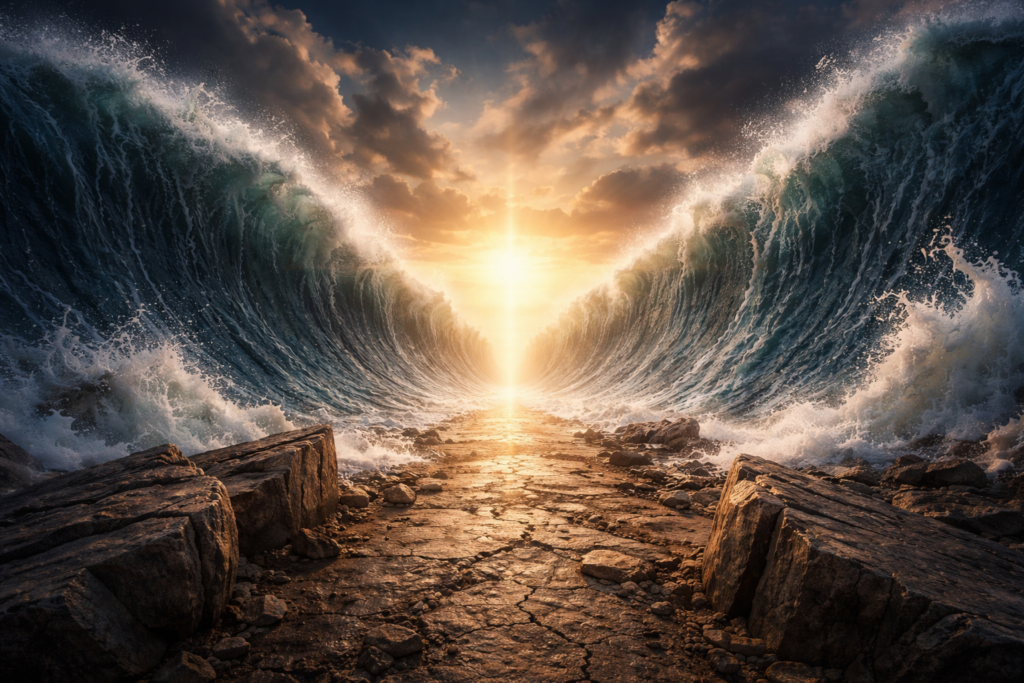
In Exodus 14, God commands Moses to stretch out his hand over the sea and split it. This is not merely a miracle of escape. It is a decisive act of recreation, deliverance, and judgment. Israel passes through the waters of chaos and emerges on dry ground.
It is the collapse of Egypt’s power and the birth of a new people. The sea that once symbolized disorder becomes the very pathway into freedom. It splits for Israel’s deliverance and then returns to drown Pharaoh and his army. The fall of one kingdom and the rise of another—Israel moves through the space in between.
The wilderness further showcases this theme. The rock is split, and water bursts forth (Psalm 78:15; Isaiah 48:21). Life emerges from rupture. Provision comes from what is split open. The rock, a symbol of stability, brings forth life-giving water. A new order emerges from what has been broken.
The Language of Splitting in Sacrifice
In Genesis 22, Abraham rises early and splits the wood for the offering. The act seems ordinary, but shares in this deeper pattern. The wood that will carry the sacrifice is itself divided. The language of splitting moves through the narrative, pointing toward the potential sacrifice of Isaac and then the substitute ram. The pattern continues to build.
Prophets and the Collapse of Kingdoms
The prophets take this imagery and expand it to a cosmic level.
Micah describes mountains melting and valleys splitting. Zechariah speaks of the Mount of Olives splitting in two as God confronts the nations. These are not just descriptions of natural events. They are declarations of divine intervention in history.
Mountains represent power, stability, and permanence—the places where kingdoms establish themselves. When they split, it signals that what appeared immovable is being overturned. God is dismantling kingdoms that stand in opposition to His own. This is the language of political and cosmic collapse.
The Heavens Are Torn Open
When Yeshua rises from the waters of the Jordan, the heavens are torn open (schizo), a word often used in the New Testament connected to the Hebrew bakah. This echoes Isaiah’s cry: “Oh that You would rend the heavens and come down.”
The tearing of the heavens signals the arrival of God’s kingdom. A boundary is broken. Access is opened. The barrier between realms is removed. Once again, something is split so that something new can begin.
The Cross: The Collapse of an Order
All of these moments lead to the cross.
At the crucifixion, the language of splitting reaches its fullest expression. The Gospel of Matthew records that the veil of the temple was torn in two from top to bottom, the earth quaked, and the rocks were split.
It is the language of cosmic upheaval. The temple veil represents the boundary between heaven and earth. The earth represents the created order. The rocks represent stability and permanence. Everything is breaking.
This is the moment where the old order begins to collapse—religious systems, political power, and even death itself are exposed. What looks like defeat is, in reality, the unmasking of every power that has shaped the world through control and violence.
The cross is not simply where Yeshua dies. It is where the world as it has been known begins to come apart.
Resurrection: The Rise of a New Kingdom
But the story does not end with rupture. The resurrection reveals what that rupture was for.
What was torn open at the cross becomes the passageway into new life. The same power that split the sea, the rock, and the earth now brings forth life from the grave. The kingdom of God does not emerge alongside the old order—it rises out of its collapse.
This is the decisive moment. The fall of one kingdom gives way to the rise of another.
As G. K. Beale observes, whenever an earthquake (or splitting) is mentioned, it “denotes the chaos between [the fall of] one kingdom and [the rise of] another.” The shaking of the earth marks the unstable space between worlds. It is the moment when an existing order is being dismantled but the new has not yet fully emerged. This is the tension point of history, where chaos is exposed and the structures that once appeared secure begin to give way, making room for the establishment of God’s kingdom.
At the resurrection, that transition is complete.
What appears to be the moment of death is, in fact, the beginning of a new creation. Access is restored. Life is renewed. A new humanity begins.
That makes a lot of sense… Josephus says that it took Israel 3 days to get to the Sea that parallels His Resurrection Day
These new insights bless me so much – a whole new world of understanding is opening up. Thank you, Lord, for every form of splitting in my life… bringing birth new life. Hosanna!
Thank you. Love it. Have also all you’re books. . So great.
Thanks so much Gertruud!! Much appreciated.