

Worship as the Undoing of Chaos
The portion Bo (Exodus 10–13) brings the Exodus narrative to its climax. The final plagues—locusts, darkness, and death are carefully ordered acts within a larger combat narrative and which challenge Israel’s worship. These chapters reveal that the conflict between Yahweh and Pharaoh is not just political but is cosmic. At stake is the question of who rules the world and by what means order is sustained.
Worship as Liberation: From Forced Labor to Avodah
At the center of this struggle stands a repeated divine command: “Let my people go, so that they may serve me.” The Hebrew verb shalach (“send,” “send away,” “let go,” “release”) suggests a forceful removal. Pharaoh must release what he refuses to relinquish. Yet the purpose of this sending is equally important: “so that they may serve me.” The word avad means both labor and worship. Israel is being transferred from one form of service to another, from forced labor under Pharaoh to voluntary worship/service under Yahweh. The Exodus is a movement from oppressive service to restorative service. Worship is the means by which chaos is undone. It is the solution to world crisis.
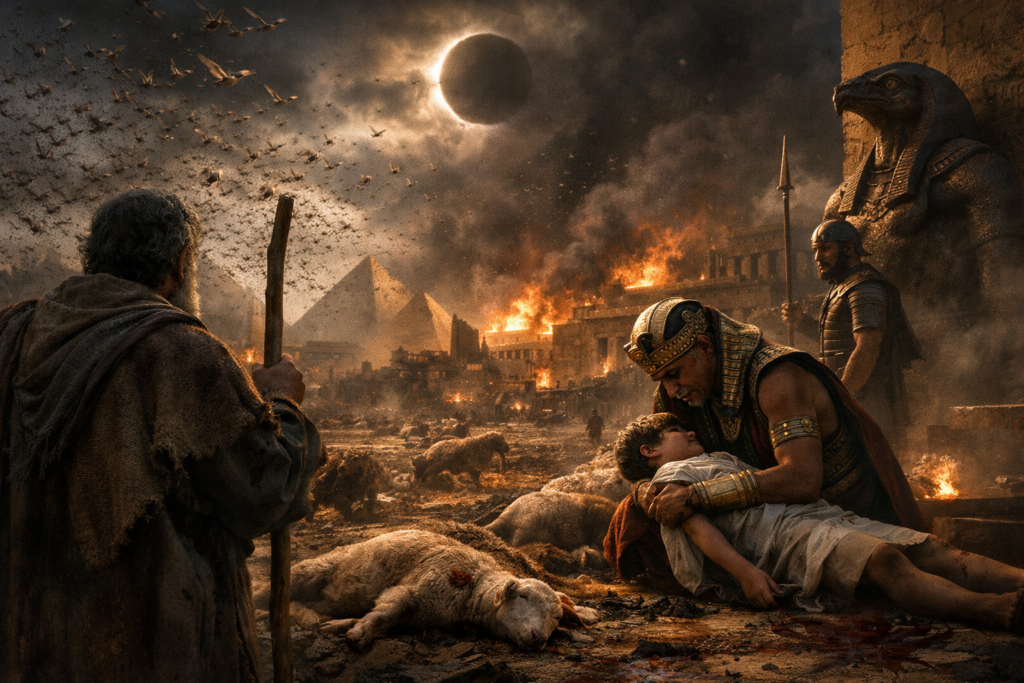
The plagues of Bo reveal how Yahweh dismantles Egypt’s theology of power. Locusts are announced as an invasion that will “cover the face of the earth” and consume what remains after the hail. This is language of de-creation. Egypt’s agricultural abundance, its control over land and food, is stripped away. The darkness that follows is described as thick and tangible, lasting three days. It is a direct challenge to Ra, the sun god. Egypt’s most revered deity is rendered powerless, while Israel remains in light. Creation itself appears to unravel under Yahweh’s command.
Pharaoh’s negotiations during these plagues expose the true nature of his resistance. He offers partial release: the people may go, but their flocks and herds must remain behind. Livestock represented wealth, stability, and future productivity. Pharaoh’s refusal is essentially economic. He will not let go of his “cash cow.” Egypt has relied on Israel’s labor and expertise, particularly in animal husbandry, and Pharaoh is unwilling to surrender his resources. Moses responds with theological clarity: the people must take sacrifices with them, and they will not know how they are to serve Yahweh until they arrive. Worship cannot be dictated by empire. It cannot be scheduled, minimized, or controlled by the very system it seeks to escape.
Divine Combat and the Dismantling of Egypt’s Gods
The final plague, the death of the firstborn, brings the conflict to its most severe point. Throughout ancient Near Eastern mythology, gods established their right to rule through cosmic combat. Creation and kingship were born of conquest. Egyptian religion reflected this worldview. Myths such as Set murdering Osiris or Sekhmet slaughtering humanity at Ra’s command portray a divine order sustained through violence. Pharaoh, viewed as a living god, maintained this order through domination, coercion, and even mass infanticide. His decree to drown Israel’s sons in the Nile was an act of state-sponsored de-creation.
Yahweh’s judgment responds measure for measure. The death of the firstborn is a direct confrontation with Egypt’s theology of power. Pharaoh’s own house is struck, revealing his impotence. In the ancient world, it was the king’s responsibility to preserve order. By failing to do so, Pharaoh is publicly exposed as a false chaos-tamer. The Egyptian people witness the humiliation of their god-king by the invisible God who acts through Moses.
The structure of the plagues reinforces this message. The first nine are arranged in three cycles of three, each building in intensity and followed by a pause. The final plague stands alone as the climax. This rhythmic progression heightens tension. These are strategic strikes. Yahweh uses nature itself as His weapon turning Egypt’s environment against its own gods. Each plague dismantles a specific aspect of Egypt’s pantheon and worldview in real time.
Yet Yahweh’s aim is not destruction for its own sake. Strike by strike, He is liberating Israel not only from physical bondage but from internal slavery—the mindset of empire that equates power with violence and order with domination. The plagues create space in Israel’s heart for true worship. Before they can be reshaped as a covenant people, the gods of Egypt must be slain.
The Exodus plagues, therefore, are a combat sequence. They are a war between justice and oppression, between creation and chaos. In Genesis, God subdues chaos by separating land from sea and filling the void with life. In Exodus, Yahweh again confronts chaos—this time embodied in empire, idolatry, and false worship. He defeats Pharaoh, judges the gods, liberates the oppressed, and begins the long process of restoring a people who have forgotten what it means to be free.
Leave a Reply